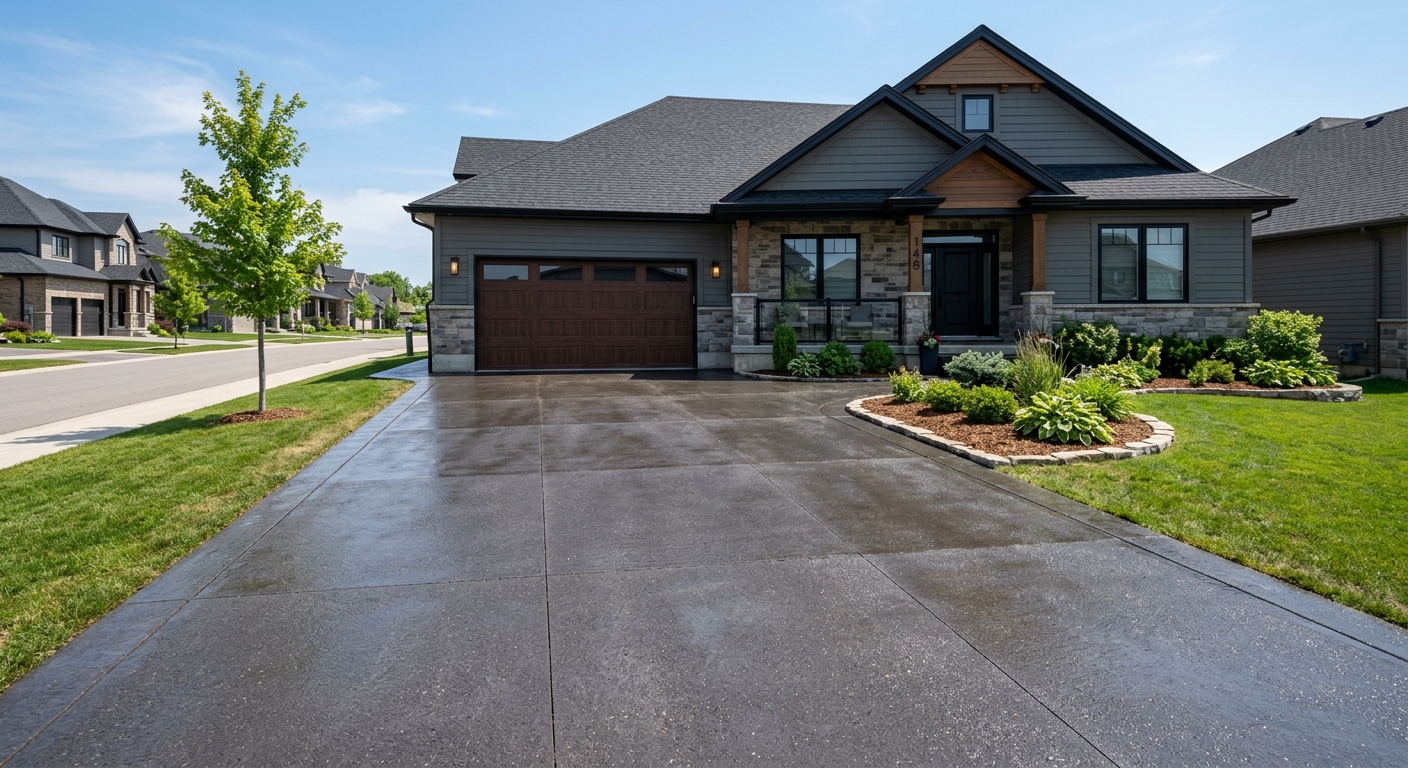
Concrete work options and costs in James Bay
In James Bay, British Columbia, homeowners typically choose concrete for driveways, patios, walkways, and the foundation systems that keep houses stable through our wet coastal winters and intermittent cold snaps. With a population of 13,055 (Statistics Canada, 2021 Census), the area has a steady turnover of residential flatwork projects—from resurfacing older slabs to adding small upgrades that help manage rain runoff and salt exposure. In the surrounding Lower Mainland–Southwest market, concrete crews are also competing for work alongside new infill and renovations, so availability can tighten during dry spring windows.
Lower Mainland–Southwest concrete pricing is strongly shaped by our shallow frost depth assumption (commonly around 450 mm / 18") and the reality of freeze–thaw cycles. Even though the frost line is less severe than in many inland regions, footings and thickened edges still need to be placed below design frost to prevent frost heave, and exterior slabs should be air-entrained to resist scaling and spalling. Rainy stretches and cool nights also affect curing schedules, which can add indirect labour time for blankets, sealers, and proper wet-curing access.
In James Bay—especially around the waterfront and older neighbourhood blocks where many homes have established driveways—concrete is in demand for curb-to-garage improvements, patio replacements, and foundation repairs tied to drainage corrections. Below is a clear comparison of common options, realistic sizes, key specs, and typical price ranges to help you line up like-for-like quotes.
| Application |
Typical Size |
Key Spec |
Finish Option |
Price Range |
| Concrete driveway (standard broom finish) |
480–620 sq. ft. (45–58 m²) |
4"–5" slab, compacted base, air-entrained mix, control joints |
Broom finish, optional sealer |
$12,500–$17,500 |
| Exposed aggregate driveway |
450–600 sq. ft. (42–56 m²) |
Air-entrained mix, proper retarder timing, dense base prep |
Exposed aggregate (scored/washed) |
$16,000–$22,500 |
| Stamped concrete driveway or patio |
350–550 sq. ft. (33–51 m²) |
Air-entrained mix, integral colour, saw-cut joints |
Stamp mats + release, border finishing |
$20,000–$30,000 |
| Plain concrete patio or walkway |
160–280 sq. ft. (15–26 m²) |
4"–5" slab, compacted granular base, joints as required |
Broom or light trowel, edges finished |
$2,800–$6,200 |
| Garage floor (interior slab) |
400–650 sq. ft. (37–60 m²) |
4"–5" slab, vapour barrier (where required), reinforcement if specified |
Burnish/float finish, optionally seal |
$6,200–$12,000 |
| Foundation footings (structural, below frost) |
Per linear foot equivalent of new work |
Excavation, formwork, rebar, concrete placed below design frost |
Structural concrete, typically not decorative |
$200–$350 |
Prices are estimates only and vary by project scope, site access and material selection.
What affects the price of concrete work in James Bay
In the Lower Mainland–Southwest region, it’s common to see the same type of concrete job come in 30–50% apart, depending on how each contractor designs the base, selects the mix, and schedules work around rain and cold nights. Costs also vary across British Columbia because colder regions typically require deeper excavations, stricter cold-weather curing measures (heating, insulated blankets), and shorter pour windows—raising excavation, forming and labour rates. Meanwhile, James Bay projects still need to protect against freeze–thaw and salt exposure, even with our shallower frost depth (often around 450 mm / 18"), so specs that reduce cracking and scaling remain non-negotiable.
Frost line depth and freeze–thaw cycles dictate every exterior spec. Footings and any thickened foundation sections must extend below the design frost depth to prevent frost heave, and exterior slabs should use air-entrained concrete to survive repeated wetting, freezing, and thawing. De-icing salt accelerates surface spalling, so sealing becomes part of a sensible maintenance plan for driveways and steps. When crews face long rainy stretches, they may add curing blankets or extend cure monitoring to reach design strength—small line items that can shift pricing meaningfully.
Concrete options also diverge in cost versus value. For example, a stamped driveway or patio can land in the $20,000–$30,000 range because it includes colour, stamps, and careful finishing; a plain patio is often closer to $2,800–$6,200 because it’s labour-efficient and simpler to finish. In James Bay, older homes near the waterfront sometimes require more careful excavation and disposal due to tight access and drainage corrections, which can raise site-prep costs even before the first cubic yard is placed.
| Price Factor |
Why It Matters |
Cost Impact |
| Frost line depth — determines footing depth and form height |
Footings must be placed below design frost to prevent frost heave and cracking |
Higher excavation and forming; can add significant labour for structural work |
| Site preparation — excavation, grading, compacted granular base |
Weak or poorly drained subgrade leads to settlement and premature cracking |
More base depth and drainage detailing increases material and equipment time |
| Reinforcement — rebar or wire mesh requirement |
Controls cracking and improves load capacity, especially for garage slabs |
Additional materials and placing labour; cost rises if custom rebar cages are needed |
| Mix design — air-entrainment and compressive strength spec |
Air-entrainment reduces freeze–thaw damage; strength spec supports durability |
Often modest per-cubic-yard cost, but can be a major quote differentiator |
| Finish type — broom vs. stamped vs. exposed aggregate |
More texture/colour work requires skilled crews and careful timing |
Labour-heavy finishes can add thousands compared with broom-finished flatwork |
| Pour size and concrete truck access to site |
Limited access may require pumping or multiple placements |
Truck/pump fees and extra labour can noticeably change totals |
| Cold-weather curing precautions — heating and blankets |
Cold nights can slow strength gain and risk early damage |
Insulation materials, heaters, and longer scheduling add cost |
| Control joint pattern and sealing cost |
Joints control where cracks occur; sealing reduces salt/scaling damage |
More labour and sealer product; prevents expensive callbacks |
Permits & regulations in British Columbia
In British Columbia, most structural concrete work—such as footings, foundation walls, and grade beams—requires a building permit and typically engineered drawings that the municipality reviews before work begins. If your project involves new foundation elements, underpinning, or changes to the support system of a house, plan on permits. Concrete flatwork like patios, walkways, and driveways typically does not require a permit by default, as it’s generally considered exterior improvements; however, it may become permit-sensitive if it affects lot grading, stormwater drainage, or impervious surface coverage rules, or if it ties into municipal right-of-way requirements. The safest approach is to confirm the specific scope with the local authority before breaking ground.
Before hiring a contractor in James Bay, verify three things step-by-step:
- British Columbia licence/registration: look for the contractor’s business licence details (and applicable trades registration) through the relevant provincial/online registry listings.
- Liability insurance: request a current Certificate of Insurance (COI) showing adequate liability limits and the effective dates.
- WCB coverage: in BC, confirm Workers’ Compensation Board (WCB) coverage documentation; the contractor should be able to provide proof/clearance documentation where applicable.
Also ask for references on similar-size residential jobs and confirm the permit responsibility in writing (who pulls it, if needed).
Getting concrete right in James Bay's freeze-thaw climate
Concrete in James Bay has to do two jobs: hold up under vehicle and foot traffic, and resist repeated wetting, cooling, freezing, and thawing. The most common failure homeowners see in exterior flatwork is spalling and surface scaling—often linked to inadequate air-entrainment, poor base preparation, and skipping proper curing. To spec the job correctly, start with base prep: use compacted granular sub-base to the right depth for local soils and drainage conditions, then ensure water can move away from the slab. Next, require an air-entrained mix with target air content typically around 5–7% for exterior flatwork, plus a minimum compressive strength of 32 MPa (or the specified design strength).
Control joints matter because they limit random cracking. Ask for a joint spacing plan that matches your slab dimensions and expected shrinkage. Curing is non-negotiable: plan for at least 7 days of proper curing conditions, and in cooler stretches, the contractor should use curing blankets or other cold-weather precautions to keep early strength on track. Finally, sealing should be planned after the cure—typically 28 days post-pour—so a penetrating sealer can repel de-icing salts and reduce moisture intrusion.
When comparing options, the price difference can be justified or not. If you’re choosing between a plain broom finish and a stamped finish, a broom-finished patio in the $2,800–$6,200 range is often the best value if you want durability without extra aesthetic labour. Stamped concrete may be worth it in the $20,000–$30,000 range when you truly want a high-end look and the installer confirms proper colour, jointing, and curing steps. To avoid callbacks, ask explicitly how they prevent spalling and what they’re doing to deliver the specified air content.
| Spec |
Why It Matters in James Bay |
What to Ask For |
Impact if Skipped |
| Compacted granular base (depth?) |
Proper base reduces settlement and supports drainage through wet coastal winters |
Base depth matching soil condition + frost protection, with compacted granular and drainage details |
Uneven settling, cracking, and edge failure |
| Air-entrained concrete mix (target air %?) |
Air entrainment is critical to resist scaling from freeze–thaw cycles and coastal moisture |
Target 5–7% air for exterior flatwork; proof of mix design |
Spalling/scaling and early surface deterioration |
| Compressive strength (MPa rating) |
Higher strength supports durability under traffic and weather exposure |
Minimum 32 MPa (or design strength), with mix documentation |
Reduced wear resistance and increased cracking risk |
| Control joints (spacing per ACI guidelines) |
Joints control cracking locations as slabs shrink and move with humidity |
Joint layout and spacing plan before the pour |
Random cracking across the slab face |
| Minimum 7-day curing period |
Cool nights and high humidity can slow strength gain in coastal BC |
How curing will be maintained for at least 7 days (blankets/sealer timing if needed) |
Surface weakness, dusting, and reduced long-term performance |
| Penetrating sealer (when applied after cure) |
Salt and water management helps protect surfaces in James Bay |
Penetrating sealer applied after cure (typically around 28 days) |
Faster staining, moisture intrusion, and salt-related spalling |
How to choose a concrete work contractor in James Bay
Start by verifying the contractor’s British Columbia credentials and coverage. For licensing/registration, use the contractor’s business information to cross-check against provincial online listings for the correct trade category (when applicable). Request a current Certificate of Insurance (liability) and confirm the COI effective dates and coverage limits match the scope (driveways and structural work usually need robust liability limits). For WCB/WCB coverage, ask for proof of active coverage—contractors should provide documentation without delay.
Next, get 2–3 itemised written quotes rather than one lump sum. You want a labour + materials breakdown so you can compare the real differences: base depth, drainage and compacted granular, reinforcement type, concrete mix specification (including air entrainment), finish steps, saw-cut timing, curing method, and disposal. Confirm whether permits are included (if structural work requires them), and whether demolition and debris removal are included. A good quote spells out exclusions: for example, how unexpected rock/utility conflicts are handled.
Pay attention to warranty terms. Look for a workmanship warranty length and clear description of what’s covered (and what isn’t), plus any manufacturer warranty on products like sealers. Ask if warranty is transferable to a new owner, which matters if you sell your home. On payment schedule, avoid paying more than 10–15% upfront; hold back the remainder until the job is complete and cleaned up. Finally, require a start date and completion estimate in writing, including curing-related delays in wet weather.
- Confirm the concrete mix spec includes air-entrainment for exterior work.
- Ask for the proposed base thickness and how it’s compacted (and whether drainage is addressed).
- Require a joint layout plan (location and spacing) before the pour.
- Verify reinforcement details: mesh vs rebar, and where it’s placed.
- Ask how they handle curing in cool, rainy James Bay weather (blankets/sealers).
- Request examples/photos of similar driveways/patios done in the Lower Mainland–Southwest climate.
- Make sure disposal and haul-away are included for demo/over-excavation.
- Clarify truck access or whether pumping is needed and what it costs.
- Get finish specs in writing (broom, exposed aggregate, stamped colour/release).
- Confirm sealing type and timing if you want salt resistance on driveways/steps.
- Check that a permit is included in the quote when structural work requires one.
- Ensure the quote includes protection (covers, barriers) and site cleanup standards.
Concrete red flags in James Bay include: vague “standard mix” language without air-entrainment, no stated base depth or compaction method, refusal to discuss control joints, quoting only the finish while skipping curing and sealing steps, and insisting on large upfront payments without a written schedule.
Frequently asked questions — concrete work in James Bay
Do I need a permit for concrete work in British Columbia?
In British Columbia, structural concrete work like new footings, foundation walls, and grade beams typically requires a building permit and engineered drawings reviewed through the municipality process. For concrete flatwork—such as patios, walkways, and driveways—permits are usually not required by default, but you should confirm if your project affects lot grading, stormwater drainage, or impervious surface rules, or if any work ties into municipal right-of-way conditions. Because James Bay projects often involve older properties and drainage corrections near the waterfront, it’s smart to verify requirements before excavation. A concrete contractor should tell you clearly whether permits are included or needed, and who is responsible for pulling them.
Concrete vs pavers for a patio in James Bay?
Concrete and pavers both work well in James Bay, but concrete usually wins on durability-per-dollar when the base is done right. A plain concrete patio often comes in around $2,800–$6,200 depending on size and site access. Pavers can look more custom and allow individual panel replacement, but they rely on excellent drainage and sub-base compaction; otherwise, weeds, settling, and uneven surfaces can develop. In our Lower Mainland–Southwest freeze–thaw and wet winter cycle, concrete with an air-entrained mix and proper joints typically handles scaling stress better when it’s sealed and cured properly. If you want a quick upgrade and a clean, long-lasting surface, concrete is often the straightforward choice.
How long does a concrete driveway last?
A well-built concrete driveway in British Columbia commonly lasts 20–30 years, and sometimes longer, but that depends heavily on the details. The biggest drivers are base prep and drainage, correct air-entrainment for freeze–thaw resilience, control joint layout, and curing quality. Salt exposure matters too—James Bay homeowners often deal with winter traction practices, and de-icing salts can accelerate spalling if the surface isn’t protected. A contractor who plans for proper curing and recommends penetrating sealer (often applied around 28 days post-pour) can significantly improve surface durability. If you’re budgeting, think in terms of total performance: spending a bit more on mix specs and sealing is usually less costly than dealing with scaling repairs later.
What is air-entrained concrete and why does it matter here?
Air-entrained concrete is made to contain tiny, evenly distributed air bubbles that give ice somewhere to expand without destroying the cement paste. In James Bay and the Lower Mainland–Southwest, moisture and freeze–thaw cycles are recurring—even with a shallower frost line—so exterior slabs and steps are at risk for scaling and spalling if the mix isn’t designed properly. That’s why reputable contractors specify air content (commonly around 5–7% for exterior flatwork) and don’t treat it as optional. If a quote doesn’t clearly mention air-entrainment or provides only “standard mix,” that’s a major red flag. In plain terms: air-entrainment is one of the most direct ways to prevent the kind of surface failure you don’t want to repair after the first few cold seasons.
How do I prepare the base for a concrete slab?
For a durable slab in British Columbia, base preparation should include excavation to the planned depth, grading to achieve correct slopes, and installing a compacted granular sub-base designed for your soil and drainage conditions. The contractor should compact in lifts and verify thickness so the slab doesn’t settle. Because James Bay is subject to wet coastal conditions and freeze–thaw stress, drainage attention matters just as much as frost depth assumptions. Ask what base depth they propose, what material they use (and thickness), and how they handle water away from the slab. You also want a clear plan for reinforcement (if required), plus a joint layout so shrinkage cracking doesn’t become random. Great base prep is what turns a “good price” into long-term performance.
How do I compare concrete quotes?
To compare quotes fairly in James Bay, avoid using only the total price—compare the spec. First, ask each contractor for an itemised breakdown (labour and materials) that covers base thickness and compaction, drainage work, reinforcement (mesh or rebar), concrete mix design (including air-entrainment for exterior flatwork), and curing plan. Then compare finishes: stamped work costs more because it includes colour, stamping, and extra finishing time; plain broom finishes are simpler. Use the local price bands as a reality check—an exterior stamped driveway/patio often lands around $20,000–$30,000, while a plain patio may be closer to $2,800–$6,200, depending on size and access. Finally, confirm exclusions (permit responsibility, disposal, truck access, and what happens with surprises). The best quote is usually the one that matches your desired specs, not the lowest number.