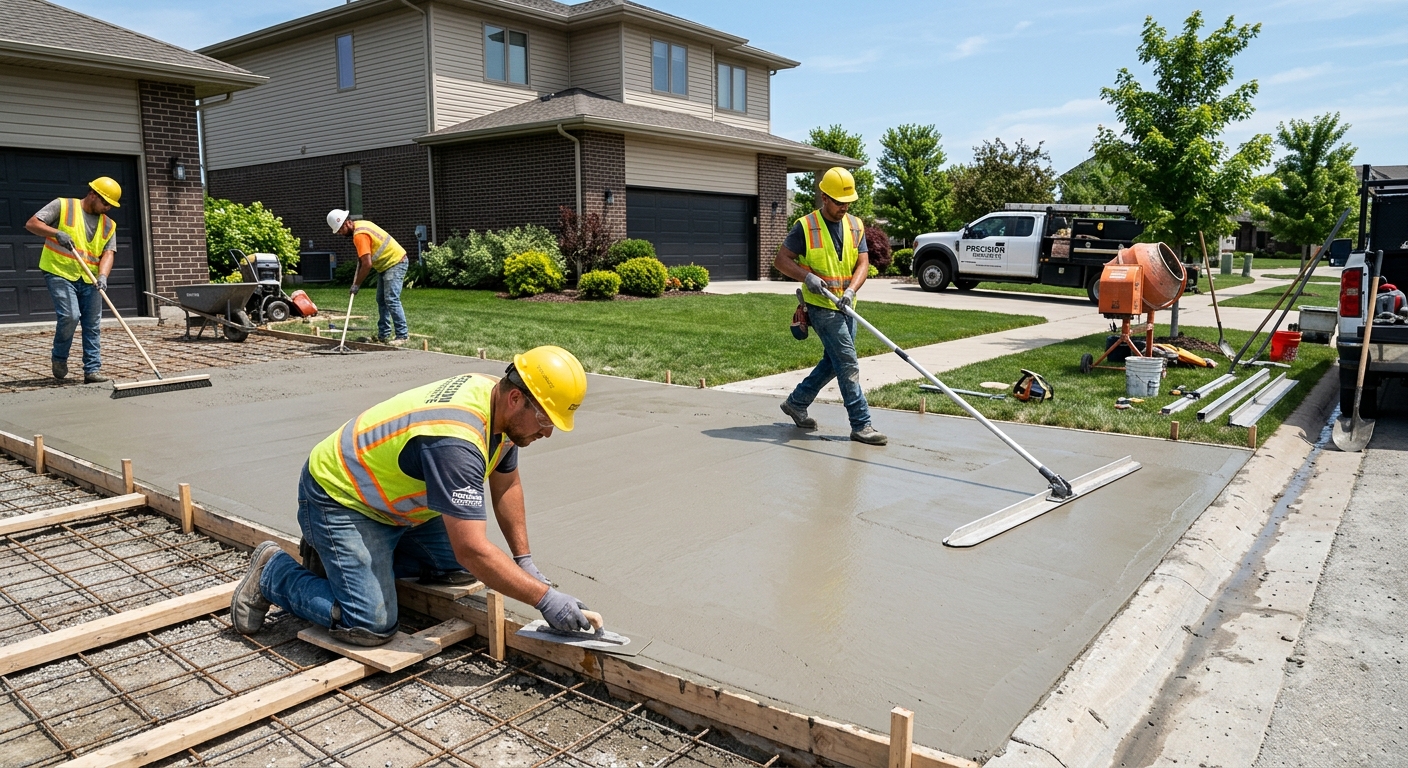
Concrete work options and costs in Smith Creek
In Smith Creek, concrete flatwork is one of the most durable upgrades you can make—especially for the families living in a town of about 3,500 residents (Statistics Canada, 2021 Census). Most homeowners here rely on practical, low-maintenance surfaces like driveways and patios, and in this market you’ll see a lot of single-detached homes that need exterior concrete to hold up against our wet seasons and freeze–thaw swings.
In the Lower Mainland–Southwest, mild winters and a shallow frost line still matter. Local practice typically targets a frost depth around 450 mm (18"), so footings and thickened edges are placed below that to reduce frost heave. Even when temperatures don’t stay low for long, repeated wetting and drying plus cool nights can stress curing and surface durability—so crews plan around rain, high humidity, and longer cure times. That planning (and the materials that protect against scaling) is part of why concrete jobs can land in different price ranges compared with the rest of BC.
Demand is especially strong in areas like the residential corridors around West Smith Creek Road, where older lots often have aging asphalt driveways and uneven walkways. As a result, you’ll find more crews bidding in spring and early summer, but schedules tighten when rain delays pours.
Below is a realistic comparison of common options in Smith Creek, with the typical size and the specs that usually control cost—then you can match a quote to the right build-up and finish.
| Application |
Typical Size |
Key Spec |
Finish Option |
Price Range |
| Concrete driveway (standard broom finish) |
400–500 sq. ft. |
Air-entrained mix; compacted granular base; proper drainage |
Broom finish with control joints |
$6,000–$12,000 |
| Exposed aggregate driveway |
400–500 sq. ft. |
Air-entrained mix; extended finishing window; sealer recommended |
Exposed aggregate with speckle/stone blend |
$9,000–$15,000 |
| Stamped concrete driveway or patio |
300–450 sq. ft. |
Air-entrained mix; release agent; integral colour or top colour |
Stamped patterns (stone/brick/wood looks) |
$8,000–$16,000 |
| Plain concrete patio or walkway |
200–350 sq. ft. |
Compacted base; joints to control cracking |
Smooth or light broom |
$3,000–$7,500 |
| Garage floor (interior slab) |
300–500 sq. ft. |
Vapour barrier (as applicable); reinforcement; curing plan |
Broom finish or smooth trowel (if specified) |
$6,000–$14,000 |
| Foundation footings (structural, below frost) |
Approx. 80–150 linear ft. |
Below design frost depth; engineered rebar and mass excavation |
Structural concrete placement |
$16,000–$35,000 |
Prices are estimates only and vary by project scope, site access and material selection.
What affects the price of concrete work in Smith Creek
In the Lower Mainland–Southwest, the same “driveway size” can still come back with quotes that differ by 30–50% across BC. The biggest reasons aren’t the headline finish—they’re the hidden line items: how deep the contractor excavates to meet the frost depth approach, how the crew manages saturated soils and drainage, and what concrete spec they’re actually pricing (air-entrainment, strength, and curing steps). In older neighbourhood pockets of Smith Creek, excavation can also hit variable subgrade and buried fill, which increases forming and labour time.
Concrete is especially sensitive to freeze–thaw cycling. Exterior slabs need air-entrained concrete to survive repeated wetting and cooling, and footings/thickened edges must extend below the design frost depth target (commonly around 0.5–1.2 m in coastal BC practice). When a site can’t drain well, base preparation (compacted granular and drainage attention) gets more expensive. Scheduling also matters: cool nights and frequent rain can slow crews, which means added labour for protection (curing blankets, sealing after cure) and sometimes a longer window to complete the pour.
To put costs into perspective: switching from standard broom driveway ($18–$28 per sq. ft. band) to exposed aggregate or stamped work is often justified by material and labour intensity—expect the higher band where decorative surface work and finishing time increase. Conversely, a plain patio in the $16–$26 band can stay close to budget when the base is straightforward and the pour is simple. In Smith Creek, if your project is on a sloped lot or near heavy rainfall runoff, expect base prep and drainage to push the job toward the top end even for “simple” flatwork. For foundation work, deeper excavation and engineered reinforcement typically drive the most significant changes, with footing pricing often translating into the higher end once below-frost excavation quantities rise.
| Price Factor |
Why It Matters |
Cost Impact |
| Frost line depth |
Determines footing depth and form height to reduce frost heave |
Can add significant excavation and concrete volume on exterior perimeter |
| Site preparation |
Excavation, grading and compacted granular base affect settlement and cracking |
Higher when soils are wet, inconsistent, or access is tight |
| Reinforcement |
Rebar or wire mesh improves performance over weaker subgrades |
Moderate to high depending on thickness and engineered requirements |
| Mix design |
Air-entrainment and compressive strength must match exterior exposure and durability needs |
Higher for exterior air-entrained mixes and tighter strength specs |
| Finish type |
Broom vs. stamped vs. exposed aggregate changes labour and materials |
Decorative finishes typically add the most cost per sq. ft. |
| Pour size and concrete truck access to site |
Short access time reduces labour and pumping/placing costs |
Can swing costs sharply if pumping is needed or wheelbarrowing is extensive |
| Cold-weather curing precautions |
Heating and insulating blankets protect strength gain in cool nights |
Adds labour and materials when pours fall near shoulder seasons |
| Control joint pattern and sealing cost |
Joint layout limits random cracking; sealers help resist de-icing salts and moisture |
Small to moderate cost, but often critical for longevity |
Permits & regulations in British Columbia
In British Columbia, structural concrete work generally needs the right approvals before you pour. Footings, foundation walls, and grade beams are considered structural items and typically require a building permit. Many projects also involve engineered drawings that the municipality (or the building department process) reviews for reinforcement details, elevations, and load paths. Even where a contractor handles the paperwork, you should confirm the permit status in writing before any excavation starts.
Concrete flatwork—like patios, walkways, and standard driveway slabs—usually does not require a building permit. The common exceptions are when your work affects lot grading, changes drainage patterns, involves variances or impacts impervious surface coverage limits, or encroaches near municipal right-of-way areas. If you’re adding a large pad, changing the slope for drainage, or modifying curb/sidewalk interfaces, ask the municipality first.
Step-by-step for a homeowner in Smith Creek: (1) Ask for the contractor’s proof of liability insurance (certificate of insurance showing the business name and coverage details). (2) Confirm they have the proper WSBC/WCB coverage for their workers (look for a clearance letter or a coverage confirmation on their documentation). (3) Verify their licence/registration status through the appropriate online registry for BC trades and/or business registration references—then match the name on the quote and invoice to the certificate. (4) Request references from similar-scale concrete jobs (driveways/patios or foundation work, depending on your scope). (5) Ensure the permit responsibility is clear: who applies, what documents are submitted, and what inspections are required before and after the pour.
Getting concrete right in Smith Creek's freeze-thaw climate
Concrete fails in Smith Creek when water finds the weak spots: poor drainage, an undersized base, low air content, or curing that didn’t reach the required early strength. In our Lower Mainland–Southwest conditions—frequent wetting, cool nights, and freeze–thaw cycling—the most common long-term complaint is surface scaling or spalling, especially near edges and areas where water pools.
Spec the job for durability, not just appearance. (1) Base preparation: build a compacted granular sub-base to the right depth for local soil and to support frost-resistance details; don’t “save” depth when the subgrade is wet. (2) Mix design: use air-entrained concrete for exterior flatwork (target about 5–7% air content depending on exposure and mix design) and set a minimum compressive strength commonly around 32 MPa for exterior slabs. (3) Control joints: place joints to limit random cracking—then seal after cure where specified. (4) Curing: plan minimum 7 days of curing under suitable conditions; in cool, damp weather, contractors should protect the slab and extend cure time so strength develops. (5) Sealing: apply a penetrating sealer after the slab cures (often around 28 days) to help repel moisture and reduce damage from de-icing salts where used.
Here’s a practical example: a standard broom driveway can land in the $18–$28 per sq. ft. band. If your site drains poorly, the “cheap” quote often arrives by skimping on base prep or air-entrainment specs. That might look like a short-term savings, but the cost of repeating repairs after scaling typically exceeds the difference—especially when decorative work like exposed aggregate or stamped surfaces is already a larger investment (often moving toward the higher $22–$36 band for finishing). Ask for the air content and curing plan up front to avoid the spalling issue that shows up after a couple of seasons.
| Spec |
Why It Matters in Smith Creek |
What to Ask For |
Impact if Skipped |
| Compacted granular base (depth?) |
Controls settlement and provides frost-resistance support under wet, shifting soils |
Confirm excavation depth, granular type, lift thickness, and compaction test approach |
Cracking, edge heave, and premature surface breakdown |
| Air-entrained concrete mix (target air %?) |
Helps resist freeze–thaw damage and scaling in cool coastal-wet conditions |
Request mix design with target air content (about 5–7% for exterior flatwork) |
Spalling and scaling within a few seasons |
| Compressive strength (MPa rating) |
Ensures durability and adequate early strength for traffic and long-term performance |
Minimum 32 MPa rating (or higher if specified) and how strength is managed |
Higher risk of surface wear, cracking, and poor long-term performance |
| Control joints (spacing per ACI guidelines) |
Limits random cracking under temperature and moisture movement |
Proposed joint spacing and layout plan before the pour |
Uncontrolled cracks and costly patching |
| Minimum 7-day curing period |
Cold damp weather slows strength gain and increases vulnerability early on |
Protection method in cool nights (blankets/sealer schedule) and curing duration |
Reduced strength, surface scaling, and poor finish durability |
| Penetrating sealer (when applied after cure) |
Repels moisture and reduces harm from de-icing salts and driving rain exposure |
Application timing (often after 28 days cure) and product type |
Faster deterioration and staining; higher maintenance costs |
How to choose a concrete work contractor in Smith Creek
Choosing the right concrete contractor in Smith Creek is mostly about verifying capability—then locking the details into a written scope. Start with British Columbia checks: confirm the contractor carries liability insurance (certificate of insurance). Next, verify WSBC/WCB coverage for their workers—ask for a clearance letter or coverage confirmation rather than “we’re covered.” Then verify licensing/registration status through the proper BC registry sources and ensure the business name on the quote matches the documents you receive. A reputable crew won’t hesitate to share proof and references.
Get 2–3 itemised written quotes. You want a breakdown that distinguishes labour, concrete supply, reinforcement, formwork, base prep (excavation and compacted granular), and finishing/sealing. Avoid a vague lump-sum number where joints, sealing, disposal, and saw-cut timing are unclear. Ask if permit pull is included (if the work is structural), and whether waste disposal and haul-away are included.
Warranty matters in concrete because the visible finish doesn’t always reveal base issues for a season. Ask for the workmanship warranty length, whether it covers cracking and spalling, and whether product/manufacturer warranties apply (and if they are transferable). Payment schedule should be conservative: never pay more than 10–15% upfront; hold back part of the balance until the job is complete, cleaned, and deficiencies are addressed.
Finally, insist on a timeline in writing—proposed start date, pour date window, and completion estimate—because rain in the Lower Mainland–Southwest can shift schedules quickly and affects curing. The more specific the plan, the fewer surprises you’ll have.
- Ask for proof of liability insurance (certificate) and ensure dates/coverage are current.
- Request WSBC/WCB clearance letter or coverage confirmation for the workers.
- Verify the contractor’s BC registration/licence status and match it to the quote/invoice name.
- Get at least two itemised quotes with separate line items for base prep, concrete, reinforcement, and finish.
- Confirm whether excavation includes disposal/haul-away, and what disposal fees are.
- Ensure the quote specifies air-entrained exterior mix and the minimum strength requirement (commonly 32 MPa).
- Require a joint layout plan (spacing and where joints will be placed) before the pour.
- Ask about curing protection and minimum cure period in cool/wet weather.
- Clarify sealing: product type and when sealer is applied after cure (often around 28 days).
- Check reinforcement details: rebar size/spacing or mesh spec and slab thickness.
- Request references from Smith Creek/Lower Mainland–Southwest projects with similar finish levels.
- Confirm payment schedule (10–15% max upfront) and define holdback terms for completion.
Concrete red flags in Smith Creek: (1) “No need for air-entrainment” for exterior slabs; (2) vague joint wording like “we’ll add joints” without spacing; (3) no curing protection plan for cool, rainy stretches; (4) skipping or under-explaining base preparation and drainage; (5) insisting on large upfront payments or refusing to provide proof of insurance and WSBC/WCB coverage.
Frequently asked questions — concrete work in Smith Creek
How long does a concrete driveway last?
A well-built concrete driveway in Smith Creek commonly lasts 25–35 years, but the range depends heavily on base prep, drainage, and the exterior concrete spec. In the Lower Mainland–Southwest, freeze–thaw cycles and wet weather can shorten service life if the contractor uses the wrong mix or skips proper air-entrainment. Sealing helps manage moisture and staining, and good joint placement reduces random cracking. If your driveway is exposed to heavy rainfall runoff or where snow melt/de-icing is used, maintenance matters more—especially in coastal areas where water can linger at edges. When comparing bids, look for the contractor to explicitly mention air-entrained exterior mix and joint plan, not just the finish. Budgeting within the $18–$28 per sq. ft. band for standard concrete usually offers better odds when the design includes the right build-up and curing steps.
What is air-entrained concrete and why does it matter here?
Air-entrained concrete is designed to include tiny, evenly distributed air bubbles in the mix. In Smith Creek and across British Columbia’s coastal-wet conditions, those microscopic voids give freezing water a place to expand, reducing internal damage that causes scaling and spalling. This matters even when temperatures aren’t consistently below freezing; repeated wetting, cool nights, and short freeze–thaw cycles can still stress the surface. If a contractor proposes standard concrete with no air content for an exterior slab, that’s one of the fastest ways to get surface deterioration. For exterior flatwork, many specs target about 5–7% air content (depending on mix design), and finishing/cure timing must support durability. It’s a key reason quotes for the same driveway can differ by 30–50% when contractors either include or exclude the correct exterior mix requirements.
How do I prepare the base for a concrete slab?
Good slab performance starts below the surface. For Smith Creek, preparation usually means removing unsuitable topsoil, then excavating to the planned depth and building a compacted granular base to the right elevation for drainage and frost-resistance details. Contractors typically place the granular in lifts and compact each layer to reduce settlement. They also pay attention to water management—subgrade drainage and grading—because trapped water around edges increases freeze–thaw damage. A proper build-up is one reason a “too-low” patio or walkway quote often comes back as cracking or unevenness later. When you review quotes, ask for the excavation depth, granular type and compaction approach, and whether the plan includes edge support and proper slope. This is especially important for exterior work where de-icing salt and prolonged coastal rainfall can amplify deterioration.
How do I compare concrete quotes?
When comparing concrete quotes in Smith Creek, don’t compare by total price alone—compare by scope and spec. Ask each contractor to provide an itemised breakdown: excavation/base prep, reinforcement (rebar or mesh), concrete mix (confirm air-entrained exterior mix and minimum strength such as 32 MPa), finish type, control joints spacing, curing protection, and whether sealing is included. Check assumptions about access (whether a truck can reach the pour area or pumping/wheelbarrowing is required). Make sure disposal/haul-away is included if excavation is significant. Also confirm if permit pull is included—structural work typically needs it, while plain flatwork often does not unless grading or right-of-way issues are involved. As a pricing anchor, standard concrete driveways often align with the $18–$28 per sq. ft. band, while decorative work like stamped or exposed aggregate typically moves toward the higher $22–$36 band. If one quote is far below, it usually omits something critical.
Can concrete be poured in cold weather in Smith Creek?
Yes, concrete can be poured in Smith Creek during cold weather, but it must be protected so it can gain strength correctly. Lower Mainland–Southwest winters are milder than much of the province, yet cool nights, rain, and short freeze–thaw cycles still require cold-weather curing precautions. Contractors may use curing blankets, temperature control measures, and insulated protection depending on forecast conditions. The goal is to avoid freezing during the early set and to maintain curing conditions long enough to reach adequate strength. Ask your contractor how they plan to protect the slab, what curing duration they assume, and whether they adjust mix or procedures. If a contractor offers no plan for curing protection and the pour is near freezing temperatures, that’s a risk. A solid bid will explicitly discuss curing timing, not just “we’ll pour and it’ll be fine.”
How do I maintain concrete in Smith Creek's freeze-thaw climate?
Maintenance in Smith Creek is about managing moisture and reducing surface damage. Start with sealing: a penetrating sealer applied after the slab cures (often around 28 days post-pour) helps repel moisture and reduces staining, which is helpful in our wet coastal climate. Keep water from pooling by maintaining drainage and addressing any low spots or grading changes near edges. Sweep debris off surfaces regularly so water can’t sit trapped in dirt. For winter, use de-icing carefully—salt can accelerate spalling if the concrete wasn’t properly air-entrained, and even good concrete benefits from using the right products and avoiding over-salting. Inspect annually for hairline cracks or edge chips and have small repairs done early. If you chose a decorative finish, follow the same principles but use products designed for sealed concrete. The best maintenance plan still depends on how the slab was built—air-entrainment, joints, base prep, and curing determine how well it holds up to freeze–thaw.