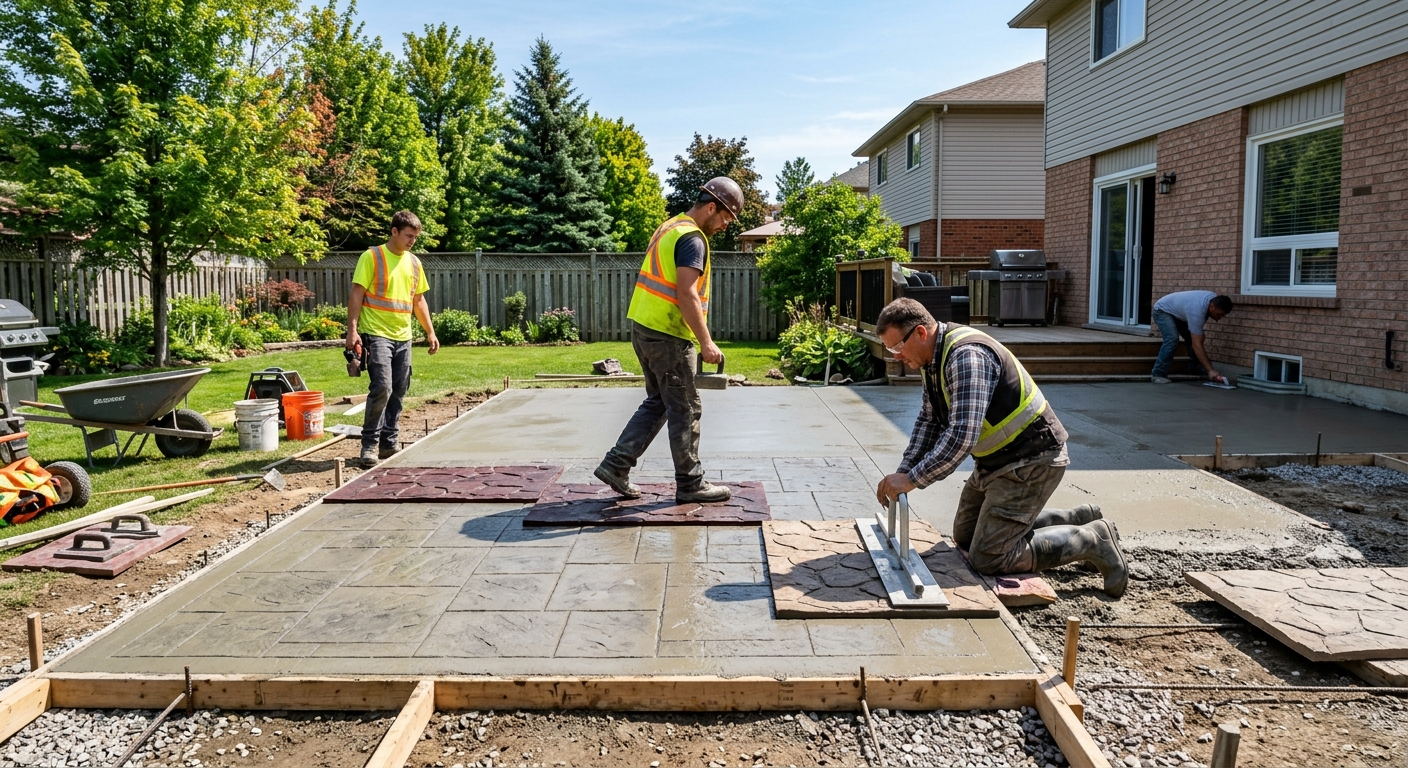
Concrete work options and costs in Burns Lake
Concrete work in Burns Lake is where practicality meets climate: you’re not just pouring “a slab,” you’re designing for frost, drainage, and freeze–thaw cycles that can push concrete around over time. In a town where 64.2% of dwellings are single-detached homes, most driveway, patio, and walkway projects come from homeowners upgrading entrances and adding usable outdoor space. That demand is steady in established pockets like downtown Burns Lake and along residential streets near the lakeshore, where access can be tight and contractors need to plan truck routes carefully.
The Nechako region’s cold-climate interior conditions shape the price more than people expect. Because footings and exterior slabs need to be placed below the local frost influence, excavation and granular base prep often take longer, and you’ll see more labour and aggregate used than in milder parts of British Columbia. The pour season is also shorter, so cold-weather placement may require insulated blankets, heaters, and stricter curing—costs that rise further when materials and labour trend upward across B.C. In Burns Lake, concrete mixes are typically air-entrained for durability, and finishing details like control joints and sealing aren’t optional if you want fewer hairline cracks and less surface deterioration.
Below is a realistic cost comparison for common concrete options you’ll see quoted in Burns Lake, so you can spot where “cheap” quotes cut corners and where premium options actually make sense.
| Application |
Typical Size |
Key Spec |
Finish Option |
Price Range |
| Concrete driveway (standard broom finish) |
400–600 sq. ft. |
Air-entrained exterior slab, control joints, 4"–5" thickness |
Broom finish + edging |
$3,600 – $6,500 |
| Exposed aggregate driveway |
400–600 sq. ft. |
Air-entrained mix + aggregate exposure process, curing protection |
Exposed aggregate + sealed finish |
$5,500 – $9,000 |
| Stamped concrete driveway or patio |
300–500 sq. ft. |
Air-entrained mix, proper joint spacing, release agents |
Stamped pattern + sealer |
$6,000 – $11,000 |
| Plain concrete patio or walkway |
150–300 sq. ft. |
Exterior air-entrained slab, drainage slope |
Broom or smooth trowel finish |
$2,200 – $5,000 |
| Garage floor (interior slab) |
480–720 sq. ft. |
16–32 MPa class, vapor barrier where required |
Standard trowel + light broom |
$6,000 – $12,000 |
| Foundation footings (structural, below frost) |
~40–90 linear ft. |
Engineered footing, below frost placement, reinforced stem as required |
Structural concrete only (no decorative finish) |
$6,000 – $18,000 |
Prices are estimates only and vary by project scope, site access and material selection.
What affects the price of concrete work in Burns Lake
In the Nechako region, two quotes for the same driveway can differ by 30–50% because the “same size” slab can hide very different specs. Contractors in Burns Lake typically price for frost protection, granular base prep, drainage, reinforcement, and cold-weather curing. If one contractor assumes shallow excavation or a simpler mix, the finished slab might look fine for a season—but it’s more vulnerable when the freeze–thaw cycles intensify in winter.
For example, the frost line depth and freeze–thaw cycles dictate every exterior decision. Footings and any structural elements that support a home should be placed below the design frost influence to prevent frost heave. Exterior slabs are also commonly done with air-entrained concrete and properly spaced control joints to relieve movement. In Burns Lake’s cold-weather conditions, the pour season is shorter, and cold-weather placement often means heaters, insulated blankets, or accelerators to protect curing. That adds labour and equipment time compared with southern coastal scheduling. Finally, de-icing salts can accelerate surface deterioration, so sealing and good finishing practices matter—especially if your home was built before 1981, when many areas of B.C. had different drainage standards and less emphasis on long-term surface durability (Homes built before 1981: 61.6%).
Here’s how that shows up in real pricing. If you’re comparing a standard broom driveway at roughly $18 – $25 per sq. ft. to a stamped option closer to $28 – $35 per sq. ft., the difference is mostly labour-intensive finishing, release agents, and joint planning—not just “prettier concrete.” A similar effect happens with foundations and footings, where structural requirements below frost can be a different category of work than a flatwork patio.
| Price Factor |
Why It Matters |
Cost Impact |
| Frost line depth |
Determines footing depth and form height needed to reduce heave |
Can add major excavation and concrete volume |
| Site preparation |
Excavation, grading, and compacted granular base set the slab grade and durability |
Often the biggest controllable variable between quotes |
| Reinforcement |
Rebar or wire mesh helps control cracking and supports load transfer |
Material + placement labour increases cost |
| Mix design |
Air-entrainment and compressive strength targets improve freeze–thaw resistance |
Higher-spec mix can raise per-yard pricing |
| Finish type |
Broom vs. stamped vs. exposed aggregate changes labour, materials, and curing care |
Stamped/exposed typically costs more per sq. ft. |
| Pour size and concrete truck access to site |
Smaller pours can require more setups; tight access adds labour |
Can increase mobilization and handwork time |
| Cold-weather curing precautions |
Heaters/blankets protect against early freezing and maintain strength gain |
Adds equipment rental and labour time |
| Control joint pattern and sealing cost |
Joints reduce random cracking; sealing protects from moisture and salts |
Small line items that prevent bigger failures |
Permits & regulations in British Columbia
In British Columbia, structural concrete work—including footings, foundation walls, and grade beams—typically requires a building permit and may require engineered drawings that the municipality reviews before work begins. For concrete flatwork like driveways, patios, and walkways, permits are usually not required when the work stays within normal lot conditions. However, permits can be triggered if your project affects lot grading, drainage patterns, or falls under municipal requirements related to impervious surface coverage or work in/near a municipal right-of-way. Before breaking ground in Burns Lake, confirm the requirements with the local authority—especially if you’re changing slopes or adding a new driveway connection.
When hiring a contractor, also verify they can legally and financially back the job. Start with their liability insurance certificate (ask for the COI and confirm it covers the types of work being done). Next, confirm their coverage for workers through the appropriate provincial system (workers’ compensation). Then ask for recent references on similar-scale Burns Lake projects, ideally with photos that show winter-season performance.
To be thorough, homeowners should also check whether the contractor has the relevant provincial licensing for their scope and trades. If they can’t provide clear documentation on request, that’s a red flag.
Getting concrete right in Burns Lake's freeze-thaw climate
Concrete fails in Burns Lake’s freeze–thaw climate for predictable reasons: water gets in, expands as it freezes, and gradually breaks down the paste and surface. Poor base prep and insufficient frost protection lead to settlement or heaving, while inadequate air-entrainment increases the risk of spalling (flaking) during repeated winter cycles. The fix is a correct specification, not just “stronger” concrete.
Start with base preparation: build a properly graded, compacted granular sub-base to the depth required by site conditions and frost considerations. A good base reduces pumping and helps maintain slab alignment. Next, specify the mix design. For exterior flatwork, air-entrainment is key—typically 5–7% air content depending on the mix design—and set a minimum 32 MPa compressive strength target for durability. Add control joints at the right spacing so cracking is controlled rather than random. For curing, plan minimum 7 days curing under protective conditions. In cold weather, curing often needs blankets and/or heaters to prevent early freezing.
Finally, consider sealing. A penetrating sealer applied after the concrete has cured helps repel water and reduces surface damage risk from de-icing salts. If you’re choosing between options, here’s an example: a broom-finished driveway might land around $18 – $25 per sq. ft., while a stamped driveway can be closer to $28 – $35 per sq. ft. The extra cost is justified when the contractor also budgets for joint layout, curing protection, and sealing—because those details are what prevent premature deterioration.
| Spec |
Why It Matters in Burns Lake |
What to Ask For |
Impact if Skipped |
| Compacted granular base (depth?) |
Reduces settlement and helps manage frost influence under the slab |
Base depth and compaction method; confirm drainage slope |
Cracking, uneven settling, premature joint failure |
| Air-entrained concrete mix (target air %?) |
Improves freeze–thaw durability in cold interior winters |
Air content target (commonly 5–7% for exterior flatwork) |
Higher chance of spalling and surface scaling |
| Compressive strength (MPa rating) |
Ensures strength gain and long-term durability |
Minimum 32 MPa (or project-specified equivalent) |
Weak surface, reduced abrasion resistance, faster wear |
| Control joints (spacing per ACI guidelines) |
Controls where cracks form during shrinkage and movement |
Joint spacing plan and saw-cut timing |
Random cracking and wider damage from freeze–thaw |
| Minimum 7-day curing period |
Allows strength development before the weather stresses the slab |
Curing plan for cold or wet days |
Early freezing/weakening leading to failure and scaling |
| Penetrating sealer (when applied after cure) |
Repels water and reduces the impact of de-icing salts |
Sealer type and timing (after full cure readiness) |
Faster deterioration, moisture intrusion, rougher surface over time |
How to choose a concrete work contractor in Burns Lake
Choosing the right concrete contractor in Burns Lake comes down to proof: proof they understand cold-climate specs, and proof they’re properly insured. Start by verifying British Columbia licensing relevant to their scope (and that they’re eligible to do the trade work they’re bidding). Then ask for a certificate of liability insurance—you should see the coverage active for the contract period. If they use crew members, they should also be covered through the province’s workers’ compensation system; ask for evidence of coverage and keep it on file.
Next, don’t accept vague, lump-sum “per job” numbers. Get 2–3 itemised written quotes that break out labour and materials (concrete supply, excavation and haul, base and rebar, forms, finishing, curing protection, and disposal). Read the scope line-by-line: what’s included, what’s excluded, and who is responsible for permits (if required). In Burns Lake, disposal and site access can quietly swing a quote—especially with tighter residential streets and winter haul considerations.
Warranty matters too. Ask for the workmanship warranty length, whether there’s a product/manufacturer warranty, and whether warranties are transferable to a future buyer. For payment, avoid large deposits—never more than about 10–15% upfront—and hold back until the project is fully completed and cleaned up. Finally, demand a timeline in writing: start date, pour day plan, and completion estimate. In cold weather, a contractor should explain how they’ll protect curing.
- Request proof of liability insurance and confirm coverage dates.
- Confirm workers’ compensation coverage (WSIB/WCB-equivalent coverage for the province).
- Ask what air-entrained mix design will be used for exterior work.
- Require an itemised base-prep scope (excavation, granular base, compaction).
- Get the reinforcement details in writing (mesh vs. rebar, spacing, tie-in method).
- Confirm control joint plan (spacing, saw-cut timing) for driveways and patios.
- Ask about cold-weather curing steps: blankets/heaters/accelerators if needed.
- Clarify sealing: whether it’s included, and when it will be applied.
- Verify disposal/haul is included or itemised separately.
- Ensure the quote states concrete thickness and total volume assumptions.
- Check warranty terms: workmanship length and what defects are covered.
- Set a payment schedule with a retainage until final inspection and cleanup.
Concrete contractor red flags in Burns Lake: no written curing plan for cold nights; quotes that don’t mention air-entrained concrete for exterior slabs; “we’ll pour if it’s above freezing” without discussing blankets/heaters; missing proof of insurance/workers’ coverage; and no clear joint layout or sealing option when you’re planning a driveway or walkway.
Frequently asked questions — concrete work in Burns Lake
How do I compare concrete quotes?
To compare concrete quotes in Burns Lake, don’t focus only on the total price—compare the specs and line items. Ask each contractor for an itemised breakdown: excavation and granular base prep, concrete volume, reinforcement (if required), finishing steps, curing protection in cold conditions, and sealing. For exterior work, make sure the quote specifies an air-entrained mix and a joint plan; these are key for freeze–thaw resistance. As a rough baseline, standard concrete driveways often land around $18 – $25 per sq. ft., while stamped concrete can be closer to $28 – $35 per sq. ft. If one quote is far below those ranges without explaining extra allowances (thinner slab, less base, fewer joints), it may be cutting the durability steps that matter most in British Columbia’s cold interior climate.
Can concrete be poured in cold weather in Burns Lake?
Yes, concrete can be poured in cold weather in Burns Lake, but it depends on temperature, wind, and how the contractor protects curing. In the Nechako interior, early freezing can weaken the slab and increase the risk of surface damage. A proper cold-weather plan typically includes insulated blankets, heaters, and protection to maintain safe curing conditions until the concrete reaches adequate strength. Contractors should also coordinate scheduling around precipitation and nighttime temperature swings, because wet and cold conditions can slow curing and harm the final finish. When you request a quote, ask directly what they’ll do if it’s below their pour threshold and how long the protection will stay in place. That’s especially important for exterior slabs, since winter freeze–thaw cycles will test the slab’s durability.
How do I maintain concrete in Burns Lake's freeze-thaw climate?
Maintenance in Burns Lake is mostly about controlling moisture and protecting the surface. Keep an eye on drainage—if water flows toward the slab edges, you’ll feed freeze–thaw damage. For de-icing, use salt in moderation and avoid repeated heavy applications that can accelerate surface deterioration. If your contractor includes sealing, a penetrating sealer applied after the concrete has cured helps reduce moisture intrusion. Visually inspect for scaling, pop-outs, or widening cracks each spring; small issues are cheaper to address early than after the slab starts moving. Since many local homes are older (61.6% built before 1981, Statistics Canada, 2021 Census), you may also see legacy grading and drainage patterns—so it’s worth checking that downspouts and runoff aren’t contributing water to your driveway or walkway.
What causes concrete to spall in Burns Lake winters?
Spalling is usually caused by freeze–thaw damage working its way through the surface. In a cold climate like Burns Lake, water enters the concrete paste (often through micro-cracks or porous surfaces), then expands when it freezes, breaking the surface layer. A major contributor is inadequate air-entrainment—without proper air bubbles, freeze–thaw stress can’t dissipate. Other common causes include poor base prep leading to movement, insufficient curing protection in the first days after the pour, and missing or improperly spaced control joints that allow random cracking. If you plan to use de-icing salts, a well-timed sealer and a durable mix also help. When you compare quotes, ask for the air-entrained mix details and whether curing will be protected during cold or wet conditions.
What is rebar and when is it required in British Columbia?
Rebar is steel reinforcement embedded in concrete to improve tensile capacity and control cracking. In British Columbia, whether rebar is required depends on the engineered design and the type of concrete work. For structural items like foundation footings, foundation walls, and grade beams, reinforcement is commonly required by design, especially where there are loads or where movement must be controlled. For exterior flatwork like driveways and patios, reinforcement may be specified based on slab thickness, sub-base conditions, and expected vehicle loads; it’s not always automatically “every job gets rebar.” The best approach is to require the contractor to state the reinforcement method and placement in the quote (mesh vs. rebar, spacing, and support chairs/ties). If you’re working on a foundation or anything structural, expect engineered drawings and a permit process in B.C., unlike typical driveway-only work.
How long does a concrete project take in Burns Lake?
Timelines in Burns Lake depend on weather windows, curing requirements, and site access. A small interior garage floor might take about a week from prep through curing and finishing, while a driveway or patio typically takes longer because of excavation, formwork, base compaction, placement, finishing, and cure protection. Cold-weather placement can add time due to required blankets/heaters and the need to hit strength and temperature conditions before removing protection. Removal and disposal of old concrete or landscaping also affects schedule. As a rule of thumb, a typical exterior flatwork project often involves several days of on-site work plus curing time before the area can be safely used. When you get quotes, ask for a start date, expected pour date, and when you can drive or place heavy loads—plus what happens if temperatures dip overnight.