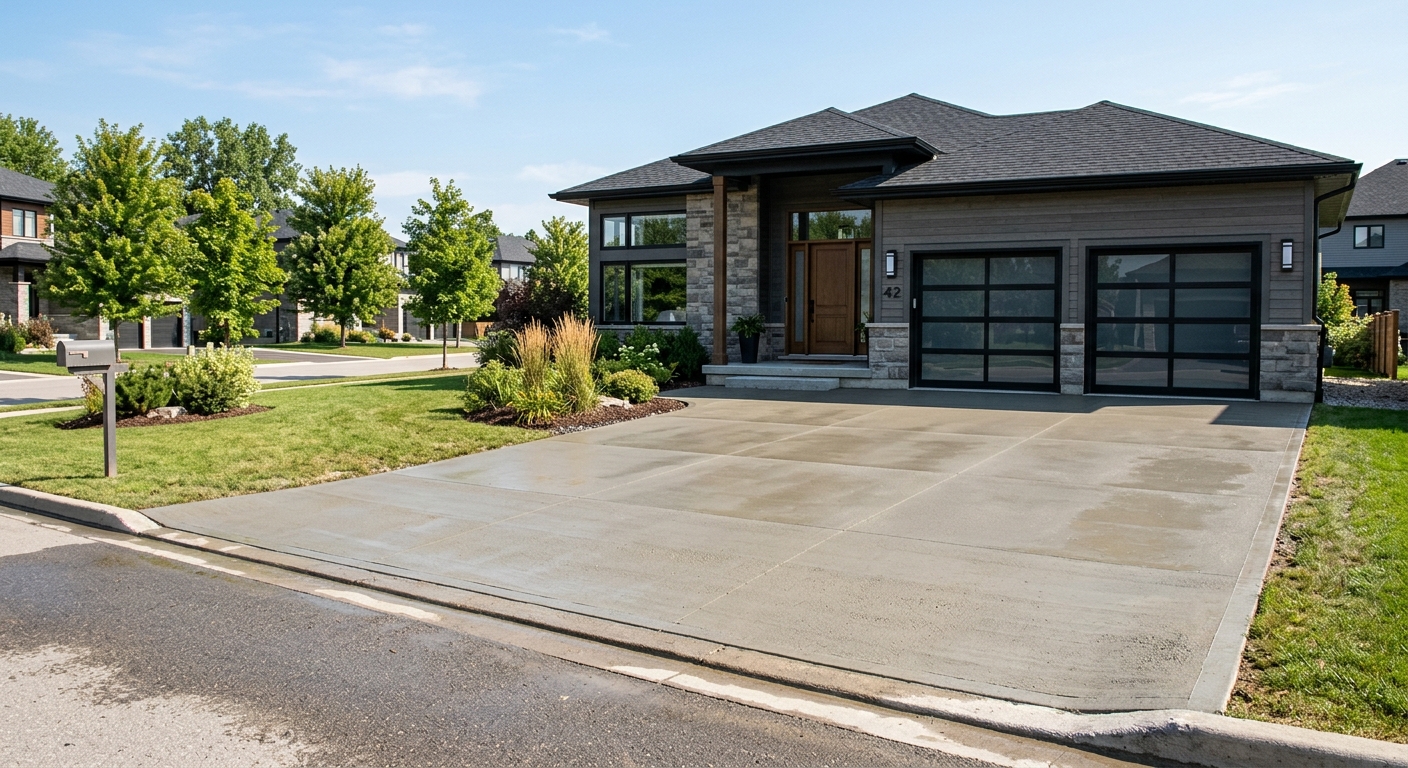
Concrete work options and costs in Ryder Lake
Concrete contractors in Ryder Lake field a lot of driveway and patio calls from homeowners who want durable, low-maintenance surfaces that can handle our coastal-wet weather and frequent freeze–thaw cycles. In Ryder Lake, the housing mix matters: there’s a steady baseline of single-detached homes (a common type of property for new driveways, walkways and backyard flatwork), and the community’s population is 1,290 (Statistics Canada, 2021 Census). That size is big enough for ongoing work, but not every crew is constantly available—so scheduling can influence the final price when rain windows narrow.
In the Lower Mainland–Southwest, costs are shaped by a shallow-but-not-trivial frost depth (local practice often assumes around 450 mm / 18") and the need to place footings and thickened edges below it to reduce frost heave. Even though winters are relatively mild versus interior BC, saturated soils and coastal rainfall keep the base moist, which increases the importance of drainage, compacted granular, and air-entrained mix designs. Contractors also plan around prolonged rain, cool nights and high humidity, using curing blankets or sealers to protect surface durability—especially on driveways and patios that see de-icing.
Demand is often highest around central Ryder Lake and the nearby lake-access pockets where properties turn over and landscaping timelines align. Use the table below to compare common options and what you can expect to budget before you request an itemised quote.
| Application |
Typical Size |
Key Spec |
Finish Option |
Price Range |
| Concrete driveway (standard broom finish) |
400–600 sq. ft. |
Air-entrained exterior mix, compacted granular base, control joints |
Broom finish |
$18,000–$28,000 |
| Exposed aggregate driveway |
400–600 sq. ft. |
Air-entrained exterior mix, proper curing and wash timing |
Exposed aggregate (salt-ready surface) |
$24,000–$36,000 |
| Stamped concrete driveway or patio |
250–450 sq. ft. |
Air-entrained exterior mix, colour hardeners, release agents |
Stamped pattern + sealer |
$22,000–$36,000 |
| Plain concrete patio or walkway |
150–300 sq. ft. |
Air-entrained mix, compacted base, edge forms and joints |
Float + broom/smooth finish |
$16,000–$26,000 |
| Garage floor (interior slab) |
400–500 sq. ft. |
Vapour barrier where needed, reinforcement as specified, curing |
Standard power trowel or light broom |
$12,000–$20,000 |
| Foundation footings (structural, below frost) |
Per typical home footing package |
Excavation and forming below local frost depth, engineered reinforcement |
Structural concrete (no decorative finish) |
$8,000–$14,000 |
Prices are estimates only and vary by project scope, site access and material selection.
What affects the price of concrete work in Ryder Lake
In the Lower Mainland–Southwest, you can see 30–50% variation between quotes for what looks like the “same” concrete job, because each contractor’s scope is rarely identical. One crew may price a broom-finish slab on a basic base, while another includes tighter subgrade grading, additional drainage, thicker compacted granular, properly sized reinforcement, and better curing protection during cool, wet spells. In British Columbia, the mix design and cold-weather precautions also drive costs—because if the concrete doesn’t get to the right early strength, durability suffers and callbacks are expensive.
Every exterior pour is governed by local freeze–thaw realities. Footings and thickened edges must extend below the design frost depth to help prevent frost heave, and exterior slabs are typically specified with air-entrained concrete so the mix can survive repeated saturation and freezing. When cold conditions shorten the effective pour season, contractors may need heated blankets, insulated protection, and tighter scheduling, which adds labour and equipment costs. Also, de-icing salt can accelerate surface scaling if the surface isn’t sealed and the mix isn’t right—so sealing and correct jointing are often non-negotiable for long-term performance.
In Ryder Lake, two common “real-world” drivers are: (1) excavation complexity where the grade is soft or drains poorly—this can push you toward more granular and undercutting; and (2) access for concrete trucks and removals, especially around tighter side yards where pumping is required. As a ballpark, a standard broom driveway usually aligns with the region’s $18–$28 band per project, while decorative options like stamped work often track the $22–$36 range once colour systems, stamp labour, and extra sealing steps are included.
| Price Factor |
Why It Matters |
Cost Impact |
| Frost line depth — determines footing depth and form height |
Footings must sit below local frost conditions to reduce frost heave. |
Higher excavation and rebar placement can add significant labour/material time. |
| Site preparation — excavation, grading, compacted granular base |
Drainage and compaction control settlement and cracking. |
Loose soils often require extra undercut and thicker base. |
| Reinforcement — rebar or wire mesh requirement |
Controls cracking and adds capacity for load-bearing areas. |
Material cost is usually moderate; labour to place chairs/spacers can be the driver. |
| Mix design — air-entrainment and compressive strength spec |
Exterior freeze–thaw durability depends on air-entrainment and strength gain. |
Higher-spec mix increases material cost and may require better scheduling to protect curing. |
| Finish type — broom vs. stamped vs. exposed aggregate |
Decorative finishes add colouring, timing and surface prep work. |
Stamp/exposure systems + extra labour + longer cure/sealer workflow raise totals. |
| Pour size and concrete truck access to site |
Access affects whether crews can pump, bucket, or must stage more frequently. |
Pump setups and longer carry distances increase labour and truck-related costs. |
| Cold-weather curing precautions — heating and blankets |
Cool nights delay strength; protection helps hit design strength. |
Heaters, blankets, and monitoring add equipment and labour line items. |
| Control joint pattern and sealing cost |
Joints manage shrinkage cracking; sealing protects against scaling from salt. |
Better joint layout and a post-cure sealer can cost more up front but reduce premature failure. |
Permits & regulations in British Columbia
In British Columbia, structural concrete work generally requires a permit and often comes with engineered drawings that the municipality reviews. This typically includes footings, foundation walls, grade beams and other structural foundation elements. For concrete flatwork—like driveways, patios and walkways—a permit usually is not required by default, unless the work affects lot grading, stormwater/lot drainage, impervious surface coverage limits, or a municipal right-of-way.
Before you break ground in Ryder Lake, confirm the requirement with the local authority so you’re not stuck redoing work after inspections. Also, verify the contractor is properly insured: ask for proof of liability insurance and coverage consistent with workers’ compensation requirements (often referred to as WCB in BC). Get references for similar-scale concrete flatwork or foundation work, and ask who will be on-site to manage curing and protection during cool, wet conditions.
How to verify licensing and insurance (step-by-step): 1) Request the contractor’s identification details and check their business information through the appropriate provincial registry channels; 2) Ask for a Certificate of Insurance that shows current policy dates and liability limits—confirm the address and scope match your project; 3) Ask whether they have workers’ compensation coverage and request documentation; 4) If foundation work is included, ensure permits are applied for before excavation and that the engineering package aligns with the excavation depth below frost.
Getting concrete right in Ryder Lake's freeze-thaw climate
Concrete fails in Ryder Lake when water gets into the slab or foundation and then freezes, expanding and prying at the surface and edges. In our Lower Mainland–Southwest climate, the biggest drivers are saturated subgrades, inadequate drainage, and—most commonly—concrete that isn’t properly air-entrained or protected during early curing. To spec the job correctly, focus on five things: (1) base preparation with compacted granular to the depth required for local soil and frost conditions; (2) mix design with proper air entrainment and a minimum 32 MPa compressive strength target for exterior durability; (3) control joints set to limit random cracking paths; (4) curing with at least 7 days of protection under suitable conditions, especially when pouring in cooler weather; and (5) sealing using a penetrating sealer after cure (commonly around 28 days) to help repel de-icing salt and reduce scaling.
Here’s where prices make sense: a stamped or decorative driveway costs more than a plain broom finish because it involves colour hardeners, careful timing, and additional sealing steps. If you’re deciding between a standard driveway and an exposed aggregate or stamped option, spend the extra budget when you need better surface durability and appearance consistency—especially for driveways that see regular salt and tire wear. For example, many homeowners in Ryder Lake budget toward the region’s $18–$28 driveway band for standard broom, then choose decorative work when they’re comfortable moving into the $22–$36 range for the added finishing and protection.
Use these specs to ask targeted questions and avoid the most expensive failure mode: spalling caused by inadequate air-entrainment and poor curing protection.
| Spec |
Why It Matters in Ryder Lake |
What to Ask For |
Impact if Skipped |
| Compacted granular base (depth?) |
Controls settlement and keeps water from pumping up into the slab during freeze–thaw cycles. |
Base depth in millimetres, compaction method, and drainage plan for wet areas. |
More cracking, uneven settlement, and faster surface deterioration. |
| Air-entrained concrete mix (target air %?) |
Air voids provide space for freezing water, reducing scaling and spalling. |
Air entrainment target of 5–7% for exterior flatwork and confirm it’s included in the mix. |
Higher risk of spalling and scaling during winter cycles. |
| Compressive strength (MPa rating) |
Adequate strength gain ensures durability and surface hardness under traffic and weather exposure. |
Minimum 32 MPa compressive strength specification and curing plan to achieve it. |
Surface dusting, reduced wear resistance, and premature failure. |
| Control joints (spacing per ACI guidelines) |
Controls where cracking happens so it doesn’t become random and unmanaged. |
Joint spacing plan, saw-cut timing, and how joints are sealed (if specified). |
Random cracking and water infiltration into slab edges. |
| Minimum 7-day curing period |
Cool, humid and rainy conditions delay strength; curing protection matters in coastal-wet weather. |
How they protect concrete (blankets/sealer timing) when nights are cold. |
Slow strength development, increased cracking, and lower final durability. |
| Penetrating sealer (when applied after cure) |
Helps repel de-icing salts and reduces moisture penetration that accelerates scaling. |
Penetrating sealer application after cure, typically around 28 days post-pour. |
Faster surface wear, scaling and staining, especially in salted drive lanes. |
How to choose a concrete work contractor in Ryder Lake
Choosing the right contractor in Ryder Lake starts with proof, not promises. In British Columbia, you should verify three things before anyone excavates: (1) licensing/business credentials relevant to the scope (especially for foundation/structural work); (2) liability insurance (ask for a Certificate of Insurance and confirm policy validity dates); and (3) workers’ compensation coverage (commonly referred to as WCB in BC—request documentation showing they have coverage for their workers). When possible, ask for clearance/letters or confirmation that extends to the project period.
Next, get 2–3 itemised written quotes rather than only lump sums. A good quote breaks labour and materials clearly: excavation/haul-off, formwork, rebar/wire mesh, granular base and compaction, concrete mix type (including air entrainment), finishing, curing measures, and sealers (including when they’re applied). Read the scope line-by-line: what’s excluded (e.g., removal of existing concrete, disposal of waste, making good landscaping, electrical saw cutting or reinforcement upgrades)? Make sure the quote states whether permits are included for structural foundation elements and what inspection timing they expect.
Warranty should be specific: workmanship warranty length, product/manufacturer warranty for sealers or admixtures, and whether it’s transferable to future owners. For payment scheduling, a safe approach is to pay no more than 10–15% upfront, then keep a holdback until complete and final finish/cure requirements are met. Finally, ask for a written start date and completion estimate that accounts for weather windows.
- Request insurance proof (liability certificate) and confirm it matches your address and project scope.
- Confirm workers’ compensation coverage for the crew (ask for current documentation).
- Ask for 3 references from similar Ryder Lake flatwork (driveways/patios) or foundation jobs.
- Get an itemised quote showing excavation, granular base, reinforcement, concrete mix specs and finishing.
- Confirm mix includes air-entrainment for exterior work and that control joints are planned.
- Ask when saw cuts happen and whether joints are sealed (if included in scope).
- Verify curing protection plan for cool nights and rainy periods (blankets/sealers if needed).
- Clarify access and whether pumping/bucketing is included or billed separately.
- Confirm disposal/haul-off is included if existing concrete is removed.
- Check whether sealing is included (and whether it’s penetrating sealer applied after cure).
- Review warranty terms in writing, including exclusions and how claims are handled.
- Agree on payment schedule with a holdback until finishing and cure steps are complete.
Concrete red flags in Ryder Lake include: quotes that omit base depth and compaction details, no clear air-entrainment/mix specification for exterior slabs, rushing curing with no mention of blankets or weather protection, vague joint spacing plans, and demanding large upfront payments without a written scope and schedule.
Frequently asked questions — concrete work in Ryder Lake
How do I prepare the base for a concrete slab?
For Ryder Lake projects, base prep is where durability is won or lost—especially with our freeze–thaw cycles and frequent wetting from coastal rainfall. A solid approach is to excavate to the engineered depth, then place a compacted granular base to the required thickness for your soil conditions and frost protection needs. Ask your contractor to specify compaction method (e.g., plate compaction/vibratory methods), base depth, and how water is managed (grading and drainage). For exterior flatwork, the goal is to keep the base from becoming a sponge that pumps moisture into the slab during temperature swings. If your yard is soft or drains poorly, you may need extra granular undercutting, which is a common reason quotes differ significantly even within the same $18–$28 driveway budget range.
How do I compare concrete quotes?
Comparing quotes in British Columbia is easiest when you compare the scope, not just the bottom line. Ask each contractor to itemise labour and materials: excavation/haul-off, granular base and compaction, reinforcement (rebar/wire mesh and how it’s supported), concrete mix design (including air-entrainment for exterior), finishing method, curing protection, and whether sealing is included. Confirm the joint plan—spacing, saw-cut timing, and whether joints are sealed. Also check what’s excluded: permit fees (typically for structural foundation elements), landscaping reinstatement, or any pumping/bucketing due to limited access. A “cheap” quote can be low only because it omits air-entrainment, proper curing, or key drainage steps, leading to surface scaling and spalling later.
Can concrete be poured in cold weather in Ryder Lake?
Yes, concrete can be poured in cold weather in Ryder Lake, but it must be done correctly to protect early strength development. The main risk is that cool nights slow hydration, and if the concrete freezes before it gains sufficient strength, durability suffers—especially for exterior slabs exposed to freeze–thaw. A good contractor will use a cold-weather curing plan: heaters or insulated blankets, careful scheduling to avoid overnight freezing, and temperature monitoring. Ask what protection they’ll provide and for how long. If the work is foundation or footings below frost, the plan needs to match the engineered requirements. Cold-weather precautions add cost, which is one reason Lower Mainland–Southwest pricing can swing upward versus warmer interior windows—even when the surface type is “just” a driveway in the $18–$28 band.
How do I maintain concrete in Ryder Lake's freeze-thaw climate?
Maintenance in Ryder Lake is mostly about moisture control and surface protection. Start with good jointing and sealing: for exterior slabs, a penetrating sealer is commonly applied after cure (often around 28 days) to repel de-icing salts and reduce scaling. Use de-icing carefully—avoid excessive salt where possible, and don’t chip ice with metal tools that damage the surface. Keep drainage working: ensure downspouts and grading don’t direct water onto the slab edges. If you see hairline cracks, keep them clean and sealed (if your contractor recommends joint sealing). For decorative finishes, sealed surfaces generally hold up better, which is one reason stamped or exposed aggregate projects often fall into the $22–$36 range—you're paying for a better surface system, not only appearance.
What causes concrete to spall in Ryder Lake winters?
Spalling is usually the result of water entering the concrete and then freezing, expanding and breaking the surface. In Ryder Lake, that cycle is driven by our cool nights, saturated soils, and wetting from rainfall. The most common technical cause is inadequate air-entrainment for exterior exposure. Without the correct air void system, freeze–thaw damage concentrates at the surface, leading to scaling and flaking (spall). Poor curing and weak early strength can also contribute, as can missing or poorly executed control joints that allow uncontrolled cracking and water intrusion. Base issues matter too: if the granular base isn’t properly compacted or drainage isn’t addressed, the slab edge becomes a moisture pathway. That’s why exterior jobs need air-entrained mix design and a curing/sealer plan.
What is rebar and when is it required in British Columbia?
Rebar is reinforcing steel embedded in concrete to control cracking and add tensile capacity in structural elements. In British Columbia, whether you need rebar depends on the engineered design and the concrete application. For foundations, footings, and grade beams, rebar is often required by engineering due to loads and settlement risk, and those structural components typically require a building permit. For exterior flatwork like driveways and patios, reinforcement may be included based on thickness, subgrade conditions, and traffic loads—sometimes it’s wire mesh, sometimes rebar, and sometimes neither if the design allows it. Ask your contractor to reference the engineered drawings or the slab design for your thickness. For budgets, foundation work often starts separately from flatwork—commonly in the $200–$350 per footing context depending on scope—while driveways typically land in the broader $18–$28 or decorative $22–$36 ranges.