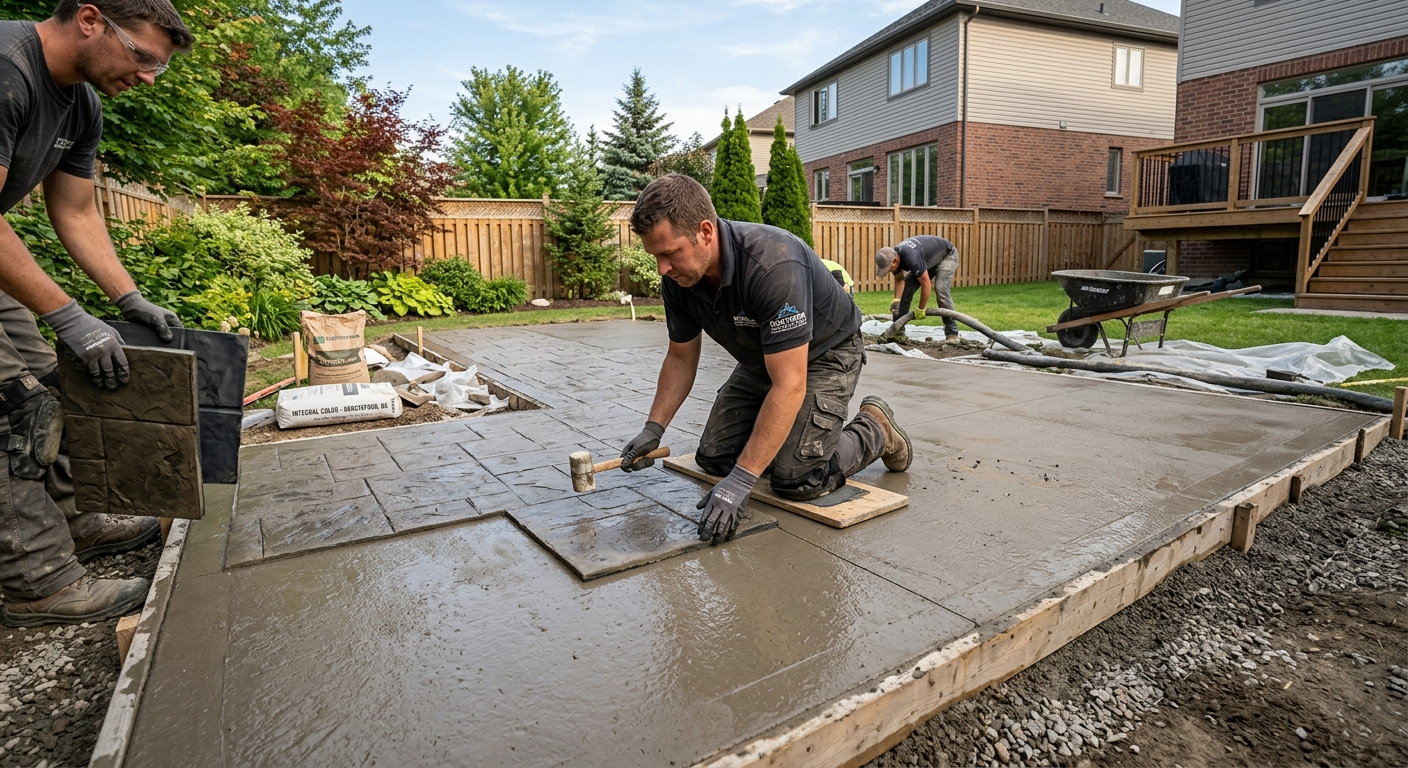
Concrete work options and costs in Langley
Langley homeowners typically choose concrete because it’s durable, easy to maintain, and well-suited to our Lower Mainland–Southwest freeze–thaw conditions when it’s built to the right spec. With single-detached houses making up 21.3% of dwellings in the area and 62.9% of households owning their homes, the market here is steady for driveways, patios, walkways, and garage slabs. That demand is especially noticeable around Langley City and the popular family neighbourhoods near Willowbrook, where infill and renovations often include new flatwork for curb appeal and practical day-to-day use.
Pricing in Langley is shaped by our coastal-wet schedule and shallow-but-critical frost considerations. While we commonly design around a frost depth of about 450 mm / 18", footings and structural elements still need to sit below the design frost zone to reduce frost heave risk. Wet weather and cool nights can slow curing and scheduling, so contractors plan pours carefully, sometimes using curing blankets, sealers, and extended protection time. For exterior slabs, air-entrained mixes and correct base drainage matter—miss either and you’ll see scaling, surface deterioration, or earlier cracking.
Below is a practical comparison of common projects you’ll see quoted for Langley properties, so you can better judge whether an estimate is realistic—then we’ll break down what drives cost differences between bids.
| Application |
Typical Size |
Key Spec |
Finish Option |
Price Range |
| Concrete driveway (standard broom finish) |
400–600 sq. ft. |
Air-entrained exterior mix, compacted granular base, control joints |
Broom finish |
$9,000–$16,500 |
| Exposed aggregate driveway |
400–600 sq. ft. |
Air-entrained exterior mix, wash/expose process, proper curing window |
Exposed aggregate with integral stone |
$11,000–$19,000 |
| Stamped concrete driveway or patio |
300–500 sq. ft. |
Air-entrained exterior mix, release agent, integral or hardener color |
Stamp pattern + colour |
$12,000–$20,000 |
| Plain concrete patio or walkway |
200–400 sq. ft. |
Compacted granular base, jointing plan, exterior air-entrained mix |
Broom or light float |
$3,500–$8,500 |
| Garage floor (interior slab) |
400–650 sq. ft. |
6 mil vapour barrier, 32 MPa concrete, jointing |
Broom finish |
$6,500–$13,500 |
| Foundation footings (structural, below frost) |
Per project (typical 1,000–2,000 sq. ft. footprint) |
Excavate to design depth below frost, rebar cage as required by engineer |
Structural concrete with formwork |
$18,000–$35,000 |
Prices are estimates only and vary by project scope, site access and material selection.
What affects the price of concrete work in Langley
If you get two quotes for what sounds like the same concrete job in Langley, it’s not unusual to see a 30–50% swing across the Lower Mainland–Southwest and other parts of British Columbia. The biggest reasons aren’t “brand” differences—they’re the specs contractors include for frost protection, base preparation, air-entrainment, reinforcement, and curing in a coastal-wet climate. In our area, exterior flatwork must be built to handle frequent freeze–thaw cycles and saturated soils, so contractors often price the job based on the total system: excavate, compact granular base, correct drainage, and then place air-entrained concrete with the right jointing and curing plan.
Frost depth and freeze–thaw cycles dictate every spec: footings must extend below the design frost depth (roughly 0.5–1.2 m in coastal BC, and typically around 450 mm / 18" in design practice with engineered adjustments as required) to prevent frost heave. Exterior slabs also need air-entrained concrete to survive repeated wetting and cooling. In colder regions with shorter pour seasons, cold-weather precautions—heating, insulated blankets, longer cure management—raise costs; in Langley, the trade-off is that scheduling can still be affected by prolonged rain, high humidity, and cool nights, which means crews may extend cure protection to reach design strength before removing forms and allowing traffic. De-icing salts can accelerate surface spalling if the concrete isn’t built for durability, so sealing is often recommended.
Two common examples: (1) A “plain” patio can start around the typical patio band of $16–$26 per sq. ft., but adding engineered drainage and thicker thickened edges may raise the price—often justified if water runs toward the slab. (2) A stamped driveway may land in the stamped band of $22–$36 per sq. ft., and the cost is usually worth it only when the base and jointing are done right; otherwise, the finish won’t hide early cracking. With older housing stock—38.1% of homes built before 1981—Langley often has more retrofit constraints (tight access, buried services, uneven grades), which can add excavation, haul-away, and rework time and push estimates upward by several thousand dollars.
| Price Factor |
Why It Matters |
Cost Impact |
| Frost line depth — determines footing depth and form height |
Controls how deep excavation and concrete placement must go to prevent frost heave. |
Major: changes excavation volume and formwork height; can swing total foundation/footing cost significantly. |
| Site preparation — excavation, grading, compacted granular base |
Base compaction and grading govern long-term settlement and cracking risk. |
Major: more haul-off, subgrade correction, or deeper base lifts price. |
| Reinforcement — rebar or wire mesh requirement |
Improves slab/footing capacity and crack control where design calls for it. |
Moderate to major: depends on engineer/structural requirements and bar layout complexity. |
| Mix design — air-entrainment and compressive strength spec |
Air-entrainment supports durability through freeze–thaw and wetting cycles. |
Moderate: specialty mix and higher-strength specs increase material cost. |
| Finish type — broom vs. stamped vs. exposed aggregate |
Finishes add labour steps, materials, and longer finishing/curing coordination. |
Moderate to major: stamped/exposed typically costs more per sq. ft. |
| Pour size and concrete truck access to site |
Access affects pumping, line distance, and crew productivity. |
Moderate: tight sites may require pumping and extra labour. |
| Cold-weather curing precautions — heating and blankets |
Protects concrete during cool nights so it reaches design strength. |
Moderate: adds equipment and crew time when conditions are marginal. |
| Control joint pattern and sealing cost |
Jointing limits random cracking; sealing helps repel de-icing salts and reduces surface scaling. |
Small to moderate: depends on sealing timing, product choice, and number of joints. |
Permits & regulations in British Columbia
In British Columbia, structural concrete work needs proper oversight. If your project involves foundation elements—such as concrete footings, foundation walls, grade beams, retaining walls, and other structural components—expect to need a building permit and often engineered drawings that are reviewed by the municipality. For concrete flatwork (patios, walkways, driveways), a permit is frequently not required unless the work affects lot grading, drainage patterns, impervious surface coverage limits, or ties into a municipal right-of-way (for example, where work intersects a lane/driveway approach requiring municipal approval).
For Langley homeowners, a practical approach is to confirm requirements with the City of Langley (or your local authority) before breaking ground—especially if you’re changing elevations, redirecting downspouts, or modifying drainage. Also verify the contractor’s coverage: liability insurance and WSIB/WCB coverage for workers. Don’t rely on verbal assurances.
To check before you sign, follow these steps: (1) Ask the contractor for a current certificate of insurance (COI) and a clearance letter or proof of WSIB/WCB account status; review the policy expiry dates. (2) Verify their business registration and whether the work scope matches their trades coverage (you can confirm commonly through provincial/registered-business search tools). (3) Request references for similar projects in the Lower Mainland—driveways and foundation/footing work done locally will be familiar with frost-protection practices and rain scheduling. If anything is vague, treat it as a red flag and keep looking.
Getting concrete right in Langley's freeze-thaw climate
In Langley, concrete failures usually come from one of five weak links: insufficient base support, poor drainage, the wrong concrete mix for the freeze–thaw cycle, inadequate control jointing, or curing that’s rushed. Our Lower Mainland–Southwest climate is “mild” compared to northern BC, but it’s still wet and it still cycles through temperature swings that can pump moisture under slabs. The result can be scaling, spalling, and premature cracking if the system isn’t specified correctly.
To spec the job right, start with base preparation: excavate to the correct depth for the local soil and design frost considerations, then place compacted granular base to reduce water and movement. Next, require an air-entrained exterior concrete mix—typically 5–7% air content for exterior flatwork—so the paste can tolerate freeze–thaw stresses. For structural and durable flatwork, also require at least 32 MPa compressive strength. Third, plan control joints early and space them to limit random cracking. Fourth, curing matters: protect and cure for at least 7 days under appropriate conditions; in cool or damp weather, crews often use blankets or seal protection and extend timelines. Finally, sealing helps with de-icing salts and surface durability: apply a penetrating sealer after the proper cure window (commonly after about 28 days).
If you’re deciding between a standard broom driveway and a finish like exposed aggregate, you can justify the added cost when the contractor is proposing the same correct base, joints, and curing. For example, exposed aggregate may run roughly $22–$36 per sq. ft. in the stamped/decorative range, but if the base prep and air-entrainment spec are identical to the standard broom mix, you’re paying for appearance—not shortcuts. If the cheaper quote skips compaction, jointing, or mix requirements, that “savings” often disappears the first time winter hits with heavy rain followed by cold nights.
| Spec |
Why It Matters in Langley |
What to Ask For |
Impact if Skipped |
| Compacted granular base (depth?) |
Reduces settlement and prevents water from sitting beneath the slab during freeze–thaw cycles. |
Exact base thickness to design; compaction method and moisture conditions |
Uneven slabs, early cracking, and moisture-driven deterioration |
| Air-entrained concrete mix (target air %?) |
Air voids protect the concrete’s paste from freeze–thaw scaling and spalling. |
Target air content (commonly 5–7% for exterior flatwork) and proof of mix type |
Scaling, pop-outs/spalling, surface roughening |
| Compressive strength (MPa rating) |
Supports long-term durability and early strength development for traffic and curing schedule. |
Minimum 32 MPa mix and planned curing/strength timeline |
Reduced capacity and higher risk of premature damage |
| Control joints (spacing per ACI guidelines) |
Controls where cracks happen, preventing random cracking that can open paths for water. |
Joint spacing and layout drawing; sawcut timing |
Random cracking, water ingress, and faster deterioration |
| Minimum 7-day curing period |
Ensures the concrete reaches proper early strength and resists early surface problems. |
Curing method (blankets/sealer) and minimum protection days in cool/wet weather |
Weak surfaces, increased cracking, and lower durability |
| Penetrating sealer (when applied after cure) |
Helps repel de-icing salts and reduces moisture absorption that drives freeze–thaw damage. |
Sealer type and timing after cure (commonly around 28 days) and surface prep method |
Faster staining and surface scaling, especially near edges and joints |
How to choose a concrete work contractor in Langley
Choosing a concrete contractor in Langley comes down to verifying coverage, getting detailed written quotes, and making sure the scope matches what we need for our freeze–thaw climate. Start by confirming British Columbia coverage: ask for liability insurance (COI) and proof of WSIB/WCB coverage for the workers who will be on site. Then check the certificate details—look at policy expiry dates and ensure the name matches the contracting company. If you can, request recent certificates and clearance letter proof rather than “old documents.”
Next, get 2–3 itemised written quotes. A good quote breaks labour and materials out clearly (excavation/base prep, reinforcement, concrete supply, finishing, sawcutting/jointing, sealing, and disposal/haul-away). Avoid a quote that only gives one lump sum without explaining what’s included. Also ask whether permits are included if required, and confirm what the contractor excludes (for example, unlisted excavation conditions, utility locating, or subgrade repairs).
Warranty is important for concrete. Ask for the workmanship warranty length, what it covers (cracks at joints vs. surface scaling), whether it’s backed by a product/material warranty for admixtures or sealers, and whether warranties are transferable if you sell the home. Keep the payment schedule controlled: never pay more than 10–15% upfront; hold back a portion until forms are removed, final grade is restored, and the job meets the agreed finish and protection steps. Finally, require a timeline in writing—start date and practical completion estimate based on weather.
- Request current COIs and WSIB/WCB proof before scheduling.
- Confirm they’ve completed similar driveway/patio work in Langley or the Lower Mainland–Southwest.
- Get an itemised quote with line items for base prep, reinforcement, concrete supply, finishing, sawcut joints, and sealing.
- Ask who handles disposal/haul-away and whether it’s included.
- Clarify whether utility locating is included and who coordinates it.
- Confirm the air-entrained exterior mix and the target air content.
- Ask for minimum compressive strength (e.g., 32 MPa) and curing method.
- Check joint spacing and sawcut timing in the scope.
- Ask how rain days are handled (blankets/temporary protection plan).
- Ensure you’re getting sealing details: product type and timing after cure (often ~28 days).
- Review payment schedule and keep a holdback until completion and cleanup are verified.
- Require a written start date and completion window tied to weather contingencies.
Concrete red flags I see in Langley include quotes that skip base thickness or compaction details, contractors who won’t commit to air-entrainment and joint spacing, vague curing promises (“it will be fine”), unrealistic timelines that ignore cool nights/rain, and payment terms asking for large upfront deposits without a clear completion checklist.
Frequently asked questions — concrete work in Langley
What is rebar and when is it required in British Columbia?
Rebar (reinforcing steel bars) is steel embedded in concrete to add tensile capacity where concrete alone isn’t strong enough. In British Columbia, when rebar is required depends on the engineered design and the type of element. For structural items—such as foundation footings, foundation walls, grade beams, and many retaining walls—rebar is commonly specified by structural drawings, particularly where loads and bending stresses exist. For exterior flatwork like driveways and patios, reinforcement may be used for crack control in larger slabs or where the slab design calls for it, but the correct decision is based on thickness, soil support, and project requirements.
If you’re in Langley and your home is older (38.1% of homes built before 1981), you may also see retrofit constraints that affect reinforcement layouts. Ask your contractor to provide the slab thickness, whether mesh is used vs. rebar, and whether there are any engineered drawings for your specific scope.
How long does a concrete project take in Langley?
In Langley, timelines depend heavily on weather, base preparation, and curing protection. For typical exterior flatwork, the “active” work—excavation, forms, placing base, pour day finishing, and sawcut planning—might take 1–3 days depending on size and access. The concrete also needs curing protection: plan on at least 7 days of curing before you treat the slab like a full-use surface. If conditions are cool or it’s rainy, contractors may extend protection with curing blankets or seal strategies to reach design strength before opening the area fully.
Garage floors and interior slabs often follow a similar pattern for curing, though access and weather disruptions are usually less. If you’re comparing options, stamped or exposed aggregate work can take longer on the finishing side; the material band may be higher (for instance, stamped/decorative often ranges from $22–$36 per sq. ft.), but that isn’t just “more concrete”—it’s more finishing steps and tighter timing. The key is to get a written start date and completion estimate that includes weather contingency.
What is a concrete overlay and is it suited to Langley?
A concrete overlay is a bonded or mechanically prepared layer placed over an existing concrete slab to improve surface condition or change appearance without removing everything. In Langley, overlays can be suitable in some situations, especially when the original slab is structurally sound and the main issue is surface wear (pitting, minor scaling, or uneven appearance). However, overlays are not a fix-all for major settlement, deep cracking, or drainage problems. Because our climate still has freeze–thaw cycling and saturated conditions, trapped moisture at the interface can cause failure if the original slab has water pathways or poor drainage.
Before choosing an overlay, ask for a condition assessment: check for delamination, spalling, active cracks, and whether slope/drainage toward the house is improved. If the slab has significant movement, removal and re-pour is often the more durable approach. If you’re considering options for flatwork, compare total long-term value rather than only the immediate cost band for a new pour.
How do I seal concrete to protect it in Langley?
Sealing in Langley is mainly about reducing moisture and protecting against de-icing salt impact. For exterior slabs, the standard approach is to use a penetrating sealer that helps repel water at the surface and reduces salt-driven deterioration. Timing is critical: most reputable contractors apply sealer after the concrete has cured properly—commonly after about 28 days—so the surface is ready to accept the product without trapping moisture.
Before sealing, the slab should be cleaned and allowed to dry fully. High humidity and cool nights in the Lower Mainland–Southwest can slow drying, so contractors may schedule sealing based on weather windows. Ask your contractor what type of sealer they use, how they prep the surface, and whether they recommend reapplication after a certain period. If you’re budgeting, sealing is a meaningful add-on cost, but it can extend the useful life of driveways and patios—especially near joints and edges where water and salts collect.
What is the difference between concrete and cement?
Cement is an ingredient; concrete is the final building material. Cement (usually Portland cement) is one component that binds everything together. Concrete is cement mixed with water, fine aggregate (sand), coarse aggregate (gravel/crushed stone), and sometimes admixtures—like air-entrainment for freeze–thaw durability and plasticizers for workability.
For Langley exterior flatwork, the practical difference matters because the mix design is what determines performance in our freeze–thaw climate. A contractor might say “we use quality cement,” but what you need to confirm is whether the concrete mix is air-entrained and meets minimum compressive strength requirements. That’s why two quotes that look similar on paper can still differ in durability—one may include an air-entrained exterior spec and correct curing plan, while another may not.
If you’re comparing costs, remember that decorative work bands (for example, stamped concrete often falls around $22–$36 per sq. ft.) are driven by finishing labour and materials too, not just “cement type.”
How much does concrete work cost in Langley?
Concrete pricing in Langley depends on slab size, thickness, base preparation, reinforcement, finish type, and site access. For planning purposes, driveway and patio numbers move around the common local bands in the Lower Mainland–Southwest. A concrete driveway typically lands around $18–$28 per sq. ft. for standard work, while a plain patio/walkway often starts around $16–$26 per sq. ft. Decorative options cost more: stamped & decorative concrete frequently falls in the $22–$36 per sq. ft. range because labour and materials are higher.
In Langley, cost can also rise when retrofitting older properties (38.1% built before 1981) requires extra excavation, drainage correction, or haul-away. Our wet coastal schedule can add curing protection time, and exterior work often needs air-entrained mixes and good control jointing. If you share your approximate square footage and whether it’s driveway vs. patio vs. foundation/footings, you’ll usually get a much tighter range from itemised quotes.