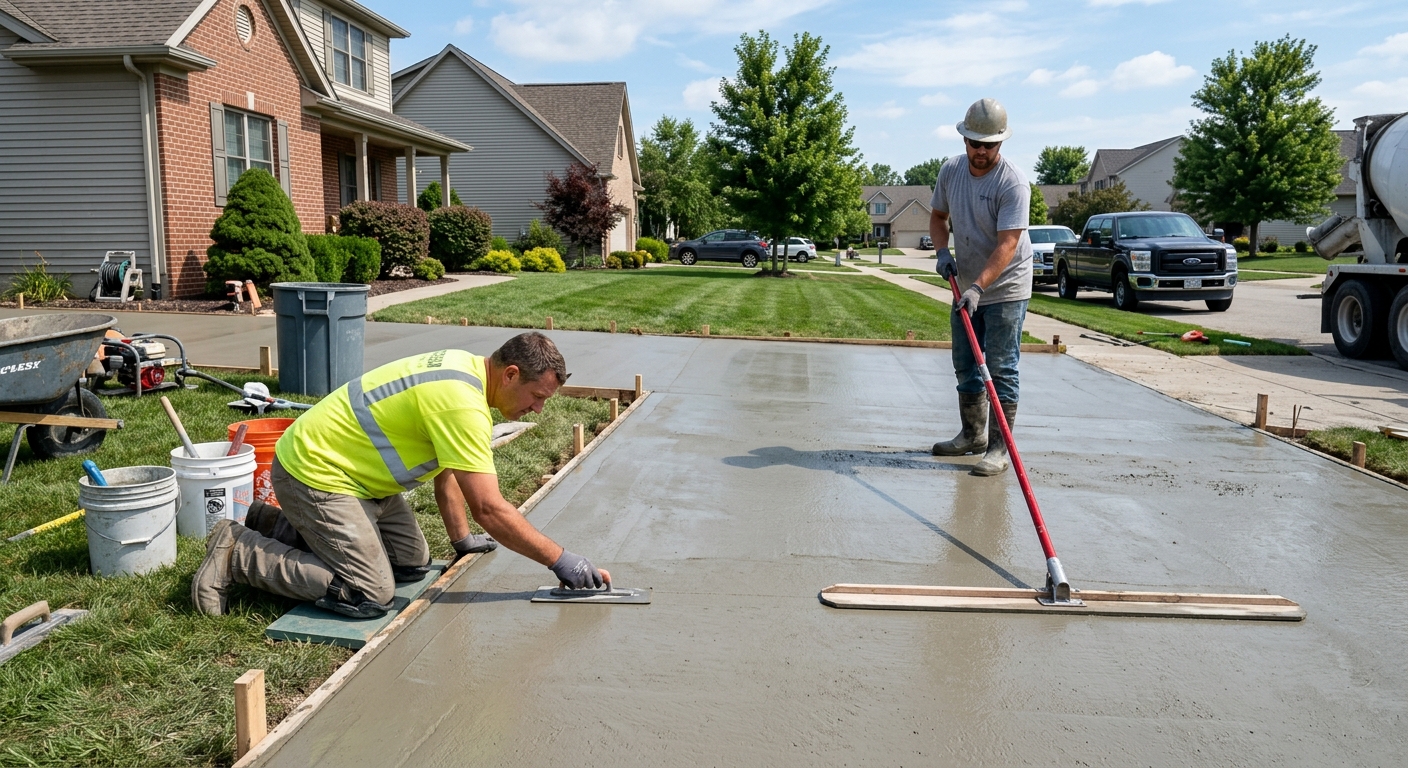
Concrete work options and costs in Ellison
Concrete work in Ellison is mostly about building durable flatwork for a coastal-wet climate and a shallow-but-active frost line. Ellison’s population was 3,094 in the 2021 Census (Statistics Canada, 2021 Census), and the local housing pattern is dominated by single-family living—driving steady demand for driveways, patios, walkways, and foundation-related concrete. In the Lower Mainland–Southwest, mild winters help, but freeze–thaw cycles and persistent rainfall still raise the bar for drainage, base prep, and mix design. Contractors price concrete accordingly because exterior slabs and footings need air-entrained concrete, properly compacted granular base, and correctly located control joints to manage cracking and surface scaling over time.
Where costs can swing is job scheduling and curing quality. Even with milder temperatures, cool nights, high humidity, and wet weather can slow strength gain, so crews often plan around prolonged rain and use curing blankets and longer cure times. The Lower Mainland–Southwest also has a design expectation of frost depth around 450 mm / 18", so exterior footings and thickened edges are typically placed below that depth to reduce frost heave risk. If you’re in an area of Ellison with ongoing infill and ongoing homebuilding activity—such as the Ellison / Metchosin-side rural pockets where access and hauling routes can vary—expect trades to prioritize sites with clear truck access and good drainage.
Below are realistic price bands homeowners see in Ellison, transitioning into quick comparisons by application and finish.
| Application |
Typical Size |
Key Spec |
Finish Option |
Price Range |
| Concrete driveway (standard broom finish) |
400–600 sq. ft. |
Reinforced slab; compacted granular base; air-entrained exterior mix |
Broomed texture, basic jointing |
$7,200–$14,500 |
| Exposed aggregate driveway |
400–600 sq. ft. |
Proper surface retarder and base compaction; air-entrained mix |
Exposed stone with sealer |
$10,800–$20,200 |
| Stamped concrete driveway or patio |
300–500 sq. ft. |
Reinforced slab; air-entrained exterior mix; textured release & curing plan |
Stamped pattern + color |
$9,200–$18,800 |
| Plain concrete patio or walkway |
200–400 sq. ft. |
Compact base; air-entrained exterior mix; jointing |
Float/screed finish with light broom |
$3,200–$9,800 |
| Garage floor (interior slab) |
400–600 sq. ft. |
Vapour barrier where required; reinforced slab; controlled joints |
Light broom or trowel-finish (varies by spec) |
$8,000–$15,800 |
| Foundation footings (structural, below frost) |
Per linear foot (typ.) |
Excavation to design frost depth (~450 mm/18" concept, typically deeper below grade); rebar; engineered forming |
Structural concrete (no decorative finish) |
$300–$550 |
Prices are estimates only and vary by project scope, site access and material selection.
What affects the price of concrete work in Ellison
In Ellison and the broader Lower Mainland–Southwest, you’ll often see the same “concrete driveway” described three different ways—and that’s why quotes can vary by 30–50% even when the square footage looks similar. Concrete isn’t just a material; it’s a sequence: excavation, base prep, reinforcement placement, mix design (especially air-entrainment), finishing, and curing. In British Columbia’s mild coastal conditions, contractors still design for freeze–thaw durability, and that means specs that aren’t optional for exterior slabs. Lower Mainland pricing also reflects availability of crews who can schedule around rain and still deliver proper cure times.
Frost line depth and freeze–thaw cycles dictate many of the structural and performance specs. Footings must extend below the design frost depth (the Lower Mainland practice commonly targets around 450 mm / 18" as a reference concept, with actual footing depth determined by soil and drainage conditions) to help prevent frost heave. All exterior slabs require air-entrained concrete mixes to manage freeze–thaw scaling and surface deterioration. Colder regions often need deeper excavations and cold-weather curing precautions (heating/blankets), which increases excavation and labour—so costs rise moving away from the Lower Mainland; however, in Ellison, the rainfall and saturation risk still adds cost through drainage detailing and longer curing windows.
Here are a few local examples of how Ellison conditions change costs. If your driveway needs more grading and subgrade correction due to saturated soils, base prep expands and the project can move from the “$18–$28” per sq. ft. driveway band toward the higher side. If you choose stamped concrete instead of a broom finish, the finish and labour complexity often justifies the “stamped & decorative” band; a typical stamped driveway or patio can land in the mid-to-high range versus a simpler plain patio/walkway. If your site requires longer pumping or truck access work (tight rural access routes), labour and scheduling time increase too, without changing the pour size.
| Price Factor |
Why It Matters |
Cost Impact |
| Frost line depth — determines footing depth and form height |
Deeper footings and thicker bases reduce heave risk |
Higher excavation and forming; often a major driver in winter-adjacent conditions |
| Site preparation — excavation, grading, compacted granular base |
Correct base thickness and compaction prevent settlement and premature cracking |
Unexpected removal/replacement can add labour and material costs |
| Reinforcement — rebar or wire mesh requirement |
Helps control crack widths and improves slab performance |
Adds material and placement time, especially for larger flatwork |
| Mix design — air-entrainment and compressive strength spec |
Air entrainment is crucial for freeze–thaw durability |
May raise material cost but reduces long-term surface spalling risk |
| Finish type — broom vs. stamped vs. exposed aggregate |
Finishes affect labour time, materials, and curing control |
Stamped/exposed options typically sit well above basic finishes |
| Pour size and concrete truck access to site |
Access determines pump/mini-mixer need and crew time |
Pumping, waiting on traffic, and additional manpower can increase totals |
| Cold-weather curing precautions — heating and blankets |
Ensures strength gain when nights are cool |
Extra blankets/heating time can raise labour and scheduling cost |
| Control joint pattern and sealing cost |
Joints manage shrinkage cracking; sealing helps repel de-icing salts |
More sawcuts/seasonal sealing can add line-item cost |
Permits & regulations in British Columbia
In British Columbia, structural concrete work—such as footings, foundation walls, and grade beams—typically requires a building permit and often engineered drawings that the municipality reviews before work starts. For concrete flatwork like driveways, patios, and walkways, a permit is usually not required by default, but it can be required if the work affects lot grading, stormwater management, or impervious surface coverage, or if it impacts a local right-of-way. Because rules can vary by situation, always confirm with the local authority before digging.
For contractor verification in Ellison, ask for documentation before any formwork or excavation:
- British Columbia contractor licensing/registration: check the provincial registry online under the contractor’s legal business name.
- Liability insurance: request a current certificate of insurance (COI) showing the insured party, coverage limits, and jobsite validity.
- WSIB/WCB coverage: in BC, ensure workers are covered through the correct workplace coverage channel; ask for confirmation in writing.
- Clearance/standing letter: if requested, ask for current proof of coverage status.
- References: verify at least 2–3 recent projects of similar scale (exterior flatwork and, if applicable, structural work).
Then, match your project scope to the permit requirement—structural concrete is the category that most often triggers municipal involvement.
Getting concrete right in Ellison's freeze-thaw climate
Concrete failures in Ellison usually trace back to water and temperature working together: saturated soils, freeze–thaw cycles, and insufficient base preparation or mix design. When exterior slabs don’t have an adequate compacted granular base, or when drainage is weak, water migrates under the slab. Freeze–thaw then expands and contracts that moisture, stressing the concrete surface and contributing to cracking and spalling. Specifying for durability is how you prevent it.
To get the job right, the spec should include: (1) base preparation with a compacted granular sub-base to the depth required by local soil and frost considerations; (2) mix design with air-entrainment—commonly 5–7% air for exterior flatwork—and a minimum 32 MPa compressive strength; (3) control joints cut or tooled to a spacing strategy that limits random shrinkage cracking; (4) curing with a minimum 7 days under proper conditions (longer when it’s cool and humid); and (5) sealing—typically a penetrating sealer applied after cure (often around 28 days post-pour) to repel de-icing salts and reduce moisture ingress.
Ask the contractor how they’ll manage cool nights and rainfall. In Ellison’s Lower Mainland–Southwest climate, crews often plan to protect the slab after finishing with curing blankets or sealers where appropriate. A concrete example of value: a stamped driveway costs more than broom-finished concrete because of additional labour, materials, and tighter timing. If the base prep and air-entrainment are properly done, that extra cost is justified by both appearance and long-term durability; however, if corners are cut on air content or curing, you can end up paying again due to scaling and surface failure—often destroying the look you paid for. For a homeowner comparing finish options, remember that a plain patio/walkway in the basic band may look “cheaper,” but the same durability specs should still be included.
| Spec |
Why It Matters in Ellison |
What to Ask For |
Impact if Skipped |
| Compacted granular base (depth?) |
Stable support reduces settlement and cracking in wet soils |
Base thickness and compaction method tied to site conditions and drainage |
Cracking, uneven settling, early surface breakdown |
| Air-entrained concrete mix (target air %?) |
Freeze–thaw durability depends on proper air content |
Air-entrainment target of 5–7% for exterior flatwork; confirm mix design |
Spalling/scaling even if the slab “looks fine” at first |
| Compressive strength (MPa rating) |
Ensures adequate strength development for exterior exposure |
Minimum 32 MPa specified for the flatwork/structural scope as applicable |
Surface damage, reduced abrasion resistance, faster deterioration |
| Control joints (spacing per ACI guidelines) |
Controls where cracks happen so they don’t become random |
Joint spacing plan and timeline for sawing/finishing |
Random cracking patterns and wider crack openings |
| Minimum 7-day curing period |
Cool nights and humidity can slow strength gain |
How curing will be protected (blankets/sealer) when conditions are wet/cool |
Reduced strength, increased risk of scaling and early failure |
| Penetrating sealer (when applied after cure) |
Moisture and de-icing exposure increase surface wear |
Penetrating sealer after full cure (often around 28 days); confirm product type |
Higher moisture ingress, staining, and faster surface aging |
How to choose a concrete work contractor in Ellison
Choosing the right concrete contractor in Ellison comes down to verification, scope clarity, and proof that they build for freeze–thaw durability—not just appearance. Start by confirming British Columbia licensing/registration for the contractor’s legal business name, then request a current certificate of insurance showing general liability for the project scope. For workplace coverage, ask for confirmation of WSIB/WCB coverage status (and current proof where applicable). Don’t rely on verbal assurances—ask for documents before the pour date.
Next, get 2–3 itemised written quotes. You want a breakdown that separates labour and materials (concrete supply, rebar/wire mesh, base prep, sawcutting, formwork), rather than a single lump sum with unclear inclusions. Read the exclusions carefully: is demo and disposal included? Is permit pulling included if structural work triggers it? Who handles any required drainage adjustments? The best quotes will specify what’s in and what’s out—especially around excavation depth, base thickness, reinforcement type, and finishing and curing methods.
Warranty matters too. Ask for a workmanship warranty length and whether it covers cracking, scaling, or settlement issues. Product/manufacturer warranty for coatings or sealers should also be documented, and ask whether it’s transferable to future owners. For payment, never pay more than 10–15% upfront; use a progress holdback until the job is complete and the slab is properly cured. Finally, get a written start date window and completion estimate that accounts for weather and curing needs.
- Verify the contractor’s BC registration/licence using the legal business name.
- Request a certificate of insurance (COI) for your job address/scope.
- Confirm workplace coverage status in writing before work starts.
- Demand itemised quotes (labour vs. materials) with quantities and unit rates.
- Check that excavation depth and granular base thickness are stated.
- Confirm air-entrained mix is required for exterior work.
- Ask what reinforcement is used (rebar/wire mesh, spacing, coverage).
- Require a control joint plan (spacing and sawcut timing).
- Ask how they protect curing during cool nights and wet weather.
- Clarify sealer type and timing (typically after cure) if included.
- Confirm demo/disposal, haul-away, and any grading/landscaping exclusions.
- Use a payment schedule with a holdback until completion and cleanup.
Concrete contractor red flags in Ellison include: vague scope details (especially on base depth and air-entrainment), refusal to provide COI/coverage proof, missing jointing or curing timelines, quotes that ignore truck access and drainage adjustments, and demanding large upfront payments with no written completion date.
Frequently asked questions — concrete work in Ellison
How deep must footings be for Ellison's frost line?
In Ellison and across British Columbia’s coastal-wet zones, contractors design foundations to reduce frost heave by going below the effective frost depth for the site. While Lower Mainland–Southwest practice commonly uses a frost-depth reference around 450 mm / 18", the actual footing depth depends on soil conditions, drainage, and engineered foundation requirements. That’s why you’ll see footings quoted with excavation and formwork that can vary even on similar lots. If the job is structural, expect a building permit and potentially engineered drawings reviewed by the municipality. As a planning benchmark, footing work is often priced per linear foot; typical foundation/footings pricing is in the $200–$350 range for many scopes, but excavation complexity can raise the all-in number.
Why does concrete crack in Ellison and how is it prevented?
Concrete cracks in Ellison mainly due to shrinkage, temperature swings, and moisture movement through saturated subgrades. Freeze–thaw cycles don’t “cause all cracking,” but they can worsen the effects by stressing the surface and undermining support if drainage and base preparation aren’t correct. Prevention is about controlling where cracking happens: use the correct air-entrained exterior mix, provide compacted granular base, and install a proper control joint pattern early enough to guide shrinkage. Curing also matters—when it’s cool and humid, strength gain slows, so crews protect the slab and may extend the cure time beyond minimums. If you’re budgeting, remember that a broom-finished patio/walkway (often in the $16–$26 band) still needs the same durability steps, even if it doesn’t get decorative labour.
Stamped vs broom-finish concrete — cost difference?
Stamped concrete costs more than broom-finish because it involves additional materials (release agents, stamping tools, colour systems) and more labour/time during the finishing window. In the Ellison market, stamped & decorative work typically sits in the $22–$36 per sq. ft. band, while standard broom-finish concrete driveway work typically trends in the $18–$28 per sq. ft. range, assuming comparable slab thickness, base prep, reinforcement, and access. The key point: the “cheap” comparison isn’t just the finish. If a contractor cuts durability specs—like air entrainment, joints, or curing—the slab may fail regardless of whether it’s stamped. A well-done stamped driveway can justify the extra cost if the base and freeze–thaw protection are fully specified and executed.
When is the best time to pour concrete in Ellison?
The best time to pour in Ellison is when you can control rain exposure and finish/curing conditions. Lower Mainland–Southwest winters are mild compared with interior and northern BC, but prolonged rainfall, cool nights, and high humidity still slow curing and can increase risk if the slab can’t be protected. Contractors often schedule pours for stretches with stable weather, then plan for curing blankets/sequencing so the concrete reaches strength before surface exposure. If you’re aiming for exterior flatwork, ask the contractor how they protect slabs during wet/cool conditions and how they’ll schedule around short-notice weather changes. For homeowners, that means confirming the pour date window in writing and understanding that a “slab cure time” affects when you can use the driveway or patio—even if the forms come off earlier.
How long does concrete take to cure?
Concrete develops strength quickly, but it doesn’t reach full durability right away. A common minimum is about 7 days of proper curing for many flatwork applications, but exterior performance and surface resilience improve as curing time increases under suitable temperature and moisture conditions. In Ellison’s humid, wet-prone climate, contractors frequently extend curing protection when nights are cool or when rain is likely. Sealing is often delayed until after cure—commonly around 28 days post-pour—so the sealer can penetrate and perform properly. If your scope includes a penetrating sealer, ask for the exact product and timing. Also, don’t plan traffic loading too aggressively: even if the slab is “hard,” early loading can compromise joints and surface integrity during the first week.
Do I need a permit for concrete work in British Columbia?
In British Columbia, it depends on what you’re building. Structural concrete work such as footings, foundation walls, and grade beams typically requires a building permit and may involve engineered drawings reviewed by the municipality. Concrete flatwork like patios, walkways, and driveways usually does not require a permit unless it affects lot grading, stormwater/drainage handling, impervious surface coverage limits, or the municipal right-of-way. Because these triggers can be site-specific in Ellison and across BC, confirm with the local authority before breaking ground. Regardless of permit needs, verify your contractor provides proper insurance and appropriate workplace coverage documentation. For your peace of mind, ask for the written scope, inclusions/exclusions, and whether permit responsibilities are included in their pricing.