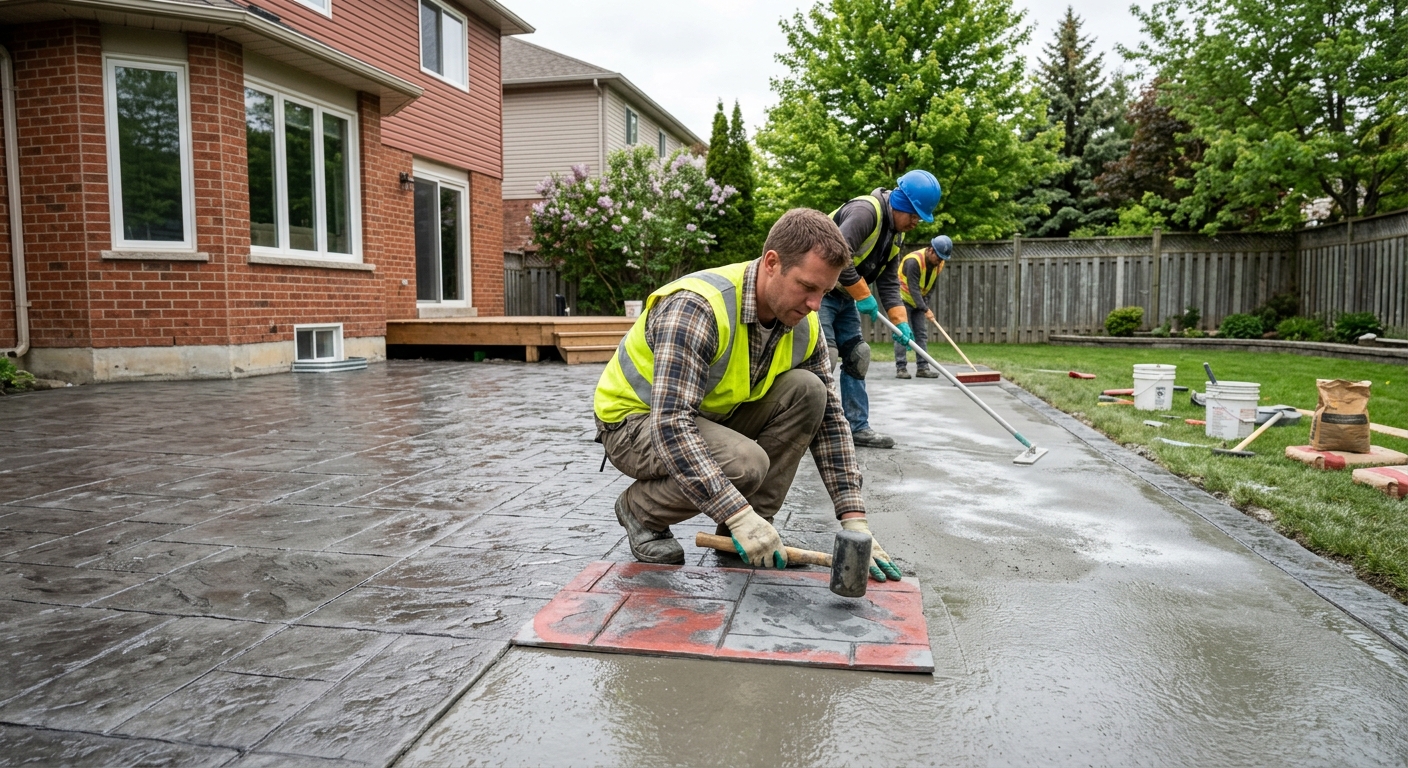
Concrete work options and costs in Promontory
In Promontory, concrete is one of the most reliable ways to get a clean, low-maintenance driveway, patio, and foundation surface—especially in a community of around 11,820 residents (Statistics Canada, 2021 Census). Most of the work demand comes from the area’s single-family housing stock, where owners typically want concrete that can handle Lower Mainland–Southwest weather swings: cool, wet periods, frequent freeze–thaw cycles, and a frost depth design approach that’s usually close to 450 mm / 18" before thickened edges and footings go deeper to prevent frost heave. In practice, that means the lower you build your base and subgrade preparation, the more your concrete budget gets squeezed by excavation depth, granular base quantity, and seasonal scheduling.
Because the Lower Mainland–Southwest market has a strong contractor bench in the Vancouver–Surrey–Abbotsford corridor, you can often find competitive pricing on standard broom-finish driveways and plain slabs. That said, Promontory jobs near busier streets or with limited access can still push costs up due to truck placement, wheelbarrow distance, and the time needed for forming and finishing. This is particularly in demand around residential pocket areas near major arterials where driveways, walkways, and patios are often planned alongside landscaping upgrades.
Below is a practical snapshot of typical options homeowners request most often, along with the specs that usually separate a low-cost pour from a long-lasting one. Use it as a starting point, then match the finish and structural requirements to your soil and drainage conditions before you compare quotes.
| Application |
Typical Size |
Key Spec |
Finish Option |
Price Range |
| Concrete driveway (standard broom finish) |
600–800 sq. ft. |
Typical 4" slab, air-entrained mix, control joints |
Broom finish |
$18,000–$28,000 |
| Exposed aggregate driveway |
600–800 sq. ft. |
Crushed stone exposure, air-entrained mix, light saw-cut joints |
Exposed aggregate |
$22,000–$34,000 |
| Stamped concrete driveway or patio |
400–700 sq. ft. |
Stamped mats, release agent, air-entrained mix, sealed after cure |
Stamps and colour hardener |
$26,000–$45,000 |
| Plain concrete patio or walkway |
200–450 sq. ft. |
4" slab, compacted granular base, control joints |
Broom or trowel finish |
$3,200–$10,000 |
| Garage floor (interior slab) |
400–600 sq. ft. |
4" slab, vapour barrier (as required), reinforcement if specified |
Smooth trowel / light broom |
$12,000–$21,000 |
| Foundation footings (structural, below frost) |
Per linear metre / small house size |
Excavate below design frost, form & pour, rebar per engineer |
Structural concrete |
$200–$350 |
Prices are estimates only and vary by project scope, site access and material selection.
What affects the price of concrete work in Promontory
In Promontory and across the Lower Mainland–Southwest, it’s common to see quotes for the “same” concrete job vary by 30–50%. The big reason is that concrete pricing is really a bundle of scope items—excavation depth, granular base thickness, reinforcement, mix design, and the time needed for proper curing—rather than just the square footage of finished slab. In one yard, a contractor may be excavating and forming for a shallow frost design; in another, saturated soil and poor drainage can force deeper base prep and additional subgrade work to keep the slab stable through freeze–thaw cycles.
Concrete specs are directly dictated by the frost line depth and climate. Even in coastal BC where the frost depth design may be relatively shallow (commonly 0.5–1.2 m in coastal BC), exterior slabs and thickened edges still need proper footing placement below the local design frost depth to reduce frost heave. For exterior flatwork, air-entrained concrete is essential to survive repeated wetting and freezing, and proper control joints are needed to manage shrinkage and temperature movement. If you’re pouring during cool, wet periods, cold-weather curing precautions—curing blankets, wind protection, and sometimes added heating—can add labour and equipment cost.
Local examples: if your driveway has steep grades or you have to rework drainage ditches, base prep can rise quickly. If you choose stamped concrete instead of broom-finish, the extra cost is usually justified by colour hardeners and labour-intensive finishing—especially when you’ll also be sealing the surface. As a reference point, standard driveways often land around the $18–$28 per sq. ft. band, while stamped & decorative options typically run closer to $22–$36 per sq. ft., depending on access and forming complexity. When you’re also dealing with older foundation conditions (common in renovated homes), expect additional excavation, patching, or reinforcement adjustments that can move your total budget by thousands of dollars.
| Price Factor |
Why It Matters |
Cost Impact |
| Frost line depth |
Footing depth and form height must be set below design frost to reduce heave |
Can raise costs significantly if excavation depth increases or shoring is required |
| Site preparation |
Excavation, grading, and compacted granular base determine slab stability |
More hauling/compaction time can add large labour and disposal costs |
| Reinforcement |
Rebar or mesh is required when loads, spans, or engineered designs call for it |
Material + installation time; complexity increases with obstacles |
| Mix design |
Air-entrainment and compressive strength specs protect against scaling and freeze–thaw damage |
Air-entrained and higher-spec mixes can add per-metre costs |
| Finish type |
Broom is straightforward; stamped/exposed aggregate require extra steps and labour |
Stamped/exposed often increases cost by the finish system and labour rate |
| Pour size and concrete truck access to site |
Smaller pours with long carry distances take longer to place and finish |
Queue time, extra crew time, and access equipment can add thousands |
| Cold-weather curing precautions |
Cool nights and high humidity slow strength gain and can threaten surface durability |
Heating/blankets and longer scheduling add labour and material overhead |
| Control joint pattern and sealing cost |
Proper jointing limits random cracking; sealing helps repel de-icing salts |
Saw-cut labour and sealer materials add cost, but reduce premature deterioration |
Permits & regulations in British Columbia
In British Columbia, structural concrete work—such as footings, foundation walls, grade beams, and other load-bearing concrete elements—typically requires a building permit, and engineered drawings are often reviewed by the municipality as part of the permit process. Concrete flatwork (patios, walkways, and driveways) usually does not require a permit on its own, but it can trigger review if it affects lot grading, drainage direction, or impervious surface coverage limits, and if any work touches municipal right-of-way areas (like approaches or sidewalk tie-ins). The safe approach is to confirm the requirement with the local authority before breaking ground, especially if you’re altering drainage, adding steps, or changing existing elevations.
For contractor accountability in Promontory, request the following before you sign: (1) proof the contractor is properly licensed for the scope they’re doing (where applicable for concrete/contracting activities), (2) general liability insurance (certificate of insurance showing your address/project), and (3) coverage for workers through WCB (WorkSafeBC). Then ask for references on similar-scale flatwork and foundation work in the Lower Mainland–Southwest.
Step-by-step for a homeowner: start with the contractor’s certificate of insurance (COI) and ensure it is current and names the project; verify their standing using online contractor/licence registries; confirm WCB coverage by requesting a clearance letter or WCB account verification; and finally, call one or two references and ask specifically about freeze–thaw performance (scaling, joint condition, and curing quality).
Getting concrete right in Promontory's freeze-thaw climate
Promontory’s concrete failures are usually about moisture movement and durability—especially during winter rain, cool temperatures, and freeze–thaw cycles. The most common issues I see are surface scaling and spalling, which often trace back to inadequate air-entrainment, poor curing, or a weak/undrained base that lets water sit under or within the slab. To spec the job correctly, start from the ground up.
(1) Base preparation: compacted granular sub-base should be to the right depth for your local soils and the frost-design requirements for exterior work. If drainage is poor, you can have the right mix and still get problems because water migrates into the slab/base. (2) Mix design: for exterior flatwork, specify air-entrained concrete with a target air content around 5–7% and a minimum compressive strength of 32 MPa (unless engineering specifies higher). (3) Control joints: plan saw-cut joints to manage cracking locations; random cracking looks bad and can become a pathway for water. (4) Curing: aim for a minimum 7-day curing period under proper conditions; in cool, damp weather, curing blankets or sealers and scheduling matter more. (5) Sealing: apply a penetrating sealer after full cure (often around 28 days) to help repel de-icing salts and reduce water absorption.
A price example that’s often worth it: if a broom-finish driveway quote comes in at the $18–$28 per sq. ft. band, adding a proper base, air-entrained mix, and a tight joint plan may be a relatively small percentage versus switching to stamped concrete, which typically runs closer to the $22–$36 per sq. ft. band. If the contractor is cutting corners on the “foundation” of durability, the cheaper finish won’t stay attractive for long.
| Spec |
Why It Matters in Promontory |
What to Ask For |
Impact if Skipped |
| Compacted granular base (depth?) |
Water retention and frost movement increase when base is thin or poorly compacted |
Confirm granular thickness and compaction requirements; how drainage is handled |
Settlement, cracking, and accelerated freeze–thaw damage |
| Air-entrained concrete mix (target air %?) |
Air bubbles give protection during freeze–thaw cycles in coastal-wet winters |
Target air content (typically 5–7% for exterior flatwork) and supplier documentation |
Higher risk of spalling and scaling |
| Compressive strength (MPa rating) |
Strength gain supports durability and reduces surface deterioration |
Minimum 32 MPa (or higher if required by design) and curing plan |
Weaker surface, dusting, and premature wear |
| Control joints (spacing per ACI guidelines) |
Limits uncontrolled cracking that can leak water into slab edges |
Joint spacing and timing (when saw cuts will occur after placement) |
Random cracks, staining, and joint-edge deterioration |
| Minimum 7-day curing period |
Cold nights and humidity slow strength development in Promontory’s climate |
How they maintain cure conditions; curing blankets/sealer where needed |
Reduced strength and poor long-term surface durability |
| Penetrating sealer (when applied after cure) |
Helps reduce water and de-icing salt absorption during winter cycles |
Confirm sealer type and application timing (commonly after ~28 days) |
Higher staining, scaling risk, and faster surface deterioration |
How to choose a concrete work contractor in Promontory
Choosing the right concrete contractor in Promontory comes down to verifying three things: credentials, scope clarity, and how they protect the slab from our wet-cold freeze–thaw reality. Start with British Columbia coverage: ask for their certificate of insurance for general liability and make sure it covers your project address. Next, confirm they carry WorkSafeBC (WCB) coverage—request a clearance letter or account verification. Licensing depends on the type of contracting work, so check their standing through the appropriate online registries for the activities they’re performing, and ensure they can legally provide the service you’re hiring.
Then get 2–3 itemised written quotes. You want a breakdown that separates labour from materials (concrete supply, reinforcement, formwork, saw cutting, disposal, and sealing) rather than a single lump sum. Scope questions matter: is the permit pull included if structural work requires it? Is excavation disposal included? What’s excluded—topsoil, driveway approach tie-in, landscaping restoration, or neighbour fence protection? A contractor who can’t clearly explain these is guessing, and guessing is what leads to budget creep and weaker specs.
Warranty matters too: ask for the length of workmanship warranty and whether it’s transferable to future owners. For payment, never pay more than 10–15% upfront; hold back a portion until the job is complete and surfaces cure properly. Finally, request a written start date and completion timeline.
- Ask for mix design documentation (air-entrainment and strength target) for exterior work.
- Confirm footing/slab depth assumptions relative to frost protection and drainage.
- Ensure the quote includes compacted granular base and compaction testing if they do it.
- Verify reinforcement details (mesh vs rebar, placement height, and tie/wrap method).
- Get the joint plan: where joints go and when saw cuts will be made.
- Ask about cold-weather curing (blankets, wind protection, and scheduling buffer).
- Confirm sealing scope (type of sealer and when applied after cure).
- Check whether disposal/hauling is included in the excavation line items.
- Request details on truck access and whether they allow time for staging and placement.
- Get proof of insurance limits and WCB coverage before work begins.
- Ask how they protect landscaping, sidewalks, and neighbouring properties during forming.
- Confirm what “finish option” means for your quote (broom vs stamped vs exposed aggregate).
Concrete red flags in Promontory: (1) no clear air-entrainment/spec mention for exterior slabs, (2) joints are “optional” or scheduled weeks late, (3) they want most payment upfront with no holdback, (4) they dismiss drainage/base prep as “not necessary” in rainy sites, and (5) no written curing/sealing plan—especially if they’re pouring in cool or wet periods.
Frequently asked questions — concrete work in Promontory
What causes concrete to spall in Promontory winters?
Spalling in Promontory is usually a freeze–thaw durability problem. When water gets into the concrete surface or near-surface pores and then freezes, the internal expansion can pop off surface paste and aggregates. The biggest triggers are inadequate air-entrainment, poor curing, and letting the slab absorb moisture because the base/drainage wasn’t prepared correctly. In the Lower Mainland–Southwest, the frequent wet weather and cool nights mean concrete is repeatedly saturated, so surface protection matters. De-icing salts can worsen it by introducing chemical exposure, which is why sealing after cure is often important. If you’re seeing early scaling or flaking, ask your contractor what air content and curing method they used—and whether joints were cut and sealed on a proper schedule.
What is rebar and when is it required in British Columbia?
Rebar (reinforcing steel bars) is used to control cracking and add tensile strength where concrete alone isn’t enough—particularly for foundations, structural elements, and slabs designed to carry heavier loads. In British Columbia, the need for rebar is determined by the structural design and engineering requirements for your specific project. For foundations and footings (structural, below frost), engineered drawings typically specify rebar size, spacing, and placement. For exterior flatwork like patios and driveways, some jobs may use welded wire mesh or rebar depending on thickness, soil support, and load expectations (like vehicle weight). The key is that reinforcement must be installed at the correct height within the slab—not sitting on the ground. A good quote will describe what reinforcement they’re providing and why.
How long does a concrete project take in Promontory?
Timeline depends on size, access, and weather, but you can plan around placement and curing realities in Promontory. For a small patio, many crews can complete excavation, forms, steel/mesh, and pour in 1–2 days, with finishing on the same day as placement. However, curing time affects when you can use the surface: many contractors recommend protecting the slab from heavy traffic for at least a week, and full durability develops over weeks. Exterior pours in cold, wet periods often need extra protection like curing blankets, which can extend the overall schedule. A typical driveway project may take several days of site prep and finishing before full readiness—then sealing, if included, is done after cure. If you’re comparing quotes, ask whether they included winter work precautions and how long they allow between pour, finishing, and final protection.
What is a concrete overlay and is it suited to Promontory?
A concrete overlay is a new layer of concrete poured over an existing slab after preparation—often used to refresh worn surfaces without full demolition. It can be suited to Promontory when the original concrete is still structurally sound, properly bonded, and doesn’t have widespread base failure. The challenge in a freeze–thaw climate is trapping moisture: if water is already coming up through the old slab or drainage is poor, an overlay can delay symptoms without fixing the root cause. A proper overlay requires thorough surface prep, correct bonding method, and attention to jointing and thickness. For driveways with extensive cracking or settlement, full replacement is usually the better long-term solution, even if it costs more upfront (for example, driveways often fall in the $18–$28 per sq. ft. band depending on scope). Ask for a condition assessment before assuming overlay is the best route.
How do I seal concrete to protect it in Promontory?
Sealing helps reduce water absorption and staining—important in Promontory where rainy periods and freeze–thaw cycles drive moisture into the surface. The usual approach is to wait until the concrete has cured fully (often about 28 days, depending on weather and mix). Contractors typically clean and prepare the surface first (removing laitance and ensuring it’s dry), then apply a penetrating sealer designed for exterior exposure. The goal is to repel de-icing salts and reduce freeze–thaw surface deterioration. Don’t seal too early; trapping moisture can undermine performance. If the slab is newly placed and still finishing is fresh, sealing is generally postponed until cure is complete. When you get quotes, check whether sealing is included, what product type they use, and whether they cover application timing and warranty for workmanship.
What is the difference between concrete and cement?
Concrete is the final building material you see and walk on—it’s a mixture made from cement, water, and aggregates (sand and gravel), plus sometimes additives for performance like air-entrainment. Cement is one component within concrete; it’s the binder that reacts with water to create the hardened paste. In Promontory’s exterior projects, the difference matters because “better concrete” usually means a better mix design, not just more cement. For example, exterior slabs exposed to freeze–thaw cycles typically require air-entrained concrete with an air content around 5–7%, plus appropriate strength (often a minimum 32 MPa unless design calls for more). A good contractor will specify mix requirements and curing procedures in the quote. If you’re comparing driveway or patio prices (such as the $16–$26 range for many exterior flatwork options), make sure the quote describes the mix and durability specs—not just the finish.