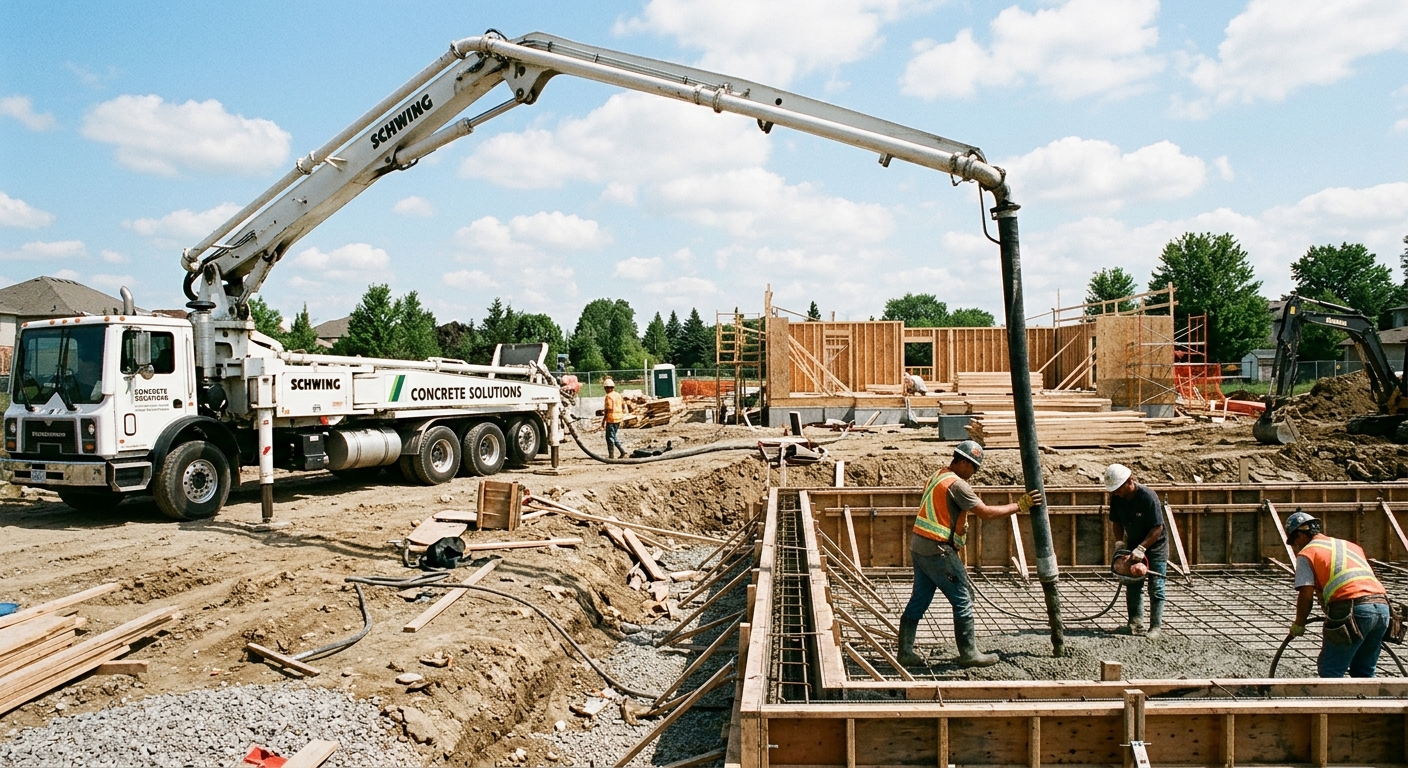
Concrete work options and costs in Mackenzie
Mackenzie is a small community (population 3,281 per the Statistics Canada, 2021 Census) where most concrete flatwork is driven by homeowners upgrading older houses. With 66.7% of dwellings being single-detached homes, the most common projects I see are driveways, patios and walkways that need to handle Cariboo freeze-thaw cycles without scaling or cracking. Also, 77.3% of homes were built before 1981, which often means existing approaches, steps, or cracked slab edges need better drainage grading and re-surfacing details—not just “pour concrete and hope.”
In the Cariboo (around Mackenzie), pricing is shaped by a true cold-weather concrete market. Winters push the frost line deeper and shorten the pour season, so contractors usually spend more on excavation, granular base preparation, reinforcement detailing, and cold-weather curing (insulated blankets, temperature control, and sometimes accelerators). Labour and mobilization can also run higher because fewer crews can safely schedule pours when temperatures drop.
Demand is especially steady in older neighbourhood pockets close to the town core and along common access routes where driveways and garage approach slabs are frequently replaced or widened after settlement issues. For most homeowners, the decision comes down to finish level and durability specs. Below is a quick comparison of typical project sizes and realistic price bands so you can align quotes before we talk about your site conditions.
| Application |
Typical Size |
Key Spec |
Finish Option |
Price Range |
| Concrete driveway (standard broom finish) |
8 ft x 20 ft (160 sq ft) |
Air-entrained mix for exterior exposure; compacted granular base; control joints |
Broomed surface |
$2,800–$4,000 |
| Exposed aggregate driveway |
10 ft x 22 ft (220 sq ft) |
Air-entrained mix; proper curing and aggregate exposure timing |
Exposed aggregate (bigger texture, better slip resistance) |
$4,000–$6,000 |
| Stamped concrete driveway or patio |
12 ft x 18 ft (216 sq ft) |
Air-entrained mix; controlled slump; colour hardener and release |
Stamped pattern + integral colour (or colour overlay where allowed) |
$5,500–$8,500 |
| Plain concrete patio or walkway |
10 ft x 12 ft (120 sq ft) |
Minimum 32 MPa compressive strength; compacted base; air-entrainment |
Simple broom or smooth trowel edge |
$1,700–$2,600 |
| Garage floor (interior slab) |
22 ft x 24 ft (528 sq ft) |
Vapour barrier, reinforcement (mesh/rebar as required), proper curing |
Plain steel trowel or light broom |
$7,500–$12,000 |
| Foundation footings (structural, below frost) |
Typical 1–2 storey home |
Engineered design; excavation to below design frost depth; rebar; concrete spec per engineer |
Structural concrete (not decorative) |
$9,000–$16,000 |
Prices are estimates only and vary by project scope, site access and material selection.
What affects the price of concrete work in Mackenzie
In Mackenzie, you can see the same general concrete scope come in 30–50% apart across the Cariboo region and wider British Columbia because the quote isn’t just “concrete per yard.” It’s excavation depth, how the base is built for frost resistance, the mix design (especially air-entrainment), and whether crews have to add cold-weather measures to hit strength targets. If one contractor includes insulated curing blankets and temperature control and another doesn’t, the lower quote can become the more expensive repair later.
Frost-line requirements and freeze-thaw cycles dictate nearly every spec here. Exterior slabs need air-entrained concrete to resist surface scaling and spalling during repeated wetting and freezing. Footings must be designed to bear below the local design frost depth; deeper frost means more excavation, more granular base, and more formwork height—costs that show up directly in the labour line. Winter timing also tightens the pour season; when temperatures drop, contractors may need heating and insulated covers, which extend equipment time and labour hours.
Two local examples I see often: (1) widening a driveway in a lot with soft subgrade may require extra granular removal/replace—if not addressed, the slab can settle and crack near the garage approach; (2) adding a stamped pattern on a driveway can be worth it only when the base and joint plan are right. A stamped driveway commonly lands in the broader $26–$40 per sq ft band for decorative work, while a broom-finished concrete driveway is typically in the $16–$25 per sq ft band. For pre-1981 homes (77.3% of the housing stock), drainage around the foundation is often older and less reliable, so part of your “real cost” becomes slope corrections and sealing—especially with winter de-icing.
| Price Factor |
Why It Matters |
Cost Impact |
| Frost line depth — determines footing depth and form height |
Deeper frost means more excavation and formwork to reach undisturbed bearing. |
Higher excavation + rebar/form labour; can add significant dollars on foundation work. |
| Site preparation — excavation, grading, compacted granular base |
Proper base thickness and compaction reduce settlement and frost heave. |
Major swing factor; poor access or soft subgrade increases disposal and granular. |
| Reinforcement — rebar or wire mesh requirement |
Controls cracking and supports load performance for driveways and slabs. |
Adds material and labour; required in many garage floors and some footings. |
| Mix design — air-entrainment and compressive strength spec |
Exterior air-entrainment improves freeze-thaw durability. |
Higher material cost; quote differences appear if one contractor uses a lower spec. |
| Finish type — broom vs. stamped vs. exposed aggregate |
Decorative finishes require extra steps, timing, and crew experience. |
Usually the biggest price jump on driveways and patios for aesthetics. |
| Pour size and concrete truck access to site |
Distance, staging, and pump needs affect delivery and labour time. |
Hard-to-access lots add charges or require smaller pours and extra visits. |
| Cold-weather curing precautions — heating and blankets |
Cold slows strength gain; curing protection is needed to prevent surface damage. |
Adds equipment and labour hours; often required in shoulder months and winter. |
| Control joint pattern and sealing cost |
Joints manage shrinkage cracking; sealing helps resist water and de-icing salt. |
Costs are modest compared with repairs; skipping it raises future spall risk. |
Permits & regulations in British Columbia
In British Columbia, structural concrete work—such as footing and foundation walls, grade beams, and other load-bearing elements—typically requires a building permit and often engineered drawings that the municipality reviews. Concrete flatwork (driveways, patios, sidewalks, and walkways) usually does not require a permit by default, but it can trigger requirements if it affects lot grading, drainage, or impervious surface coverage limits, or if work touches municipal right-of-way. In Mackenzie, I always advise homeowners to confirm with the local authority before breaking ground, especially when the project changes slope toward the street or alters how water flows off the property.
Before hiring, verify the contractor carries liability insurance and that they have the right workers’ compensation coverage (WSIB/WCB). Here’s a practical step-by-step checklist you can follow: (1) Ask for a current certificate of insurance showing they’re covered for your job’s type; (2) request proof of workers’ compensation coverage; (3) confirm the scope includes required excavation, forming, reinforcement, and concrete placement—not just “materials and a pour”; (4) check online contractor licensing/registry information relevant to B.C. requirements (and match the business name to the invoice); (5) get references on similar-sized slabs in cold-weather conditions.
Done properly, these checks protect you from delays, uncovered work, and quality issues that often surface after freeze-thaw seasons.
Getting concrete right in Mackenzie's freeze-thaw climate
Concrete failures in Mackenzie are usually predictable: poor base preparation, inadequate air-entrainment, badly timed joints, or rushed curing. In a cold-weather freeze-thaw market like the Cariboo, the biggest visible issue is spalling—tiny pop-outs on the surface—caused by water freezing inside concrete that wasn’t designed for exposure. That’s why you should spec the job for durability, not just appearance.
Start with base preparation: use compacted granular sub-base to the required depth for your soil and the frost conditions so the slab doesn’t heave or settle. Next, insist on a proper mix design: for exterior flatwork, air-entrainment is typically targeted around 5–7% air content, with a minimum 32 MPa compressive strength so the slab achieves strength even when weather cools. Control joints are also critical—spacing should be designed to limit random cracking into manageable lines. Curing matters just as much: in cold weather, plan for at least 7 days of curing under conditions that keep concrete in the right temperature band. Finally, sealing is part of a good winter plan: apply a penetrating sealer after the concrete has cured (often at 28 days) to repel de-icing salts and water from soaking into the surface.
Want a simple pricing example? If you choose a decorative stamped driveway (commonly priced higher within the $26–$40 per sq ft range for decorative work) but the contractor proposes a “minimal base” and no cold-weather curing protection, you’re paying extra for looks while risking spalling. In Mackenzie, spending the money on correct base, air-entrainment, and protected curing is what protects both the plain and decorative surfaces.
| Spec |
Why It Matters in Mackenzie |
What to Ask For |
Impact if Skipped |
| Compacted granular base (depth?) |
Reduces settlement and frost heave under freeze-thaw loading. |
Specify base thickness and compaction requirements for your soil. |
Cracking, edge spalling, and uneven slab settlement. |
| Air-entrained concrete mix (target air %?) |
Improves freeze-thaw durability in exterior exposure. |
Ask for air-entrainment and confirm it’s for exterior flatwork. |
Higher risk of surface scaling and spalling. |
| Compressive strength (MPa rating) |
Ensures strength gain and durability through winter cycles. |
Confirm minimum 32 MPa (or higher if your design calls for it). |
Weaker surface, dusting, and faster deterioration. |
| Control joints (spacing per ACI guidelines) |
Manages shrinkage cracking so it doesn’t randomize. |
Request a joint plan (spacing + timing for saw cutting). |
Random cracking that looks worse and can leak water. |
| Minimum 7-day curing period |
Cold weather slows strength gain and increases surface damage risk. |
Ask how they protect and maintain temperature during curing. |
Reduced strength and more early-age cracking/spalling. |
| Penetrating sealer (when applied after cure) |
Helps repel moisture and de-icing salts entering pores. |
Confirm sealer type and timing (after cure; often ~28 days). |
More water ingress and salt scaling over subsequent winters. |
How to choose a concrete work contractor in Mackenzie
Choosing a concrete contractor in Mackenzie is mostly about verifying coverage and matching specs to your freeze-thaw reality. First, confirm British Columbia requirements: ask for proof of liability insurance and workers’ compensation coverage (WSIB/WCB). Then check licensing/registration information online for the business name and confirm it matches what appears on the estimate and invoice. If a contractor can’t provide certificates quickly, that’s usually a warning sign.
Next, get 2–3 itemised written quotes. You want breakdowns showing labour and materials, not just a “lump sum pour price.” Compare whether they include excavation, granular base, reinforcement (if required), formwork, concrete mix spec (including air-entrainment), delivery and pump/access logistics, cold-weather curing measures, joint cutting, and disposal of excess material. Also ask whether permits are included when structural elements require them.
Warranty should be clear: a workmanship warranty length, what it covers (cracking, surface scaling, settlement related to base), and whether it’s transferable if you sell the home. For payment, never let them push you to pay more than 10–15% upfront; hold back the remainder until the finish meets spec and clean-up is complete. Finally, demand a written timeline—start date and estimated completion—because shoulder-season weather can affect curing and finishing schedules.
- Request proof of liability insurance and confirm the coverage period.
- Verify workers’ compensation coverage (WSIB/WCB) for their crews.
- Ask for examples of similar cold-weather projects in Northern B.C. conditions.
- Get an itemised quote: excavation, base, reinforcement, mix design, curing protection.
- Confirm air-entrainment is included for any exterior concrete.
- Ask for the joint plan: where joints go and when they will be cut.
- Clarify curing protection in cold weather (blankets/heating) and who pays for it.
- Confirm slopes and drainage away from the foundation for older home sites.
- Check whether disposal and excess material hauling are included.
- Insist on a written schedule with start date, pour date, and finish timing.
- Review warranty terms in writing—workmanship vs product/manufacturer warranty.
- Use a payment schedule: small deposit only, hold back until punch-list completion.
Concrete red flags I watch for in Mackenzie: quotes that don’t mention air-entrainment for exterior slabs, vague joint timing (“we’ll cut when we can”), no plan for cold-weather curing, missing reinforcement details (mesh/rebar), and payment terms asking for big upfront money without a clear scope and schedule.
Frequently asked questions — concrete work in Mackenzie
Do I need a permit for concrete work in British Columbia?
In British Columbia, structural concrete like footings, foundation walls, and grade beams typically requires a building permit and often engineered drawings reviewed by the municipality. For concrete flatwork such as driveways, patios, walkways, and sidewalks, a permit is usually not required unless your work changes lot grading, drainage patterns, impervious surface coverage, or touches municipal right-of-way. Because Mackenzie is a small town where drainage details matter during spring melt and freeze-thaw cycles, I strongly recommend confirming with the local authority before you pour—especially if the project is raising the driveway, adding step-downs, or redirecting water toward the street. Also, make sure your contractor is properly insured and has the right workers’ compensation coverage so you’re protected if something goes wrong.
Concrete vs pavers for a patio in Mackenzie?
For a patio in Mackenzie, both concrete and pavers can work, but they “fail” differently in freeze-thaw conditions. Concrete with proper air-entrainment and joints tends to be more predictable for long-term durability, provided the granular base is compacted and slopes shed water away from the home. Pavers can look great and are modular, but if the bedding sand or base is poorly compacted, they can shift as moisture freezes and thaws, leading to uneven surfaces and weed growth at joints. In cost terms, a simple plain concrete patio often falls in the $14–$22 per sq ft band for typical projects, while decorative approaches vary more. If you want a “fixed” surface that matches a driveway, concrete is usually the cleaner maintenance choice—especially when sealing and proper curing are included.
How long does a concrete driveway last?
A properly built concrete driveway in Mackenzie can last decades, but “how long” depends heavily on freeze-thaw durability details. Exterior slabs need air-entrained concrete and well-drained, compacted granular base to reduce spalling and settlement. Control joints should be laid out and cut on schedule so shrinkage cracking occurs in planned lines. Cold-weather curing is also important: if the slab isn’t protected during early-age cold, the surface can weaken and scale sooner. Practically, you’ll often see the difference in the first few winters—surface pitting, scaling, or pop-outs are signs the mix or curing wasn’t right. In terms of budgeting, a standard broom-finished driveway commonly aligns with the $16–$25 per sq ft range, and paying for correct base and curing is what protects that investment through multiple seasons of freeze-thaw.
What is air-entrained concrete and why does it matter here?
Air-entrained concrete is made with a controlled amount of microscopic air bubbles in the mix. Those bubbles give space for freezing water to expand, which reduces surface scaling and spalling during freeze-thaw cycles. In Mackenzie and the Cariboo, this matters because exterior concrete is repeatedly exposed to wetting, freezing temperatures, and de-icing salts. If the contractor skips air-entrainment or uses a lower air content than specified for exterior exposure, the slab may look fine at first but can show surface damage after one or more winters. That’s why a strong quote should explicitly call out air-entrained mix for driveways and patios, plus sealing after cure to help limit salt and moisture penetration. This is one of the easiest ways to protect your slab’s long-term performance in B.C.’s colder climates.
How do I prepare the base for a concrete slab?
Base preparation is where concrete projects succeed or fail in Mackenzie. The contractor should excavate to the right depth for your frost conditions, then place and compact granular base in lifts to achieve the required compaction. The goal is to create a stable, well-drained layer so water doesn’t pool under the slab and freeze—avoiding heave and settlement. You should ask what base thickness they’re proposing, how they’ll compact it, and whether they’re accounting for local soil conditions and drainage away from the foundation. A common mistake is “pouring over whatever is there” or using insufficient granular thickness, which can later show as cracking near edges or uneven areas. If the quote is unusually low in the $16–$25 per sq ft driveway range, check whether base and compaction are truly included, not just assumed.
How do I compare concrete quotes?
Comparing concrete quotes in Mackenzie is easiest when you force like-for-like scopes. Ask each contractor for an itemised breakdown: excavation, granular base thickness and compaction, reinforcement (mesh/rebar where required), concrete mix spec (including air-entrainment for exterior work and minimum compressive strength), joint plan, curing protection in cold weather, and finishing details (broom, stamped, exposed aggregate). Also confirm haul/pump and disposal are included, and whether sealing is offered for exterior slabs at the proper time after cure. For foundation work, ensure the footing design is engineered and the excavation is to required frost bearing depth. Finally, check payment schedule and warranty terms. A lower quote may only look attractive if it omits air-entrainment or cold-weather curing—issues that can cost more than the difference between $14–$22 (patios/walkways) and $26–$40 (decorative) finishes over time.