Concrete work options and costs in Eagle Ridge
Eagle Ridge, British Columbia is a great place for concrete flatwork—driveways, patios, and walkways are popular with the area’s growing family housing. In the 2021 Census, the region’s population reached 11,004, and the Lower Mainland–Southwest is where you’ll see steady demand for exterior concrete tied to maintenance and new builds. Much of the work is in and around the neighbourhoods near the Lougheed Highway corridor and school-area streets, where older lots are frequently upgraded and new driveways/sidewalk approaches are added.
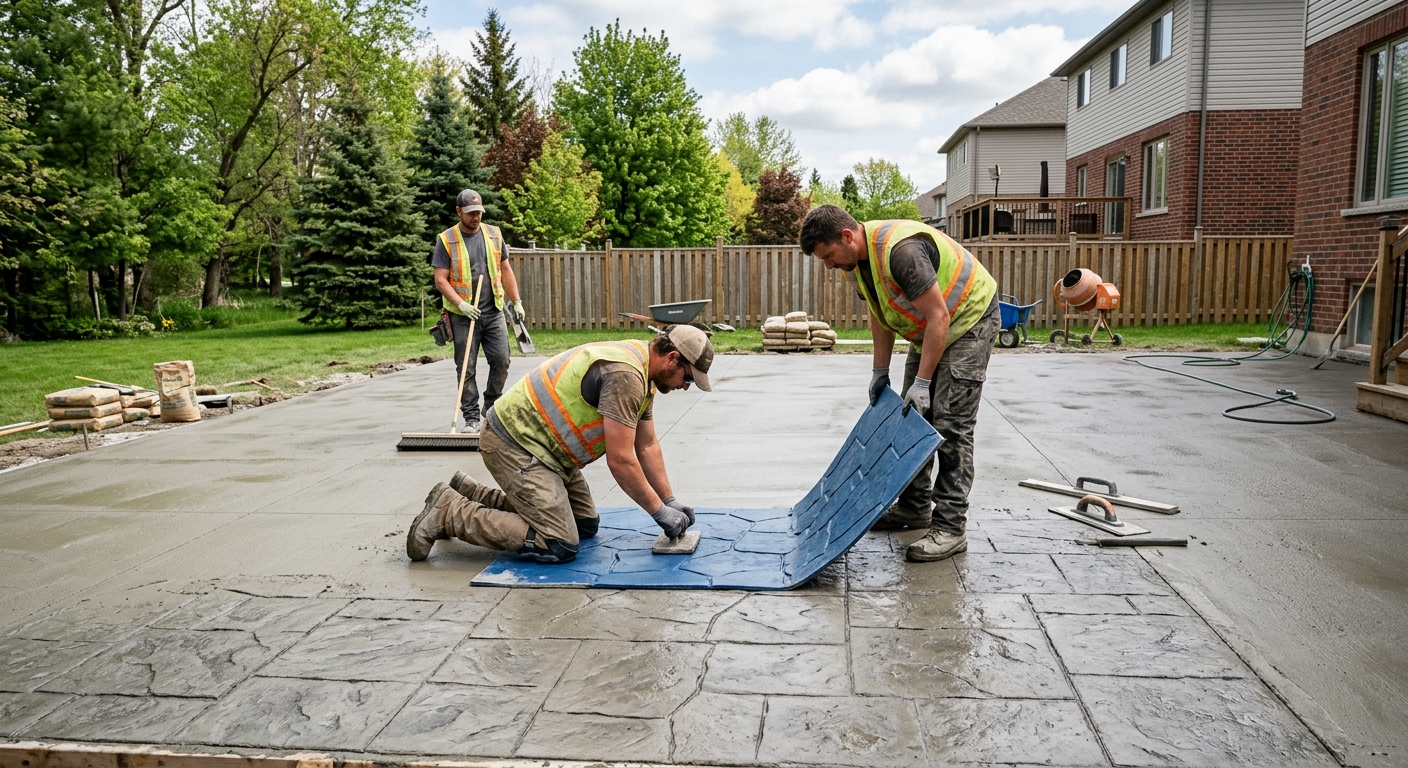
In the Lower Mainland–Southwest, mild winters and a shallow frost line still matter because coastal rainfall and freeze–thaw cycles can attack slabs and edges. Local practice typically assumes a frost depth around 450 mm / 18", so footings, piers, and thickened edges are placed below that to reduce frost heave risk. That means excavation, granular base engineering, and air-entrained mixes aren’t optional—they’re built into how contractors price jobs. Scheduling also affects costs: prolonged rain, cool nights, and high humidity can extend curing timelines, and contractors may use curing blankets or sealers to protect surface durability. Availability can tighten in peak seasons, especially for decorative work like stamping and exposed aggregate, which requires more finishing labour and time.
Below is a practical comparison of common concrete options in Eagle Ridge, with the specs that typically drive price up or down. Use this as a starting point before you request itemised quotes.
| Application |
Typical Size |
Key Spec |
Finish Option |
Price Range |
| Concrete driveway (standard broom finish) |
400–600 sq. ft. |
Air-entrained exterior mix; control joints; granular base with compaction |
Broom finish |
$7,500–$16,000 |
| Exposed aggregate driveway |
400–600 sq. ft. |
Air-entrained mix; colour/stone exposure plan; curing and sealing |
Exposed aggregate |
$10,500–$21,000 |
| Stamped concrete driveway or patio |
250–500 sq. ft. |
Air-entrained mix; integral colour; densifier/antiquing as specified |
Stamped + release + texture |
$9,000–$22,500 |
| Plain concrete patio or walkway |
200–450 sq. ft. |
Air-entrained exterior mix; proper slope and drainage |
Broom/steel trowel finish (based on use) |
$3,800–$10,500 |
| Garage floor (interior slab) |
300–650 sq. ft. |
Flat, level slab; vapour control plan if needed; proper reinforcement |
Machine-finish + light texture |
$6,000–$16,500 |
| Foundation footings (structural, below frost) |
Varies by home design |
Excavation to frost protection depth (below ~450 mm / 18"); engineered rebar layout |
Structural concrete only |
$18,000–$45,000 |
Prices are estimates only and vary by project scope, site access and material selection.
What affects the price of concrete work in Eagle Ridge
In Eagle Ridge and across the Lower Mainland–Southwest, the same “concrete driveway” can land 30–50% apart between quotes because the hidden costs live in base preparation, engineered thickness, reinforcement, mix design, and how the contractor protects curing in wet weather. Even when labour rates are similar, one crew may include proper subgrade drainage and a properly compacted granular base, while another assumes a simpler base and “good enough” curing. That difference quickly changes the concrete mix requirements and the time on site.
Frost line depth and freeze–thaw cycles dictate every exterior spec here. Footings and thickened edges must extend below the design frost depth (local practice often assumes about 450 mm / 18"), while exterior slabs generally use air-entrained concrete so the freeze–thaw cycle doesn’t drive scaling and spalling. In colder regions, crews deal with deeper excavations and shorter pour seasons—raising excavation, forming, and heating costs—so compared to those areas, Lower Mainland projects can be less expensive overall, but still not “cheap” if drainage and air-entrainment are done correctly. De-icing salt is another reality: it accelerates surface breakdown, making sealing a smart add-on for driveways and patios that see winter maintenance.
Concrete choices also move the number. For example, a standard broom driveway may fit the $18–$28 band per square foot for typical concrete flatwork, but stamped work usually pushes toward the $22–$36 band because of extra finishing labour and more materials for colour and detailing. In Eagle Ridge, older soil conditions and saturated basements can increase excavation and base depth, while good vehicle access can reduce truck waiting time and forming labour.
| Price Factor |
Why It Matters |
Cost Impact |
| Frost line depth |
Determines footing depth and form height to avoid frost heave |
Higher excavation depth increases labour and disposal |
| Site preparation |
Excavation, grading, and a compacted granular base control settlement and cracking |
More granular, more compaction time, more rework risk |
| Reinforcement |
Rebar or wire mesh controls shrinkage cracking and supports loads |
Added material + tying/placement labour |
| Mix design |
Air-entrainment and strength targets protect against freeze–thaw and scaling |
Spec-qualified mix can cost more per cubic yard |
| Finish type |
Broom vs stamped vs exposed aggregate changes labour intensity and material steps |
Stamped/exposed typically costs more than standard broom |
| Pour size and concrete truck access to site |
Smaller access-limited pours may require additional manpower and equipment |
Long carry distances and delays raise labour |
| Cold-weather curing precautions |
Heating blankets and controlled curing help reach design strength |
Blankets/heaters and longer scheduling add cost |
| Control joint pattern and sealing cost |
Joint spacing reduces random cracking; sealing repels de-icing salts |
Additional cutting and materials, but fewer premature failures |
Permits & regulations in British Columbia
In British Columbia, structural concrete work—such as footings, foundation walls, and grade beams—typically requires a building permit and often relies on engineered drawings that the municipality reviews. For Eagle Ridge homeowners, that usually means the scope tied to the structure is the part that triggers permitting and inspections. In contrast, concrete flatwork (patios, walkways, driveways) often does not require a permit unless it affects lot grading, impervious surface coverage limits, drainage, or municipal right-of-way requirements.
Before breaking ground, confirm the exact scope with your local authority (and your engineer if the project is tied to a foundation system). Also verify the contractor carries liability insurance and has the appropriate coverage for workers (commonly referenced as WSIB/WCB coverage, depending on the trade/coverage structure). Ask for references on projects of similar size and complexity—especially when frost protection depth, reinforcement, or drainage details are involved.
To verify a contractor in British Columbia step-by-step, start with the public online contractor registry for licensing status (search the contractor’s legal name/company name). Next, request a current certificate of insurance and check that it’s active for the project term and that the limits are appropriate for the job. Then ask for proof of coverage for workers and any clearance documentation that applies. Finally, ask for their written scope and an itemised quote so you can see what’s included (excavation, granular base, reinforcement, disposal, and curing/finishing steps).
Getting concrete right in Eagle Ridge's freeze-thaw climate
Concrete failures in Eagle Ridge are most often linked to poor base preparation, inadequate air entrainment, weak curing, and a neglect of joints and sealing in a freeze–thaw coastal environment. To spec the job correctly, start with base prep: you want a compacted granular sub-base to the right depth for the local soil and the project’s frost-protection requirements. Local practice often assumes a frost depth around 450 mm / 18", so exterior edges and structural elements should be built below that level. For slabs, the goal is stable support to prevent settlement-related cracking.
Next is mix design. For exterior work, request air-entrained concrete with a target air content in the 5% to 7% range (typical guidance for freeze–thaw durability). Pair that with a minimum 32 MPa compressive strength so the slab achieves the design performance even in cool, damp curing conditions. Control joints matter because they create planned crack locations: if you skip or randomise joints, cracks often show up where water can sit and freeze.
Curing is where timing changes costs and outcomes. In British Columbia’s cool, humid weather windows, plan for proper protection and longer cure timelines; a minimum 7-day curing period under suitable conditions is a baseline. Finally, sealing should be applied after the concrete has cured (commonly 28 days post-pour for best performance). Sealer helps repel de-icing salt, reducing surface scaling risk on driveways.
A quick dollar example: if you choose stamped concrete (often in the $22–$36 band) you’re paying for extra finishing steps. That premium is justified only if the slab underneath is correctly built (proper base, air-entrained mix, joints, and curing). If the slab is compromised, you’ll pay twice—once for decoration, and again when spalling or random cracking shows up.
| Spec |
Why It Matters in Eagle Ridge |
What to Ask For |
Impact if Skipped |
| Compacted granular base (depth?) |
Supports the slab and resists settlement under wet coastal conditions |
State the granular base depth and compaction method (e.g., compacted in lifts) |
Settlement cracks, uneven surface, faster deterioration |
| Air-entrained concrete mix (target air %?) |
Protects against freeze–thaw scaling and spalling |
Target air content typically 5%–7% for exterior flatwork |
Surface scaling/spalling and rough, weak-top finish |
| Compressive strength (MPa rating) |
Ensures durability through cool, damp curing and service loads |
Minimum 32 MPa (or project-specified requirement) |
Low strength, increased cracking and reduced wear resistance |
| Control joints (spacing per ACI guidelines) |
Controls where cracks form in wet-freeze cycles |
Joint spacing plan that matches slab thickness and layout |
Random cracking, water intrusion, freeze damage |
| Minimum 7-day curing period |
Cold nights and humidity can slow strength gain if not managed |
Confirm curing protection plan if temps are cool/rainy |
Insufficient early strength and surface defects |
| Penetrating sealer (when applied after cure) |
Repels de-icing salts and reduces scaling risk |
Sealer after cure—often around 28 days post-pour |
Faster surface breakdown and staining |
How to choose a concrete work contractor in Eagle Ridge
Choosing the right concrete contractor in Eagle Ridge starts with verification. In British Columbia, confirm the contractor’s licensing status through the public online registry for their legal company name. Next, request liability insurance and read the certificate details: you want it to be current, project-relevant, and with limits appropriate to your scope. For worker coverage, ask how they comply with WCB/WSIB-type coverage requirements for their crew, and request proof/clearance documentation where applicable. If a contractor can’t produce these documents quickly, that’s a serious red flag.
Then get 2–3 itemised written quotes—don’t accept vague lump sums. You want a breakdown that separates labour and materials and clearly lists what’s included: excavation and disposal, granular base depth, reinforcement, concrete mix spec (including air entrainment), forms, finishing, control joints, sealing, and curing/blankets if cool weather hits. Confirm whether permits (if required) and inspections are included or excluded. Ask who pulls permits when the project involves structural items like footings and foundation walls.
Review warranty too. Ask for the workmanship warranty length, whether it’s in writing, and if it covers cracks related to finishing/curing and jointing (not just cosmetic issues). Also ask about product/manufacturer warranty for sealers or admixtures. For payment schedule, a common practical rule is to never pay more than 10–15% upfront; hold back a meaningful portion until the job is complete, cleaned, and tested/approved. Finally, get a start date and completion estimate in writing, tied to weather realities in the Lower Mainland.
- Verifiable BC licensing status for the legal contractor name
- Current liability insurance certificate (active coverage dates)
- Proof of worker coverage (WCB/WSIB-type coverage as applicable)
- 2–3 itemised quotes with labour + materials breakdown
- Clear scope for excavation, disposal, and granular base depth
- Concrete mix spec written (air-entrainment and compressive strength)
- Reinforcement listed (wire mesh vs rebar, where required)
- Control joint pattern and cutting plan stated
- Curing plan included (especially for cool nights/rain)
- Sealer included or excluded, plus timing after cure
- Written start date and completion target
- Warranty terms in writing and what it covers/excludes
Concrete red flags in Eagle Ridge include: quotes that don’t mention air-entrained mix for exterior work, “no need” guidance on control joints, unclear base depth/compaction details, starting in rainy windows without a curing plan, and payment requests that exceed 10–15% upfront.
Frequently asked questions — concrete work in Eagle Ridge
Why does concrete crack in Eagle Ridge and how is it prevented?
In Eagle Ridge and the wider Lower Mainland–Southwest, concrete cracks usually come from shrinkage plus moisture movement, and they can worsen with wetting and freeze–thaw cycles near exterior edges. The most preventable issues are bad base preparation, inadequate air-entrainment for freeze–thaw durability, and a missing or poorly planned control joint pattern. Even if your driveway starts out looking smooth, water can find a path to the slab if joints aren’t cut soon enough and at appropriate spacing, leading to random cracking that’s more likely to widen over time. Prevention is built into spec: a compacted granular base, correct exterior air-entrained mix, timely jointing, and proper curing. If you’re budgeting, a standard broom driveway typically falls within the $18–$28 range, but don’t try to “save” by skipping base and joints.
Stamped vs broom-finish concrete — cost difference?
Stamped concrete costs more than a broom finish mainly because it’s labour-intensive: additional integral colouring, release agents, stamping tools/placement, and more finishing and timing control. In Eagle Ridge, that cost premium usually shows up in the $22–$36 band for stamped & decorative work, compared with standard concrete flatwork often aligning closer to the $18–$28 band for broom-finish driveways. The bigger point is that decoration doesn’t fix foundation problems—if the base prep, air entrainment, and control joints aren’t handled correctly, stamped surfaces can still crack or spall. When you’re comparing quotes, ask whether both options have the same mix design (air content and strength), reinforcement approach, and curing/sealing plan. If they do, the difference is usually justified by the finish steps.
When is the best time to pour concrete in Eagle Ridge?
The best time in Eagle Ridge is when temperatures stay within a workable range and you have a window with limited heavy rain and predictable curing conditions. In the Lower Mainland–Southwest, winters are mild compared to inland BC, but cool nights and persistent coastal moisture still slow curing and increase the chance of surface defects. Contractors usually prefer late spring through early fall for larger flatwork because evaporation and curing conditions are more stable, and it’s easier to protect the slab to reach strength. If you must pour in cooler weather, you should expect cold-weather precautions like curing blankets and careful scheduling to meet early strength targets. A contractor should also plan around truck access and joint cutting timing so the slab doesn’t become a “do it later” project that’s hard to finish properly. This is one reason quotes can vary by season—even for the same driveway size.
How long does concrete take to cure?
Concrete curing is a process, not a single day. As a practical baseline for exterior projects in British Columbia, you should plan for at least a minimum 7-day curing period under proper conditions before expecting normal traffic patterns, though that depends on temperature, wind, and rain exposure. Full design strength is typically achieved later; many homeowners ask about timelines because they see rain and cold. That’s also why good contractors manage curing protection if night temperatures are cool or the forecast is wet—curing blankets and shielding can protect strength gain. If you’re adding a sealer for de-icing salt resistance, plan to apply penetrating sealer after the slab has cured—often around 28 days post-pour—so the concrete surface is ready to accept it and you get the durability benefit. Skipping curing steps is one of the quickest routes to surface scaling and early deterioration.
Do I need a permit for concrete work in British Columbia?
In British Columbia, structural concrete work—footings, foundation walls, and grade beams—typically requires a building permit and is usually tied to engineered drawings reviewed by the municipality. Concrete flatwork such as patios, walkways, and driveways often does not require a permit, unless the work affects lot grading, impervious surface coverage rules, drainage, or impacts a municipal right-of-way. Because every lot and scope can be slightly different in Eagle Ridge, the safest approach is to confirm with the local authority before you pour. When interviewing contractors, ask whether permits are included in their process for structural scopes and who coordinates inspections. Also verify the contractor’s licensing status, liability insurance, and worker coverage proof before they start—those checks help protect you when the work is inspected and documented.
Concrete vs pavers for a patio in Eagle Ridge?
Concrete and pavers both work well in Eagle Ridge, but the “better” choice depends on your priorities. Concrete is often chosen for cost predictability and clean, monolithic results—especially for straight runs where drainage slopes can be controlled. Plain concrete patios commonly fall in the $16–$26 band, and stamped concrete can move into the $22–$36 range if you want a decorative look. Pavers offer modular repair advantages (individual stones can be replaced) and can be aesthetically flexible, but they still require careful base prep and edge restraint to avoid shifting in wet freeze–thaw cycles. If you use de-icing salt, both need a plan for drainage and surface protection. For a lasting patio, the deciding factor is usually whether the installer nails base compaction, jointing/drainage strategy, and long-term maintenance expectations—not just the initial material price.