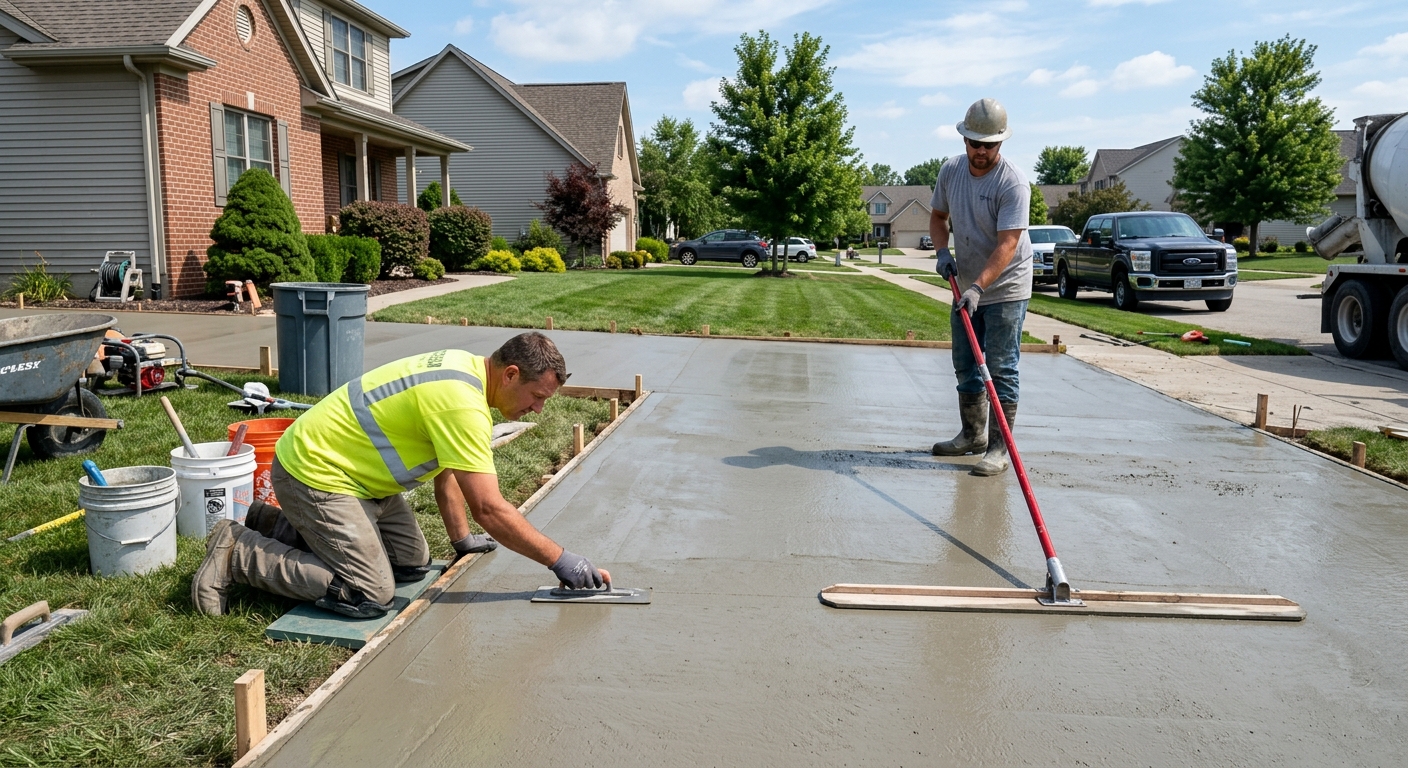
Concrete work options and costs in Parksville
Parksville homeowners typically start with one of three concrete upgrades: a driveway, a patio/walkway, or new foundation work. With 60.2% of local dwellings being single-detached homes (Statistics Canada, 2021 Census), the demand for exterior flatwork is steady—especially around the Crowned Harbour and North Nanaimo Street corridors where lots tend to be actively refreshed as families modernize landscaping and parking. It’s also a community where older housing stock still matters: 29.5% of homes were built before 1981 (Statistics Canada, 2021 Census), and many of those properties need driveway re-lays, slab patching, or drainage corrections before concrete can perform long-term.
On Vancouver Island and the Coast, pricing is influenced by a relatively shallow frost line and frequent freeze–thaw cycles. That combination drives the details: air-entrained mixes for exterior slabs, granular base prep, proper drainage, and well-planned control joints. Wet weather can slow excavation and curing—so reputable contractors price in weather contingencies and site protections, which helps reduce surface scaling and random cracking later.
Labour availability can also tighten during popular pour windows around spring and early fall, especially when crews are juggling multiple neighbours in Parksville. The result is that the same “size” project can land at different ends of the price band depending on haul distance, access to the forms and truck, reinforcement needs, and whether extra mix or curing protection is required. Below is a practical comparison to help you benchmark your quote before you call for measurements.
| Application |
Typical Size |
Key Spec |
Finish Option |
Price Range |
| Concrete driveway (standard broom finish) |
400–600 sq ft |
Air-entrained exterior slab; granular base + proper thickness |
Broom finish + standard control joints |
$6,400 – $15,000 |
| Exposed aggregate driveway |
400–600 sq ft |
Air-entrained mix; correct curing/retarder for wash/expose |
Exposed aggregate finish |
$9,600 – $18,000 |
| Stamped concrete driveway or patio |
250–500 sq ft |
Air-entrained mix; integral color or surface color; release system |
Stamped pattern + sealer |
$6,500 – $17,500 |
| Plain concrete patio or walkway |
200–350 sq ft |
Air-entrained exterior mix; slope to drain |
Smooth or lightly broomed finish |
$2,800 – $7,700 |
| Garage floor (interior slab) |
300–500 sq ft |
Interior mix; vapor considerations as needed |
Float + broom/smooth finish |
$4,800 – $11,500 |
| Foundation footings (structural, below frost) |
Varies by foundation layout |
Reinforced concrete; depth below frost + engineered requirements |
Formed structural finish (not decorative) |
$12,000 – $45,000 |
Prices are estimates only and vary by project scope, site access and material selection.
What affects the price of concrete work in Parksville
In Parksville, two quotes for the “same” concrete project can differ by 30–50% across Vancouver Island and the Coast, depending on how each contractor prices site conditions, durability specs, and weather risk. Even small changes—like excavating unsuitable soil, upgrading drainage, or increasing thickness to suit local subgrade—can move your job from the low end of the $16–$25/sq ft driveway band to the high end when reinforcement, thicker sections, or better mixes are required. Stamped and decorative work typically sits higher in the $22–$35/sq ft band because it involves pattern tooling, coloring (and careful finishing timing), plus more sealer and curing controls.
The biggest cost driver is the frost line and freeze–thaw cycles that characterize coastal Vancouver Island winters. While the frost depth used for design is generally around 0.5–1.2 m in coastal BC, the principle is the same: footings and foundation elements must sit below the design frost to prevent heave and cracking. Exterior slabs also need air-entrained concrete so the paste can tolerate repeated freezing and thawing. Contractors also plan around the pour season—cooler temperatures and saturated soils slow strength gain, which means more protection during curing (blankets, insulated covers, scheduling around heavy rain or cold snaps). Finally, de-icing salt use accelerates surface spalling if the mix and finishing aren’t right—so sealing and joint discipline become part of the cost, not a “nice to have.”
In Parksville, cost can rise quickly if your site needs additional granular base, if there’s poor drainage or standing water, or if access requires a pump or more labour for forming. It can lower when you have stable, clean subgrade, straightforward truck access, and a simple joint layout. The age of surrounding homes (including many pre-1981 properties) often signals older drains, shifting grades, or failing sidewalks that must be corrected before any new slab is placed—sometimes adding thousands to the prep scope.
| Price Factor |
Why It Matters |
Cost Impact |
| Frost line depth |
Determines footing depth and form height |
Deeper excavation and more concrete can add major labour and materials |
| Site preparation |
Excavation, grading, compacted granular base |
Unstable soil and re-grading raise disposal and base material costs |
| Reinforcement |
Rebar or wire mesh requirement |
More steel and labour for placement and chairs increases price |
| Mix design |
Air-entrainment and compressive strength spec |
Upgraded mix costs more but reduces scaling and random cracking risk |
| Finish type |
Broom vs. stamped vs. exposed aggregate |
Decorative finishing and tooling add labour and materials |
| Pour size and concrete truck access to site |
How far concrete must be carried or pumped |
Pump/extra crews and time can move the quote up sharply |
| Cold-weather curing precautions |
Heating and blankets |
Protection measures can add labour and rental/consumable costs |
| Control joint pattern and sealing cost |
Controls cracking and protects surface in de-icing season |
More saw cuts and sealing adds cost, but helps avoid repairs |
Permits & regulations in British Columbia
In British Columbia, structural concrete work typically needs a building permit. That includes concrete you can’t “just pour” without engineered review, such as: foundation walls, grade beams, reinforced footings, and other structural slabs or elements that affect the building’s load path. In many cases, engineered drawings are required and reviewed as part of permit approval.
Concrete flatwork—patios, walkways, driveways, and garage floor slabs—is often done without a permit unless it affects lot grading, drainage, or impervious surface coverage limits, or it ties into municipal right-of-way requirements. If you’re changing the slope toward a ditch/drain, modifying storm connections, or replacing a section near a property line/sidewalk, it’s smart to confirm with the local authority before breaking ground.
For Parksville homeowners, the contractor verification process should be straightforward. Start by requesting proof of contractor liability insurance (certificate of insurance showing coverage is current), and confirm the contractor is enrolled for workplace coverage under the province’s workers’ compensation system. Next, confirm their credentials through the provincial registry for contractors (licensing/registration status). Ask for a clearance letter or account proof if they cannot immediately provide documentation. Finally, request references from similar-scale concrete jobs in the Nanaimo-to-Parksville area, and make sure the quote clarifies whether the contractor is pulling any permit paperwork that’s required for structural scope.
Getting concrete right in Parksville's freeze-thaw climate
Concrete failures in Parksville are usually traced back to three things: weak or improperly prepared base, a mix that can’t handle freeze–thaw, and joints/curing that allow early moisture movement. In Vancouver Island and Coast conditions, exterior slabs are exposed to repeated wetting and freezing, which is why air-entrainment isn’t optional for driveways, patios, and walkways. If the air content is too low, water expands as it freezes and leads to scaling and spalling—often starting at edges and around joints.
To spec the job correctly, insist on: (1) base preparation with a properly compacted granular sub-base at the designed depth for your soil and local frost considerations; (2) an air-entrained exterior mix with target air content around 5–7% and a minimum 32 MPa compressive strength; (3) control joints placed to limit random cracking (and matched to your slab dimensions and traffic points); (4) curing for at least 7 days under suitable conditions—cool and saturated weather slows early strength gain, so contractors may need covers or blankets; and (5) penetrating sealer applied after cure (commonly 28 days post-pour) to repel moisture and reduce de-icing salt impact.
When comparing options, it’s normal for stamped or exposed aggregate to cost more. For example, if a standard broom driveway is quoted near $16–$25/sq ft while a stamped option lands closer to $22–$35/sq ft, the additional cost can be justified because you’re paying for complex finishing, integral color/release systems, and tighter curing/finishing timing—not just “pretty stamps.” If a decorative quote is close to standard broom pricing, ask what has been simplified (mix spec, thickness, curing protection, joint layout, or sealing scope).
| Spec |
Why It Matters in Parksville |
What to Ask For |
Impact if Skipped |
| Compacted granular base (depth?) |
Proper support prevents settlement that cracks and pumps water |
Granular base type and compacted depth for your site conditions |
Cracking, uneven slabs, and accelerated edge failure |
| Air-entrained concrete mix (target air %?) |
Freeze–thaw durability depends on microscopic air voids |
Target air content about 5–7% for exterior flatwork |
Scaling/spalling, especially in cold snaps and salted areas |
| Compressive strength (MPa rating) |
Strength gain affects durability and load performance |
Minimum 32 MPa (or as per engineered/design spec) |
Surface damage and reduced long-term resistance |
| Control joints (spacing per ACI guidelines) |
Joints manage shrinkage cracking to predictable locations |
Slab panel layout and joint spacing plan for your dimensions |
Random cracks and difficult-to-repair ugly “networking” |
| Minimum 7-day curing period |
Cool, damp weather slows strength gain in coastal BC |
How curing will be protected if temperatures drop or rain hits |
Low early strength and higher risk of surface deterioration |
| Penetrating sealer (when applied after cure) |
Helps repel moisture and reduces de-icing salt damage |
Sealer type and timing commonly around 28 days post-pour |
Faster water ingress, staining, and more winter surface scaling |
How to choose a concrete work contractor in Parksville
Start by verifying the contractor’s British Columbia credentials and coverage. Ask for a current certificate of liability insurance (and make sure it matches the job address), then confirm their workers’ compensation coverage so you’re not exposed if a crew member is injured on your site. For licensing/registration, check the provincial contractor registry status online and request proof their account is active; if they can’t provide verification, treat it as a red flag.
Next, get 2–3 itemised written quotes—not lump sums—so you can compare labour, concrete supply, removal/disposal, granular base, reinforcement, forms, finishing, and sealing. A solid quote will spell out what’s included: is the permit included where required, is old concrete saw-cut and hauled away, and are you getting compaction testing or documented base prep? Also confirm timelines and weather handling: ask for the start date window, an expected completion date, and what happens if rain or cold weather interrupts curing.
Warranty matters for concrete. Look for a clear workmanship warranty length and whether it covers common issues like settlement cracks or joint failure, and ask about the manufacturer/product warranty for materials used (sealers, admixtures). Payment should be controlled: never agree to large upfront deposits—aim for roughly 10–15% to start—and hold back payment until the final walk-through and any touch-ups are complete. Concrete is only as good as the prep and finishing details, so the contractor should be comfortable walking you through their method, not just giving a price.
- Ask the contractor what frost/bottom-of-footing design depth they are following for structural work below frost.
- Confirm exterior slabs are specified with air-entrained mix and document target air content.
- Require an itemised breakdown: excavation, disposal, granular base, reinforcement, concrete, finishing, sealing.
- Check whether wire mesh vs rebar is used and whether it’s supported (chairs) to sit at the correct depth.
- Look for a written plan for drainage: slopes, tie-ins, and how runoff won’t pond near foundations.
- Verify curing protection: blankets/covers if temperatures drop or rain threatens early strength.
- Confirm control joint layout: spacing and where saw cuts are placed relative to loads and edges.
- Ask when sealer is applied and whether it’s included (often after cure, commonly around 28 days).
- Ensure the quote specifies access assumptions (truck location, whether pump/extra crew is needed).
- Request disposal included for removed concrete and soil, with haul distance assumptions if relevant.
- Review warranty terms in writing—what’s covered, exclusions, and the claim process.
- Set a payment schedule with a small deposit and a holdback until completion and cleanup.
Concrete contractor red flags in Parksville: missing proof of liability insurance or workers’ compensation coverage; quoting “standard mix” without mentioning air-entrainment for exterior work; vague scope that doesn’t specify granular base thickness/compaction; skipping or minimizing control joints; and offering fast “pours” with no plan for cold snaps or protecting curing surfaces after wet weather.
Frequently asked questions — concrete work in Parksville
How do I prepare the base for a concrete slab?
Base prep is where most driveway and walkway problems begin in Parksville. A good contractor will remove unstable topsoil, then excavate to the designed grade and place a compacted granular sub-base at the specified depth (the thickness depends on your soil and slab thickness). Granular material should be placed in lifts and compacted to reduce future settlement. Because Vancouver Island and Coast winters include freeze–thaw cycles, drainage matters: the slab needs proper slope so water doesn’t pond, and the base should support free drainage instead of holding moisture near edges. Ask your contractor what granular type is used, how compaction is verified, and how they handle any soft or “boggy” spots—especially common where older drainage has failed. This prep is also a key driver of cost compared with the driveway rate band of $16–$25/sq ft.
How do I compare concrete quotes?
Comparing quotes gets easier when you insist on like-for-like specs. Ask each contractor for an itemised breakdown: removal/disposal, excavation, granular base depth, reinforcement (rebar vs mesh), concrete thickness, air-entrained mix requirements, finishing method, curing protection, and sealing. For Parksville’s freeze–thaw climate, make sure the quote explicitly includes air-entrainment for exterior flatwork and a control joint plan—those details affect durability as much as the finish. Also compare access assumptions: truck placement, whether a pump is needed, and any extra labour for moving forms. Finally, check whether decorative options truly include the same foundation prep; a stamped price might look close, but if the base or mix is downgraded you can pay twice in repairs. Use local benchmarks like driveway costs in the $16–$25/sq ft range and patios/walkways around $14–$22/sq ft to sanity-check your total.
Can concrete be poured in cold weather in Parksville?
Yes, concrete can be poured in cold weather in Parksville, but it has to be done correctly. Coastal BC winters can stay milder than interior regions, yet you still get cold snaps and long cool periods that slow strength gain. If the weather will drop near freezing, contractors need cold-weather curing precautions—such as protecting the slab with insulated blankets or temporary enclosures and using appropriate mix and admixtures so concrete reaches safe strength before it freezes. The key is that “pouring” is only half the job; curing protection is what prevents surface scaling and weak early strength. Ask your contractor what temperature range triggers extra protection, how long covers/blankets will stay on, and how they plan around rain. A responsible contractor will schedule and price for these weather contingencies, because they’re directly tied to durability and warranty outcomes.
How do I maintain concrete in Parksville's freeze-thaw climate?
Maintenance in Parksville is about reducing moisture and protecting the surface during winter cycles. Start by keeping joints clean and watching for small gaps—if water gets into cracks and freezes, it expands and worsens damage. Use a penetrating sealer as recommended (many projects include it after full cure, commonly around 28 days post-pour) to help repel moisture and reduce de-icing salt impact. Avoid aggressive pressure washing too soon after a pour, and don’t use sanding abrasives that can damage the surface finish. For driveways, keep drainage functioning so water doesn’t pond at the edges; settlement or poor slope often shows up first around winter. If you notice early scaling, have it assessed before it spreads. Maintenance is cheaper than replacement, and good sealing and joint discipline are usually the difference between a long service life and frequent winter repairs.
What causes concrete to spall in Parksville winters?
Spalling usually comes from water getting into the concrete and freezing, then repeating that cycle until surface material pops off. In Parksville’s freeze–thaw climate, the most common root cause is inadequate air-entrainment in the mix. Air-entrained concrete forms microscopic voids that give freezing water room to expand, reducing internal pressure. If the mix has too little air or if it’s not properly designed for exterior exposure, the surface can scale and spall—often starting at corners, edges, and joint lines where water concentrates. De-icing salt can worsen the problem by increasing chemical exposure and moisture movement. Other contributors include poor base drainage, weak curing, and missing or incorrectly spaced control joints that create random cracking paths. That’s why reputable contractors specify exterior durability details upfront rather than treating them as extras.
What is rebar and when is it required in British Columbia?
Rebar (reinforcing steel) is embedded into concrete to help control cracking and improve strength under load. In British Columbia, whether rebar is required depends on the structure and design—driveways and patios are often reinforced with wire mesh or rebar based on thickness, soil conditions, and expected loads, while structural elements like foundation footings and grade beams are commonly engineered and reinforced. For Parksville homeowners, the important point is that structural concrete generally needs engineered requirements and typically requires a building permit. Flatwork still benefits from reinforcement when designed for vehicle loads or when the subgrade isn’t ideal, but the “right” steel type and placement must match the slab thickness and slab support conditions. Ask your contractor to identify whether they’re using rebar or mesh, the spacing, and how it’s supported so it’s placed at the correct depth in the slab—because poorly placed steel doesn’t perform as intended.