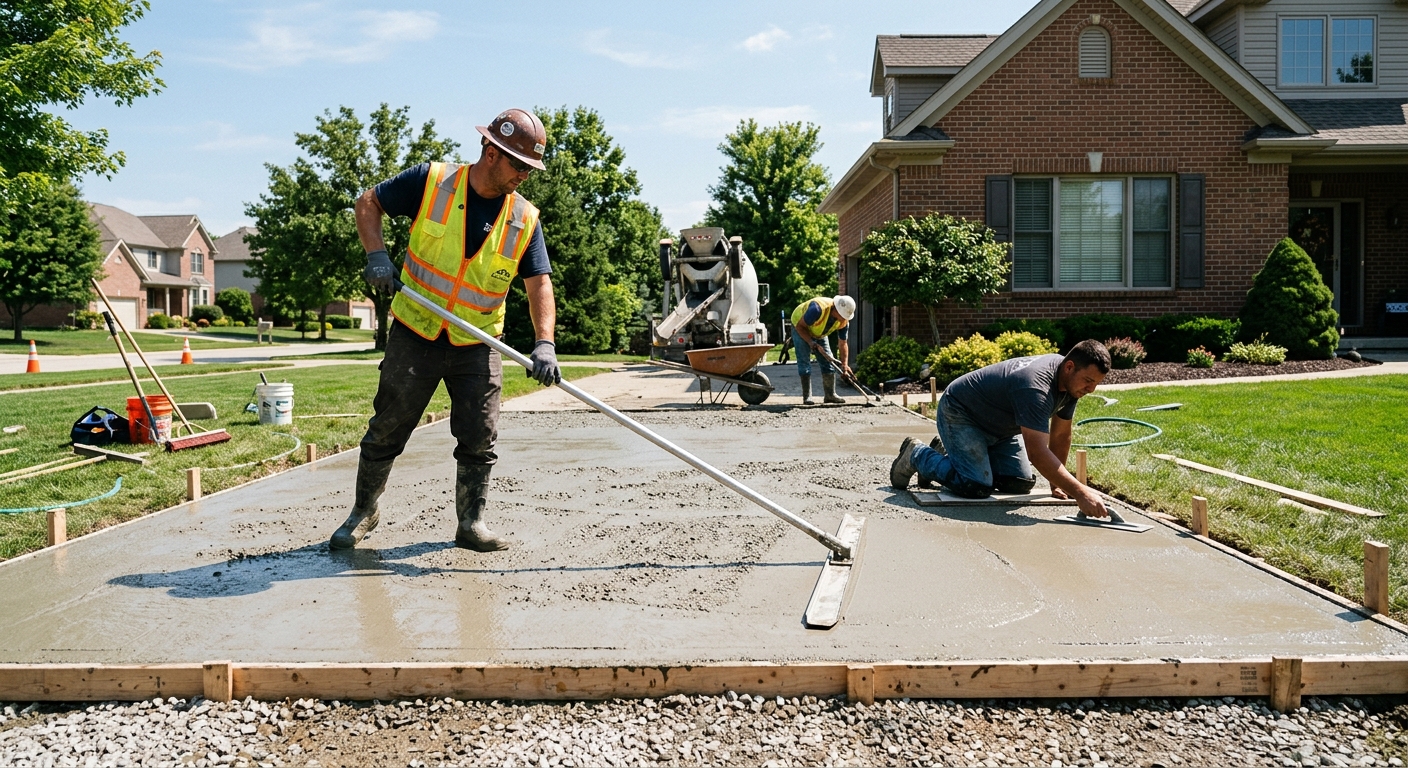
Concrete work options and costs in Middlegate
Middlegate homeowners often start with one simple question: “What will my concrete project cost?” With a population of 4,000 (Statistics Canada, 2021 Census), the town may feel small, but the concrete demand is steady—especially around established residential pockets like main-street and older neighbourhood areas where driveways and patios are due for replacement. In the Lower Mainland–Southwest, many houses are long-established and flatwork wears differently than in drier regions, because coastal rain and frequent freeze–thaw cycles test the durability of exterior slabs, steps, and driveway edges.
Even though winters are comparatively mild, our frost depth and seasonal moisture still shape every part of a quote. Local practice typically plans for frost depth around 450 mm / 18", placing footings and thickened edges below that range to help prevent frost heave. That drives forming, excavation depth, granular base, and scheduling. At the same time, contractors in the Vancouver–Surrey–Abbotsford corridor stay busy, and when rain or cool nights extend curing timelines, labour and supervision costs rise. For many homeowners, that’s why two “similar” driveway jobs can land far apart—especially when one includes proper drainage, air-entrained mix design, and longer cure protection.
Below is a quick comparison of the common concrete options you’ll see quoted in Middlegate, including typical sizes and the specs that usually separate a short-lived pour from one that lasts.
| Application |
Typical Size |
Key Spec |
Finish Option |
Price Range |
| Concrete driveway (standard broom finish) |
12' x 20' (240 sq. ft.) |
Air-entrained exterior mix, proper base drainage, control joints |
Broom finish |
$18,000–$28,000 |
| Exposed aggregate driveway |
12' x 20' (240 sq. ft.) |
Air-entrained mix, consistent wash timing, sealed surface |
Exposed aggregate |
$22,000–$34,000 |
| Stamped concrete driveway or patio |
10' x 20' (200 sq. ft.) |
Air-entrained exterior mix, colour hardener (if specified), joints |
Stamped (patterned) + sealer |
$22,000–$36,000 |
| Plain concrete patio or walkway |
10' x 16' (160 sq. ft.) |
Air-entrained mix, compacted granular base, edge restraint |
Float & broom (light texture) |
$16,000–$26,000 |
| Garage floor (interior slab) |
20' x 22' (440 sq. ft.) |
Vapour barrier (as required), compacted base, crack control |
Smooth trowel or light broom |
$18,000–$34,000 |
| Foundation footings (structural, below frost) |
Varies by house size |
Below design frost depth (local practice typically targets ~450 mm / 18" range), rebar as engineered |
Structural concrete (no decorative finish) |
$8,000–$20,000 |
Prices are estimates only and vary by project scope, site access and material selection.
What affects the price of concrete work in Middlegate
In the Lower Mainland–Southwest, you can see concrete quotes swing by 30–50% for what looks like the same job—because the “hidden work” changes. One contractor may price a slab using a basic mix and limited base prep, while another includes the full exterior durability package: excavation to correct levels, compacted granular base with drainage attention, air-entrained concrete, and a joint/sealer plan designed for freeze–thaw. Labour availability also matters in Middlegate; when rains roll in or crews are booked for larger projects across the corridor, scheduling and supervision costs rise.
Frost and freeze–thaw cycles dictate every exterior spec. While our design frost depth is often around 450 mm / 18", footings and thickened edges still need to be placed below frost for the local soil conditions—otherwise you invite frost heave and settlement-related cracking. Exterior slabs also need air-entrained concrete mixes to manage repeated freeze–thaw. Cooler seasons bring a shorter effective pour window, and cold-weather precautions (insulating blankets, temperature monitoring, and sometimes short-term heat) add cost—especially if the pour is near the edge of acceptable conditions. Finally, de-icing salt accelerates surface scaling if you don’t use proper finishing and sealing; sealing is frequently the cheapest line item that protects the whole surface.
Here are practical Middlegate examples of cost movement: replacing a driveway near existing grading often adds excavation and retaining/granular work; adding rebar or wire mesh for an engineered slab increases materials and labour; and choosing stamped concrete can add pattern tools and colour/finishing labour—commonly shifting many projects toward the $22–$36 decorative band rather than standard flatwork in the $18–$28 driveway band. Housing age and proximity to older drainage can also affect disposal fees and base depth, which is where smaller “scope differences” turn into real dollar differences.
| Price Factor |
Why It Matters |
Cost Impact |
| Frost line depth — determines footing depth and form height |
Prevents frost heave by placing structural elements below design frost |
Higher excavation/forming; can meaningfully increase structural concrete scope |
| Site preparation — excavation, grading, compacted granular base |
Correct base and drainage protect against settlement and water-driven failure |
More truckloads/granular and labour; often a major quote spread |
| Reinforcement — rebar or wire mesh requirement |
Controls cracking and improves slab/footing performance under load |
Added materials + tie-in labour; increases cost for thicker or engineered slabs |
| Mix design — air-entrainment and compressive strength spec |
Exterior air content and strength help resist freeze–thaw and scaling |
More expensive mix and strict batching; usually required for outdoor work |
| Finish type — broom vs. stamped vs. exposed aggregate |
Finish impacts labour time and durability when paired with sealing |
Stamped/exposed typically costs more than standard broom finishing |
| Pour size and concrete truck access to site |
Access limits may require smaller loads, pumping, or extra crew time |
Can add labour and equipment costs quickly |
| Cold-weather curing precautions — heating and blankets |
Protects concrete while it gains strength; critical in cool nights/high humidity |
Extra materials and time if pours fall near seasonal thresholds |
| Control joint pattern and sealing cost |
Joints reduce random cracking; sealer helps repel salts and moisture |
Small line item for sealer, but often essential for exterior longevity |
Permits & regulations in British Columbia
In British Columbia, structural concrete work generally needs a building permit, and it’s commonly tied to engineered drawings. This includes footings, foundation walls, and grade beams. Municipal review is typically required because these elements affect structural safety and load paths. For concrete flatwork—driveways, patios, and walkways—permits often are not required by default, unless the work changes lot grading, increases impervious surface coverage beyond allowances, affects municipal right-of-way, or alters drainage in a way the municipality must review.
Regardless of scope, always confirm with the local authority before breaking ground—especially in Middlegate where drainage and surface water management can affect neighbouring properties. Also verify the contractor carries liability insurance and appropriate worker coverage (commonly WCB coverage for workers).
To check a contractor in BC step-by-step, start with their identity and credentials: (1) ask for their certificate of insurance showing liability coverage and effective dates; (2) ask for proof of worker coverage (and confirm it matches your contractor’s business entity name); (3) request references on similar-scale concrete flatwork or foundation work; and (4) when relevant, check that any referenced permit/engineer documentation aligns with the work proposed. If they’re vague about insurance details or won’t provide documents, that’s a red flag you shouldn’t ignore.
Getting concrete right in Middlegate's freeze-thaw climate
Concrete failures in Middlegate usually come back to water movement and temperature swings. Even in the Lower Mainland–Southwest, repeated freeze–thaw cycles and saturated soils can push moisture into the slab edges and near the surface, leading to scaling and spalling—especially when the concrete mix wasn’t air-entrained correctly or finishing/jointing came too fast. To spec the job right, you want an integrated plan: base prep, mix design, jointing, curing, and sealing.
(1) Base preparation: Use compacted granular sub-base to the correct depth for your soil and local drainage realities. Poor base compaction or missing drainage creates settlement and water pockets, both of which accelerate cracking. (2) Mix design: For exterior flatwork, air-entrained concrete is typically targeted in the 5–7% air content range, and it should meet a minimum 32 MPa compressive strength spec for many residential exterior applications. (3) Control joints: Plan a joint layout that limits random cracking; joints are your “planned weak points.” (4) Curing: Arrange for at least 7 days of proper curing conditions, and protect the pour during cold nights with curing blankets if needed. (5) Sealing: Apply a penetrating sealer after the concrete has cured—commonly around 28 days—to help repel de-icing salts and reduce moisture ingress.
Ask technical questions that directly prevent spalling: “What air content will you design for?” “How deep is the granular base and how is drainage handled?” and “What curing and sealing timeline do you recommend in Middlegate?”
On pricing, you don’t always save by going minimal. For example, skipping sealer may keep an exterior patio closer to the $16–$26 band, but you risk accelerated surface wear that can translate into earlier repairs or replacement—often far exceeding the cost difference. A well-prepped, properly air-entrained patio that lands near the middle of that band typically performs noticeably better over multiple winters.
| Spec |
Why It Matters in Middlegate |
What to Ask For |
Impact if Skipped |
| Compacted granular base (depth?) |
Reduces settlement and blocks moisture pockets that freeze and expand |
Granular base depth based on your site’s soil and drainage; specify compaction method |
Uneven cracking, pumping, and faster deterioration at edges |
| Air-entrained concrete mix (target air %?) |
Protects surface from freeze–thaw scaling and spalling |
Air-entrainment target (commonly 5–7% for exterior flatwork) and documented mix spec |
Scaling/spalling within a few winters, especially with salt exposure |
| Compressive strength (MPa rating) |
Strength gain supports durability under loads and temperature movement |
Confirm minimum 32 MPa rating (or higher if engineered) |
Lower durability and increased risk of cracking and wear |
| Control joints (spacing per ACI guidelines) |
Limits random shrinkage cracking where freeze–thaw can widen damage |
Joint spacing plan before pour; confirm saw-cut or formed joints timing |
Random cracks that can open during wet/cold cycles |
| Minimum 7-day curing period |
Allows strength development through cool nights and high humidity |
Protection plan if temperatures drop; blankets/curing compound only if approved |
Surface weakness, reduced long-term performance |
| Penetrating sealer (when applied after cure) |
Helps repel salts and reduces moisture ingress in coastal-wet conditions |
Sealer applied after full cure window—commonly around 28 days |
Faster scaling/spalling from salt and rainwater exposure |
How to choose a concrete work contractor in Middlegate
Choosing the right concrete contractor in Middlegate comes down to proof, not promises. Start by verifying British Columbia requirements and basic protection. Ask for their business credentials and check their liability insurance certificate—make sure it clearly lists your contractor’s legal business name and shows coverage amounts appropriate for construction work. For worker coverage, request proof of WSIB/WCB (depending on how the contractor describes their coverage) and confirm it’s active for the people who will be on your site.
Next, get 2–3 itemised written quotes rather than lump sums. You want a breakdown that separates labour from materials and clearly states what’s included in base prep, reinforcement, formwork, saw-cut joints, finishing, curing protection, and disposal. A quote should say whether permits are included (when needed) and whether concrete washout and debris disposal are priced in. If it’s silent, assume it’s excluded and ask—because those costs show up fast in the Lower Mainland–Southwest.
Then evaluate warranty and scheduling. A reputable contractor provides a workmanship warranty length in writing, and you should ask how product/manufacturer warranties apply to sealer or admixtures. Confirm whether the warranty is transferable if you sell the home.
For payment, keep it controlled: don’t pay more than 10–15% upfront, and hold back a portion until the job is complete and cleaned. Finally, get the start date and completion estimate in writing so rain delays and cure protection timelines are planned, not improvised.
- Verify the contractor’s insurance certificate matches their business name and is current.
- Confirm worker coverage proof (WCB/WSIB equivalent) for the crew on your site.
- Ask for references on similar driveway/patio or foundation scopes in BC’s coastal-wet conditions.
- Require an itemised quote: excavation, granular base, rebar/wire mesh, concrete supply, finishing, joints, sealing, disposal.
- Ask what drainage measures are included at the edges and where water will go.
- Confirm thickness and reinforcement details match the intended load (especially driveway approaches).
- Clarify whether control joints are saw-cut, formed, and the spacing plan.
- Ask about curing protection plan for cool nights (blankets/temperature monitoring if needed).
- Confirm sealer type and timing (commonly ~28 days post-pour for penetrating sealer).
- Check whether permit pulling is included when structural work requires it.
- Review payment schedule; cap upfront at 10–15% and retain holdback until completion.
- Get a written start/completion timeline and how rain impacts scheduling.
Concrete contractor red flags in Middlegate: (1) quotes that don’t mention air-entrainment and jointing for exterior work, (2) no clear curing plan for cold nights or rainy weeks, (3) refusing to provide insurance/coverage documents, (4) vague scope language like “standard prep” with no base depth or drainage details, and (5) asking for large upfront payments or no holdback despite completion being outstanding.
Frequently asked questions — concrete work in Middlegate
How do I prepare the base for a concrete slab?
In Middlegate, base prep is the foundation of the foundation—because freeze–thaw cycles and coastal wet conditions drive water movement. Your contractor should remove topsoil and soft material, then grade to the right elevations with a properly compacted granular sub-base at the specified depth. The granular base needs to be compacted in lifts (not dumped and left), and drainage should be planned so water doesn’t sit under the slab edges. If you’re doing a driveway or patio, ask about edge restraint, compacted base coverage, and whether they’re addressing any wet soils. Good base prep is one reason legitimate exterior flatwork costs line up with typical driveway and patio bands, like $18,000–$28,000 for many standard driveway installs, rather than an unrealistically low number that ignores drainage and compaction. (Statistics Canada, 2021 Census)
How do I compare concrete quotes?
When comparing concrete quotes in Middlegate, don’t compare only the total—compare what’s included. Ask each contractor to itemise labour and materials: excavation quantity, granular base depth and compaction method, reinforcement (rebar/wire mesh), concrete mix spec (especially air-entrainment for exterior work), finish type, control joints (spacing plan and saw-cut/formed method), curing protection, and sealing. Also confirm disposal, equipment access (truck access or pumping), and whether permit pulling is included when structural work is involved. If one quote is much lower, it may be missing drainage preparation or air-entrained mix, which is critical for freeze–thaw durability. For a realistic benchmark, many driveway projects in the region fall in the $18–$28 band for standard broom finishes, while stamped options commonly trend toward $22–$36 because they require additional labour and materials.
Can concrete be poured in cold weather in Middlegate?
Yes, concrete can be poured in cold weather in Middlegate, but only with proper cold-weather practices. The key risk is that concrete must reach sufficient early strength before it’s exposed to freezing conditions. Contractors typically monitor temperature, protect the slab or footings with insulation blankets, and may use heating measures to keep the concrete and sub-base at safe temperatures during curing. In the Lower Mainland–Southwest, the issue isn’t extreme cold like interior BC—it’s cool nights, high humidity, and longer time to achieve strength. That’s why a quote may include extra curing blankets or longer protection time. Ask the contractor what temperatures trigger protection and how they’ll manage curing for the minimum 7-day period. A responsible contractor will also schedule around prolonged rain so the pour isn’t watered down or finished under unsuitable conditions.
How do I maintain concrete in Middlegate's freeze-thaw climate?
Maintenance in British Columbia’s coastal-wet climate is mainly about water and de-icing salt management. For exterior slabs like patios and driveways in Middlegate, use a penetrating sealer after the concrete has cured—commonly around 28 days—to help repel salts and reduce moisture ingress. Keep surface drainage in mind: don’t let downspouts dump onto the slab edges, and clear debris from weeping points so water doesn’t pool. When removing snow, use non-corrosive de-icers when possible and avoid aggressive scraping that gouges the surface. Cracks and chips should be addressed early (minor repairs before freeze–thaw widens them). Maintenance is also why the right specs matter: if the mix isn’t air-entrained and the sealing is skipped, scaling can start sooner, even if the initial price looked like a bargain within the typical $16–$26 patio/walkway range.
What causes concrete to spall in Middlegate winters?
Spalling in Middlegate winters typically comes from freeze–thaw damage compounded by salt and water intrusion. The most common technical cause is inadequate air-entrainment: without the right air void structure, water that gets into the paste and surface can expand when it freezes, breaking off the outer layer. Poor base prep and drainage can worsen the problem by letting water accumulate under or at the slab edge. Another contributor is finishing and curing under unsuitable conditions—such as finishing too early or insufficient curing protection during cool periods—which can leave a weaker surface. Salt accelerates deterioration by increasing the rate of scaling at the surface. If your contractor doesn’t specify air-entrainment and a joint/sealer plan, spalling risk rises significantly. Ask for documentation of the mix design, including target air content, and confirm the sealer timing after curing for exterior durability.
What is rebar and when is it required in British Columbia?
Rebar is steel reinforcement embedded in concrete to help resist tensile forces and control cracking. In British Columbia, whether rebar is required depends on the engineered design, the slab thickness, intended loads, soil conditions, and how the project is structured. For structural concrete—like footings and foundation walls—reinforcement is commonly specified by engineers reviewed through permit processes. For residential exterior flatwork such as patios, some projects use wire mesh or rebar at specific spacings, while lighter applications may rely on proper thickness, base prep, and control joints. In Middlegate’s freeze–thaw climate, reinforcement is often part of ensuring slabs perform through moisture and seasonal movement, especially at driveway approaches and where loads are higher. Ask your contractor to state the exact reinforcement type, location (top/middle/bottom of slab), and spacing, and to tie it back to the thickness and the load requirements in the quote.