Concrete work options and costs in Terra Nova
In Terra Nova, concrete work is one of those home upgrades that quietly pays you back—clean driveways, durable patios, and foundations that hold steady through the damp Lower Mainland winters. Terra Nova’s housing base is largely built around single-detached living (Statistics Canada, 2021 Census), and with a 2021 population of 5,447, there’s a steady but specialized demand for driveway and patio crews who can schedule around rain and cool nights. (Statistics Canada, 2021 Census)
In the Lower Mainland–Southwest, concrete pricing and design are shaped by a shallow frost line and frequent coastal wetting. Even with frost depth commonly assumed around 450 mm / 18", we still build footings and thickened edges below that line to reduce frost heave risk. Saturated soils and freeze–thaw cycles also mean base prep is not “optional”—it’s part of keeping slabs from scaling and cracking. Contractors in the Vancouver–Surrey–Abbotsford corridor tend to plan pour days carefully and may use curing blankets, sealers, and longer curing windows to reach surface durability, especially for exterior flatwork.
Demand is especially strong around Terra Nova’s Schanzer Park / McMillan area, where homeowners frequently refresh curb appeal and replace older asphalt with concrete. If you’re comparing options, the fastest way is to look at typical sizes and key specs, then match the finish to your goals—durability, appearance, and long-term maintenance—before you review an itemized quote. That’s what the table below is designed to help you do.
| Application |
Typical Size |
Key Spec |
Finish Option |
Price Range |
| Concrete driveway (standard broom finish) |
200–300 sq ft (18–28 m²) |
Air-entrained exterior mix, compacted granular base, control joints |
Broom finish, standard edging |
$3,600 – $7,400 |
| Exposed aggregate driveway |
200–300 sq ft (18–28 m²) |
Air-entrained exterior mix, broom-free surface, proper curing for durability |
Exposed aggregate (common for coastal-wet appearance) |
$5,200 – $9,400 |
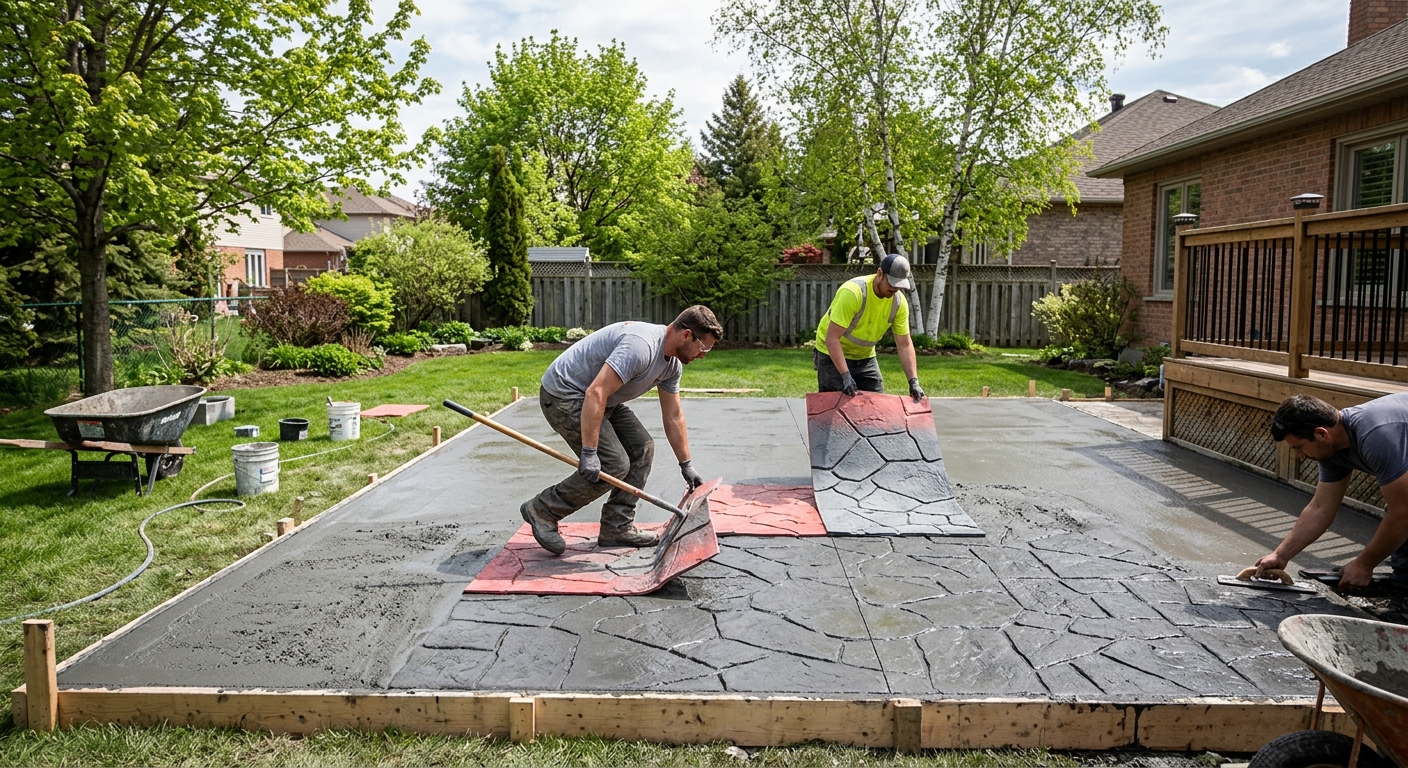
| Stamped concrete driveway or patio |
150–280 sq ft (14–26 m²) |
Air-entrained exterior mix, integral colour, release agent & curing plan |
Stamped pattern + sealer |
$4,500 – $10,100 |
| Plain concrete patio or walkway |
120–240 sq ft (11–22 m²) |
Air-entrained exterior mix, compacted base, joints as required |
Float/level then broom or light texture |
$2,200 – $5,900 |
| Garage floor (interior slab) |
400–600 sq ft (37–56 m²) |
Interior mix, thickness per design, vapour considerations if required |
Steel trowel or light broom texture |
$6,500 – $13,500 |
| Foundation footings (structural, below frost) |
Varies by home size; often by perimeter length |
Excavation and structural concrete below design frost depth |
Formed footings, engineered reinforcement as required |
$18,000 – $35,000 |
Prices are estimates only and vary by project scope, site access and material selection.
What affects the price of concrete work in Terra Nova
In the Lower Mainland–Southwest, it’s common to see quotes for the “same” concrete project vary by 30–50%. The big reasons aren’t just the finish—they’re the buried details: how deep the excavation must go, what base material and compaction is specified, whether reinforcement is required, and how long crews must manage curing during rain and humidity. When you compare Terra Nova bids, remember that labour efficiency changes with access (narrow side yards, landscaping to protect, disposal distance) and with scheduling (cold nights and wet stretches can slow production).
Frost line depth and freeze–thaw cycles directly dictate the design spec. Even though coastal BC typically assumes a frost depth around 0.5–1.2 m for excavation planning, contractors still place exterior footings and thickened edges below the design frost depth to reduce frost heave. Exterior slabs also need air-entrained concrete mixes to survive repeated wetting and cooling. In cooler weather, crews may use heating and insulating blankets so the concrete reaches strength properly; that can add cost compared with a summer pour.
Two Terra Nova-specific examples show how conditions move the price:
- If your driveway sits over saturated soils or poor drainage, base prep and drainage improvements can push a standard broom driveway up toward the upper end—often a meaningful reason prices drift beyond the typical concrete driveway / slab band of $18–$28 per sq ft.
- If you choose decorative work like stamped concrete, the material and labour for integral colour and finishing can justify the step-up compared to a plain patio at the $16–$26 per sq ft band, especially when cracking control joints and sealing are executed well.
Finally, Terra Nova’s housing age and retrofit reality matter. Replacing an older slab or removing compacted fill often costs more than “pouring on grade” because demolition and disposal increase labour and truck movements—so the same finish can land at different totals depending on what’s underneath. For reference, foundation and footing work is often priced based on structural requirements rather than surface square footage, and it commonly falls in the $200–$350 per linear-foot band depending on design and site conditions.
| Price Factor |
Why It Matters |
Cost Impact |
| Frost line depth — determines footing depth and form height |
Footings must extend below design frost to prevent frost heave |
Can raise excavation and forming labour; biggest driver on foundation perimeter work |
| Site preparation — excavation, grading, compacted granular base |
Proper base supports slabs and limits settlement and scaling |
More granular, more compaction time, possible drainage corrections |
| Reinforcement — rebar or wire mesh requirement |
Rebar/wire location and coverage help control cracking and load capacity |
Material + labour; can add cost if steel chairs/spacers are required |
| Mix design — air-entrainment and compressive strength spec |
Air entrainment protects exterior surfaces from freeze–thaw scaling |
Small per-yard material change but meaningful value on durability; affects concrete supplier scheduling |
| Finish type — broom vs. stamped vs. exposed aggregate |
Labour intensity and materials vary by finish system |
Stamped/exposed aggregate typically costs more than broom-finished flatwork |
| Pour size and concrete truck access to site |
Access constraints increase labour, pumping, and staging time |
Long carries, pump set-ups, or multiple loads increase total |
| Cold-weather curing precautions — heating and blankets |
Ensures concrete reaches strength and durability requirements |
Can add line-items for blankets, heaters, and monitoring |
| Control joint pattern and sealing cost |
Joints reduce random cracking; sealing helps repel de-icing salts and staining |
More saw cuts and quality sealer application can add cost but reduce maintenance |
Permits & regulations in British Columbia
In British Columbia, the permit requirement depends on what you’re building and whether it affects structural systems or site servicing. Structural concrete work—like footings, foundation walls, and grade beams—typically requires a building permit and often engineered drawings reviewed by the municipality. For concrete flatwork such as driveways, patios, and walkways, permits are often not required by default, unless your project changes lot grading, increases impervious surface beyond local limits, or involves the municipal right-of-way.
Before breaking ground in Terra Nova, confirm details with the local authority so you don’t get caught mid-project. Also verify your contractor is properly insured. Ask for proof of liability insurance and coverage for workers (WSIB/WCB coverage), and request references from similar-scale jobs nearby.
Step-by-step: how a homeowner verifies contractor status in BC
- Get the contractor’s legal name from the quote, then search for their credentials using the appropriate provincial/online business registry.
- Ask for a Certificate of Insurance (COI) and check coverage limits, expiry date, and that your address is eligible where required.
- Request proof of WSIB/WCB coverage for the trades handling the concrete work.
- Confirm they’ve done similar exterior flatwork in wet-coastal conditions—don’t rely on generic portfolio photos.
- Verify in writing what permit (if any) is the contractor’s responsibility to pull.
Getting concrete right in Terra Nova's freeze-thaw climate
Concrete failures in Terra Nova almost always trace back to a few repeat causes: weak base preparation, inadequate air-entrainment, poor jointing, and curing that doesn’t match the weather. The Lower Mainland–Southwest climate can look “mild,” but repeated wetting, cool nights, and freeze–thaw cycles still stress exterior surfaces—especially driveways and patios where de-icing or salt spray can worsen scaling.
To spec the job correctly, build the checklist from the ground up. (1) Base preparation: use compacted granular sub-base to the correct thickness for your soil and frost considerations. Don’t assume the old base is adequate—settlement and voids show up as surface cracks later. (2) Mix design: specify an air-entrained exterior mix (commonly 5–7% air) and a minimum 32 MPa compressive strength target as required by your structural/flatwork design. (3) Control joints: add joints at spacing that limits random cracking; then finish and seal them properly. (4) Curing: plan for at least 7 days of curing under suitable conditions, using blankets if nights are cool or if rain interrupts strength gain. (5) Sealing: schedule a penetrating sealer after cure—typically around 28 days post-pour—so the surface repels staining and helps resist de-icing salts.
A common cost decision is whether to “save” on durability. For example, if a stamped patio is quoted near the decorative band (often $22–$36 per sq ft for textured work), the extra cost is justified only if the contractor also nails the air-entrainment, jointing and cure plan. Skipping those details can turn a beautiful finish into a costly rework. For a homeowner planning a simpler patio, plain concrete at $16–$26 per sq ft is a good value in Terra Nova when the base and curing are done correctly.
| Spec |
Why It Matters in Terra Nova |
What to Ask For |
Impact if Skipped |
| Compacted granular base (depth?) |
Supports the slab and limits settlement in wet coastal soils |
Ask for the proposed base thickness and compaction standard |
Cracking, rocking, and surface deterioration |
| Air-entrained concrete mix (target air %?) |
Protects exterior concrete from freeze–thaw scaling and spalling |
Confirm target air content and exterior mix designation |
Spalling, scaling, and faster surface failure |
| Compressive strength (MPa rating) |
Strength ensures durability and appropriate performance over time |
Specify minimum 32 MPa (as required for your scope) |
Reduced strength gain and higher risk of cracking |
| Control joints (spacing per ACI guidelines) |
Limits random cracking due to shrinkage and temperature swings |
Ask for the joint layout drawing or spacing plan |
Uncontrolled cracks and uneven appearance |
| Minimum 7-day curing period |
Cold nights and humidity can slow strength development |
Ask how curing will be managed if rain/cool weather hits |
Weak surface, lower durability, reduced wear resistance |
| Penetrating sealer (when applied after cure) |
Repels moisture and helps protect against de-icing salts and staining |
Confirm application timeline—typically after full cure (around 28 days) |
More staining, higher moisture uptake, faster deterioration |
How to choose a concrete work contractor in Terra Nova
Choosing the right contractor in Terra Nova is mostly about verifying details that protect your slab and your budget. Start with British Columbia requirements: confirm the contractor’s credentials through the relevant provincial online registry, then ask for a Certificate of Insurance showing liability coverage and expiry dates. For worker protection, request proof of WSIB/WCB coverage for the crew and any subcontractors handling excavation, finishing, and saw cutting. A reputable contractor will provide documents without pushing back.
Next, get 2–3 itemised written quotes. You want a breakdown that separates labour vs. materials, removal/disposal, forming, base prep, concrete supply, reinforcement, finishing, joints, sealing, and any traffic/dust protection. If one quote is “much cheaper,” it often means they’ve excluded drainage, granular base, reinforcement placement, disposal, or curing controls—those are exactly the items that matter most in freeze–thaw weather.
Read exclusions carefully: is the permit included (if required), and is the cost to haul away old materials part of the scope? Ask for a clear warranty: workmanship warranty length, whether the product/manufacturer warranty applies to the concrete or just the sealer, and if warranties are transferable if you sell the home. On payment, never pay more than 10–15% upfront. Use a holdback until the final cleanup, seal (if included), and any remedial work are completed. Finally, get a start date and completion estimate in writing—rain delays happen in the Lower Mainland, so your contract should address rescheduling and curing protection.
- Provide COI (liability insurance) and confirm coverage is active.
- Provide proof of WSIB/WCB coverage for workers.
- Use itemised quotes (labour, materials, disposal, base prep, reinforcement, curing).
- Ask what mix design is being used for exterior air entrainment.
- Confirm control joint layout and saw-cut timing.
- Confirm curing method if cold or rainy weather occurs (blankets/heaters where needed).
- Confirm sealing type and the application date (after cure).
- Clarify who pulls permits and what’s included if the scope changes.
- Confirm reinforcement details (rebar/wire mesh, chairs/spacers, coverage).
- Ask about base thickness and compaction testing (or at least how compaction is verified).
- Review payment schedule: keep initial deposit to 10–15% and holdback until completion.
- Get a timeline that accounts for drying/curing and rain protection.
Concrete red flags in Terra Nova: contractors who won’t discuss air-entrainment for exterior slabs; quotes that ignore base preparation and drainage; no mention of control joints or sealing; asking for large upfront payments (beyond 10–15%); and refusing to provide insurance/WSIB/WCB documentation or a written scope that matches your drawings.
Frequently asked questions — concrete work in Terra Nova
How long does a concrete project take in Terra Nova?
In Terra Nova and the broader Lower Mainland–Southwest, most residential concrete flatwork can be poured in a day or two, but curing and weather control drive the total schedule. For a typical driveway or patio, demolition and base prep may take 1–3 days depending on access and disposal needs, and the pour/finish is usually a single production day. The real timeline is curing: exterior concrete needs time to reach adequate strength, and in cool, wet stretches contractors often protect the slab with coverings or extended cure windows. As a planning baseline, many owners see usable access after about a few days, with full durability closer to the 28-day mark—especially if you’re sealing. If your quote references decorative work, timelines also depend on pattern layout and sealing steps.
What is a concrete overlay and is it suited to Terra Nova?
A concrete overlay is a new surface layer placed over an existing slab—often to improve appearance and address moderate surface wear without full demolition. In Terra Nova’s coastal-wet climate, overlays can work well if the existing concrete is structurally sound, drainage is corrected, and prep is thorough (profiling, cleaning, and bonding system selection). The risk is that if the old slab has settlement or widespread cracking, an overlay can “lock in” the failure pattern—especially under freeze–thaw cycles. Overlays don’t replace the need for proper jointing and edge detailing. Cost varies widely by thickness, bonding system, and prep, and it can end up close to replacing the slab in some cases. If you’re budgeting, a plain patio at about $16–$26 per sq ft can be a helpful comparison point when deciding whether a full replacement is more durable than an overlay.
How do I seal concrete to protect it in Terra Nova?
Sealing helps in Terra Nova because the surface gets repeated moisture and temperature movement, which can contribute to staining and moisture uptake. For exterior flatwork, you typically apply a penetrating sealer after the concrete has cured—commonly around 28 days post-pour—so the slab is ready to accept the product. Ask your contractor what type of sealer they use, how they prep the surface (cleaning and any required drying), and whether the sealer is intended for de-icing salt exposure. Sealing should not be used as a substitute for the correct mix (air entrainment), control joints, and curing. A properly specified and sealed broom-finished driveway is generally easier to maintain, and it helps preserve appearance over time even with Lower Mainland rainfall.
What is the difference between concrete and cement?
Concrete is the finished construction material—cement plus water plus aggregates (like sand and gravel) and often admixtures. Cement is one ingredient within concrete; it reacts with water to form a paste that binds everything together. In Terra Nova and across British Columbia, when contractors talk about “mix design,” they’re typically referring to how much cementitious material (including cement and supplementary materials, depending on supply), water ratio, aggregate size, and admixtures are used to meet performance requirements. For exterior projects, that also includes air entrainment and curing controls so the slab can resist freeze–thaw scaling. When you compare quotes, ask what the contractor is specifying for exterior air content and target compressive strength rather than focusing only on the word “cement.”
How much does concrete work cost in Terra Nova?
Concrete costs in Terra Nova are influenced by base prep, drainage, frost-aware design, and finishing complexity. For a driveway or slab, a common pricing range for the area is about $18–$28 per sq ft depending on finish, access, and specs. For patios and walkways, you’ll often see $16–$26 per sq ft for plain work. If you choose stamped or decorative work, the range can shift upward—stamped & decorative concrete often lands around $22–$36 per sq ft because of integral colour, pattern labour, and sealing. Foundation/footing pricing is different: structural footing work is commonly quoted as $200–$350 (per unit basis, depending on design) because it’s excavation and engineered structural concrete below the design frost depth. The most reliable way to confirm your cost is an itemised quote that shows what’s included: demolition, granular base, reinforcement, curing protection, and sealing.
How deep must footings be for Terra Nova's frost line?
In British Columbia’s coastal climate, the design frost depth is typically much shallower than in inland and northern regions, and local practice often assumes frost depth around 0.5–1.2 m for planning—though the exact required depth is determined by engineering and your site conditions. Regardless of whether the frost line is “shallow,” footings and thickened edges must still extend below the design frost depth to reduce frost heave and ensure stable support through freeze–thaw cycles. In Terra Nova, saturated soils and heavy rainfall also make drainage and base preparation critical, even when frost depth is less than in Ontario or Alberta. If you’re building or doing foundation work, rely on the engineered drawings for the actual footing depth and reinforcement placement, and confirm excavation and form height with your contractor before scheduling the pour.