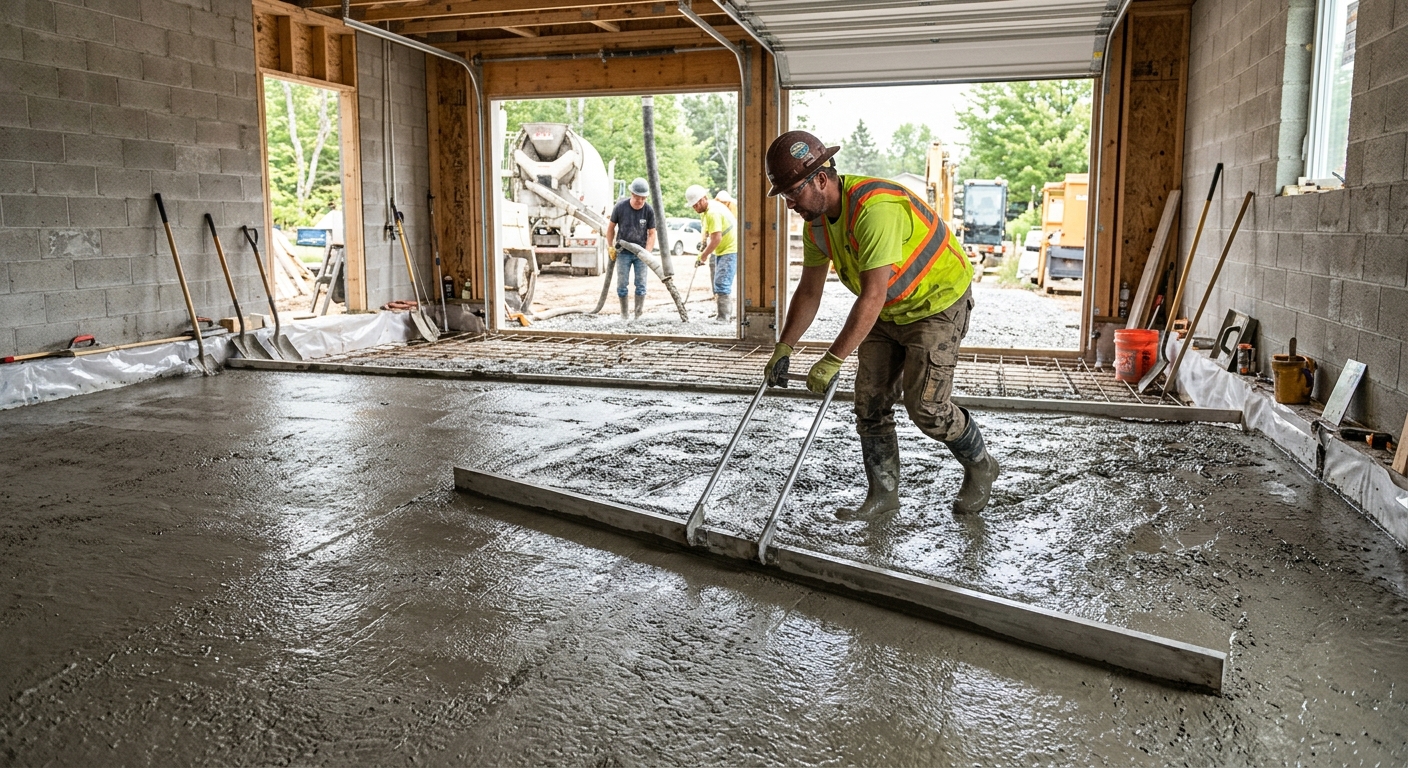
Concrete work options and costs in Terrace
In Terrace, concrete work tends to be priced around durability and weather readiness as much as square footage. About 60.0% of local dwellings are single-detached homes (Statistics Canada, 2021 Census), which is why driveways, patios and walkways are steady demand items for homeowners—especially in neighbourhoods like Thornhill and the areas around the city’s downtown core. North Coast freeze-thaw cycles and coastal wet weather mean the “cheap option” rarely wins on long-term performance: exterior slabs typically need air-entrained concrete, properly drained granular base prep, and correctly spaced control joints to manage movement and moisture.
Concrete costs in the Terrace market also reflect practical scheduling realities. The effective pour season can tighten when temperatures swing, and curing protection becomes more important when rain is likely soon after a pour. On some smaller sites, truck access is limited by grades and landscaping, which affects excavation scope, pumping needs, and cleanup time. In other words, two projects that look similar on paper can differ in labour, mobilization, and materials—and it’s why homeowners often see quote differences based on site conditions rather than “concrete only.” With Terrace’s housing stock—58.1% of homes built before 1981 (Statistics Canada, 2021 Census)—many jobs involve retrofits around older foundations, mature trees, and existing drainage patterns, which can increase prep costs.
Below is a practical cost comparison of common concrete options to help you translate a quote into scope and finish decisions before you compare contractors.
| Application |
Typical Size |
Key Spec |
Finish Option |
Price Range |
| Concrete driveway (standard broom finish) |
400 sq. ft. |
Reinforced slab; exterior air-entrained mix; control joints |
Broom finish, cut joints |
$12,000–$22,000 |
| Exposed aggregate driveway |
400 sq. ft. |
Air-entrained mix; decorative aggregate reveal; sealing |
Exposed aggregate with seal coat |
$16,000–$28,000 |
| Stamped concrete driveway or patio |
300 sq. ft. |
Air-entrained decorative mix; proper base and joints |
Stamp pattern + integral colour |
$9,000–$18,000 |
| Plain concrete patio or walkway |
200 sq. ft. |
Exterior mix; compacted base; joints |
Broom or smooth trowel (project-dependent) |
$1,800–$5,000 |
| Garage floor (interior slab) |
300 sq. ft. |
Reinforcement; vapour considerations if required; proper base |
Light broom / trowel finish |
$7,000–$14,000 |
| Foundation footings (structural, below frost) |
Per linear foot (project-dependent) |
Below local frost depth; engineered spec; reinforcement |
Structural concrete, formwork as required |
$6,000–$12,000 |
Prices are estimates only and vary by project scope, site access and material selection.
What affects the price of concrete work in Terrace
In Terrace and across the North Coast of British Columbia, quotes for the same concrete job can swing by 30–50% because the price is driven by exposure conditions and site work—not just the amount of concrete poured. A driveway priced at the low end for one property may jump to the high end on a different lot if excavation is deeper, dewatering is needed, or if access forces extra labour. The climate is a big part of that: freeze-thaw cycles dictate every exterior spec. Footings must extend below the design frost depth to prevent frost heave, and exterior slabs generally require air-entrained concrete to survive repeated expansion and contraction. Cold-weather curing precautions also matter—if the crew can’t complete finishing and curing under favourable conditions, contractors often add heating, insulated blankets, or protection time to reduce surface damage and strength loss.
On top of that, coastal wet conditions make curing more sensitive to early rain and wind-driven moisture. That shortens the practical pour season and increases scheduling risk, especially when you’re working on smaller sites where crews wait longer for access or for weather windows. If your home is in an older area with mature landscaping, retrofits around drainage pathways can raise prep costs. For example, replacing a driveway with proper compacted base and drainage may align with the region’s typical concrete driveway range of $12,000–$22,000 for a mid-sized project, while a stamped concrete driveway or patio (more materials and labour per square foot) often lands in the $9,000–$18,000 band for a typical decorative scope.
A practical illustration: if a straightforward broom-finished patio is estimated at the low end of the plain patio band (often $1,800–$5,000 for smaller areas), upgrading to stamped work can be worth it—but only if the base prep is the same. Decorative finishes don’t “fix” a weak base; they just make a weak base more expensive.
| Price Factor |
Why It Matters |
Cost Impact |
| Frost line depth — determines footing depth and form height |
Ensures footings sit below frost to prevent heave |
Higher excavation and formwork; can add thousands depending on soil/grade |
| Site preparation — excavation, grading, compacted granular base |
Drainage and compaction prevent settlement and pumping water |
More granular, hauling, and labour; typical quote swing when access is difficult |
| Reinforcement — rebar or wire mesh requirement |
Controls cracking and improves load capacity |
Material + placement labour; increases cost on driveways and garage slabs |
| Mix design — air-entrainment and compressive strength spec |
Improves durability through freeze-thaw and wet exposure |
Small material cost increase, but non-negotiable for exterior work in Terrace |
| Finish type — broom vs. stamped vs. exposed aggregate |
More time, specialized labour, and consumables for decorative finishes |
Stamped/exposed typically add significant labour and materials |
| Pour size and concrete truck access to site |
Access affects pumping, hose runs, and schedule |
Extra charges for pumping or longer carries; can raise mobilization costs |
| Cold-weather curing precautions — heating and blankets |
Protects strength gain and surface integrity |
Adds labour, materials, and sometimes delays |
| Control joint pattern and sealing cost |
Manages cracking and reduces moisture/ice damage |
Sealers and saw-cut labour add cost, but improve lifespan |
Permits & regulations in British Columbia
In British Columbia, structural concrete work typically requires a building permit—particularly when you’re creating or changing the load-bearing elements of a home. That usually includes: concrete footings, foundation walls, grade beams, and other structural foundation components that support the building. In many cases, engineered drawings are also reviewed as part of the permit process. For homeowners, that means permitting responsibility generally sits with the project team (often the builder/engineer), but you should still confirm who is pulling the permit before concrete is delivered.
Concrete flatwork—patios, walkways, and driveways—often does not require a permit by default. However, you may need a review if the work changes lot grading, involves drainage or runoff patterns, or affects municipal right-of-way conditions and surface coverage limits. Terrace projects can also be impacted by how stormwater is managed around the foundation; that’s one reason you should confirm expectations before demolition begins.
Before you sign, verify the contractor’s credentials in BC. Start with their business information and liability insurance certificate (request a COI and confirm the address/jobsite is covered). For workers’ coverage, ensure they have WSBC/WCB coverage for the crew. Then ask for references from similar-scale concrete work in northern BC climates. Finally, when possible, check the contractor’s licensing/registration using the relevant online registry and review the current status before scheduling a pour. If a contractor can’t provide insurance/coverage documentation or references, it’s a red flag in any Terrace neighbourhood.
Getting concrete right in Terrace's freeze-thaw climate
Concrete fails in Terrace when the base isn’t prepared correctly, the mix can’t handle freeze-thaw exposure, joints aren’t placed early enough, or curing is rushed by rain or early cold. The biggest drivers are moisture and movement: water gets under or into slabs, freezes, and expands—so exterior work must be engineered for drainage and durability, not just appearance. For your specs, focus on five steps.
(1) Base preparation: excavate to the right depth for the site and compact a granular sub-base to reduce settlement. In coastal wet conditions, drainage detailing matters because a “good-looking” subgrade that holds water will undermine the slab later. (2) Mix design: require air-entrainment for exterior flatwork (commonly 5–7% air content for better freeze-thaw resistance) and a minimum compressive strength appropriate to the project (often at least 32 MPa for typical structural/exterior durability requirements). (3) Control joints: set a planned joint pattern early so cracks, if they occur, open where you intended rather than randomly. (4) Curing: allow a minimum 7 days of proper curing under protective conditions—cold weather or early rain can weaken the surface finish and reduce strength gain. (5) Sealing: apply a penetrating sealer after cure (commonly at 28 days post-pour for many products) to repel moisture and help reduce damage from de-icing salts and water exposure.
Here’s where pricing makes sense: if a plain patio is in the $1,800–$5,000 band, you’re paying for the essentials. Upgrading to stamped work can land around $9,000–$18,000 depending on size and detailing, but that premium is justified only if the base, mix, joints, and curing meet the same durability standard. Stamping won’t compensate for inadequate air-entrainment—spalling from freeze-thaw typically shows up later, and repair costs are far higher.
| Spec |
Why It Matters in Terrace |
What to Ask For |
Impact if Skipped |
| Compacted granular base (depth?) |
Reduces settlement and helps drainage during wet seasons |
Base depth to match frost and site conditions; compaction test or documented process |
Cracking, uneven slab, water pooling, early deterioration |
| Air-entrained concrete mix (target air %?) |
Improves freeze-thaw durability in exterior exposures |
Ask for 5–7% air content for exterior flatwork |
Spalling and surface scaling over freeze-thaw cycles |
| Compressive strength (MPa rating) |
Strength gain supports abrasion resistance and long-term performance |
Minimum 32 MPa (or as engineered/spec’d for the project) |
Soft surface, premature wear, reduced durability |
| Control joints (spacing per ACI guidelines) |
Controls where cracking occurs as the slab moves |
Joint spacing plan and saw-cut timing before random cracking develops |
Random cracks, moisture pathways, faster freeze-thaw damage |
| Minimum 7-day curing period |
Cold and rain windows can slow strength gain |
Protection plan if temperatures drop or rain is forecast |
Weaker surface finish and reduced long-term strength |
| Penetrating sealer (when applied after cure) |
Helps repel moisture and reduces salt/water impact |
Apply after cure (often at 28 days) with product-surface compatibility |
Higher risk of water ingress, scaling, and staining |
How to choose a concrete work contractor in Terrace
Choosing a concrete contractor in Terrace is mostly about confirming three things: credentials, clarity of scope, and whether they build to durability specs for freeze-thaw. In British Columbia, verify the contractor’s business status and request proof of liability insurance (a current certificate of insurance showing coverage for the work). Also confirm they have WSBC/WCB coverage for their workers. If a contractor can’t provide these documents before you schedule a pour, don’t wait—any delays can disrupt your weather-window and curing plan, which matters here.
Next, get 2–3 itemised written quotes. You want labour and materials broken out (excavation, base material, reinforcement, concrete supply, finish labour, joints, sealing, disposal). Avoid lump-sum quotes that don’t specify what’s included. Read the scope for exclusions like: permitting (if applicable), dewatering, insulation/blankets for cold pours, saw-cutting and joint sealing, haul/disposing of excess material, and concrete truck washout. For warranties, ask for the workmanship warranty length, whether there’s a separate product/manufacturer warranty for sealers or admixtures, and whether it’s transferable if you sell the home.
Payment scheduling matters in northern BC projects: never pay more than about 10–15% upfront, and hold back funds until the work is complete and cured to the agreed acceptance standard. Finally, insist on a written timeline with a realistic start date and completion estimate, including weather contingency if rain or cold interrupts finishing and cure protection.
- Ask for proof of liability insurance and current WSBC/WCB coverage before contract signing.
- Request references for similar driveway/patio jobs in wet-freeze climates (northern BC experience is a plus).
- Get itemised quotes: excavation, base, reinforcement, concrete supply, finishing, joints, sealing, disposal.
- Confirm frost-depth compliance and the exact base prep method they use on your lot.
- Ensure exterior work includes air-entrainment and a specified finish approach.
- Verify joint plan: spacing, saw-cut timing, and whether joints are sealed.
- Ask how they protect curing when rain or cold weather is forecast.
- Check whether dewatering/pumping is included if the excavation is wet.
- Clarify concrete truck access (pump vs hose length) and whether that affects labour.
- Confirm disposal: where excavated material goes and whether hauling is included.
- Review warranty terms in writing (workmanship length, coverage limits, acceptance criteria).
- Set payment schedule: 10–15% max upfront; holdback until completion and walk-through.
Concrete-specific red flags in Terrace include: crews who won’t state whether the exterior mix is air-entrained, quotes that omit control joints and curing protection, “cheap” decorative pricing that doesn’t mention base prep and sealing, no proof of WSBC/WCB or liability insurance, and contractors who ask for most payment upfront or avoid putting timelines in writing.
Frequently asked questions — concrete work in Terrace
How long does concrete take to cure?
In Terrace, concrete curing is a combination of time and conditions (temperature, rain, and wind). For most slabs and flatwork, you should plan for at least a 7-day curing period before treating the surface as fully stable for light use. Strength keeps increasing after that, but early performance is what protects against freeze-thaw damage. If rain is likely soon after the pour, the contractor should use curing protection strategies so the surface doesn’t dry out or get damaged while strength is still developing.
Decorative work (like stamped concrete) can also need extra care so you don’t compromise finishing or colour development. If your quote is in the standard concrete driveway band of $12,000–$22,000, ask whether the crew includes a curing plan and whether they schedule around weather windows typical for the North Coast. (Statistics Canada, 2021 Census) indicates a stable homeowner market; it doesn’t change cure timing, but it does mean most homeowners want predictable scheduling in a short pour season.
Do I need a permit for concrete work in British Columbia?
In British Columbia, structural concrete work generally requires a building permit, including things like footings, foundation walls, and grade beams. For concrete flatwork—such as patios, walkways, and driveways—permits are often not required unless the work affects lot grading, drainage patterns, impervious surface coverage limits, or municipal right-of-way conditions. Because Terrace projects can be impacted by site drainage and runoff near older foundations, it’s smart to confirm with the local authority before you start.
When you compare quotes, ask explicitly whether the contractor is handling permitting (if it applies) or whether you must. A good contractor will also confirm whether engineered drawings are needed for foundation-related scope. For flatwork, they should still discuss drainage and how they’ll manage runoff so you don’t create new problems. If you’re working within the plain patio/work-walkway pricing band of $1,800–$5,000, the scope is usually simpler, but that doesn’t mean grading details should be ignored.
Concrete vs pavers for a patio in Terrace?
Concrete and pavers can both work well in Terrace, but the decision usually comes down to maintenance expectations and the quality of base prep. Concrete patios—especially air-entrained exterior pours with control joints—handle freeze-thaw well when the base is properly compacted and drained. Pavers can also perform well, but they rely heavily on the sand setting bed, edging restraints, and long-term drainage; if water is trapped beneath, you can get heaving or unevenness.
From a cost perspective, a plain concrete patio or walkway often fits the smaller scope band of $1,800–$5,000 (project-dependent). Stamped decorative options can rise into the $9,000–$18,000 band depending on size and detailing. Pavers can be competitive, but they usually require careful edging and more ongoing inspection after a wet winter. If you want a low-maintenance look and you’re confident the contractor will build to exterior durability specs, concrete is often the straightforward choice in Terrace’s North Coast conditions.
How long does a concrete driveway last?
A well-built concrete driveway in Terrace often lasts for decades, but the exact lifespan depends on base prep, drainage, air-entrainment, joint placement, and curing. In freeze-thaw conditions, the most common early issues are scaling/spalling at the surface and cracking from movement or moisture. Those risks are largely controlled before the first truck arrives: excavate properly, compact the base, use an exterior-rated air-entrained mix, and install control joints on a planned pattern.
Cost and duration are connected. Driveways in the regional band of $12,000–$22,000 typically include the practical durability items: reinforcement, a proper sub-base, and exterior finish choices that stand up to wet winters. If a quote is dramatically lower but doesn’t mention air-entrainment, joints, and curing protection, you’re often paying later through repairs. Ask what they do to prevent water from sitting under the slab (grading/drainage), and whether they seal the surface when appropriate.
What is air-entrained concrete and why does it matter here?
Air-entrained concrete is mixed with tiny, evenly distributed air bubbles that give freezing water room to expand. In Terrace, that matters because exterior slabs go through repeated freeze-thaw cycles and coastal wet weather. Without air-entrainment, water in the concrete can freeze and expand in ways that damage the cement paste, leading to surface scaling and spalling—often the first visible sign of durability problems.
When you’re getting an exterior quote, especially for driveways and patios, ask the contractor to specify that the mix is air-entrained and to state the target air content (commonly 5–7% for exterior flatwork). Also ask about joint spacing and sealing, since moisture still matters even with the right mix. If your project is a stamped or decorative option, you’ll still want the same durability base and mix—decorative finish is not a substitute for air-entrainment. In Terrace’s market, exterior durability spec is part of why pricing for driveways commonly sits in the $12,000–$22,000 range.
How do I prepare the base for a concrete slab?
Base preparation is where concrete performance is made or lost in Terrace. The goal is a stable, well-drained foundation that minimizes settlement and reduces water trapped under the slab. Your contractor should excavate to a depth that matches local frost considerations and the project design, then place and compact a granular sub-base to the required thickness and compaction level. If the area is wet, ask how they’ll handle dewatering so the base isn’t churned up during the pour period.
Ask what they use for drainage and how they ensure water can’t pool at the slab edge. For exterior slabs, the mix should be air-entrained, and reinforcement and control joints should be planned before concrete is delivered. If you’re comparing quotes for a driveway that falls near the $12,000–$22,000 band, make sure the base prep is clearly described—not just “concrete only.” For a smaller patio in the $1,800–$5,000 band, you should still expect the same principles: correct excavation, compacted granular base, joints, and a real plan for curing in North Coast weather.