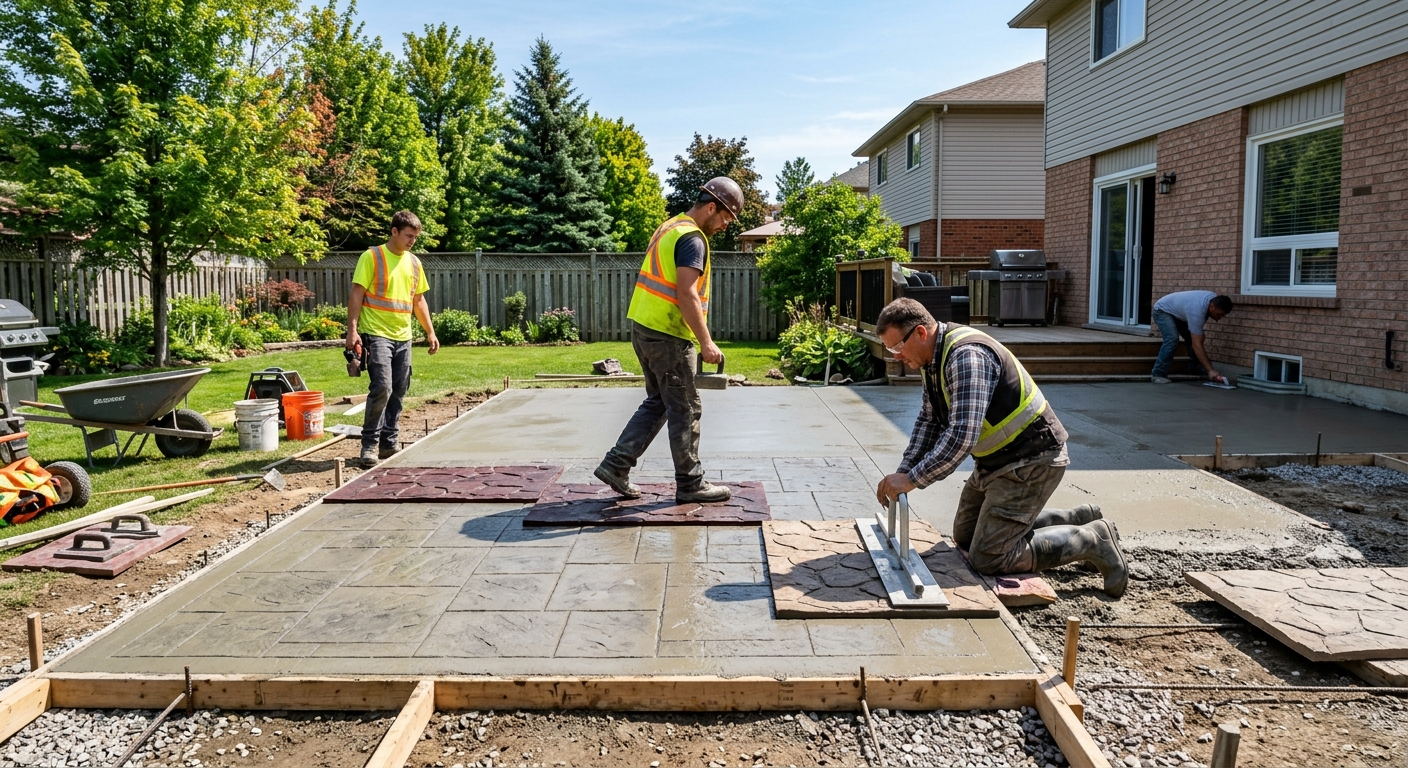
Concrete work options and costs in Sooke
Sooke is a place where homeowners rely on solid concrete flatwork year-round—driveways, patios, and walkways have to handle constant dampness, coastal winds, and the region’s freeze–thaw cycles. In a community of 15,086 people (Statistics Canada, 2021 Census), most families are in owner households (80.3% of households own), and single-detached homes make up a large share of the housing stock (62.3% of dwellings). That combination is why driveway and patio work is consistently in demand around areas like East Sooke and the Summit neighbourhood, where lots tend to be steep and drainage planning is part of the job.
On Vancouver Island and the Coast, pricing is shaped by a relatively shallow frost line compared to the Interior, but local codes still require footings and exterior slabs to be designed for frost protection. That means excavating below frost and building a proper granular base, even when winters are milder. Freeze–thaw cycles also push durability requirements: air-entrained concrete, well-managed drainage, and correct control joint planning are non-negotiable for minimizing surface scaling and random cracking.
Finally, you’ll notice contractor availability and scheduling can affect cost. Rainy stretches slow curing and may require protective coverings or mix adjustments. A well-run crew can keep your pour moving, but weather contingencies are built into many quotes—especially for larger slabs or exposed finishes.
Use the table below to compare typical options and realistic price ranges for Sooke projects.
| Application |
Typical Size |
Key Spec |
Finish Option |
Price Range |
| Concrete driveway (standard broom finish) |
20' x 10' (200 sq. ft.) |
Exterior slab on compacted granular base |
Broom finish + edging + joints |
$3,200 – $5,000 |
| Exposed aggregate driveway |
20' x 10' (200 sq. ft.) |
Air-entrained exterior mix |
Exposed aggregate with sealer |
$4,200 – $6,200 |
| Stamped concrete driveway or patio |
16' x 12' (192 sq. ft.) |
Exterior mix + integral color |
Stamp pattern + release + sealer |
$4,200 – $6,700 |
| Plain concrete patio or walkway |
12' x 8' (96 sq. ft.) |
Proper base + reinforcement as needed |
Float/screed + light broom finish |
$1,300 – $2,300 |
| Garage floor (interior slab) |
20' x 20' (400 sq. ft.) |
Vapour barrier + granular base (varies) |
Standard finish with control joints |
$5,800 – $10,000 |
| Foundation footings (structural, below frost) |
House perimeter varies |
Below frost depth with granular levelling |
Structural concrete + rebar cage |
$10,500 – $18,000 |
Prices are estimates only and vary by project scope, site access and material selection.
What affects the price of concrete work in Sooke
In Sooke, you can see the same driveway-size concrete job come in 30% to 50% apart between quotes, even when finish looks similar. The biggest drivers are the specs that don’t show: frost protection depth, subgrade condition, and whether the contractor is building for long-term durability in a Vancouver Island and Coast climate that cycles between wet and freezing. Concrete pricing also reacts to labour demand and truck mobilization around the Island—if your schedule lands during a busy weather window, crews may need extra manpower or protective measures to meet curing expectations.
Practically, frost depth and freeze–thaw cycles dictate your entire foundation and exterior-slab recipe. Exterior work generally requires air-entrained concrete mixes to survive repeated wetting and freezing, and footings must extend below the local design frost band to prevent frost heave and uneven settlement. Colder BC regions often pay more for deeper earthworks and shorter pour seasons, but in coastal Sooke we still plan for cool, saturated soils that slow strength gain—so your contractor may price in mix upgrades, curing blankets, or scheduling buffers when temperatures drop.
Two common Sooke examples: (1) a sloped lot near East Sooke or the Summit can increase excavation and disposal, pushing you toward the upper end of flatwork pricing (for instance, driveway work can land closer to the $16–$25 per sq. ft. backbone range when the base needs extra reconstruction). (2) If your driveway ties into an older apron or includes regrading, a “simple pour” can become a drainage and base-prep job—often closer to the $22–$35 per sq. ft. stamped/decorative range once colour, stamping, and additional labour are included. Homes built before 1981 (31.4% of dwellings, Statistics Canada, 2021 Census) may also have older drainage patterns, which is one reason replacement flatwork frequently includes subgrade assessment and sometimes reinforcement changes.
| Price Factor |
Why It Matters |
Cost Impact |
| Frost line depth — determines footing depth and form height |
Controls frost heave risk and how much concrete/excavation you need |
More excavation and height = higher material and labour |
| Site preparation — excavation, grading, compacted granular base |
Bad base leads to settlement and cracking |
Rebuild subgrade can add significant time and disposal |
| Reinforcement — rebar or wire mesh requirement |
Helps control cracking in larger slabs and exterior traffic areas |
Extra steel, chairs, and placement labour |
| Mix design — air-entrainment and compressive strength spec |
Durability in freeze–thaw cycles and strength gain in cool weather |
Higher-performance mix can add per-cubic-yard cost |
| Finish type — broom vs. stamped vs. exposed aggregate |
More labour steps and materials for decorative surfaces |
Stamped/exposed work usually costs more than broom finish |
| Pour size and concrete truck access to site |
Long carries, tight access, and multiple loads raise placement cost |
Mobilization fees and extra crew time |
| Cold-weather curing precautions — heating and blankets |
Protects strength gain and reduces surface damage |
Added materials and labour during cold snaps |
| Control joint pattern and sealing cost |
Controls cracking and reduces moisture/salt intrusion |
More layout work and sealing materials after cure |
Permits & regulations in British Columbia
In British Columbia, the permitting approach depends on whether the work is structural or just flatwork. In most cases, structural concrete work—such as footings, foundation walls, and grade beams—requires a building permit, and engineered drawings are often reviewed by the municipality. For concrete flatwork (patios, walkways, driveways), a permit usually is not required by default, unless the project affects lot grading, triggers impervious surface coverage limits, changes drainage in a way that impacts neighbouring properties, or involves work within or affecting the municipal right-of-way. The safest way to proceed in Sooke is to confirm with the local authority before breaking ground.
Before you hire, verify your contractor is set up for insurance and jobsite compliance. Step-by-step for homeowners in Sooke: (1) Confirm the contractor’s licence and business status on the relevant provincial/online registry that lists businesses authorized to perform construction work. (2) Ask for a current certificate of insurance showing general liability coverage; your contractor should list your address as an additional insured where applicable. (3) Confirm Workers’ Compensation coverage via the WSBC/WCB clearance process—get a copy of the clearance letter or verification number. (4) Review past projects that match your scope (exterior slab, drainage-heavy sites, or decorative finishes) and request references for similar Vancouver Island freeze–thaw conditions.
If a quote doesn’t clarify who pulls permits (when required) or how they handle engineered details, ask directly—those omissions can lead to delays and expensive rework.
Getting concrete right in Sooke's freeze-thaw climate
Concrete failures in Sooke are usually predictable: freeze–thaw damage, inadequate base prep, and poor joint or curing practices. The coastal climate is milder than the Interior, but repeated wetting and freezing still puts stress on surfaces and expands water trapped in pores. The right way to spec your project is to build the full system—base, mix, joints, curing, and sealing—so water can’t get in and the concrete has the durability needed for long service life.
(1) Base preparation is where you win or lose. Use a compacted granular sub-base to the correct depth for your soil and frost protection needs, and ensure drainage is addressed before placement. (2) Mix design should include air-entrainment—commonly 5–7% air content for exterior flatwork—plus a minimum compressive strength target of 32 MPa so the concrete reaches sufficient strength even in cool weather. (3) Control joints must be planned with a realistic pattern and consistent tooling to limit random cracking. (4) Curing matters more than many homeowners expect: plan for at least 7 days of proper curing conditions, and if temperatures drop, the contractor may need curing blankets or protection to avoid surface weakness. (5) Sealing is typically a minimum 28 days post-pour with a penetrating sealer to repel de-icing salts and reduce moisture intrusion.
Ask these questions to avoid the most common failure—spalling from inadequate air-entrainment. If a contractor can’t clearly state air content targets, curing method, joint spacing, and sealer timing, you’re taking unnecessary risk. As a dollar example: upgrading from a basic broom-finish driveway to an exposed aggregate option can add about $1,000 to $2,000 on a typical 200 sq. ft. driveway. That premium is justified when it comes with correct mix specs, stronger finishing procedures, and proper sealing—not just a change in appearance.
| Spec |
Why It Matters in Sooke |
What to Ask For |
Impact if Skipped |
| Compacted granular base (depth?) |
Reduces settlement and frost-related movement in coastal soils |
Granular base depth and compaction test/standard used |
Cracking, uneven surface, and joint failure |
| Air-entrained concrete mix (target air %?) |
Protects against freeze–thaw scaling and spalling |
Target air content (often 5–7% for exterior flatwork) |
Surface scaling and spalling in winter conditions |
| Compressive strength (MPa rating) |
Strength gain supports durability under repeated freeze–thaw stresses |
Minimum 32 MPa compressive strength target |
Lower durability and higher cracking risk |
| Control joints (spacing per ACI guidelines) |
Controls shrinkage and limits random cracking paths |
Planned joint spacing and timing of joint cutting/tooling |
Unpredictable cracking and water entry |
| Minimum 7-day curing period |
Cool, wet periods slow strength gain on Vancouver Island |
Curing duration and protection method in cool weather |
Surface weakness and early wear |
| Penetrating sealer (when applied after cure) |
Helps repel moisture and de-icing salts where used |
Penetrating sealer after cure, typically 28 days post-pour |
Faster staining, moisture intrusion, and premature surface damage |
How to choose a concrete work contractor in Sooke
Choosing a concrete contractor in Sooke is mostly about confirming they’ll build to the durability specs your climate demands—not just pouring concrete. Start by verifying British Columbia licensing and insurance. Ask for: (1) proof of current business/contractor authorization (look for the online registry entry that matches the legal business name on the contract), (2) a current certificate of general liability insurance, and (3) WSBC/WCB coverage confirmation (a clearance letter or verification). If they can’t provide documents promptly, treat that as a serious red flag.
Next, get 2–3 itemised written quotes. You want a breakdown that separates labour and materials and clarifies what’s included: granular base depth, reinforcement type and placement, air-entrainment/mix spec, joint plan, curing method, and whether sealing is part of the scope. A lump-sum quote without specs is hard to compare. Make sure permit responsibility is stated when structural work needs permits, and confirm whether disposal, saw-cutting, and protection of landscaping are included.
For warranty, ask for workmanship warranty length and whether it applies to cracking associated with improper curing/jointing. Also ask about product/manufacturer warranties for specialty materials like sealers or admixtures and whether they are transferable to you as the homeowner. Payment schedule should be conservative: never pay more than about 10% to 15% upfront, and use a holdback until completion and cleanup are verified. Finally, insist on timeline terms—start date and estimated completion—written into the contract.
- Provide mix design details, including air-entrainment targets for exterior flatwork.
- State frost/protection approach and granular base depth in writing.
- Show the planned control joint layout and tooling/cutting timing.
- Confirm curing plan (blankets/protection if cold snaps occur).
- Include sealing scope: product type and timing (often after cure).
- List reinforcement: rebar vs. mesh, size, spacing, and support chairs.
- Confirm excavation limits, disposal, and restoration of disturbed areas.
- Clarify truck access plan for Sooke roads/drive slopes and pumping needs.
- Ask what is excluded (demo, hauling, permits, engineering, hydro/utility locates).
- Request evidence of insurance and WSBC/WCB clearance before scheduling.
- Review warranty terms for workmanship and any conditions or exclusions.
- Use a written schedule with start/completion dates and weather contingency notes.
Concrete red flags in Sooke: (1) vague talk about “good concrete” without stating air content and strength targets, (2) no plan for control joints or sealing in freeze–thaw conditions, (3) skipping granular base detail and compaction expectations, (4) pressure for large upfront payments or no holdback, and (5) a contract that doesn’t spell out who pulls permits when structural work is involved.
Frequently asked questions — concrete work in Sooke
How do I compare concrete quotes?
Start by comparing like-for-like specs, not just the final number. In Sooke (and across Vancouver Island and the Coast), quotes can differ by 30% to 50% when one company includes a proper granular base, reinforcement, and air-entrainment while another gives a thinner “commodity” scope. Ask each bidder to list labour and materials separately and specify: air-entrained mix targets for exterior flatwork, minimum compressive strength, granular base depth, reinforcement type, joint spacing and timing, curing protection, and whether sealing is included and when it’s applied. If you’re budgeting for a driveway, use the local backbone pricing as a sanity check—standard broom-finish driveway work often falls around $16–$25 per sq. ft. If your quote is far outside that range, ask what’s different.
Can concrete be poured in cold weather in Sooke?
Yes, concrete can be poured in cold weather in Sooke, but it must be protected and properly managed. Coastal winters still bring damp cold snaps that slow strength gain, which can lead to weak surfaces or early surface damage if curing is rushed. A competent contractor plans for cold-weather curing using insulation blankets, wind protection, and temperature monitoring, plus mix adjustments as needed to meet performance targets. Ask how they protect the slab during the pour and through the critical early curing period. For exterior flatwork, don’t accept a plan that only says “we’ll pour and hope”—you want a documented curing method and at least 7 days of protection. If they can’t explain their cold-weather process, expect durability issues later during freeze–thaw cycles.
How do I maintain concrete in Sooke's freeze-thaw climate?
Maintenance in Sooke is about keeping water and salts from attacking the surface. First, allow the concrete to cure properly before sealing—many contractors apply a penetrating sealer after cure, often around 28 days post-pour. Keep an eye on drainage: if water pools near the slab edges, you’ll increase freeze–thaw stress and risk joint deterioration. For driveways and patios, sweep debris regularly so standing moisture doesn’t sit in low spots. Avoid harsh de-icing practices; if you do use de-icers, use them carefully and stay consistent with the sealer plan. If you notice scaling, spalling, or widening joints, address it early—repairing joint edges and resealing spots is usually cheaper than replacing a damaged section.
What causes concrete to spall in Sooke winters?
Spalling is commonly caused by freeze–thaw damage when water enters the concrete and expands as it freezes. In Sooke and throughout coastal BC, that cycle is intensified by damp conditions and how the surface was finished and cured. The most important technical cause is inadequate air-entrainment—air-void systems provide room for freezing water to expand, reducing internal pressure. Other contributors include poor base preparation, weak curing conditions, and control joints that are missing or too widely spaced, allowing random cracking and water pathways. If you’re seeing spalling on an exterior slab, ask whether the concrete was air-entrained and whether joints were planned and sealed. In many real-world issues, the “cheapest” mix choice is what creates the later repair cost.
What is rebar and when is it required in British Columbia?
Rebar is reinforcing steel embedded in concrete to help control cracking and improve structural performance, especially in slabs subjected to loads, movement, or thicker sections. In British Columbia, when the work is structural—such as certain foundation elements—rebar requirements are typically determined by engineering and the building design being reviewed. For exterior flatwork like driveways, reinforcement needs can vary with slab thickness, soil conditions, and span/loading, and may be specified by the contractor’s engineered approach or local best practice. In Sooke, reinforcement is often discussed alongside base prep because settlement and movement make cracks more likely. Ask your contractor what reinforcement they’re using (rebar vs. wire mesh), the bar size/spacing, and how it’s supported so it sits in the correct position. A durable exterior slab isn’t just about thickness—it’s about correct placement and restraint.
How long does a concrete project take in Sooke?
Timelines depend on size, site access, and weather conditions, but you can use realistic planning expectations for Sooke. Demo and excavation can take 1–3 days for many driveway or walkway projects, followed by base grading and forms/reinforcement preparation. The actual pour is often just hours, but finishing and protection determine whether it’s successful. Curing is the longer part: many jobs require careful protection for at least 7 days for strength development, with full durability continuing to build beyond that. If temperatures drop, your contractor may add curing time using blankets or heated protection. Decorative work (stamped or exposed aggregate) usually adds schedule because additional steps are required. As an example, a typical 200 sq. ft. driveway might be scheduled over about 1 week end-to-end, but curing affects when you can use the surface.