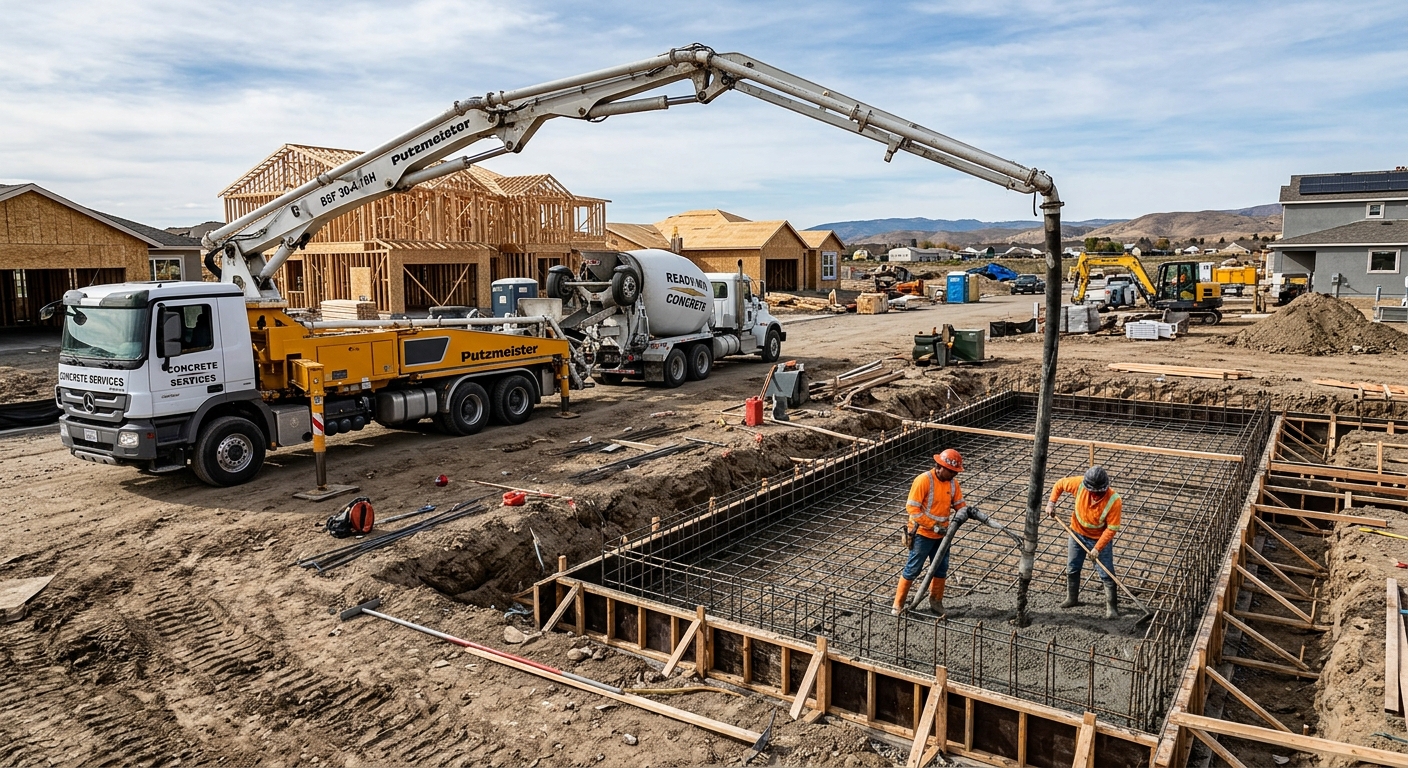
Concrete work options and costs in Telkwa
Telkwa is a small community in the Nechako region where concrete flatwork is a year-round need, but it’s priced and built around a true cold-climate interior reality. Most homeowners here live in single-detached houses—about 88.4% of dwellings—so driveways, patios, walkways, and garage floors are common upgrades (Statistics Canada, 2021 Census). With 495 homeowner households (88.4% of households own), there’s steady demand for durable slabs that can handle frost heave and freeze–thaw cycles without spalling or lifting.
Because the frost line and temperature swings are the main drivers, the cost of the “same-looking” concrete job can swing significantly. Nechako contractors typically excavate deeper and build a properly compacted granular base, then use air-entrained concrete for exterior slabs. Your pour season is also shorter in Telkwa than in southern B.C., so cold-weather curing precautions—insulated blankets, heaters, and tighter scheduling—can add labour and material costs. Supply and logistics matter too: even when the concrete price bands look straightforward, the region’s colder placement conditions and regional labour availability affect how crews schedule trucks and finishers.
In Telkwa, concrete work is especially in demand around the valley road access areas where driveways connect to existing gravel and drainage paths—properties near older lanes often need more base correction and grading. That’s why the best comparisons start with the finishes and structural specs, not just the square footage—see the table below.
| Application |
Typical Size |
Key Spec |
Finish Option |
Price Range |
| Concrete driveway (standard broom finish) |
12 m x 3 m (36 m²) |
Exterior slab; air-entrained concrete; control joints |
Broom finish with sealer option |
$18,000–$25,000 |
| Exposed aggregate driveway |
12 m x 3 m (36 m²) |
Air-entrained mix; proper base and edge support |
Exposed aggregate with honed look |
$20,000–$27,000 |
| Stamped concrete driveway or patio |
9 m x 3.5 m (31.5 m²) |
Air-entrained mix; release agent and integral colour |
Stamp + colour hardener |
$22,000–$33,000 |
| Plain concrete patio or walkway |
6 m x 2 m (12 m²) |
Exterior slab; air-entrained concrete; joints |
Steel trowel or broom depending on use |
$4,000–$7,000 |
| Garage floor (interior slab) |
6 m x 6 m (36 m²) |
Minimum 32 MPa; well-compacted sub-base |
Broom finish; optional hardener |
$16,000–$24,000 |
| Foundation footings (structural, below frost) |
Typical house run (varies) |
Engineered spec; below design frost depth; rebar per plan |
Structural concrete formwork and finish |
$12,000–$21,000 |
Prices are estimates only and vary by project scope, site access and material selection.
What affects the price of concrete work in Telkwa
In the Nechako region, homeowners often see quotes for the “same” driveway or patio that differ by 30–50%. In practice, those differences come from frost requirements, how much base correction is needed, how crews manage cold-weather placement, and what finish system is included. Even though B.C. material costs have risen, concrete pricing here is driven equally by temperature and labour logistics: longer excavation and more granular aggregate for a stable slab, plus additional care to prevent freeze–thaw damage.
A key driver is frost line depth and the resulting freeze–thaw cycles. Exterior slabs and structural footings must be detailed for frost movement, and footings need to extend below design frost depth to reduce heave risk. Concrete flatwork also needs air-entrainment to survive repeated freezing and thawing. Nechako’s shorter pour season means cold-weather curing precautions—heating, insulated blankets, and protective coverings—often add labour and equipment time. Finally, de-icing salt accelerates surface deterioration, so sealing becomes part of long-term performance.
In Telkwa, older lots can raise costs when drainage is off or when existing fill is unstable. That can add excavation and a thicker engineered base. Conversely, a straightforward replacement on a well-drained, already-prepped grade can keep costs closer to the lower end of the $18,000–$25,000 driveway band or the $4,000–$7,000 patio band. With 41.1% of homes built before 1981 (Statistics Canada, 2021 Census), it’s common to see older grading patterns and buried downspout runoff paths that need correction before concrete is poured.
| Price Factor |
Why It Matters |
Cost Impact |
| Frost line depth — determines footing depth and form height |
Deeper excavation and more concrete volume reduce frost heave |
High |
| Site preparation — excavation, grading, compacted granular base |
Compaction and drainage prevent settlement and cracking |
Medium to High |
| Reinforcement — rebar or wire mesh requirement |
Controls cracking and supports loads where specified |
Medium |
| Mix design — air-entrainment and compressive strength spec |
Air improves freeze–thaw durability; strength supports impact and load |
Medium |
| Finish type — broom vs. stamped vs. exposed aggregate |
Labour, materials, and curing workflow change by finish system |
Low to High (highest on stamped) |
| Pour size and concrete truck access to site |
Smaller or hard-access pours may require extra batching/handling |
Medium |
| Cold-weather curing precautions — heating and blankets |
Protects placement temperature and early-age strength development |
Medium to High |
| Control joint pattern and sealing cost |
Joints reduce random cracking; sealer improves surface resistance |
Low to Medium |
Permits & regulations in British Columbia
In British Columbia, permits and engineering requirements depend on what you’re building. Structural concrete work—typically footings, foundation walls, and grade beams—usually requires a building permit and often engineered drawings reviewed through the municipal process. Concrete flatwork like patios, walkways, and standard driveways typically does not require a permit by default, but it can become permit-relevant if your work affects lot grading, drainage, or impervious surface coverage limits, or if it impacts municipal right-of-way (for example, heavy changes near a driveway crossing).
Before breaking ground in Telkwa, confirm with the local authority on whether your specific scope needs a permit. Also ensure your contractor carries liability insurance and workers’ compensation coverage (WSIB / WCB depending on employer registration). Ask for references on similar-scale work in cold-climate conditions, since finishing and curing practices matter as much as the concrete strength.
Step-by-step, homeowners can verify a contractor in B.C. like this:
- Check the contractor’s licensing/registration status using the appropriate online registry listings (use the company name exactly as on the quote).
- Request a current Certificate of Insurance (COI) and confirm it’s active; ask that it names you if required by your municipality.
- Confirm workers’ compensation coverage by requesting proof of coverage (WSIB/WCB) before work starts.
- Ask for a written scope, not just an estimate—especially for footing depth, drainage details, and curing plan.
- Verify whether demolition, haul-off, and any permit fees are included or excluded.
Getting concrete right in Telkwa's freeze-thaw climate
Concrete failures in Telkwa are usually not about “bad concrete”—they’re about how the slab is built for freeze–thaw. The biggest risks are heaving from inadequate base support, cracking from movement that isn’t relieved, and spalling when air-entrainment or finishing/cure practices don’t match exterior conditions. Spec the job around the Nechako climate zone: deeper, well-compacted base; air-entrained mix; correct jointing; and protection during cold pours.
Start with base preparation: a compacted granular sub-base to the right depth for your soil and frost conditions, with drainage paths planned so water doesn’t sit under the slab. Next, mix design: for exterior flatwork, air-entrainment matters (commonly in the 5–7% range) and the concrete should meet at least 32 MPa compressive strength for durability. Then control joints: spacing should limit random cracking so the slab moves where you want it to. Curing is equally important—plan for a minimum 7-day curing period under proper conditions, and in cold weather use heaters or insulated blankets to prevent early freezing. After the cure, apply a penetrating sealer roughly at 28 days post-pour to repel de-icing salts and reduce water intrusion.
When you’re comparing options, pay attention to the few specs that affect longevity. For example, a broom-finish driveway might land near the lower end of the $18,000–$25,000 band, but paying for correct air-entrainment, base thickness, and joint work prevents the kind of surface breakdown that leads to premature repairs. Stamped concrete costs more—often in the $22,000–$33,000 range—but it’s only worth it when the structural prep and air content are still done to exterior-spec standards.
| Spec |
Why It Matters in Telkwa |
What to Ask For |
Impact if Skipped |
| Compacted granular base (depth?) |
Supports the slab through frost movement and settlement |
Confirm base thickness and compacted depth based on soil and drainage plan |
Settlement, slope issues, cracking |
| Air-entrained concrete mix (target air %?) |
Resists freeze–thaw deterioration and reduces risk of spalling |
Request air content targets (commonly 5–7% for exterior flatwork) |
Surface scaling/spalling, early breakdown |
| Compressive strength (MPa rating) |
Ensures durability and load resistance in a cold interior climate |
Minimum 32 MPa (confirm test cylinder spec) |
Lower strength, faster wearing on traffic areas |
| Control joints (spacing per ACI guidelines) |
Provides planned crack locations during movement |
Joint spacing pattern and saw-cut timing details |
Random cracking across the slab |
| Minimum 7-day curing period |
Builds early strength and reduces cracking from temperature/moisture swings |
Confirm curing method (protection in cold/wet weather) |
Premature freezing, reduced strength, surface defects |
| Penetrating sealer (when applied after cure) |
Helps repel water and de-icing salt exposure |
Ask for “when” and “which” sealer; target application around 28 days |
Higher water absorption, scaling in freeze–thaw cycles |
How to choose a concrete work contractor in Telkwa
Choosing the right concrete contractor in Telkwa is less about flashy photos and more about proof. First, verify British Columbia licensing/registration for the specific business doing the work. Next, ask for liability insurance and confirm coverage details on a current Certificate of Insurance (COI). For workers, request proof of workers’ compensation coverage (WSIB / WCB). If a company can’t provide documentation quickly, that’s a practical red flag—especially when excavation and heavy concrete handling are involved.
Then get 2–3 itemised written quotes. You want a labour + materials breakdown, with line items that reflect what actually changes the price in Telkwa: excavation/haul-off, granular base prep, reinforcement, concrete mix specs (air-entrainment and strength), finishing system, control joints, cold-weather protection, and sealing. Avoid a vague lump sum that doesn’t state whether disposal is included or whether municipal paperwork is handled if a permit is required. Make sure the scope clearly states what’s excluded (for example, replacing drains, regrading beyond a certain area, or removing oversized roots).
Warranty matters too. Ask for workmanship warranty length, whether it covers labour for repair, and whether product/manufacturer warranties apply to sealers or decorative systems. Confirm if warranties are transferable if you sell the home. For payment, never pay more than 10–15% upfront; hold back until the job is complete and joints/sealer timing are addressed. Finally, request a written start date and an estimated completion timeline that accounts for winter curing requirements.
- Ask for proof of insurance (COI) and confirm it’s active.
- Verify workers’ compensation coverage (WSIB/WCB) before work starts.
- Request licensing/registration proof for the contractor’s business name.
- Get itemised quotes (labour + materials), not only a single total.
- Confirm concrete mix spec: air-entrainment and minimum 32 MPa.
- Ask how deep the base/sub-base is and how it’s compacted.
- Confirm reinforcement plan (mesh vs rebar) per the intended use.
- Clarify joint layout: spacing and saw-cut/placement timing.
- Ask about cold-weather plan (blankets/heaters) and curing protection.
- Confirm sealing: product type and timing around 28 days.
- Make sure disposal/haul-off and site restoration are stated in writing.
- Agree on a payment schedule with a holdback until final inspection.
Concrete contractor red flags in Telkwa include: quotes that don’t mention air-entrainment or joints, skipping a written cold-weather curing plan, “all-in” pricing that omits excavation/disposal details, refusing to provide COI or workers’ compensation proof, and scheduling pours without confirming truck access or base compaction requirements.
Frequently asked questions — concrete work in Telkwa
What is a concrete overlay and is it suited to Telkwa?
A concrete overlay is a new surface layer placed over an existing concrete slab—often to improve appearance or correct minor surface damage. In Telkwa, it can be suitable only when the existing slab is still structurally sound, level enough, and not actively failing from freeze–thaw. Overlays work best where cracks are stable and drainage is corrected, because trapped water and ongoing movement will eventually telegraph through and break the bond. If you’re dealing with surface spalling from de-icing salt or joints that are no longer functioning, overlay may delay the inevitable repairs. Cost-wise, an overlay project can be competitive compared with full replacement, but your total price will depend on prep—scarifying, patching, and whether the underlying slab is properly evaluated. For many homeowners, the “right” choice ends up closer to a driveway-level budget in the $18,000–$25,000 range when proper prep is needed.
How do I seal concrete to protect it in Telkwa?
In Telkwa and across B.C.’s cold interior, sealing is about reducing water and salt intrusion, which is important because freeze–thaw cycles can turn small moisture pockets into scaling and spalling. The usual approach is to cure the concrete first—think minimum 7 days for curing strength development—and then apply a penetrating sealer after the slab has fully cured, typically around 28 days post-pour. Use a product meant for exterior slabs and confirm it’s compatible with your finish (broom, exposed aggregate, or stamped). Before sealing, the surface should be clean and dry—no lingering dust, curing compounds, or wet patches—otherwise you can get poor penetration or blotchy performance. For homeowners, sealing also makes future cleaning easier. If your contractor offers sealing, ask for the exact sealer type and confirm coverage rate on the quote.
What is the difference between concrete and cement?
Cement is just one ingredient in concrete. Cement (often Portland cement) acts as the binder that reacts with water to create strength. Concrete is the finished composite—cement plus water, sand, gravel (aggregate), and sometimes admixtures such as air-entrainment agents for freeze–thaw durability. In Telkwa, you’ll mostly hear contractors talk about “the concrete mix” because the combined properties—especially air content and strength—determine how well the slab handles cold winters and moisture cycling. That’s why a quote should reference air-entrainment for exterior slabs and a minimum compressive strength such as 32 MPa, rather than focusing only on “cement brand.” When people compare prices, they’re often really comparing mix design, base preparation, reinforcement/joints, and how the contractor protects the pour during cold weather—not cement alone.
How much does concrete work cost in Telkwa?
Concrete costs in Telkwa depend mainly on site conditions, the finish, and how much frost-proofing is required through proper base prep and structural detail. For a practical reference, a concrete driveway (standard broom finish) typically falls in the $18,000–$25,000 band, while plain patios and walkways often land around $4,000–$7,000 for small to mid-size areas. Stamped concrete is usually higher—commonly in the $22,000–$33,000 range for driveway or patio scopes because of materials and additional labour for stamping and colour. Foundation footings are priced differently from flatwork and usually land in the $12,000–$21,000 range for typical runs, depending on engineering and excavation depth below frost. With 41.1% of local homes built before 1981 (Statistics Canada, 2021 Census), older grading and drainage issues can add prep cost—so itemised quotes are essential.
How deep must footings be for Telkwa's frost line?
Footing depth is determined by local frost conditions and the project’s engineered design, so the correct depth should come from your drawings and the applicable site frost requirements for B.C.’s interior climate. In general, footings must extend below the design frost depth to reduce frost heave—this is why excavation and formwork are a major portion of footing costs. In the Nechako region’s cold interior setting, contractors plan deeper excavation than in milder coastal areas, and they build the foundation to resist freeze–thaw movement. For your specific home, ask the contractor to confirm footing elevations and show how the depth matches the engineered foundation plan. If anyone offers to “estimate” footing depth without design specs, that’s not the approach you want. Get the engineering detail and verify it aligns with what the contractor intends to build.
Why does concrete crack in Telkwa and how is it prevented?
Concrete cracks are often normal shrinkage/movement—not a guaranteed defect—but in Telkwa they can become a durability issue if joints aren’t planned and if water gets in during freeze–thaw. The most common drivers are temperature cycling, drying/shrinkage early in the curing period, and soil movement from freeze heave when base prep and frost protection aren’t correct. Prevention is mainly in the spec: air-entrainment for freeze–thaw resistance, a properly compacted granular base, and correctly placed control joints that relieve stress so cracks occur where they’re designed to. Also, curing needs protection—minimum 7-day curing and cold-weather measures when temperatures drop—so early-age freezing doesn’t weaken the surface. Finally, exterior slabs should be sealed (often around 28 days after pour) to reduce water and de-icing salt intrusion. If you want a durable driveway in Telkwa, insist on joints and mix design, not only a “pretty finish.”