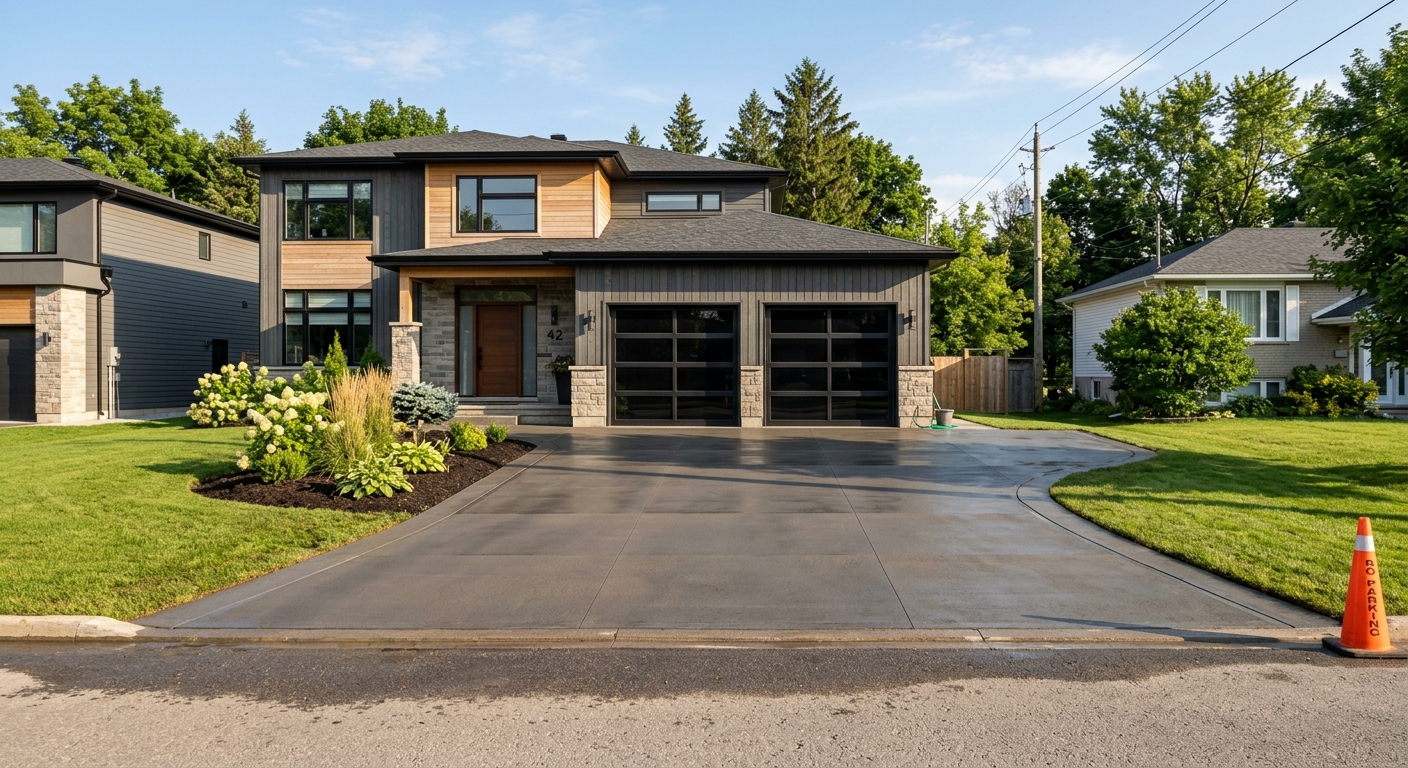
Concrete work options and costs in Qualicum Beach
Concrete work in Qualicum Beach is a little different than in drier, frost-free climates because we’re dealing with frequent wetting and freeze–thaw cycles along Vancouver Island and the Coast. That matters most for homeowners installing concrete flatwork—driveways, patios, and walkways—because these areas see direct weather exposure, vehicle loading, and de-icing salt. In Qualicum Beach, about 79.3% of dwellings are single-detached homes, which is exactly the kind of housing stock that typically upgrades or replaces exterior concrete as properties age. With 27.3% of homes built before 1981, it’s also common to see older slabs and walkways that need removal, regrading, or full replacement for proper drainage and frost protection.
Pricing and scheduling are shaped by local availability and weather windows. Even though coastal BC winters are milder than interior regions, cool temperatures and saturated soils slow strength gain and increase the risk of surface scaling if the mix, base prep, and curing plan aren’t done right. In neighbourhoods such as Errington Road and the surrounding Qualicum Beach rural interface, concrete is especially in demand due to frequent driveway and drainage retrofits for older lots and cottage-style properties.
Below is a practical comparison of common options, typical sizes, and what you should expect to pay. Use it as a baseline, then we can refine the numbers once we confirm excavation depth, soil conditions, steel requirement, truck access, and finish level.
| Application |
Typical Size |
Key Spec |
Finish Option |
Price Range |
| Concrete driveway (standard broom finish) |
400–600 sq. ft. |
Air-entrained exterior mix, compacted granular base, control joints |
Broom finish |
$16,000–$25,000 |
| Exposed aggregate driveway |
400–600 sq. ft. |
Proper cement paste control, air-entrainment, sealed for salt resistance |
Exposed aggregate finish |
$20,000–$30,000 |
| Stamped concrete driveway or patio |
300–500 sq. ft. |
Air-entrained mix, patterned release system, heavy-duty base |
Stamped & textured |
$22,000–$35,000 |
| Plain concrete patio or walkway |
200–400 sq. ft. |
Exterior mix, compacted base, broom/steel-trowel edging as needed |
Smooth broom or light steel trowel |
$14,000–$22,000 |
| Garage floor (interior slab) |
300–600 sq. ft. |
Vapour control, properly graded base, fibre or mesh per design |
Steel trowel + control joints |
$18,000–$28,000 |
| Foundation footings (structural, below frost) |
Varies by plan |
Excavation to design frost depth, reinforced concrete, drainage detailing |
Structural concrete |
$25,000–$45,000 |
Prices are estimates only and vary by project scope, site access and material selection.
What affects the price of concrete work in Qualicum Beach
In Qualicum Beach, you can see quotes for what looks like the same concrete job vary by 30–50% across Vancouver Island and Coast (and across wider British Columbia) because the biggest cost drivers aren’t the “concrete price” alone—they’re the site conditions, frost protection requirements, and the labour to build the right subgrade and finishing system. The difference often shows up in excavation depth, granular base and compaction quality, reinforcement (mesh vs. rebar), and how the contractor handles cold, wet weather curing plans. On a project with tight access or a lot of removal, the labour and equipment time can outweigh the material cost.
Locally, the shallow-but-critical frost design band and repeated freeze–thaw cycles dictate every exterior spec. Contractors generally design footings to sit below the design frost depth for coastal BC—often in the 0.5–1.2 m range—so frost heave doesn’t lift slabs and crack them. Exterior slabs also need air-entrained concrete (typically 5–7% air content) to survive freeze–thaw exposure. When the weather is cool and saturated, curing slows down, and proper protection (insulating blankets, scheduling, and sometimes mix adjustments) costs more, especially if a pour needs to be rescheduled due to heavy rain. De-icing salt further stresses surfaces, so sealing and detailing matter.
Two examples that commonly raise cost in Qualicum Beach: (1) older lots with poor drainage or high water tables, which means added excavation and upgraded granular base, can shift a driveway project from the lower end of the $16,000–$25,000 band toward the higher end; (2) if you want stamped finishes—often in the $22,000–$35,000 band—there’s additional labour for form control, texture tooling, and release system consistency, so skipping those details isn’t really an “option.” Homes built decades ago (27.3% pre-1981) often require more demo and base correction before you can even get to a proper finish.
| Price Factor |
Why It Matters |
Cost Impact |
| Frost line depth — determines footing depth and form height |
Footings must be below design frost to prevent heave and random movement |
Higher depth increases excavation, forming, and concrete volume |
| Site preparation — excavation, grading, compacted granular base |
Wrong base prep leads to settlement and cracking, especially in wet coastal soils |
More trucking, granular, and compaction time |
| Reinforcement — rebar or wire mesh requirement |
Controls cracking and improves durability under loads |
Material + labour increases (chairs, tying, overhead for rebar) |
| Mix design — air-entrainment and compressive strength spec |
Air entrainment is key for freeze–thaw survival |
Higher-spec mix costs more and may require tighter batching/scheduling |
| Finish type — broom vs. stamped vs. exposed aggregate |
Finish systems require different tooling and timing |
Stamped/exposed adds labour, materials, and quality control |
| Pour size and concrete truck access to site |
Access affects how much labour/equipment is needed to place concrete |
Long carry or limited access can add significant labour |
| Cold-weather curing precautions — heating and blankets |
Cool temperatures slow strength gain and raise surface damage risk |
Blankets, monitors, and scheduled protection add cost |
| Control joint pattern and sealing cost |
Joints control cracking; sealing helps repel salts and water intrusion |
Extra saw-cutting/finishing and sealer material/application |
Permits & regulations in British Columbia
In British Columbia, structural concrete work typically needs a building permit, and engineered drawings are often reviewed by the municipality before construction begins. That includes concrete footings, foundation walls, grade beams, and any structural slabs tied to engineered support systems. For concrete flatwork—driveways, patios, and walkways—permits are usually not required unless the work affects lot grading, stormwater/impervious surface limits, or municipal right-of-way conditions (for example, work close to curb/sidewalk areas or changes that impact drainage).
Here’s how a homeowner in Qualicum Beach can verify a contractor properly, step by step. First, confirm licensing/registrations that apply to the contractor and the scope they’re doing (we’ll usually be clear whether we’re acting as a contractor versus supplying labour under another arrangement). Next, ask for a certificate of insurance showing general liability coverage and request the effective dates. Third, ask for WSIB/WCB coverage documentation—if the contractor has employees performing the work, they should be properly covered. Look for the certificate to match the company name that will appear on your contract and dates that cover the entire project period.
Finally, request clearance letters and/or proof of account status where applicable and check references on similar concrete jobs in the Vancouver Island and Coast market. Before breaking ground, always confirm whether your specific flatwork triggers any grading or right-of-way requirements with the local authority.
Getting concrete right in Qualicum Beach's freeze-thaw climate
Concrete failures in Qualicum Beach almost always trace back to one or more “systems” issues: base preparation, air-entrainment, control joints, curing, and (for exterior slabs) sealing. In a freeze–thaw environment, water gets into the concrete’s surface and microcracks. If the mix doesn’t have enough air voids, that water freezes and expands, pushing the surface apart—spalling and scaling follow. That’s why we treat exterior flatwork as a durability project, not just a finishing project.
Spec the job in the right order. Start with base preparation: remove unsuitable material and install a properly compacted granular sub-base to the depth required by the design and site conditions (we’ll confirm this after we assess soil and existing drainage). Next, mix design: for exterior flatwork, we typically target 5–7% air content and specify a minimum 32 MPa compressive strength so the slab gains enough capacity even when conditions slow curing. Then control joints: joints need to be cut with the right spacing and timing so cracking occurs at predictable locations—not randomly through the field. Curing should be a minimum 7-day period under proper conditions; in cold snaps, we protect the slab with blankets and manage temperature so strength development isn’t interrupted. For salt exposure and de-icing, a penetrating sealer is applied after cure (commonly around 28 days) to improve water and salt repellency.
Ask the contractor direct questions: “What air content are you targeting?” “How deep is the granular base for my soil?” “What’s your joint spacing plan and cutting timing?” A common misconception is that you can save money by “going plain.” For example, a broom-finished patio might land closer to the $14,000–$22,000 band, while a stamped option is often in the $22,000–$35,000 band—but if the base, air entrainment, and curing are correct in both, the premium is justified mainly by labour and finishing complexity, not by skipping the durability specs.
| Spec |
Why It Matters in Qualicum Beach |
What to Ask For |
Impact if Skipped |
| Compacted granular base (depth?) |
Proper support prevents settlement and cracking in wet coastal soils |
Depth and compacted lift plan matched to your site and frost design |
Uneven settlement, joint failure, premature cracking |
| Air-entrained concrete mix (target air %?) |
Air voids help concrete survive freeze–thaw cycles |
Target air content typically 5–7% for exterior flatwork |
Spalling and surface scaling, especially after salt exposure |
| Compressive strength (MPa rating) |
Strength supports durability under traffic and moisture exposure |
Minimum 32 MPa specified for the slab/footing scope |
Reduced strength gain, higher risk of early wear |
| Control joints (spacing per ACI guidelines) |
Controls where cracks form as the slab shrinks/expands |
Joint spacing plan and confirmation of saw-cut timing |
Random cracking through visible areas |
| Minimum 7-day curing period |
Cool, damp coastal conditions slow strength development |
How curing will be protected in cold/rain and for at least 7 days |
Surface weakness, scaling, reduced long-term durability |
| Penetrating sealer (when applied after cure) |
Repels water and de-icing salts, reducing freeze damage |
Penetrating sealer applied after cure (commonly around 28 days) |
Faster moisture/salt intrusion and surface deterioration |
How to choose a concrete work contractor in Qualicum Beach
Choosing the right contractor matters in Qualicum Beach because durability depends on details like air-entrainment targets, base compaction, joint timing, and curing protection—not just the look of the finished surface. Start by verifying British Columbia compliance: ask the contractor for their proof of liability insurance (certificate of insurance) showing coverage and effective dates for the project. If they employ workers, they should also provide WSIB/WCB coverage documentation; review it to ensure the named insured matches the contracting company and that coverage runs for the entire schedule.
Next, request 2–3 itemised written quotes. You want labour + materials broken out, not just a lump sum number. A good quote will clearly list demo/removal, excavation, granular base, reinforcement type, concrete mix spec (including air entrainment), finishing method, saw-cut control joints, curing/protection, and disposal. Ask whether permits are included if your scope triggers them (structural work generally does; some grading/right-of-way impacts may as well). Confirm who supplies and places steel mesh/rebar and whether chairs/bars for cover are included.
Warranty should be specific: workmanship warranty length, whether cracks are addressed (and under what conditions), and how product/manufacturer warranties work for sealers or special admixtures. Payment schedule is another key indicator—never pay more than 10–15% upfront, and insist on a holdback until the job is complete and deficiencies are corrected. Finally, get a start date and completion estimate in writing, including weather contingencies for Vancouver Island’s wet swings and cold snaps.
- Ask for proof of liability insurance with matching company name and project coverage dates.
- Confirm WSIB/WCB coverage for employees (or verify subcontractor coverage where applicable).
- Get at least three references for concrete projects similar in size and finish (driveways/patios).
- Require an itemised quote: removal, excavation, base, reinforcement, concrete mix, finishing, joints, curing, sealer.
- Clarify what’s excluded (landscaping reinstatement, swales, downdrains, disposal, hauling over-distance).
- Confirm whether they plan for truck access and placement method (pumps/hoses where needed).
- Ask for their mix spec: air-entrainment targets and minimum compressive strength (commonly 32 MPa for exterior scopes).
- Ask how control joints will be laid out and when they’ll be cut.
- Ask what curing protection is used during cool or rainy conditions and for how long.
- For exterior slabs, confirm whether a penetrating sealer is included and the planned timing after cure.
- Review warranty terms in writing and make sure workmanship coverage is clear for cracks and scaling.
- Use a payment schedule with a holdback until final inspection/acceptance.
Concrete red flags we often see in Qualicum Beach include: quotes that omit air-entrainment or curing/protection details, no clear plan for control joints, no mention of sealing for exterior flatwork exposed to salt, unusually low pricing that skips granular base correction, and contracts that require full upfront payment or won’t provide insurance/coverage proof.
Frequently asked questions — concrete work in Qualicum Beach
How deep must footings be for Qualicum Beach's frost line?
In Qualicum Beach and coastal areas on Vancouver Island, footings are typically designed to sit below the design frost depth range used for the coastal climate band—often around 0.5–1.2 m depending on the exact site and engineered/municipal requirements. The depth isn’t something you should “guess” from a rule of thumb; it depends on local soil conditions, water table, and the foundation design. For structural work (like footings and foundation walls), you’ll also be dealing with permitted and often engineered drawings reviewed by the local authority. A proper contractor will confirm the required depth in your drawings/specs and will excavate to that level with the correct granular and drainage detailing. Skipping this step increases the risk of frost heave and cracking.
Why does concrete crack in Qualicum Beach and how is it prevented?
Concrete cracks mainly because it shrinks as it cures, expands and contracts with temperature, and gets stressed by moisture movement—then freeze–thaw cycles make surface damage worse if the concrete isn’t durable enough. In Qualicum Beach, water intrusion and repeated wetting/freezing are the big durability triggers, especially for exterior slabs. Prevention comes from a complete spec: compacted granular base, air-entrained exterior mix, properly timed control joints, and adequate curing/protection. A lot of homeowners notice cracks after a few seasons when salts and melt water penetrate. If the air-entrainment is low or joints are poorly planned, you can also get spalling and scaling. The best quotes address these items directly—not just the finish look.
Stamped vs broom-finish concrete — cost difference?
Stamped and broom-finish concrete differ mainly in labour and finishing complexity, not in whether the slab can be made durable. In Qualicum Beach, a standard broom-finish driveway or walkway often falls around the $16,000–$25,000 band for typical driveway scopes, while stamped driveways or patios commonly land in the $22,000–$35,000 band because the work requires more preparation, precise pattern placement, and texture tooling. You may also see added time for release agents and careful sealing for exterior durability. If a contractor offers “stamped” for an unusually low premium, it’s worth asking whether they’re still using air-entrained mix and a full base prep plan. A stamped surface that’s built with the right durability specs will hold up much better through freeze–thaw.
When is the best time to pour concrete in Qualicum Beach?
The best window in Qualicum Beach is when the site is workable and temperatures allow proper curing without excessive protection costs. Coastal BC weather can swing quickly—heavy rain, cool snaps, and wet subgrades can all affect placement and finishing. Contractors typically aim for stretches with stable conditions so the concrete can be placed, finished, and protected during the critical early curing period. If conditions turn colder or very wet, you can still pour, but the contractor should plan cold-weather curing protection (such as insulating blankets or temperature management) to maintain strength gain and reduce surface scaling risk. For homeowners, the key is scheduling around access and prep work—excavation, base compaction, and drainage detailing must be ready. Don’t rely on “any day” promises; get the plan in writing.
How long does concrete take to cure?
Concrete curing has two timelines: strength gain and long-term durability. For typical residential exterior work in British Columbia, we treat proper curing/protection as at least 7 days in good conditions, because early-age strength is when the concrete is most vulnerable to surface damage. However, many durability-oriented steps—like applying penetrating sealers designed to repel water and de-icing salts—are commonly done after the concrete has cured and matured, often around 28 days. Cool, saturated weather can slow strength gain, so the contractor’s curing plan matters as much as the mix design. Ask how they’ll protect the slab during the first week and what curing practices they’ll use if the forecast is cold or rainy.
Do I need a permit for concrete work in British Columbia?
In British Columbia, structural concrete work—footings, foundation walls, grade beams, and similar elements—usually requires a building permit and often involves engineered drawings reviewed by the local authority. Concrete flatwork like patios, walkways, and driveways often does not require a permit, unless it affects lot grading, impervious surface coverage limits, stormwater/drainage requirements, or work near municipal right-of-way areas (such as curb/sidewalk interfaces). For Qualicum Beach homeowners, the safest approach is to confirm with the local authority before breaking ground, especially if your project involves drainage changes, regrading, or any tie-in to existing foundations. Also, make sure the contractor carries liability insurance and provides WSIB/WCB coverage documentation so you’re protected during construction.