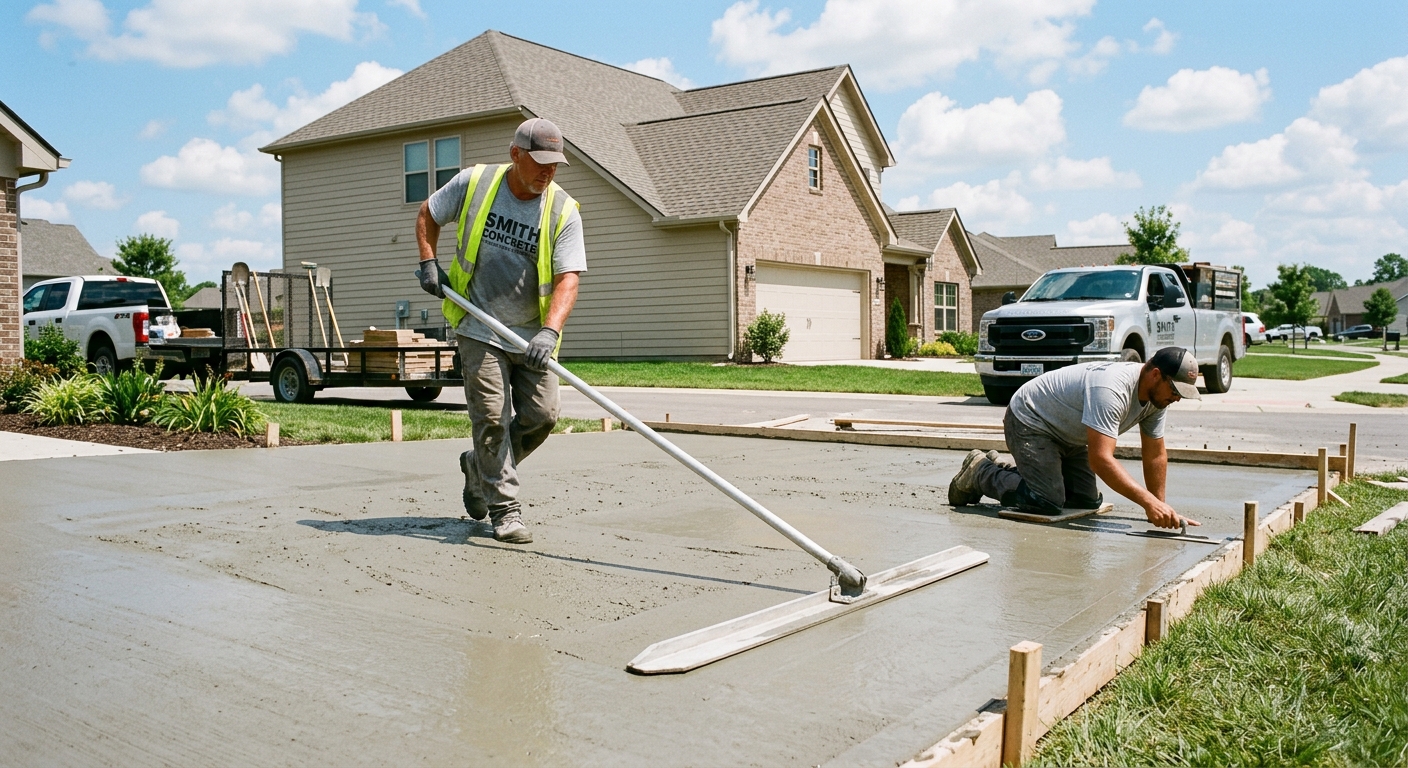
Concrete work options and costs in Mount Currie
Concrete work in Mount Currie is shaped by a familiar Lower Mainland–Southwest reality: most homes are older than you might think and the wet, cool shoulder seasons can be hard on fresh slabs. With single-detached houses making up 75.6% of dwellings, driveways, walkways, patios, and garage floors are the most common projects homeowners ask about. Local ownership is also strong—36.7% of households are owner-occupied—so there’s steady demand for curb appeal upgrades that still perform through freeze–thaw cycles.
In this region, pricing is driven less by “extreme cold” and more by shallow seasonal freezing, saturated soils, and repeated temperature swings. Typical practice assumes a frost depth around 450 mm / 18", so footings, piers, and thickened edges are installed below that level to protect foundations from frost heave. For exterior flatwork, crews price in air-entrained concrete, proper control joints, and drainage-ready base prep. Rain and high humidity can also extend scheduling and curing—so contractors often plan around prolonged wet weather, use curing blankets where needed, and budget extra time to reach design strength and a durable surface.
Where this trade is especially in demand tends to be along busy access routes and higher-visibility streets near local gathering areas—many homeowners in and around the Mount Currie village core upgrade their driveways and front steps in the same seasons, which can tighten availability and affect labour rates. With that in mind, here’s a side-by-side of typical price bands you’ll see for common concrete applications.
| Application |
Typical Size |
Key Spec |
Finish Option |
Price Range |
| Concrete driveway (standard broom finish) |
400–600 sq. ft. |
Compacted granular base; air-entrained exterior mix; control joints |
Broom finish |
$18,000–$28,000 |
| Exposed aggregate driveway |
400–600 sq. ft. |
Engineered base; air-entrained mix; correct jointing and cure plan |
Exposed aggregate |
$22,000–$34,000 |
| Stamped concrete driveway or patio |
250–450 sq. ft. |
Air-entrained mix; proper sub-base; release agent and curing |
Stamped pattern (imprint + color) |
$16,000–$30,000 |
| Plain concrete patio or walkway |
150–350 sq. ft. |
Drainage slopes; air-entrained mix; saw-cut control joints |
Plain (light broom or float) |
$6,000–$14,000 |
| Garage floor (interior slab) |
350–600 sq. ft. |
Vapour barrier where needed; mesh/rebar per design; proper base |
Float finish (often sealed) |
$9,000–$18,000 |
| Foundation footings (structural, below frost) |
As engineered for the foundation |
Excavation to below design frost; formwork; rebar per engineer |
Structural concrete |
$8,000–$18,000 |
Prices are estimates only and vary by project scope, site access and material selection.
What affects the price of concrete work in Mount Currie
In the Lower Mainland–Southwest, two homeowners can receive quotes that differ by 30% to 50% for what looks like the same concrete job because the hidden work changes: excavation depth, base thickness, drainage detailing, reinforcement, mix spec, and curing logistics. Add in scheduling pressure during the wetter parts of the year and the fact that experienced crews can be booked ahead—labour and truck time aren’t always flexible.
Most of the variation comes down to freeze–thaw protection specs. Frost line depth dictates footing depth and form height; in coastal BC it’s often 0.5–1.2 m, but designs still place footings below the design frost to prevent heave. Exterior slabs also need air-entrained concrete to survive cycling and scaling. Then there’s curing. Even though winters are mild, cold nights and high humidity can slow early strength gain—so crews may use curing blankets or additional temperature protection. De-icing salt can accelerate spalling on surfaces that aren’t sealed or are made with the wrong mix.
In Mount Currie specifically, cost can rise when soils are saturated and excavation takes longer, when access is tight and forms/materials must be hand-carried, or when drainage must be upgraded to keep the slab and base dry. It can also come down when demolition is minimal, the subgrade is stable, and you choose a straightforward finish. For example, switching from a broom-finish driveway to stamped concrete is often the difference between the lower end of the driveway bands and the upper end—because stamping needs extra materials, timing, and labour. Similarly, a plain patio may land closer to the lower $16–$26 per sq. ft. band, while decorative work typically pushes toward the higher end.
Finally, the housing stock matters. With 19.0% of homes built before 1981, older lots often have mature landscaping, buried utilities, or older drainage paths that complicate excavation and disposal. That can easily add hundreds to thousands to the job before any “new concrete” is even poured.
| Price Factor |
Why It Matters |
Cost Impact |
| Frost line depth — determines footing depth and form height |
Footings must extend below design frost to reduce frost heave risk. |
Can shift excavation and rebar/form labour by thousands. |
| Site preparation — excavation, grading, compacted granular base |
Weak subgrade and poor drainage lead to settlement and cracking. |
Most variable line item; wetter sites raise costs. |
| Reinforcement — rebar or wire mesh requirement |
Controls cracking from shrinkage and supports loads in key areas. |
Material and labour increases if heavy reinforcement is needed. |
| Mix design — air-entrainment and compressive strength spec |
Air entrainment helps resist freeze–thaw scaling in exterior exposure. |
Higher-spec mix costs more per cubic yard; usually worth it. |
| Finish type — broom vs. stamped vs. exposed aggregate |
Finishes require different labour, materials, and curing discipline. |
Stamped/exposed commonly adds labour + specialty products. |
| Pour size and concrete truck access to site |
Long carries and multiple pours raise time and labour. |
Access constraints can add significant setup costs. |
| Cold-weather curing precautions — heating and blankets |
Cold/cool nights slow strength gain and increase surface risk. |
Shortens weather window; adds materials and time. |
| Control joint pattern and sealing cost |
Joints manage shrinkage; sealing improves durability against salts. |
Sealing and correct jointing add line items but reduce call-backs. |
Permits & regulations in British Columbia
In British Columbia, concrete that is part of a building’s structural system typically needs a building permit. That includes footings, foundation walls, and grade beams—any work that affects how the structure carries loads. Many structural concrete projects also require engineered drawings reviewed through the municipal permit process. By contrast, concrete flatwork such as patios, walkways, and most driveways often does not require a permit, as long as it doesn’t change lot grading, undermine drainage, or trigger municipal rules around impervious surface coverage or right-of-way impacts.
Before work starts in Mount Currie, confirm the scope with the local authority. Also verify the contractor is properly set up: ask for their liability insurance and their workers’ compensation coverage documentation (WSBC/WCB). Then request references for similar-scale concrete jobs—especially exterior flatwork in wet climates where air-entrainment and jointing are critical.
To verify credentials as a homeowner, start online, then request paperwork in writing:
- Look up the contractor’s trade/lawful authorization on the appropriate provincial online registry (search by business name).
- Ask for a Certificate of Insurance and confirm it lists your contractor’s current active coverage.
- Confirm workers’ compensation clearance or coverage documentation (your contractor should be able to provide current proof).
- Have the permit responsibility spelled out in the quote: who pulls it, if required.
- Match the quote scope to engineered details (for foundations/footings).
Getting concrete right in Mount Currie's freeze-thaw climate
Concrete failure in Mount Currie usually isn’t about the concrete “breaking in half”—it’s about gradual surface and durability problems caused by moisture and temperature swings. The top risks are freeze–thaw scaling, settlement from inadequate base prep, and random cracking from shrinkage without the right control joint plan. The solution is to spec the job correctly for the Lower Mainland–Southwest climate and to build in the protection layers that keep water out of vulnerable zones.
Start with base preparation: you want a compacted granular sub-base to the right depth for local soils and drainage, not just “whatever was under the old drive.” Next is mix design. Exterior flatwork should use air-entrained concrete (target 5–7% air for many exterior applications) and a minimum 32 MPa compressive strength so the slab reaches durability targets. Third, plan control joints. Joint spacing needs to limit random cracking—then keep the joints clean and sealed where appropriate. Fourth is curing. Even in mild BC, a minimum 7-day curing period is important, and cold/cool nights may require blankets or curing protection to prevent early-age surface damage. Fifth, sealing: a penetrating sealer applied after adequate cure (commonly around 28 days) helps repel de-icing salts and rain-driven contaminants.
When homeowners compare options, it’s easy to waste money on decorative choices without fixing the base or curing plan. For instance, opting for stamped concrete might add cost compared to a simple broom finish, but it’s justified when you’re also paying for correct joints, air-entrainment, and proper curing. If those fundamentals are missing, the “pretty” surface won’t last, and you’ll be paying again for patching.
| Spec |
Why It Matters in Mount Currie |
What to Ask For |
Impact if Skipped |
| Compacted granular base (depth?) |
Moisture + weak base leads to settlement and cracking in wet coastal soils. |
Confirm excavated depth, granular type, lift thickness, and compaction testing. |
Uneven slab, rocking, and faster cracking/edge spalling. |
| Air-entrained concrete mix (target air %?) |
Freeze–thaw cycling attacks unprotected exterior concrete surfaces. |
Ask for target air content (commonly 5–7%) and slump/air test plan. |
Surface scaling/spalling and premature deterioration. |
| Compressive strength (MPa rating) |
Strength gain affects durability and resistance under winter moisture exposure. |
Confirm minimum 32 MPa rating and curing method. |
Higher risk of early-age damage and reduced long-term performance. |
| Control joints (spacing per ACI guidelines) |
Controls shrinkage cracks during cool, humid seasons. |
Ask for joint spacing plan and jointing method (saw-cut/timing). |
Random cracking; water migration increases freeze–thaw damage. |
| Minimum 7-day curing period |
Cool nights slow early strength and can weaken the surface layer. |
Ask about curing blankets/sealer schedule during rain/cold periods. |
Surface defects, dusting, and reduced abrasion resistance. |
| Penetrating sealer (when applied after cure) |
Helps repel salt and reduce water absorption during wet winters. |
Ask when it’s applied (often around 28 days) and which product is used. |
Higher staining, faster surface wear, and salt-driven spalling. |
How to choose a concrete work contractor in Mount Currie
Choosing the right concrete contractor in Mount Currie comes down to verification, clarity, and workmanship discipline—especially in a freeze–thaw, rain-exposed environment. First, confirm their credentials in British Columbia. Ask for proof of liability insurance (so you’re not exposed if something gets damaged) and documentation for workers’ compensation coverage (WSBC/WCB). To check licensing/trade authorization, use the provincial online registry by contractor name and business—then cross-check that the name on their certificate of insurance matches exactly.
Next, get 2–3 itemised written quotes rather than a single lump sum. You want a breakdown that separates excavation/site prep, granular base and compaction, reinforcement, concrete volume and mix spec, forms, finishing, joints, and curing/sealing. Ask what’s included for disposal and whether a permit pull is responsibility of the contractor if required for your scope.
Warranty matters. Ask for a clear workmanship warranty length (in writing), whether the warranty is transferable to new owners, and whether there’s a product/manufacturer warranty for sealers, pigments, or specialty systems. For payment, a safe approach is to avoid large advances—commonly keep upfront payments to 10%–15% and use a holdback until completion and cleanup.
Finally, timelines should be specific: request a start date window, a realistic completion estimate, and what weather conditions can pause work in this region’s wet seasons.
- Provide a written scope with measurements (sq. ft., thickness, footing sizes).
- List mix spec: air-entrainment and target compressive strength (e.g., 32 MPa).
- Confirm sub-base thickness and compaction method.
- State reinforcement requirements (mesh vs rebar and where).
- Explain control joint spacing and timing (saw-cut plan).
- Describe curing plan for cool/rainy days (blankets/sealer schedule).
- Confirm sealing product and whether it’s included (often after 28 days).
- Include disposal and whether hauling is part of the quote.
- Clarify access/hoisting: line-by-line costs for difficult delivery.
- Spell out what’s excluded (demo, removal of roots, drainage upgrades).
- Provide warranty terms in writing and what triggers a service call.
- Use a payment schedule that keeps upfront at 10–15% max.
Concrete red flags in Mount Currie include: quotes that don’t mention air-entrainment for exterior flatwork, vague “we’ll grade and pour” language without base thickness details, lack of a jointing plan (leading to random cracking), skipping curing/blankets in cool or wet weather, and refusing to put insurance/warranty terms in writing.
Frequently asked questions — concrete work in Mount Currie
Why does concrete crack in Mount Currie and how is it prevented?
Concrete in Mount Currie typically cracks due to shrinkage, thermal movement, and moisture movement—especially when water can get under or into the slab during wet periods. Freeze–thaw cycles then widen tiny defects over time. Prevention starts with proper sub-base and drainage so the slab doesn’t settle, plus a control joint pattern placed to manage shrinkage. You should also insist on air-entrained concrete for exterior work so freeze–thaw doesn’t turn small issues into surface scaling. A correctly timed saw-cut and (where appropriate) sealing help keep water from migrating into cracks. If you’re pricing a driveway, remember that a broom-finish pour often sits in the lower driveway band, while decorative work can cost more—either way, the jointing and mix spec are non-negotiable in British Columbia’s coastal-wet conditions.
Stamped vs broom-finish concrete — cost difference?
Stamped concrete usually costs more than broom-finished concrete because it requires specialty materials (stamps, release agent, dyes or integral colour) and extra labour for timing and texture finishing. In Mount Currie, the cost difference is also influenced by schedule and curing discipline—stamped surfaces are less forgiving if crews rush through or don’t protect the slab during cool, humid weather. A broom-finish driveway often lines up with the lower end of the driveway band (commonly around $18–$28 per sq. ft. equivalent depending on scope), while stamped driveway or patio projects frequently push toward the upper range (often tied to the $22–$36 decorative band). If the base prep, air-entrainment, and joint layout aren’t done correctly, stamped concrete won’t last just because it looks better—so compare quotes on specs, not just the pattern.
When is the best time to pour concrete in Mount Currie?
The best time to pour concrete in Mount Currie is when you can maintain consistent curing conditions: avoid long stretches of heavy rain, and plan for cool nights and high humidity typical in the Lower Mainland–Southwest. Many contractors prefer spring to early fall for exterior flatwork because that’s when surfaces dry faster and curing temperatures are more reliable. That said, experienced crews can still pour earlier or later if they plan for curing blankets and protection. Ask your contractor how they manage cold-weather curing precautions (insulation/heating where needed) and what they do when weather changes mid-day. Scheduling is part of why quotes can vary; truck access and crew availability tighten during peak windows in the Vancouver–Surrey–Abbotsford corridor.
How long does concrete take to cure?
Concrete cure time has two parts: strength gain and surface readiness. In practice, you should expect at least a 7-day curing period where the slab is protected and allowed to develop strength, especially for exterior flatwork exposed to damp conditions in British Columbia. Full performance is typically discussed at around 28 days for many durability and sealer schedules, which is why penetrating sealers are often applied after that cure window. If you pour right before a rainy stretch, curing protection matters more than many homeowners expect—blankets and proper cover help the surface reach strength without frost-related stress. For garage floors and interior slabs, the schedule can be shorter for light traffic, but the durability benefits still depend on proper curing.
Do I need a permit for concrete work in British Columbia?
It depends on the scope. In British Columbia, structural concrete work such as footings, foundation walls, and grade beams generally requires a building permit and, often, engineered drawings reviewed through the municipal process. By contrast, many concrete flatwork projects—like patios, walkways, and most driveways—often don’t require a permit, unless they affect lot grading, impervious surface coverage limits, drainage, or the municipal right-of-way. For a homeowner in Mount Currie, the safest approach is to ask the contractor to confirm whether your specific scope triggers a permit before breaking ground. Also request the contractor’s plan for responsibility: who pulls the permit (if needed) and who verifies compliance.
Concrete vs pavers for a patio in Mount Currie?
In Mount Currie’s wet, freeze–thaw conditions, concrete and pavers can both work well, but they fail differently. Concrete patio slabs—when built with a properly compacted granular base, air-entrained mix, correct control joints, and adequate curing—tend to be simpler to maintain and can give a cleaner, uniform look. Pavers can be flexible for minor movements and are easier to replace in a small section if something settles. However, paver performance depends heavily on base depth, edge restraints, and drainage; saturated bases can still shift. From a budgeting standpoint, plain concrete patios and walkways typically fall in the lower $16–$26 band (depending on size and site prep), while decorative stamped concrete pushes higher into the $22–$36 decorative band. If you want a modern finish on a typical site, concrete often wins on value; if you anticipate utility work later or want easy spot repairs, pavers may fit better.