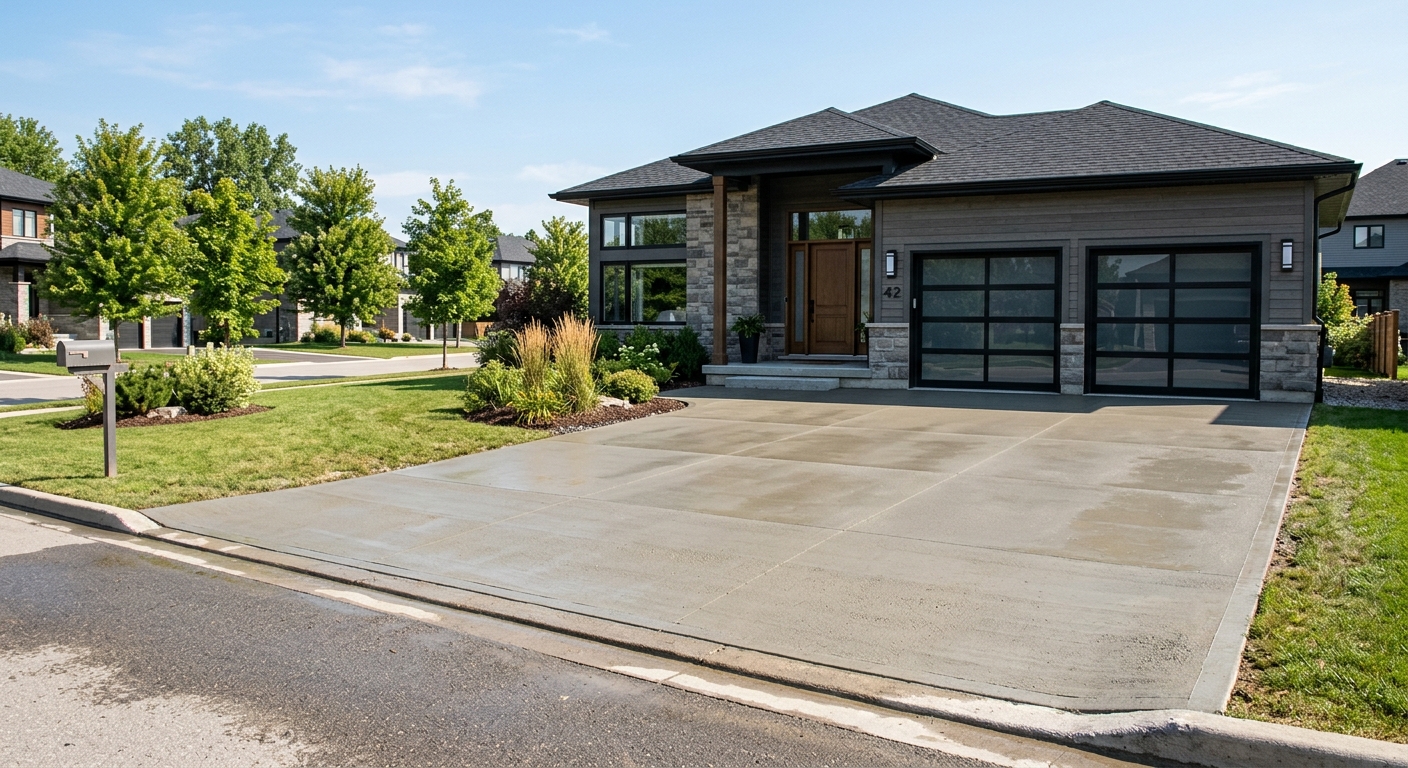
Concrete work options and costs in Hatzic
Concrete work in Hatzic, British Columbia is very much a “right-spec, right-season” trade. With a population of 2,952 people (Statistics Canada, 2021 Census), Hatzic is a smaller community within the Lower Mainland–Southwest, so crews often balance work across nearby corridors first. Most concrete flatwork demand comes from residential lots—particularly single-detached homes, which are common across the region—and that drives steady demand for driveways, patios, and walkways. (Statistics Canada, 2021 Census). On top of that, local availability can affect scheduling: when rain settles in across the Fraser Valley and coastal humidity stays high, experienced finish crews may already be booked.
In the Lower Mainland–Southwest, mild winters and a shallow frost line still matter for concrete pricing. Our local practice assumes a frost depth around 450 mm / 18", so footings and thickened edges are placed below that line to reduce freeze–thaw movement. Even with a shallow frost depth, saturated soils and repeated cold snaps can trigger scaling and surface deterioration if the mix isn’t air-entrained and the base isn’t properly drained.
That’s why two quotes for the same driveway can land far apart: one contractor may include full sub-base prep, engineered drainage attention, air-entrained mix, control joints, and proper curing; another may skim those items. As a reference point, typical driveway concrete generally falls in the region’s $18–$28 band, while foundation/footings work is usually priced separately in the $200–$350 range per unit of scope (depending on design and quantities). Below is a practical comparison to help you line up apples-to-apples scopes for Hatzic projects near places like the Hatzic Lake area.
| Application |
Typical Size |
Key Spec |
Finish Option |
Price Range |
| Concrete driveway (standard broom finish) |
400–600 sq. ft. |
Air-entrained exterior mix, compacted granular base, joints |
Broom finish + saw cuts |
$3,800–$6,800 |
| Exposed aggregate driveway |
400–600 sq. ft. |
Air-entrained exterior mix, controlled wash/surface retarder, joints |
Exposed stone aggregate |
$5,800–$9,600 |
| Stamped concrete driveway or patio |
250–450 sq. ft. |
Air-entrained exterior mix, integral color or stains, joints |
Stamp + release + color hardener (as specified) |
$6,200–$12,600 |
| Plain concrete patio or walkway |
200–400 sq. ft. |
Air-entrained mix, compacted base, control joints |
Float and broom or broomless edging |
$2,600–$6,200 |
| Garage floor (interior slab) |
400–600 sq. ft. |
Vapour barrier where needed, smooth trowel or broom, jointing |
Light broom or smooth finish |
$5,000–$10,500 |
| Foundation footings (structural, below frost) |
Based on design |
Excavation to below design frost, rebar, concrete spec per engineer |
Structural concrete only |
$9,500–$21,000 |
Prices are estimates only and vary by project scope, site access and material selection.
What affects the price of concrete work in Hatzic
In Hatzic and across the Lower Mainland–Southwest, the same “driveway size” can produce a quote spread of 30–50% because concrete pricing is driven by what happens under the finished surface, not just the concrete itself. Base preparation, drainage attention, mix design, reinforcement detailing, and curing planning all change the labour and material intensity. Contractors also price risk differently—especially in a coastal-wet schedule where rain, cool nights, and high humidity can delay pours and finishing, adding cost through more crew hours and longer mobilization.
Frost and freeze–thaw cycles shape every exterior spec. Even though coastal BC has a shallower frost depth than many interior regions, local codes and practice still assume footings and thickened edges extend below the design frost line—roughly 0.5–1.2 m in coastal BC—to prevent frost heave. Exterior slabs typically require air-entrained concrete and proper control joints to manage cracking and scaling. In colder regions, a shorter pour season often means cold-weather curing precautions (heating, insulation blankets), but in the Lower Mainland–Southwest we still plan around cool, wet stretches that can make achieving design strength on schedule more challenging.
In practical Hatzic terms, costs rise when the contractor must excavate deeper for stable base, address saturated soils with improved drainage, or provide more rebar than a basic wire-mesh option. Costs can drop when a site has easy truck access, stable subgrade, and a straightforward geometry. For example, shifting from standard broom-finish ($18–$28 band) to stamped concrete (often running higher, such as the $22–$36 decorative band for stamped & decorative work) can be worth it, but only if the contractor still keeps the same durable base prep and air-entrained mix. Similarly, foundation/footings work (often referenced as $200–$350 per unit of structural scope depending on design and quantities) can climb quickly if the engineered drawing calls for additional reinforcement or extensive excavation to reach firm material.
| Price Factor |
Why It Matters |
Cost Impact |
| Frost line depth — determines footing depth and form height |
Footings must sit below the design frost to reduce frost heave |
Higher excavation and forming = higher cost |
| Site preparation — excavation, grading, compacted granular base |
Proper base compaction and drainage prevent settlement and surface issues |
More truckloads and labour can add significant dollars |
| Reinforcement — rebar or wire mesh requirement |
Controls cracking and supports structural demands |
Rebar placement time and materials increase labour cost |
| Mix design — air-entrainment and compressive strength spec |
Air entrainment improves freeze–thaw durability for exterior slabs |
Higher-spec materials and scheduling can raise totals |
| Finish type — broom vs. stamped vs. exposed aggregate |
Decorative finishes require extra materials, tools, and timing |
Stamped/exposed generally adds more labour hours |
| Pour size and concrete truck access to site |
Small pours with limited access can increase handwork and logistics |
Access constraints raise labour and equipment costs |
| Cold-weather curing precautions — heating and blankets |
Ensures concrete reaches strength before exposure |
Blankets/heaters add daily rental and labour |
| Control joint pattern and sealing cost |
Joints reduce random cracking; sealing helps repel de-icing salts |
More detailed jointing + sealing adds but improves longevity |
Permits & regulations in British Columbia
In British Columbia, the rule of thumb is that structural concrete typically needs a building permit and is commonly based on engineered drawings that the municipality reviews. That means work such as foundation walls, grade beams, structural footings, and other load-bearing concrete elements generally require permits before you break ground. Concrete flatwork like patios, walkways, and driveways often does not require a permit—unless the project affects lot grading, triggers municipal requirements around impervious surface coverage, impacts drainage, or involves work near the municipal right-of-way.
Regardless of what’s required, don’t skip verification. In Hatzic, your best first step is to contact the local authority for confirmation in writing (or at least documented advice) before scheduling excavation. Also confirm the contractor carries liability insurance and appropriate provincial workers’ compensation coverage (WCB) for the crew—this is essential for homeowner protection.
How to verify contractor legitimacy step-by-step:
- Look up the contractor’s licence status through the appropriate BC licence registry resources available online.
- Ask for a current certificate of insurance (liability) naming you as an additional insured where applicable.
- Request proof of WCB clearance or documentation that coverage is active for the individuals on the project.
- Check references on similar-scale projects in the Lower Mainland–Southwest (driveways and exterior slabs are a good match for your climate).
- Confirm who pulls any permits (if required) and get that responsibility stated in your contract.
Getting concrete right in Hatzic's freeze-thaw climate
Concrete failures in Hatzic are usually not dramatic; they’re gradual and climate-driven. The biggest culprits are spalling and scaling from inadequate air-entrainment, poor base drainage that leaves soils saturated, and cracking that happens when control joints aren’t properly planned for slab geometry. In the Lower Mainland–Southwest, the combination of frequent wet conditions and freeze–thaw cycles means your exterior slab needs durability details, not just thickness.
To spec the job correctly, start with (1) base preparation: the sub-base should be compacted granular material to the depth needed for local soil stability and frost protection. Then (2) mix design: use air-entrained concrete with typical target air content around 5–7% for exterior flatwork, and specify a minimum 32 MPa compressive strength (or higher if engineered/required by your design). Next, (3) control joints: plan saw-cut or formed joints so cracking occurs in predictable lines instead of random spider cracks. For (4) curing, plan for at least 7 days under suitable conditions; in cool, damp stretches, crews may need curing blankets to protect early strength gain. Finally, (5) sealing: apply a penetrating sealer about 28 days after the pour to repel salts and reduce surface water absorption—important for longevity in de-icing and rainy-season splash zones.
Ask direct questions to avoid the common failure: “What air content are you using, and how do you confirm it?” If a contractor can’t answer, that’s a risk. For a price example, moving from plain patio concrete to stamped concrete can add budget, but if the contractor keeps the same durable base and proper air-entrained mix, the premium is justified. If someone tries to save money by reducing base prep or skipping sealing/curing, the “cheap” option often costs more later in patching and surface repairs—especially in Hatzic’s wet-and-cold swings.
| Spec |
Why It Matters in Hatzic |
What to Ask For |
Impact if Skipped |
| Compacted granular base (depth?) |
Reduces settlement and helps drainage so freeze–thaw doesn’t worsen |
Granular base thickness for your soil + compaction test/crew method |
Cracking, uneven settling, premature surface failure |
| Air-entrained concrete mix (target air %?) |
Air pockets protect concrete during freeze–thaw and wet cycles |
Target air content (commonly 5–7% for exterior flatwork) on the mix ticket |
Spalling, scaling, and scaling-related roughness |
| Compressive strength (MPa rating) |
Ensures durability and ability to reach design strength before exposure |
Minimum 32 MPa spec (or higher if required) and cure plan |
Lower strength, surface wear, and joint deterioration |
| Control joints (spacing per ACI guidelines) |
Controls crack locations so freezing movement doesn’t create random fractures |
Planned joint spacing and confirmation of saw-cut timing |
Random cracking and water infiltration into slab edges |
| Minimum 7-day curing period |
Proper curing is critical when nights are cool and humidity stays high |
How they protect the slab (curing blankets/sealer timing) when it’s cold or rainy |
Weak surface, reduced durability, increased cracking risk |
| Penetrating sealer (when applied after cure) |
Helps repel water and de-icing salt action that contributes to surface spalling |
Sealer type and application after 28 days, with surface prep steps |
Faster water uptake and deterioration |
How to choose a concrete work contractor in Hatzic
Choosing the right concrete contractor in Hatzic is mostly about verifying credentials and matching the quote to the technical spec needed for our freeze–thaw conditions. Start with licensing (where applicable for the contractor’s trade scope), then confirm liability insurance and WCB coverage. How to check: request their licence details and view them using the online registry information available in BC, then ask for a current certificate of insurance (liability) before work begins. For WCB, ask for proof or a clearance letter that shows coverage is active for the crew who will be on site.
Next, get 2–3 itemised written quotes. Avoid vague lump sums. You want labour and materials broken out—especially excavation/base, reinforcement, concrete mix type (air-entrained), finishing, joints, disposal, and curing/sealing. Read the scope carefully for exclusions: Is demolition included? Is hauling/disposal included? Are permit costs included (if required)? Is the quote assuming easy truck access, or does it include pump/hand-carry costs?
Then check warranty and payment structure. A workmanship warranty should be written and the length should be stated. Product/manufacturer warranty details matter too—ask whether it’s transferable if you sell your home. For payment, keep it safe: never pay more than 10–15% upfront, and insist on a holdback until substantial completion and your checklist items are done. Finally, lock in a timeline: get the start date and completion estimate in writing, because rain delays are common in the Lower Mainland–Southwest.
- Confirm licence status and trade scope relevant to your job.
- Request and verify liability insurance certificate (current dates, coverage limits).
- Verify WCB clearance/coverage for all workers.
- Get itemised quotes: demo, excavation, granular base, rebar/mesh, concrete mix, finishing, joints.
- Insist on air-entrained exterior mix details on paper.
- Ask how they handle rain and cool nights (curing plan in writing).
- Confirm control joint spacing and saw-cut timing.
- Check whether sealing is included for driveways/patios and the timing (after cure).
- Clarify disposal and whether trucking/hauling is included.
- Confirm site protection and cleanup responsibilities.
- Verify the warranty length and what it covers (cracks, scaling, spalling, workmanship).
- Agree on payment schedule with a holdback and milestones.
Concrete red flags in Hatzic: (1) they won’t discuss air-entrainment or control joints; (2) they propose “cheap” exterior concrete at the low end without explaining the mix ticket; (3) they schedule pours in heavy rain with no curing plan; (4) they ask for large upfront payments; and (5) they provide a non-itemised quote that hides base prep and drainage details.
Frequently asked questions — concrete work in Hatzic
Stamped vs broom-finish concrete — cost difference?
Stamped concrete costs more than broom-finish because it involves extra materials (integral color or release agents), specialized stamp tooling, and careful timing during the finishing window. In the Lower Mainland–Southwest, a standard driveway in Hatzic often aligns with the $18–$28 pricing band for concrete driveway/slab work, while stamped & decorative concrete typically sits in the higher $22–$36 range for that decorative category. That said, a “stamped driveway” quote shouldn’t skip durability basics—air-entrained mix, compacted granular base, and correct control joint layout are non-negotiable in our freeze–thaw climate. A good contractor will itemize those items so you can compare total scope rather than only finish type.
When is the best time to pour concrete in Hatzic?
The best time to pour in Hatzic is when you can protect the slab long enough to reach early strength: typically late spring through early fall, when days are warmer and rain windows are shorter. That said, the Lower Mainland–Southwest has frequent showers, so crews plan around weather forecasts rather than only “season.” If you must pour during cool, damp periods, ask about curing blankets, wind/rain protection, and how they keep finishing quality consistent. Avoiding freeze conditions during early curing matters because freeze–thaw and saturated subgrades can worsen scaling. When contractors are booked ahead, scheduling can affect cost too (more mobilizations or staffing adjustments), so confirm your start date and weather plan in writing.
How long does concrete take to cure?
Concrete needs time to gain strength and stabilize. For exterior flatwork in British Columbia, most contractors plan a minimum 7-day curing/protection period for early strength before subjecting the slab to normal use patterns. Full durability development continues beyond that, and surface treatments like penetrating sealers are generally applied around 28 days after the pour once curing is complete. In Hatzic, cool nights and high humidity can slow strength gain, so curing practices (blankets, curing methods, and protecting against rain) are critical. If a contractor tells you the slab is “good to go” in two or three days without a curing plan, that’s a common quality risk—especially where freeze–thaw cycles and water saturation are factors.
Do I need a permit for concrete work in British Columbia?
Often, structural concrete work in British Columbia requires a building permit—think foundation walls, structural footings, and grade beams—and engineered drawings may be reviewed by the municipality. For concrete flatwork like driveways, patios, and walkways, permits are typically not required unless the work affects lot grading, drainage, or municipal limits around impervious surface coverage or impacts the right-of-way. In Hatzic, the cleanest approach is to confirm in advance with the local authority. For your contractor, ask who pulls any permit (if needed) and get it written into your scope. Also verify they’re properly insured and covered under WCB so you’re protected.
Concrete vs pavers for a patio in Hatzic?
Concrete is usually the best choice when you want a uniform, long-lasting surface with fewer individual components, especially if your priority is a stable slab for outdoor living areas. A plain concrete patio in the Lower Mainland–Southwest commonly lands in the $16–$26 band for patio/walkway work, depending on base prep and finish details. Pavers can look more “architectural” and can be easier to replace if one area fails, but paver longevity depends heavily on base design and proper bedding/drainage. In Hatzic’s freeze–thaw and wet conditions, the under-base (compaction and drainage) is where most performance differences are made. If a quote for either option doesn’t clearly explain base prep and joints/drainage strategy, it’s hard to compare durability honestly.
How long does a concrete driveway last?
A well-built concrete driveway in Hatzic commonly lasts 20–30 years (and longer in some cases) because the main durability threats are manageable when the job is spec’d correctly: air-entrained mix for freeze–thaw resistance, proper base drainage to prevent saturated subgrade issues, and correct control joints to reduce random cracking. Surface sealing and good curing also extend life by reducing water absorption and protecting against de-icing salt effects. The investment usually shows up in the quote: if your driveway price is at the low end of the regional $18–$28 band but the contractor can’t explain air-entrainment, curing, and joint spacing, you should be cautious. A premium finish like exposed aggregate or stamping can add cost, but it won’t replace the fundamentals that drive lifespan.