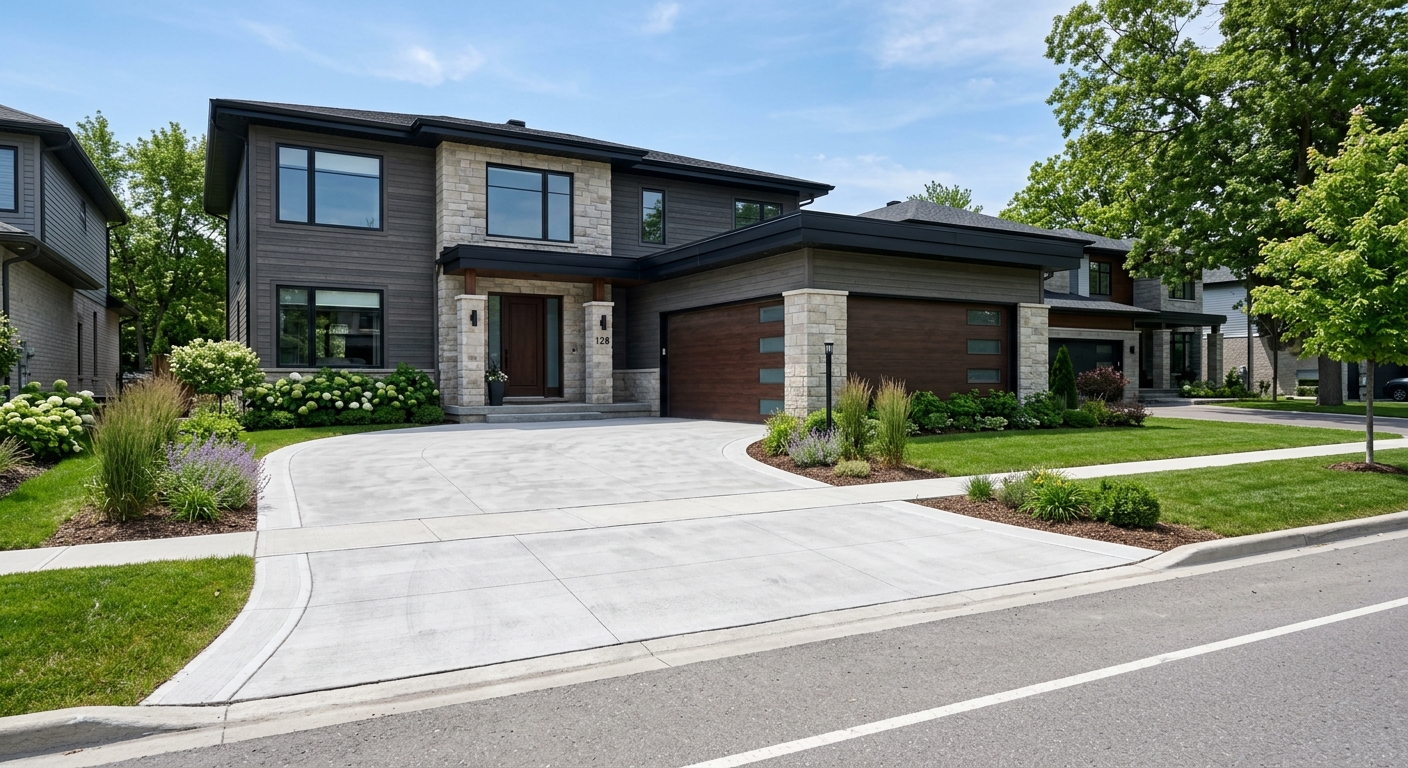
Concrete work options and costs in Crofton
Crofton is a small, service-oriented community on Vancouver Island where concrete flatwork is in steady demand, especially around homes that rely on durable driveways and low-maintenance patios through our coastal-wet winters. With a population of 1,446 (Statistics Canada, 2021 Census), there’s a limited pool of crews, so scheduling can affect pricing when contractors are busy. In this part of the Lower Mainland–Southwest market, concrete work is most often tied to single-detached homes and their outdoor upgrades (driveways, patios, walkways, and interior garage slabs), which means your project is usually competing for the same seasonal window.
Lower Mainland–Southwest conditions shape both the design and the cost. Even with a shallow frost depth typical of coastal BC (local practice often assumes frost around 450 mm / 18"), we still protect slabs and foundations from freeze–thaw damage and heavy rainfall. That drives excavation depth, drainage and the use of air-entrained mixes, plus longer curing/scheduling when cool, humid weather slows strength gain. In practice, that’s why two companies can quote different totals for what looks like the “same” driveway: engineered base prep, mix design, truck access, and rain management can change labour time and materials. In Crofton, trade demand is especially noticeable around the Crofton Village area where lot access and drainage details are commonly tight.
Below is a practical comparison of options you’ll see in Crofton, tied to the region’s typical price bands. Use it to sanity-check any estimate before signing.
| Application |
Typical Size |
Key Spec |
Finish Option |
Price Range |
| Concrete driveway (standard broom finish) |
16 ft x 30 ft (480 sq. ft.) |
Reinforced slab, air-entrained mix, control joints |
Broom finish, standard edging |
$18–$28 |
| Exposed aggregate driveway |
16 ft x 30 ft (480 sq. ft.) |
Air-entrained mix, screened/washed aggregate |
Exposed aggregate with seal coat |
$22–$34 |
| Stamped concrete driveway or patio |
400–600 sq. ft. |
Air-entrained mix, rebar/wire mesh as required |
Stamp pattern + release + protective sealer |
$22–$36 |
| Plain concrete patio or walkway |
12 ft x 16 ft (192 sq. ft.) |
Compact base, control joints, air-entrained mix |
Broom or smooth finish, light finishing |
$16–$26 |
| Garage floor (interior slab) |
20 ft x 20 ft (400 sq. ft.) |
Fibre and/or mesh, proper vapour control where needed |
Steel-trowel finish or broom finish |
$20–$33 |
| Foundation footings (structural, below frost) |
Per running foot (varies by plan) |
Excavate below frost, form, rebar, pour to specs |
Structural concrete with engineered layout |
$200–$350 |
Prices are estimates only and vary by project scope, site access and material selection.
What affects the price of concrete work in Crofton
In the Lower Mainland–Southwest region, it’s common for quotes on the “same” concrete work to swing by 30–50% once you look past the surface finish. The spread usually comes from differences in base preparation, drainage details, reinforcement, and the concrete mix design required for our wet coastal winters and freeze–thaw cycles. Even when the frost depth is relatively shallow for coastal BC, local practice still assumes footings and thickened edges go below the design frost depth (often around 450 mm / 18"). That single requirement affects excavation depth, forming labour, and haul/disposal costs.
Exterior slabs and driveways also need air-entrained concrete to survive freeze–thaw cycles and resist scaling from saturated soils. When projects are delayed by rain or cool nights, contractors may need curing blankets and longer cure timelines to reach target strength before de-shuttering and finishing. Cold-weather curing precautions can add cost compared with a warm, dry stretch—particularly if work starts late in the season and the crew has to protect freshly poured concrete from temperature drops.
In Crofton, cost can be higher where access forces smaller trucks or more wheelbarrowing, and where the existing grade is poorly drained. For example, a straightforward broom-finish driveway can align with the region’s $18–$28 band, but if your base needs significant regrading and extra granular drainage, the project can lean toward the top end. Similarly, stamped concrete starts in the $22–$36 range; the real cost justification is the labour-intensive forming, stamping, and sealing—not just the surface look. Your local housing stock also matters: older lots often have tighter drainage and more irregular subgrade, which can add a few days of excavation and base rebuild before any pour.
| Price Factor |
Why It Matters |
Cost Impact |
| Frost line depth — determines footing depth and form height |
Footings and thickened edges must extend below design frost to prevent heave |
Excavation/forming can add significant labour and disposal |
| Site preparation — excavation, grading, compacted granular base |
Right base depth and compaction reduce settlement and surface failure |
More grading and granular = higher materials + equipment time |
| Reinforcement — rebar or wire mesh requirement |
Controls cracking and improves slab performance under loads |
Cost increases with bar schedule, chairs/tie-wire, and placement time |
| Mix design — air-entrainment and compressive strength spec |
Air entrainment and strength target help resist scaling during freeze–thaw |
Premium mix and stricter batching/QA can raise unit cost |
| Finish type — broom vs. stamped vs. exposed aggregate |
Finish system changes labour intensity and curing/sealer steps |
Stamped/exposed work typically costs more per sq. ft. |
| Pour size and concrete truck access to site |
Access affects pumping, distance, and crew time |
Limited access can add small equipment rental and hand-placement labour |
| Cold-weather curing precautions — heating and blankets |
Cold nights slow strength gain and increase early-age damage risk |
Blankets/heating increase labour and consumables |
| Control joint pattern and sealing cost |
Joints manage cracking; sealing helps repel de-icing salts and moisture |
More joints and sealer materials can add line-item cost |
Permits & regulations in British Columbia
In British Columbia, structural concrete work typically needs permits and often engineered drawings reviewed by the municipality. That includes footings, foundation walls, and grade beams. If the project affects structural integrity or forms part of the foundation system, don’t assume it’s “just concrete”—treat it as a regulated build component and confirm requirements with the local authority before you pour.
Concrete flatwork such as driveways, patios, and walkways usually does not require a building permit, unless your project impacts lot grading, triggers municipal impervious surface coverage limits, or involves work within/near the municipal right-of-way (for example, ties to driveway approaches or drainage alterations). Even when permits aren’t required, municipal rules can still apply to drainage, runoff direction, and how close you build to property lines.
To verify a contractor in Crofton, start by checking licensing through the proper provincial registry for their trade and confirm they carry liability insurance and WSIB/WCB coverage. Then ask for a current certificate of insurance (COI) showing your contractor’s policy active dates and appropriate limits. If the contractor provides subcontractors, request their coverage as well. Finally, look for references on similar foundation/flatwork scopes and verify the company can show proof of past performance in coastal BC conditions like rain-managed pours and curing procedures.
Getting concrete right in Crofton's freeze-thaw climate
Concrete fails in Crofton mainly when water gets into the slab or foundation and then freezes, expanding and breaking apart paste at the surface. The most common issue I see after poor workmanship is spalling from inadequate air entrainment, especially on exterior flatwork exposed to wet coastal rainfall and repeated freeze–thaw cycles. The fix is not “more sealer” after the fact—it’s correct spec and execution: build a well-compacted base, use the right mix, include control joints, and cure properly before you expose the slab to the next weather cycle.
Start with base preparation: excavate to the proper depth for local soil conditions and place a compacted granular sub-base. Next, specify air-entrainment; for exterior flatwork, we target 5–7% air content and design for at least 32 MPa compressive strength. Then plan control joints early—spacing must limit random cracking so joints take the movement. Curing matters just as much: plan for a minimum 7-day cure, and in cool, humid weather use protective curing measures (blankets/sealers/extended schedule) so the slab reaches strength. After curing, apply a penetrating sealer around 28 days post-pour to repel de-icing salts and reduce moisture ingress.
On cost: a stamped patio often lands in the $22–$36 band because stamping and higher finish labour are real work. However, if a contractor offers a “cheap stamped” price and cuts corners on air entrainment or base prep, you risk early surface deterioration—where the repair cost far exceeds the upfront savings. A plain patio can be in the $16–$26 band, but it still needs the same durability spec for our freeze–thaw conditions, not just a basic mix.
| Spec |
Why It Matters in Crofton |
What to Ask For |
Impact if Skipped |
| Compacted granular base (depth?) |
Prevents settlement and helps manage water under the slab |
Base depth target and compaction method (and whether drainage is addressed) |
Uneven settling, cracking, and faster surface wear |
| Air-entrained concrete mix (target air %?) |
Reduces scaling/spalling risk during freeze–thaw cycles |
Confirmation of air content target (typically 5–7% for exterior) |
Premature spalling and flaky surface in wet winters |
| Compressive strength (MPa rating) |
Ensures durability and resistance before and during harsh weather |
Minimum 32 MPa (or higher per engineered design if required) |
Lower strength at early age; increased cracking and surface breakdown |
| Control joints (spacing per ACI guidelines) |
Controls where shrinkage/cracking occurs on exterior slabs |
Proposed joint spacing and layout around edges/fixtures |
Random cracks that can trap water and accelerate freeze–thaw damage |
| Minimum 7-day curing period |
Strength gain is slower in cool, humid coastal conditions |
How the crew will protect the pour and the cure timeline |
Surface damage before full strength; weakened, rough finishes |
| Penetrating sealer (when applied after cure) |
Helps repel moisture and de-icing salts that can worsen scaling |
Sealer application timing (around 28 days post-pour) and product type |
Higher water absorption and faster deterioration |
How to choose a concrete work contractor in Crofton
Choosing the right contractor in Crofton is mostly about verifying coverage and getting a quote that separates scope from assumptions. In British Columbia, confirm the company is properly licensed for the work they’ll perform, then request a current certificate of liability insurance and proof they’re covered for workers (WSIB/WCB). If they can’t provide documentation promptly, that’s a red flag. Also ask whether any subcontractors are used; if they are, you want their coverage confirmed too.
Next, get 2–3 itemised written quotes. You want a breakdown that shows excavation and haul/disposal, granular base and compaction, reinforcement (rebar/wire mesh and placement), concrete mix specification, finishing type, control joints, curing/blankets (if needed), and sealing (if included). Avoid quotes that lump everything into a single number without telling you what’s included—concrete failures are often tied to missing base prep or an unspecified mix. Ask whether permits are included (when applicable for structural work) and whether disposal is covered for over-excavation or unsuitable soil removal.
For warranty, look for a written workmanship warranty length and understand whether product/manufacturer warranties apply to materials. Confirm if the warranty is transferable to a new homeowner (important in a small market where homes change hands). For payment, keep it controlled: never pay more than 10–15% upfront; use a holdback until the final curing/sealer and joint finishing are complete. Finally, get a start date and completion estimate in writing, not “weather permitting” alone—Crofton’s wet/cool conditions can impact scheduling.
- Ask for the contractor’s BC licence/trade registration details and confirm they match the scope.
- Request a COI for liability insurance with current active dates and appropriate limits.
- Verify WSIB/WCB coverage (and ask how it’s handled for any subcontractors).
- Get itemised quotes (excavation, base, reinforcement, concrete supply, forming, finishing, curing, sealing).
- Confirm concrete mix spec: air entrainment for exterior and minimum 32 MPa compressive strength.
- Ask for proposed control joint spacing and locations around edges/penetrations.
- Clarify curing plan (especially blankets/insulation if cool weather is expected).
- Confirm whether sealing is included and when it will be applied (around 28 days post-pour).
- Check what’s included for drainage work and subgrade prep (not just “remove and pour”).
- Discuss disposal/haul: what happens to unsuitable soil and extra granular?
- Confirm access/pumping assumptions if the truck can’t reach the pour area directly.
- Use a payment schedule with a holdback until completion and finish quality are verified.
Concrete red flags in Crofton include: vague mix specs (no air-entrainment confirmation), skipping control joints or spacing them randomly, pressure to pay most of the cost upfront, promises to “seal right away” (before cure timing), and no written timeline that accounts for rain/cool nights during curing.
Frequently asked questions — concrete work in Crofton
Do I need a permit for concrete work in British Columbia?
In British Columbia, structural concrete work—such as footings, foundation walls, and grade beams—typically requires a building permit and often engineered drawings reviewed by the municipality. Concrete flatwork like patios, walkways and driveways often does not require a permit, but it can be required if the work affects lot grading, impervious surface limits, or involves changes near the municipal right-of-way. Because rules can vary by the impact of the project, the safest approach for homeowners in Crofton is to confirm with the local authority before breaking ground, especially if you’re changing drainage or raising/lowering grade. Also verify your contractor can discuss permit triggers clearly and can provide insurance and proof of coverage before any excavation starts.
Concrete vs pavers for a patio in Crofton?
For patios in Crofton, concrete usually wins on long-term maintenance when it’s built correctly for freeze–thaw: air-entrained mix, compacted base, proper control joints, and curing. Pavers can also perform well, but they depend heavily on base and drainage; if water collects under/around pavers, they can heave or settle over time. Cost-wise, a plain concrete patio often aligns with the regional $16–$26 per sq. ft. band, while pavers can be competitive initially depending on the thickness, base depth, edging, and labour. If you want a “flatwork look” with less labour, concrete is often simpler to maintain. If you prefer easier panel replacement or a very specific design pattern, pavers may suit better—just ensure the contractor addresses water management and compaction.
How long does a concrete driveway last?
A well-built driveway in British Columbia’s coastal-wet, freeze–thaw climate can last decades. The key variables are base prep, air-entrained mix, reinforcement (as required), and whether control joints were planned to control cracking. In Crofton, rain and moisture exposure matter as much as cold snaps; a driveway that’s poured over poor base or made with a mix that isn’t properly air-entrained is more likely to scale and spall at the surface. Finishing and curing also matter—if the slab isn’t protected through cold nights, early-age damage can shorten service life. Many homeowners also choose a penetrating sealer (applied after cure) to reduce moisture intrusion. If you’re comparing quotes, don’t only compare the $18–$28 broom-finish band; confirm the durability specs behind that number.
What is air-entrained concrete and why does it matter here?
Air-entrained concrete includes tiny, evenly distributed air bubbles in the mix. Those bubbles provide space for water to expand when it freezes, which greatly reduces scaling and spalling—especially on exterior slabs exposed to repeated freeze–thaw cycles. In Crofton and across coastal BC, we often get saturated conditions from rainfall followed by cold snaps, which is exactly when improperly specified concrete starts to deteriorate. That’s why reputable contractors in the Lower Mainland–Southwest market build every exterior flatwork quote around an air-entrained mix and proper control joints, not just surface finish. If you see a quote that doesn’t clearly mention air-entrainment and curing protection, ask the contractor directly. Even a “nice-looking” driveway can fail early if the mix isn’t right.
How do I prepare the base for a concrete slab?
Base preparation is usually 50% of a concrete slab’s performance. In Crofton, the goal is to excavate to the right depth for your soil and frost considerations, then place a compacted granular sub-base to reduce settlement and manage moisture. The crew should grade for proper drainage, remove unsuitable material, and compact in lifts to achieve a stable foundation before any rebar/wire mesh is placed. For exterior slabs, drainage attention and correct compaction are critical because rainfall can saturate the soil, and freeze–thaw cycles can push water and damage the slab from below. Ask your contractor to describe the proposed base depth, compaction method, and how they’ll handle any drainage issues before the pour. A detailed quote with these items is the best way to compare contractors fairly.
How do I compare concrete quotes?
To compare concrete quotes in Crofton, look for comparable scopes—not just the bottom-line number. Ask for itemised breakdowns: excavation and haul/disposal, granular base and compaction, reinforcement (rebar/wire mesh and placement), concrete mix design (including air entrainment for exterior and minimum 32 MPa strength), finishing type, curing plan, and whether sealing is included and when it’s applied (typically around 28 days post-pour). Confirm control joint pattern and spacing so cracks are managed, not random. It’s also normal for prices to differ: for example, a standard broom driveway might sit in the $18–$28 band, while stamped work commonly ranges into the $22–$36 band due to additional labour and finishing. If a quote is far outside the band without explaining spec differences, ask why.