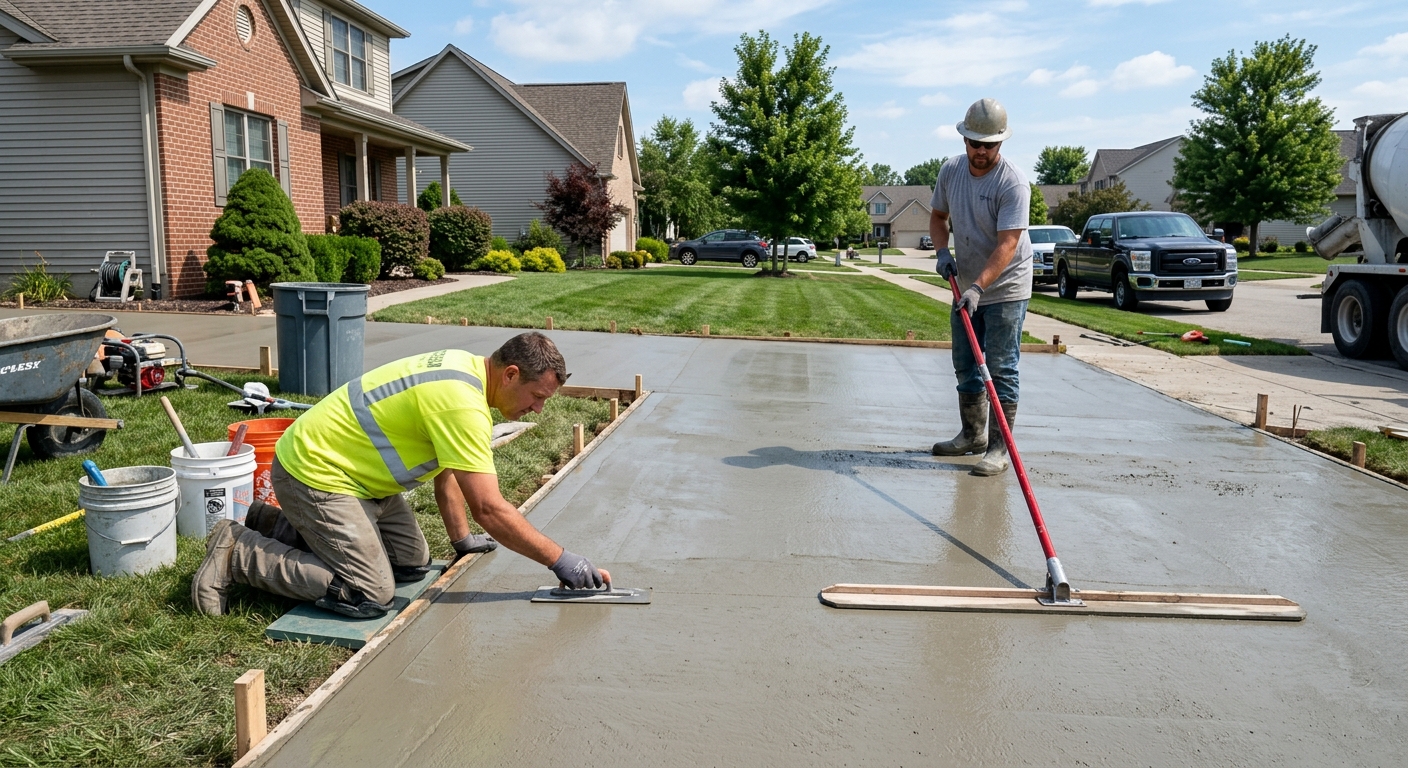
Concrete work options and costs in Whonnock
Whonnock is a small community in the Lower Mainland–Southwest (population 3,444, Statistics Canada, 2021 Census), and most concrete flatwork here serves the same core needs: driveways, patios, walkways, and foundations for a growing mix of homes. In fact, Whonnock’s housing stock is dominated by single-detached properties, which is why driveway and patio work is often the most active segment for contractors along roads feeding into the community (Statistics Canada, 2021 Census). The good news is the Lower Mainland–Southwest has milder winters than interior BC, so we get workable seasons more often than colder regions. The trade-off is that the coastal-wet climate and freeze–thaw cycles still punish poorly planned slabs: drainage, air-entrained concrete, and correct jointing matter as much as the finish.
In this area, frost-depth design is based on local code practice with a frost depth around 450 mm / 18", meaning footings, piers, and thickened edges are placed below that to avoid frost heave. We also plan around prolonged rain, cool nights, and high humidity—so curing blankets and longer cure timing are common, especially for exterior work. Labour availability can tighten when multiple crews are staging near Surrey and Maple Ridge during good weather windows, which is one reason quotes for the “same” slab can vary. If you’re near the Cedar Grove / Whonnock Lake corridor, or working on driveways off Glenwood Avenue and nearby residential lanes, expect consistent demand for durable exterior flatwork.
Below are typical price bands you’ll see in Whonnock, so you can compare like-for-like when reviewing quotes.
| Application |
Typical Size |
Key Spec |
Finish Option |
Price Range |
| Concrete driveway (standard broom finish) |
300–500 sq. ft. |
Air-entrained mix, compacted granular base, control joints |
Broom finish, sealant optional |
$18,000 – $28,000 |
| Exposed aggregate driveway |
300–500 sq. ft. |
Air-entrained mix, base prep, proper curing to support dressing |
Exposed aggregate (washed/granule exposure) |
$22,000 – $32,000 |
| Stamped concrete driveway or patio |
200–450 sq. ft. |
Air-entrained mix, integral color, rebar where required |
Stamped patterns + release + sealer |
$22,000 – $36,000 |
| Plain concrete patio or walkway |
150–350 sq. ft. |
Proper slope/drainage, compacted base, control joints |
Broom or smooth finish |
$16,000 – $26,000 |
| Garage floor (interior slab) |
400–700 sq. ft. |
Vapour barrier, compacted base, mesh or bars (per design) |
Float/trowel finish, jointed |
$18,000 – $30,000 |
| Foundation footings (structural, below frost) |
Per project (e.g., 1–2 storey home) |
Excavate to below frost, reinforced concrete, approved thickness |
Structural finish (not decorative) |
$200 – $350 |
Prices are estimates only and vary by project scope, site access and material selection.
What affects the price of concrete work in Whonnock
In Whonnock and the wider Lower Mainland–Southwest region, it’s common to see quotes for the “same” concrete project swing by 30–50% once you compare real specs and site conditions. On paper, a driveway might look similar, but the cost difference often comes from what’s underneath: excavation depth, granular base thickness, reinforcement, concrete mix design, and the time required to protect fresh concrete during wet or cool weather. In British Columbia, that’s especially true because coastal rainfall and frequent freeze–thaw cycles can affect curing and long-term durability—so contractors who build for longevity usually spend more up front.
Specifically, frost line depth dictates footing and thickened edge locations. Even though Lower Mainland winters are milder than interior BC, local code practice typically assumes a frost depth around 450 mm / 18", so footings are placed below that to prevent frost heave. Exterior slabs also need air-entrained concrete (typically 5–7% air) to resist freeze–thaw scaling and spalling. When the temperature drops near pour day, crews may need cold-weather curing precautions—insulating blankets, longer protection times, and sometimes heated enclosures—which adds labour and equipment costs. Finally, de-icing salt accelerates surface damage, so sealing is often recommended for driveways and walkways.
Here are a few concrete examples from Whonnock sites: (1) A sloped yard near Whonnock Lake can raise excavation and grading costs because we must build proper subgrade drainage and slope to daylight; (2) clay-heavy soils can require more granular removal/replacement, which pushes the “base prep” portion upward; (3) if you choose stamped concrete (often $22,000 – $36,000 for typical driveway/patio sizes), the additional labour for stamping, coloring, and sealing is justified when you want appearance to last through wet winters and salt exposure.
Even a simple broom-finish driveway (often $18,000 – $28,000) can cost more if truck access is tight or if drainage upgrades are needed to keep the slab stable and dry.
| Price Factor |
Why It Matters |
Cost Impact |
| Frost line depth |
Determines footing depth and form height for structural stability |
Can add excavation/formwork time; critical for footings and piers |
| Site preparation |
Excavation, grading, and compacted granular base reduce settlement and cracking |
More soil removal or hauling increases labour/equipment |
| Reinforcement |
Rebar or wire mesh controls cracking where design requires it |
Material and placement labour; sometimes required by engineering |
| Mix design |
Air-entrainment and compressive strength specs protect against freeze–thaw |
Higher-performing mix can cost more per load |
| Finish type |
Broom vs. stamped vs. exposed aggregate affects labour and curing/sealing needs |
Stamped/exposed typically adds trade time and materials |
| Pour size and concrete truck access to site |
Large pours and limited access can force pump/extra labour |
Short access routes can increase set-up and handling costs |
| Cold-weather curing precautions |
Blankets/insulation help concrete reach strength without damage |
Additional rental and labour if temps are marginal |
| Control joint pattern and sealing cost |
Proper joints limit random cracking; sealing reduces salt and water intrusion |
Materials and extra finishing/sealer labour |
Permits & regulations in British Columbia
In British Columbia, the key difference is whether the concrete work affects the structure or drainage/grade. Structural concrete work—such as footings, foundation walls, grade beams, and any foundation elements that support the building—typically requires a building permit and usually engineered drawings reviewed by the municipality. Concrete flatwork (driveways, patios, and walkways) usually does not require a permit by itself, unless it changes lot grading, touches municipal right-of-way considerations, or conflicts with impervious surface coverage or drainage requirements. Because Whonnock properties often have tight side yards and variable drainage, it’s smart to confirm with the local authority before breaking ground.
To protect yourself, verify the contractor carries liability insurance and has the appropriate coverage (WCB/WSIB in the general sense of provincial worker coverage—ask them to provide proof of coverage for their workers). Ask for references from similar-scale projects in the Lower Mainland–Southwest, ideally with photos before and after rain events.
Step-by-step homeowner checks:
- Ask for the certificate of insurance (liability) and confirm the policy name matches the contractor’s legal entity on the quote.
- Request proof of worker coverage documentation for their crew.
- Ask for their contractor credentials where applicable and confirm any business registration details.
- When permits are needed, ask who pulls the permit and whether inspections are included in the scope.
- Request at least 2–3 comparable references in the Metro Vancouver / Fraser Valley area and confirm completion dates.
Before any excavation in Whonnock, these checks are often the fastest way to avoid delays, rework, and warranty disputes.
Getting concrete right in Whonnock's freeze-thaw climate
Concrete failures in Whonnock usually come down to water and temperature—specifically, freeze–thaw cycles coupled with poor drainage and incomplete curing. When water gets under or into concrete and then freezes, it expands and can break the bond near the surface, leading to scaling and spalling. The best way to avoid this is to spec the job so it performs as a system: base preparation, mix design, joints, curing, and sealing.
1) Base preparation: We build a compacted granular sub-base to the right depth for local soils and frost protection. If the subgrade is soft or poorly drained, no finish can fix it later. 2) Mix design: For exterior flatwork, use air-entrained concrete with a target air content typically in the 5–7% range for freeze–thaw resistance, plus a minimum 32 MPa compressive strength (project specs can vary, but this is a common durability baseline for exterior work). 3) Control joints: Create joints to manage cracking rather than letting it happen randomly—spacing should follow accepted North American practice for the slab thickness and exposure. 4) Curing: Plan for at least 7 days of curing under proper conditions. In cool, humid Lower Mainland weather, curing blankets and longer protection times are often necessary to reliably reach strength. 5) Sealing: Apply a penetrating sealer after the concrete has cured—commonly at 28 days—so de-icing salts and rain water don’t keep getting into pores and accelerating deterioration.
A practical example: if you’re choosing between a broom-finish driveway and a stamped driveway, stamped concrete often costs more (typical range $22,000 – $36,000 versus $18,000 – $28,000 for standard broom finishes). The price difference is justified when the stamping, coloring, and sealer schedule are done correctly—but durability still depends on air-entrainment, base prep, and curing. In other words, don’t “buy the look” while cutting corners on the freeze–thaw system.
| Spec |
Why It Matters in Whonnock |
What to Ask For |
Impact if Skipped |
| Compacted granular base (depth?) |
Prevents settlement and keeps the slab stable as wet soil freezes/thaws |
Base thickness and compaction method, plus drainage plan |
Uneven settling, cracking, and faster deterioration |
| Air-entrained concrete mix (target air %?) |
Air bubbles protect against freeze–thaw scaling and spalling |
Specified target air content for exterior exposure |
Surface scaling and spalling within a few winters |
| Compressive strength (MPa rating) |
Ensures structural/durability performance at service loads |
Minimum MPa rating and mix design statement |
Reduced strength gain; increased cracking risk |
| Control joints (spacing per ACI guidelines) |
Limits random cracking and controls where shrinkage cracks open |
Joint spacing plan for your slab thickness and panel size |
Wider, irregular cracks that admit water |
| Minimum 7-day curing period |
Cold and wet weather slows strength development if not protected |
Curing method and protection during cool nights/rain |
Lower durability and weaker surfaces prone to damage |
| Penetrating sealer (when applied after cure) |
Repels water and salt intrusion, reducing freeze–thaw deterioration |
Penetrating sealer and application timing (commonly ~28 days) |
Salt staining, higher porosity water uptake, faster scaling |
How to choose a concrete work contractor in Whonnock
Start with verification. In British Columbia, you want a contractor who can show their business details, carry liability insurance, and provide proof of worker coverage for their crew. How to check:
- Licence/registration (where applicable): ask for their business credentials and confirm they match the company name on the contract/quote.
- Liability insurance: request a current certificate of insurance and confirm coverage limits are appropriate for concrete work (excavation, trucks, forming).
- Worker coverage: ask for proof of coverage documentation for anyone working on your site.
- Certificates & clearance letters: if they provide them, review that they’re current and applicable to the project start date.
- References: ask for photos of projects completed in wet Lower Mainland conditions, not only dry-season installs.
Next, get 2–3 quotes that are itemised—not lump sum with vague line items. Look for a breakdown of excavation, base prep, reinforcement, concrete supply, finishing, curing method, and sealing (if included). Confirm exclusions in writing: disposal of excess soil, pump or crane costs, repairs to existing asphalt/curbs, and any drainage improvements. For permits, ask plainly whether permit pull/engineering liaison (when required for structural work) is included or billed separately.
Warranty matters in Whonnock because freeze–thaw exposure reveals mistakes over winters. Ask for a workmanship warranty length and whether the product/manufacturer warranty applies to your exact finish system. For payment, never pay more than 10–15% upfront. Use a holdback until the final grade, finishing, and curing/sealing (if scheduled) are complete. Also insist on a written start date and completion estimate—rain timing can shift work, but dependable contractors plan around it.
- Request the exact mix design/air-entrainment spec for exterior pours.
- Ask how they handle cool nights (blankets, insulation, curing time extensions).
- Confirm reinforcement type and placement (mesh vs. rebar, cover thickness).
- Check joint plan: spacing and how joints are formed.
- Verify slope and drainage are included in the scope.
- Ask about base depth and compaction requirements.
- Confirm sealing type and timing (sealers after curing, commonly ~28 days).
- Look for a plan for disposal/haul-away if excavation increases.
- Ask how they protect landscaping and existing utilities.
- Confirm truck access plan and whether a pump is required.
- Ensure photo documentation is offered before and after forming.
- Get everything in writing: scope, exclusions, and schedule.
Concrete red flags in Whonnock include contractors who: refuse to discuss air-entrainment and curing; quote a low price without explaining base prep depth or drainage; promise “no joints” to avoid lines; skip mention of sealing for salt exposure; or ask for large deposits before forms and materials are confirmed.
Frequently asked questions — concrete work in Whonnock
What is a concrete overlay and is it suited to Whonnock?
A concrete overlay is a new layer placed on top of an existing slab, usually to refresh appearance and add a functional surface without fully removing the concrete. In Whonnock, overlays can be suitable when the existing concrete is structurally sound—meaning it’s not badly cracked, lifting, or undermined by drainage issues. Because Lower Mainland–Southwest conditions involve freeze–thaw cycles and wet winters, an overlay won’t fix poor base prep or rising water. If the original slab has water problems, you’ll still get cracking and failure at the bond line. Typical new driveways in Whonnock often land in the $18,000 – $28,000 range for broom-finish work, so an overlay should be priced clearly compared to full replacement. Ask your contractor about prep methods (scarifying/grinding), bonding agents, thickness, and curing/scheduling around cool, rainy periods in BC.
How do I seal concrete to protect it in Whonnock?
To protect concrete in Whonnock, sealing is primarily about reducing water and de-icing salt intrusion that can lead to freeze–thaw scaling and staining. For most exterior flatwork, use a penetrating sealer applied after the concrete has cured—commonly around 28 days—when the slab is dry enough and the surface is ready. In the coastal-wet climate of the Lower Mainland–Southwest, moisture conditions can delay sealing, so contractors should coordinate with the weather window. The sealing process should include surface cleaning and (when needed) a light prep method before the sealer is applied evenly. If you’re budgeting, sealing may be bundled with upgrades like stamped or decorative work (often within $22,000 – $36,000 for typical driveway/patio scopes), but confirm whether it’s included. Ask for the sealer product name and application timing in British Columbia conditions.
What is the difference between concrete and cement?
Concrete is the final engineered product you see and walk on—it’s a mix of cement, aggregates (sand and gravel), water, and often admixtures. Cement is one ingredient inside the concrete. In practical homeowner terms, when contractors talk about “concrete mix design,” they’re discussing the performance of the whole concrete system: the water-to-cement ratio, cement content, air-entrainment for freeze–thaw durability, and compressive strength targets. That matters in Whonnock because exterior slabs and walkways are exposed to rain, cool nights, and winter freeze–thaw cycles. So even if two quotes both say “concrete,” the real difference is usually the mix spec: air content, strength rating, and curing approach—not the wordcement alone. When reviewing pricing that falls into bands like $16,000 – $26,000 for patios/walkways, ask what air-entrained specification and strength rating they’re using.
How much does concrete work cost in Whonnock?
Concrete costs in Whonnock depend on size, site access, and the durability specs required for Lower Mainland–Southwest freeze–thaw conditions. As a realistic starting point, many homeowners budget around $18,000 – $28,000 for a broom-finish concrete driveway of typical size, and about $16,000 – $26,000 for a plain patio or walkway. Decorative options cost more: stamped driveways and patios are often in the $22,000 – $36,000 range because of integral colour, stamping labour, and sealing schedule. Foundations/footings are priced differently because they’re structural and placed below frost; typical costing is often discussed as a range like $200–$350 per relevant unit/scope item in local estimates. In British Columbia, price swings of 30–50% can occur for the “same” project when excavation depth, base prep, reinforcement, or cold-weather curing precautions change. Always compare quotes line-by-line.
How deep must footings be for Whonnock's frost line?
In Whonnock and the Lower Mainland–Southwest, local code practice typically assumes a frost depth around 450 mm / 18". That means structural footings, piers, and thickened edges should be placed below that frost line to prevent freeze heave. In practice, your engineering or municipal foundation plan will set the exact footing depth based on your soil conditions and the foundation type. If you’re seeing shallow “cost-saving” excavation in a quote, that’s a red flag because frost protection is non-negotiable in coastal BC freeze–thaw exposure. For homeowner planning, confirm the footing depth on the stamped drawings and ask what frost-depth basis the contractor used. Structural foundation work usually requires a building permit in British Columbia, so the plan and inspection process are there to keep footing depth correct.
Why does concrete crack in Whonnock and how is it prevented?
Concrete cracks in Whonnock mainly due to shrinkage, temperature movement, and moisture—then freeze–thaw cycles can worsen the appearance and durability if water enters cracks. Cracking is normal to some extent, but the goal is controlled cracking through proper jointing. Prevention starts with correct base prep (compacted granular and drainage), air-entrained concrete for exterior exposure, and control joints placed at appropriate spacing for your slab thickness. Curing matters too: concrete must be protected long enough—often at least 7 days—to reach strength without premature drying in cool, wet conditions. Sealing after curing (commonly around 28 days) helps reduce water and salt intrusion that can accelerate deterioration. If you’re aiming for lower-cost broom-finish slabs in the $18,000 – $28,000 range, don’t assume cost savings means “no joints” or “light base prep.” Those shortcuts are how freeze–thaw damage shows up over subsequent winters.