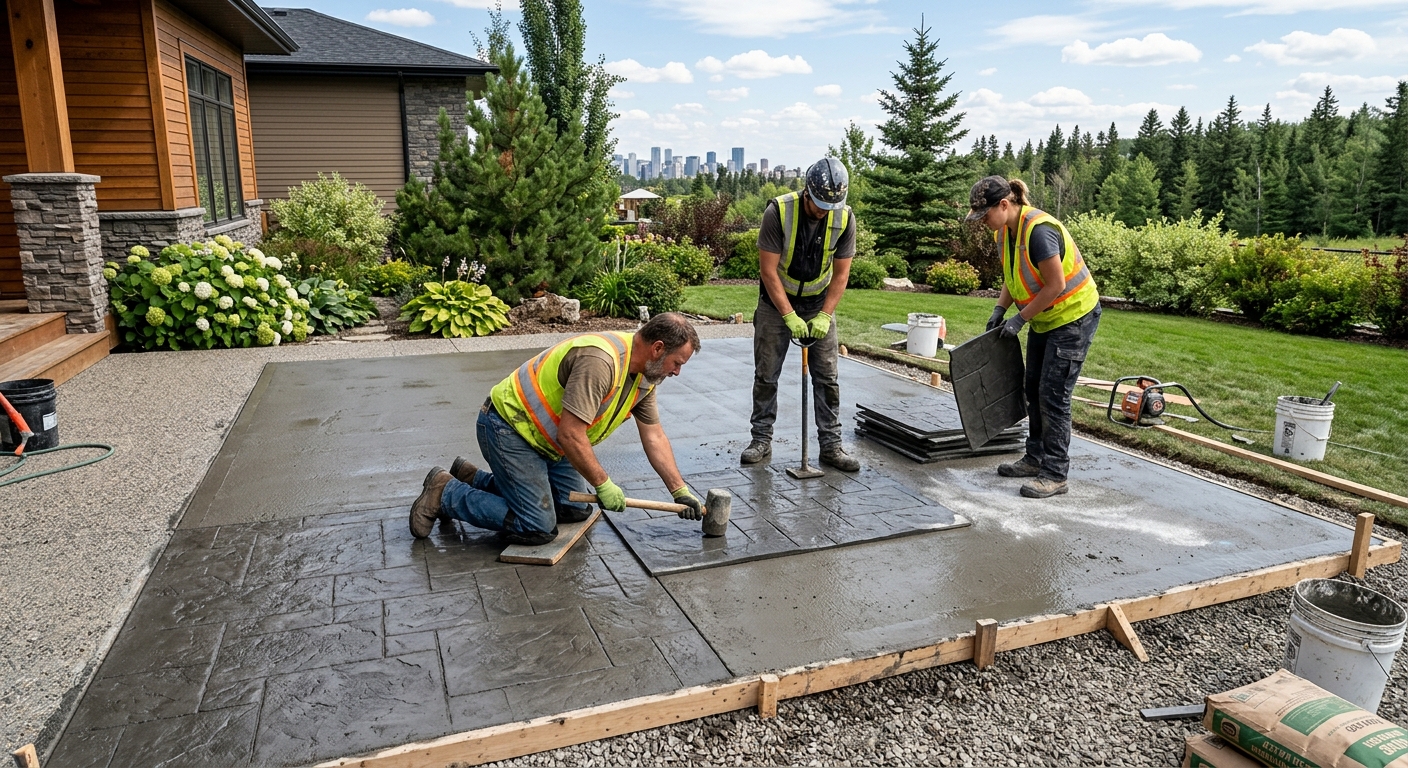
Concrete work options and costs in Mill Bay
Concrete work in Mill Bay is shaped by our climate and by how many homeowners here rely on durable flatwork around single-family houses. With a population of about 7,200 (Statistics Canada, 2021 Census), the market is smaller than Vancouver proper, so scheduling can tighten during peak spring and early fall pour windows. In the Lower Mainland–Southwest, mild winters and a shallow frost line still mean concrete has to be designed for freeze–thaw cycles and heavy coastal rainfall. In practice, that drives specs like compacted granular base, drainage details, air-entrained mixes, and footings set below the local design frost depth (commonly around 450 mm / 18" in our region). Wet weather also affects labour productivity and curing time—cool, damp stretches can slow strength gain and push crews to adjust timelines to protect the surface.
Concrete contractors also tend to be in especially high demand in neighbourhoods around Mill Bay core and the foreshore-side areas, where driveways, entry patios, and small re-slabs are common upgrades for older homes and waterfront properties. If you’re comparing options, it’s helpful to think beyond the finish: for example, a plain broom finish driveway is usually cheaper than stamped or exposed aggregate because it includes extra materials, more labour, and more careful finishing to control colour and texture during humid curing conditions.
Below is a practical side-by-side cost comparison for Mill Bay projects, using typical sizes you’d see in homeowners’ scopes—then you can cross-check the line items in your quote.
| Application |
Typical Size |
Key Spec |
Finish Option |
Price Range |
| Concrete driveway (standard broom finish) |
400–600 sq. ft. |
Thickness ~4" (about 100 mm), compacted granular base |
Broom finish + basic edges |
$18,000–$28,000 |
| Exposed aggregate driveway |
400–600 sq. ft. |
Higher-spec mix with controlled aggregate exposure |
Exposed aggregate (satin, textured surface) |
$22,000–$34,000 |
| Stamped concrete driveway or patio |
300–500 sq. ft. |
Integral colour + release system + saw-cut pattern |
Stamped pattern (e.g., slate/stone look) |
$22,000–$36,000 |
| Plain concrete patio or walkway |
200–400 sq. ft. |
Thickness ~4" (about 100 mm), compacted base |
Broom finish or light trowel + edging |
$12,000–$26,000 |
| Garage floor (interior slab) |
400–650 sq. ft. |
Vapour barrier, proper base, mesh or rebar as required |
Broom finish (or steel trowel in some cases) |
$14,000–$28,000 |
| Foundation footings (structural, below frost) |
Varies by footing layout |
Footings placed below design frost depth (typ. region practice ~450 mm base guideline) |
Reinforced structural concrete |
$6,500–$18,000 |
Prices are estimates only and vary by project scope, site access and material selection.
What affects the price of concrete work in Mill Bay
If you’re seeing quotes that differ by 30–50% for the “same” concrete job in the Lower Mainland–Southwest, the cause is usually not the concrete alone—it’s the design details crews must include to survive Mill Bay’s winter freeze–thaw cycles and wet spells. Even within British Columbia, contractors can price differently based on their base-prep method, reinforcement approach, and curing plan. In coastal-wet climates, the labour calendar can also tighten, and crews may need extra protection (curing blankets, sealers and longer cure schedules) to reach the intended surface durability.
In this region, footings and thickened edges are set below the design frost depth to prevent frost heave, and exterior slabs typically use air-entrained mixes to manage scaling and spalling under repeated wetting and freezing. While the frost line is shallower than interior or northern BC, the shallow depth doesn’t remove frost risk—it changes it. As a result, excavation depth, forming height, and drainage work still add up. When temperatures drop, cold-weather curing precautions—insulating blankets, controlled warming, and timing adjustments—raise material waste and labour hours. De-icing salts common on driveways can further accelerate surface wear, which is why sealing is often recommended after the pour.
Concrete costs can also move with practical differences: a driveway on sloped ground may require more grading and a better sub-drain, pushing the job toward the higher end of the $18–$28 / sq. ft. style backbone band (driveways), while a simple patio with good access and standard broom finish often stays closer to the $16–$26 band. In older Mill Bay neighbourhoods, existing soils may be disturbed or poorly drained, and even one extra truckload of granular base or a new drainage tie-in can shift the price by several thousand dollars.
| Price Factor |
Why It Matters |
Cost Impact |
| Frost line depth — determines footing depth and form height |
Footings must be placed below the design frost depth to reduce frost heave risk |
Higher excavation and forming; can add significant labour and equipment time |
| Site preparation — excavation, grading, compacted granular base |
Mill Bay soils and rainfall require proper subgrade prep and drainage continuity |
More granular, saw-cutting, haul-off and compaction passes increase cost |
| Reinforcement — rebar or wire mesh requirement |
Helps control cracking and supports loads (especially garage floors and structural elements) |
Material + placement labour; missed reinforcement can reduce service life |
| Mix design — air-entrainment and compressive strength spec |
Exterior air-entrainment and proper strength protect against freeze–thaw scaling |
More expensive mix and strict QA testing; usually worth the premium in coastal BC |
| Finish type — broom vs. stamped vs. exposed aggregate |
Premium finishes add colour systems, texturing tools, and time-sensitive finishing steps |
Stamped/exposed typically runs higher than plain broom-finish work |
| Pour size and concrete truck access to site |
Long pump runs or constrained access increase placement time |
Extra labour, pump/line costs, and potential staging fees |
| Cold-weather curing precautions — heating and blankets |
Cool, damp nights slow strength gain and can harm surface durability |
Blankets, heaters, extra labour and tighter scheduling raise the budget |
| Control joint pattern and sealing cost |
Joints manage cracking; sealing helps with de-icing salts and moisture exposure |
Saw-cut labour and sealer materials/crew time |
Permits & regulations in British Columbia
In British Columbia, structural concrete work generally requires a building permit—especially anything tied to the safety and stability of the home. That includes footings, foundation walls, grade beams, and other structural elements that transfer loads to the ground. In many cases, engineered drawings are reviewed by the municipality as part of the permit process. By contrast, concrete flatwork such as patios, walkways, and driveways typically does not require a permit on its own, unless it affects lot grading, drainage, impervious surface coverage limits, or involves work near the municipal right-of-way.
Because Mill Bay is a coastal area with significant rainfall, drainage and surface water management can become part of the review conversation when projects change runoff patterns. Always confirm details with the local authority before you break ground—especially if you’re raising a driveway elevation, adding a new patio, or tying in to existing drainage.
To verify a contractor in BC, follow a simple, step-by-step process: (1) confirm their company profile is active and review their professional credentials as applicable; (2) ask for a current Certificate of Insurance and confirm liability coverage is adequate for concrete flatwork and any site access risks; (3) confirm workers’ coverage—WSIB/WCB clearance where applicable—for anyone working on your property; (4) request references for similar-scale work in your area and verify the finish quality and jointing/drainage details match what you need.
If they can’t provide clear insurance proof or detailed scope documentation, treat it as a red flag—especially in a freeze–thaw climate where surface durability and base prep matter.
Getting concrete right in Mill Bay's freeze-thaw climate
In Mill Bay, the biggest concrete failures are usually surface-related: spalling, scaling, and premature cracking. Those problems happen when water gets into the slab/edges, freezes, expands, and disrupts the surface—often compounded by poor drainage and joints that don’t control crack locations. The Lower Mainland–Southwest climate still includes freeze–thaw cycles, and our coastal rain means slabs are frequently saturated. That’s why correct specs are non-negotiable: (1) base preparation with compacted granular to the right depth and proper drainage; (2) a mix design with appropriate air-entrainment; (3) a control joint pattern that limits random cracking; (4) curing that protects strength development during cool, humid weather; and (5) sealing after the cure to help repel moisture and de-icing salts.
For exterior flatwork, air-entrained concrete is the safeguard against freeze–thaw damage. A homeowner-friendly way to frame the budget is to compare options: a plain broom-finish driveway typically fits the lower end of the concrete driveway band (around $18–$28 per the project backbone), while decorative stamped concrete can land higher (around $22–$36). That price difference is justified when the contractor also plans for the harder finishing window, the same durability specs (air, joints, curing), and the added attention needed for consistent colour in humid conditions. If the durability package is reduced to “save money,” you’ll feel it later—usually as rough, flaking surfaces around joints and traffic areas.
When you ask technical questions, target the failure points: “What air content are you designing for?” “How are you proving the base is compacted to grade?” “When will you seal, and what product are you using?” A good contractor can answer without hesitation—because in Mill Bay’s wet coastal cycles, those details are the difference between a driveway that looks good for years and one that starts to deteriorate early.
| Spec |
Why It Matters in Mill Bay |
What to Ask For |
Impact if Skipped |
| Compacted granular base (depth?) |
Controls settlement and keeps water from pumping upward into the slab |
Base thickness for your soil and load (often ~4–8" compacted granular depending on design) and proof of compaction |
Settlement cracks, pumping, and faster surface deterioration |
| Air-entrained concrete mix (target air %?) |
Manages freeze–thaw scaling and helps protect the surface in wet winters |
Air content target for exterior flatwork (commonly about 5–7% air for air-entrained mixes) |
Spalling and scaling even if the finish looks okay initially |
| Compressive strength (MPa rating) |
Ensures durability and adequate strength gain for the intended exposure |
Minimum 32 MPa compressive strength (or the project’s specified equivalent) |
Reduced performance and higher risk of early cracking or surface wear |
| Control joints (spacing per ACI guidelines) |
Limits uncontrolled shrinkage cracking in saturated conditions |
Planned joint spacing and saw-cut timing (ask for the layout and schedule) |
Random cracks through the finish and worse freeze–thaw access to the slab |
| Minimum 7-day curing period |
Cold nights and coastal humidity slow strength gain and surface drying |
How curing will be handled and protected (blankets/cover if needed), aiming for at least 7 days under proper conditions |
Surface weakness, reduced durability and higher spalling risk |
| Penetrating sealer (when applied after cure) |
Helps repel moisture and reduces the impact of de-icing salts on the surface |
Sealer applied after cure (commonly around 28 days post-pour, if weather conditions allow) |
Faster staining, scaling, and wear in wet traffic lanes |
How to choose a concrete work contractor in Mill Bay
Choosing a concrete contractor in Mill Bay comes down to proof: proof they can build for coastal freeze–thaw conditions, proof they’re insured, and proof their quote matches your scope. In British Columbia, start by confirming the contractor’s licensing/credentials where applicable for the work they perform, then check their liability insurance and workers’ coverage (WSIB/WCB clearance as required). The easiest way is to ask for documents up front: a Certificate of Insurance (showing active coverage), and proof of workers’ coverage for the crew doing your project. If they can’t produce current certificates before starting, pause the process—your risk is real.
Next, get 2–3 itemised written quotes with clear line items (labour, materials, excavation and base prep, reinforcement, concrete supply, forms, finishing, saw-cutting, sealing, and disposal). Avoid lump sums that don’t state thickness, base thickness, reinforcement type, and finish specifications. Ask whether permit handling (if required for structural work) is included, and whether demolition/haul-off and site restoration are included.
Warranty also matters. Ask for workmanship warranty length, whether it covers cracking and spalling issues caused by workmanship (not misuse), and confirm what’s covered by the concrete product/manufacturer and whether it’s transferable if you sell your home. Then talk payment schedule: never pay more than about 10–15% upfront, and hold back a portion until the job is complete and cleaned up. Finally, require a written timeline with a start date and estimated completion, especially because rain and cool nights can affect curing and surface protection.
- Request itemised pricing for excavation, granular base, reinforcement, and finishing—not just “concrete supply.”
- Confirm slab/driveway thickness and the intended base thickness for your site.
- Ask for their air-entrained mix plan for exterior work.
- Verify joint layout: where joints will be placed and when saw-cutting will occur.
- Ask how they protect curing in cool, wet Mill Bay weather (blankets/curing compound/sealer schedule).
- Confirm disposal and haul-off are included if they remove existing concrete.
- Check whether drainage tie-ins (swales/fields/ground drains) are included when required.
- Ask for a colour/finish method and sample photos of projects in similar coastal conditions.
- Get proof of liability insurance before work starts.
- Confirm workers’ coverage/WSIB/WCB clearance for the crew.
- Ensure a clear warranty statement is in writing and understand what it covers.
- Keep payment staged: 10–15% upfront maximum, with holdback until final grading and cleanup are done.
Concrete red flags in Mill Bay: vague quotes that don’t state thickness/base/reinforcement; “no need” dismissal of air-entrainment for exterior slabs; failure to discuss drainage or joint sealing; asking for large upfront payments; and no written timeline or cure/protection plan for rainy/cool weather.
Frequently asked questions — concrete work in Mill Bay
When is the best time to pour concrete in Mill Bay?
In Mill Bay, the best pours are typically during stretches of stable weather—late spring through early fall—when daytime temperatures support normal curing and you can limit extended rain exposure. Even though coastal winters are milder than inland BC, freeze–thaw cycles still happen and saturate the slab repeatedly. That means cold nights can slow strength gain and increase the risk of surface damage if the contractor doesn’t use proper curing blankets and protection. A good contractor will plan around forecast windows, set up drainage and cover protection ahead of time, and schedule finishing steps (especially for stamped or exposed aggregate) to reduce rework in high humidity. If you’re budgeting, decorative work usually costs closer to the $22–$36 backbone range because it requires tighter weather control.
How long does concrete take to cure?
Concrete has two timelines: strength development and surface readiness. For most residential exterior work in British Columbia, crews plan for at least 7 days of proper curing before treating the slab as fully “set,” with curing protection particularly important during cool, damp Mill Bay nights. Full design strength generally takes longer—often around 28 days—so contractors should protect the surface and manage moisture/temperature rather than rushing to remove forms or open the area too soon. That’s also why sealing is usually scheduled after the cure window (commonly around 28 days post-pour) to help repel moisture and de-icing salts. If someone offers to rush curing without blankets, covers, or temperature control, ask how they ensure the slab reaches intended durability for our freeze–thaw cycles.
Do I need a permit for concrete work in British Columbia?
In British Columbia, structural concrete work like footings, foundation walls, and grade beams typically requires a building permit, often with engineered drawings reviewed by the municipality. Concrete flatwork such as patios, walkways and driveways often doesn’t require a permit by itself, but it can if the project changes lot grading, affects drainage, triggers impervious surface considerations, or impacts municipal right-of-way or stormwater handling. In Mill Bay, drainage details matter because heavy coastal rainfall can magnify runoff issues if elevations change. The safest approach is to ask your contractor what category your scope falls under and then confirm with the local authority before you start excavation. Also verify the contractor provides proof of liability insurance and workers’ coverage before breaking ground.
Concrete vs pavers for a patio in Mill Bay?
Concrete and pavers can both work well in Mill Bay’s wet, freeze–thaw climate, but the maintenance trade-offs differ. Concrete patios are usually poured over compacted granular base, then finished with broom or a decorative option; properly placed control joints and air-entrained mix help manage cracking and surface scaling. Pavers can look great and allow easier localized repairs if a section shifts, but they still depend on good base prep and drainage—otherwise you can get uneven settling and weed growth in joints. Pricing varies by scope: a plain concrete patio often aligns with the $16–$26 driveway/patio band backbone, while decorative concrete moves upward similar to $22–$36. If you want a clean, continuous surface with fewer individual units to maintain, concrete is commonly the simpler long-term choice when installed with correct air and jointing.
How long does a concrete driveway last?
A well-built driveway in Mill Bay can last many years, but “how long” depends on the durability package: air-entrained concrete for freeze–thaw, properly compacted granular base, drainage management, correct control jointing, and curing/protection. Driveways also face chemical exposure from de-icing salts and abrasion from vehicles, which is why sealing after cure (often around 28 days post-pour) can materially slow surface deterioration. If a contractor skimped on air-entrainment or rushed curing in cool, humid weather, you may see scaling or spalling much earlier—even if the initial finish looked good. Cost typically reflects these choices: standard broom-finish driveway scopes often fall within the $18–$28 backbone range, while premium textured finishes add labour and material for appearance and performance.
What is air-entrained concrete and why does it matter here?
Air-entrained concrete is a mix designed to include tiny, evenly distributed air bubbles. Those micro-bubbles create space for freezing water to expand without blowing apart the concrete surface, which is crucial in British Columbia’s coastal conditions where slabs can repeatedly saturate and then freeze. In Mill Bay, that freeze–thaw cycle and moisture exposure is what leads to spalling and scaling when air-entrainment is missing or incorrect. For exterior flatwork, contractors typically target air content in the range of about 5–7% and should also specify appropriate compressive strength and jointing. If you’re comparing quotes, ask directly whether the mix is air-entrained for exterior exposure and how they protect curing during cool, damp nights. That one spec often does more to determine longevity than the choice of broom finish vs a decorative pattern.