Concrete work options and costs in Lillooet
Lillooet homeowners typically choose between standard broom-finished slabs and more durable decorative options when they’re refreshing entryways, driveways, and patios. In a town where single-detached homes make up 69.4% of dwellings and owner households account for 83.3% of households (Statistics Canada, 2021 Census), concrete flatwork is a common “everyday upgrade” that holds value. It’s also a practical choice for walkability around older properties—55.4% of local homes were built before 1981 (Statistics Canada, 2021 Census), and many have older, uneven steps or worn drive surfaces.
In the Lower Mainland–Southwest, pricing and specs are shaped by mild winters paired with a shallow frost line and frequent freeze–thaw cycles. Even though frost depth is often assumed around 450 mm (18") in this region, contractors still place footings below that level and build thickened edges for exterior slabs to reduce frost heave. Coastal-wet weather and occasional cool, damp stretches also affect curing schedules: we often plan for slower strength gain, use curing blankets or sealers, and coordinate around rain to protect surfaces. Labour availability can swing with ongoing projects along the Fraser Valley corridor, so timelines for drainage excavation and concrete truck scheduling may change week to week.
In Lillooet, concrete demand is especially steady around the Bridge River/Seton Lake access areas and the downtown core where drive access, drainage, and compacted base prep are frequent upgrade items. Use the table below to compare typical sizes, key specs, finish choices, and realistic budget ranges for common jobs.
| Application |
Typical Size |
Key Spec |
Finish Option |
Price Range |
| Concrete driveway (standard broom finish) |
16 ft x 24 ft (384 sq ft) |
Air-entrained exterior mix, compacted granular base, control joints |
Broom finish |
$7,800–$10,700 |
| Exposed aggregate driveway |
16 ft x 24 ft (384 sq ft) |
Air-entrained exterior mix, wash/expose process, sealer-ready surface |
Exposed aggregate |
$9,500–$13,200 |
| Stamped concrete driveway or patio |
12 ft x 20 ft (240 sq ft) |
Air-entrained mix, integral colour, densifier/sealer system |
Stamped pattern |
$6,000–$8,700 |
| Plain concrete patio or walkway |
10 ft x 16 ft (160 sq ft) |
Proper base drainage, control joints, air-entrainment |
Float + light broom |
$2,600–$4,200 |
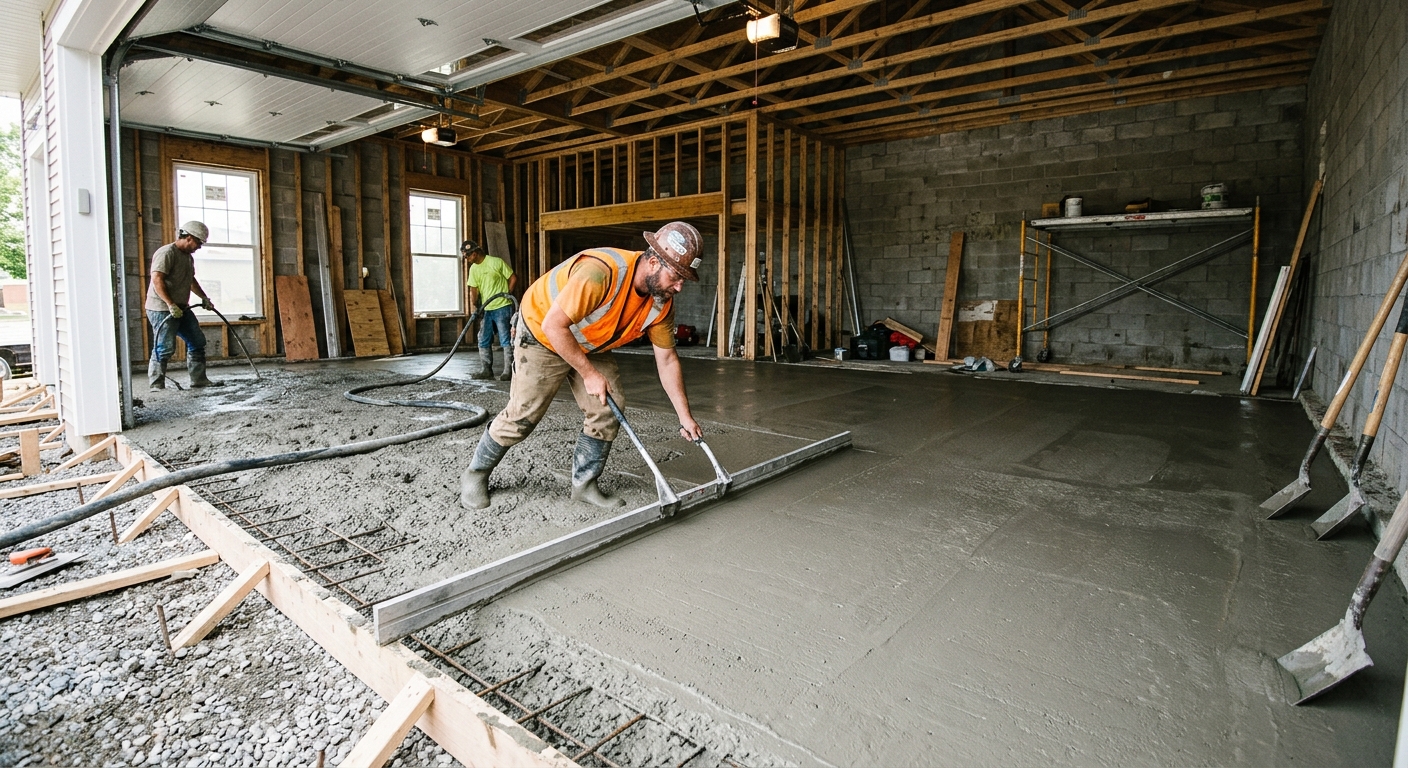
| Garage floor (interior slab) |
20 ft x 22 ft (440 sq ft) |
Vapour barrier (if specified), reinforced slab, proper curing |
Steel-trowel finish |
$7,600–$12,500 |
| Foundation footings (structural, below frost) |
Typical: 40 linear ft |
Excavation to design frost depth, rebar/anchors, engineered sizing |
Structural concrete |
$8,000–$14,000 |
Prices are estimates only and vary by project scope, site access and material selection.
What affects the price of concrete work in Lillooet
In Lower Mainland–Southwest, two contractors can quote the “same” concrete project and still land 30% to 50% apart—usually because the lower number skips critical base work, uses a different concrete spec, or assumes easier access. In practical terms, the variation you’ll see across British Columbia comes from how each crew handles frost protection, drainage, and curing in damp, cool conditions. Frost depth and freeze–thaw cycles drive the specs: exterior concrete needs air-entrained mixes to resist scaling and spalling, and structural footings must extend below the design frost depth (in coastal BC, commonly about 0.5–1.2 m depending on soil and design). When crews have to dig deeper or build thicker edges, costs rise due to excavation volume and more forming.
For flatwork, colder regions usually add cost because pour seasons are shorter and cold-weather curing precautions (heating, insulated blankets, temperature management) are required. In Lillooet specifically, the local soil and drainage conditions often dictate how much granular base and how much subgrade preparation is needed to keep slabs stable during wet periods. A typical driveway at $18–$28 per sq ft can move toward the upper end if truck access is tight (more labour for placement and consolidation), if drainage corrections are required, or if the base needs additional compacted depth. Decorative options also follow clear economics: stamped concrete often carries a premium (roughly $22–$36 per sq ft equivalent when you factor colour, labour, and finishing), but it’s justified when you’re trying to match a stone-like look or reduce maintenance complaints.
Housing stock matters too. With many homes built before 1981 (Statistics Canada, 2021 Census), you’ll more often see older foundations and reworked grades, which can add hidden scope—uneven excavations, ledge removal, or tie-ins to existing drainage. The result is not “mystery” pricing; it’s how crews protect the slab through freeze–thaw and wet weather, while still managing truck scheduling and proper cure time.
| Price Factor |
Why It Matters |
Cost Impact |
| Frost line depth — determines footing depth and form height |
Footings must sit below design frost to prevent frost heave |
Higher excavation and forming if deeper than minimum |
| Site preparation — excavation, grading, compacted granular base |
Weak subgrade leads to settlement and cracking |
Additional truckloads/compaction time |
| Reinforcement — rebar or wire mesh requirement |
Controls cracking and improves slab performance |
Material + labour for placement and supports |
| Mix design — air-entrainment and compressive strength spec |
Exterior freeze–thaw survival depends on air content |
Premium concrete and batching control |
| Finish type — broom vs. stamped vs. exposed aggregate |
Finishes require different processes and skilled crews |
Stamped/exposed adds labour and materials |
| Pour size and concrete truck access to site |
Access affects pump/placing time and may change schedule |
More labour and potential equipment mobilization |
| Cold-weather curing precautions — heating and blankets |
Slower strength gain increases risk if not managed |
Heating blankets, monitoring, longer cure management |
| Control joint pattern and sealing cost |
Joints manage cracking; sealing helps repel de-icing salts |
Additional sawing, sealing materials, and wait times |
Permits & regulations in British Columbia
In British Columbia, structural concrete work typically requires a building permit and often engineered drawings reviewed through the municipality. That includes items like footings, foundation walls, grade beams, and any structural elements tied to the building’s load path. For concrete flatwork—driveways, patios, and walkways—permits are frequently not required by default. However, a permit may be necessary if the work affects lot grading, drainage, or impervious surface coverage limits, or if the project impacts a municipal right-of-way (for example, modifications near a curb, sidewalk, or driveway approach). The practical step is to confirm with the local authority before you break ground, especially if you’re changing drainage patterns or tying into existing service routes.
For contractor vetting in Lillooet, verify three things before work starts:
- Licence/registration: check the contractor’s business credentials using the provincial online registry sources your contractor provides (and confirm the correct legal name matches the quote).
- Liability insurance: request a Certificate of Insurance showing the policy is active and includes general liability coverage suitable for concrete work.
- Coverage for workers: confirm WSBC/WCB coverage for the contractor’s employees (or subcontractors) via documentation they can provide.
Then ask for references and photos of similar-scale projects (driveways, drainage revisions, and slab details) in BC conditions. If the scope touches structural foundations, make sure the permit and engineered requirements are clearly listed on the contract documents.
Getting concrete right in Lillooet's freeze-thaw climate
Concrete failure in Lillooet most often shows up after wet seasons: freeze–thaw cycles encourage surface scaling and, in harsher spots, deeper spalling—especially around edges, joints, and areas exposed to de-icing salts. The fix is not “better looks,” it’s better engineering: a properly prepared base, a freeze–thaw resistant mix, correct jointing, and curing/finishing done at the right pace for cool, damp weather.
Start with base preparation. Exterior slabs need a compacted granular sub-base to the right depth and grade for drainage, not just a quick scrape-and-pour. Next, mix design: for exterior flatwork, specify air-entrainment (commonly 5–7% air content) and minimum 32 MPa compressive strength. Then control joints: place them to limit random cracking and ensure joints are cut/scheduled so cracking doesn’t become uncontrolled. Curing is also critical in this climate—plan for at least 7 days of curing under proper conditions, and protect the slab if temperatures drop (curing blankets/heated protection where needed). After the concrete has cured, apply a penetrating sealer around the 28-day mark to repel salts and water intrusion.
A common homeowner question is whether to spend more for decorative finishes. For example, if a broom-finished driveway comes in at roughly $18–$28 per sq ft but stamped concrete is closer to $22–$36 per sq ft equivalent, the difference is justified when you want increased curb appeal and can accept more up-front finishing labour. It’s not justified if the base is questionable—an under-built broom slab will fail just as fast as a stamped one. Ask your contractor to show how they’ll prevent the typical freeze–thaw spalling problem by confirming air-entrainment and joint/sealer sequencing.
| Spec |
Why It Matters in Lillooet |
What to Ask For |
Impact if Skipped |
| Compacted granular base (depth?) |
Reduces settlement and limits water pooling during freeze–thaw |
State granular depth and compaction method; confirm drainage grade |
Uneven slab, premature cracking, water intrusion |
| Air-entrained concrete mix (target air %?) |
Improves freeze–thaw durability and resists scaling/spalling |
Confirm target air content (typically 5–7% for exterior flatwork) |
Surface scaling, spalling around edges/joints |
| Compressive strength (MPa rating) |
Helps the slab reach design durability under damp, cool conditions |
Specify minimum 32 MPa for exterior applications |
Reduced strength gain and faster wear |
| Control joints (spacing per ACI guidelines) |
Limits random cracking caused by drying shrinkage and temperature movement |
Request planned joint layout/spacing and sealing compatibility |
Uncontrolled cracks that become water paths |
| Minimum 7-day curing period |
Ensures strength development before the slab is exposed to weather |
Confirm curing protection in cool/rainy stretches |
Low surface strength and higher risk of damage |
| Penetrating sealer (when applied after cure) |
Helps repel de-icing salts and reduces moisture uptake |
Ask for penetrating sealer applied after cure (often ~28 days) |
Faster deterioration and staining/scale build-up |
How to choose a concrete work contractor in Lillooet
Choosing the right contractor in Lillooet starts with proof, not promises. Ask for their current British Columbia credentials (and confirm the contractor name on the quote matches the legal business name), then request a Certificate of Insurance for general liability—so you’re covered if there’s accidental damage. For worker coverage, ask for documentation confirming WSBC/WCB coverage for their employees and any subcontractors they use. A reputable crew will provide this without pressure and will explain how their insurance applies to the project.
Next, get 2–3 itemised written quotes rather than one lump sum. You want labour and materials broken out so you can see what’s included: excavation and disposal, granular base depth, reinforcement type, air-entrained mix spec, forming, finishing, saw-cut jointing, and whether sealing is included. Also check exclusions: is the quote for saw-cut control joints only, or are joints sealed? Is permit pulling included if structural work triggers it? If truck access requires a pump or wheelbarrow/placement plan, it should be stated.
On warranty, ask for two layers: workmanship (how long the contractor stands behind the installation) and any product/manufacturer warranty on sealer/coloured/stamped systems. Clarify whether it’s transferable if you sell your home.
For payments, avoid paying more than 10%–15% upfront. Hold back payment until the job is complete and cleaned, and the curing/sealing steps (where included) have been carried out. In your contract, require a start date and an estimated completion window—concrete scheduling in BC depends heavily on weather and truck availability.
- Confirm BC credentials match the quote and contract name.
- Request Certificate of Insurance before work starts.
- Verify WSBC/WCB coverage for all workers and subs.
- Require an itemised quote (labour, materials, excavation, disposal).
- Check granular base depth and compaction requirements are spelled out.
- Confirm reinforcement type (mesh vs. rebar) for your application.
- Ask for the concrete mix spec: air-entrainment and target strength.
- Confirm control joint layout and timing of saw-cut.
- Ask about curing protection during cool nights/rainy stretches.
- Determine whether sealing is included and when it’s applied.
- Read the scope: what’s excluded (stairs, drainage repairs, forms removal, disposal)?
- Set a payment schedule with a holdback until final cure/seal steps.
Concrete red flags in Lillooet include: quotes that don’t mention air-entrainment for exterior slabs, skipping engineered details for foundation work, refusing to show insurance/coverage paperwork, vague jointing/cure language, and pushing for large upfront deposits instead of a structured schedule.
Frequently asked questions — concrete work in Lillooet
What is the difference between concrete and cement?
In everyday language, people say “cement” when they mean the finished slab, but in British Columbia the technical distinction matters. Cement is one ingredient—powdered clinker plus gypsum—used to make concrete. Concrete is the full mix: cement, water, sand, and gravel (and often admixtures like air-entraining agents for freeze–thaw durability). For Lillooet exterior work, contractors should specify an air-entrained concrete mix so the slab can handle winter wetting and freezing cycles without excessive scaling or spalling. If your quote only says “cement” without a freeze–thaw-friendly concrete spec, it’s a sign the scope is too vague. Ask what air content and compressive strength the supplier is batching for your driveway, patio, or foundation scope.
How much does concrete work cost in Lillooet?
Concrete pricing in Lillooet typically follows the regional per-square-foot bands used across the Lower Mainland–Southwest corridor, then adjusts for excavation, access, and how much protection is required for freeze–thaw conditions. For a typical concrete driveway, you may see budgets around $7,800–$10,700 for a standard broom-finished driveway sized about 16 ft x 24 ft (384 sq ft). Plain patios and walkways usually land lower, while decorative finishes rise in cost—stamped concrete often falls into a premium tier compared with broom. If you’re comparing quotes, look beyond the total: confirm the base prep depth, whether the mix is air-entrained for exterior exposure, and whether sealing is included. Those spec details explain most price differences better than “contractor markup.”
How deep must footings be for Lillooet's frost line?
Lillooet’s frost conditions are why good contractors treat footing depth as an engineered requirement, not a guess. Even though Lower Mainland–Southwest practice often assumes a frost depth around 450 mm (18"), footings for exterior structural support must be placed below the design frost depth for your soil conditions to prevent frost heave. In coastal BC, that design depth is often in the approximate range of 0.5–1.2 m depending on the site and frost model, but the correct number is set by the building design and local assumptions. Your permit/engineer details (for foundations that require them) will drive excavation depth, rebar placement, and forming height. If a contractor quotes foundation work without discussing below-frost design depth and engineered dimensions, ask for the drawings or footing schedule before proceeding.
Why does concrete crack in Lillooet and how is it prevented?
Cracking in Lillooet is usually a predictable combination of shrinkage, temperature movement, and water-driven freeze–thaw cycles—not “cheap concrete.” Control joints manage where cracks will form by giving the slab planned weak points. Base preparation prevents differential settlement, which otherwise concentrates stresses and causes wider or uneven cracking. Exterior slabs also need air-entrained concrete to reduce freeze–thaw damage that can turn fine cracking into surface scaling and spalling over time. Proper curing matters too: a rushed cure increases shrinkage stress. Finally, sealing after cure helps limit moisture and de-icing salt penetration. If you’re troubleshooting, ask whether joints are correctly spaced and cut on time, whether the mix was air-entrained, and whether the granular base was compacted to a stated depth. Those decisions prevent most “bad cracking” issues.
Stamped vs broom-finish concrete — cost difference?
Stamped concrete typically costs more than broom-finish because it adds materials and labour: integral colouring or colour hardener, release agents, form/texture tooling, and careful finishing to control pattern quality. In the regional pricing bands, stamped and decorative concrete generally sits higher, often around $22–$36 per square foot equivalent for that decorative tier. In contrast, a standard broom driveway follows the lower flatwork band (often $18–$28 per square foot equivalent depending on size and prep). The real reason to pay the premium is aesthetics plus the ability to match drainage and base prep so the slab lasts. But don’t assume stamped is “more durable”—durability still depends on air-entrainment, joints, proper base prep, and curing. If those aren’t properly specified, you’ll pay extra for appearance without avoiding failure.
When is the best time to pour concrete in Lillooet?
For Lillooet and broader British Columbia conditions, the best time to pour is when temperatures support proper curing and you can protect the slab from rain and early freezing. Because you can still get cool nights and damp spells, late spring through summer is usually safest for flatwork and foundation pours that need controlled curing. That said, professional crews can pour outside peak temperatures if the job is managed with cold-weather curing precautions—insulated blankets, temperature monitoring, and sometimes temporary heating to keep the concrete developing strength. Rain planning is equally important: in a wet coastal climate, contractors often adjust pour timing, provide curing protection, and plan finishing steps so the surface isn’t damaged. In your estimate, ask how they schedule around weather, what curing measures are included, and whether sealing is planned for after the recommended cure period (often around 28 days).