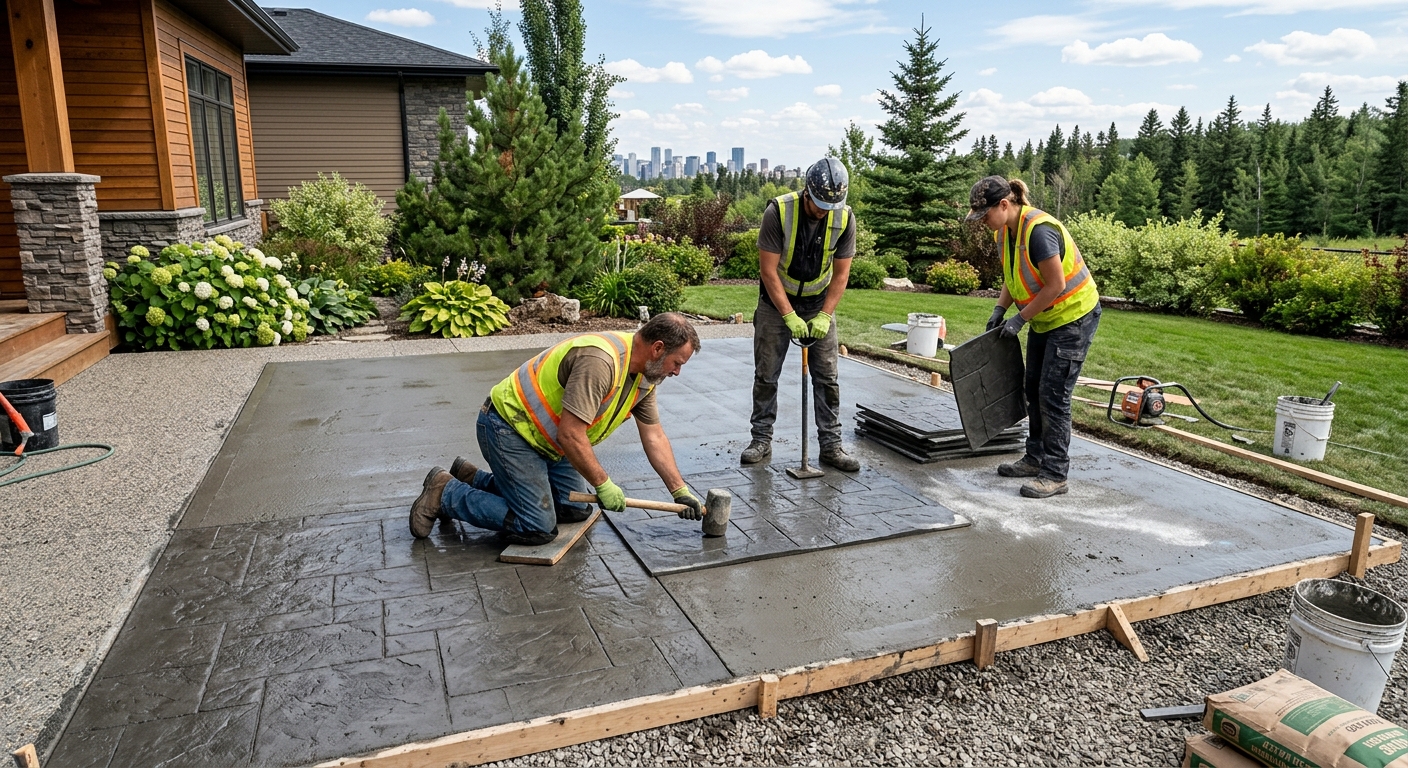
Concrete work options and costs in Golden
Concrete work in Golden is a little different than in warmer parts of British Columbia, mainly because freeze–thaw cycles are hard on flatwork. Golden’s housing profile is very family-heavy and homeowner-led: single-detached houses make up 56.5% of dwellings, and owner households are 69.2% of households (Statistics Canada, 2021 Census). That’s why you’ll see steady demand for driveways, patios, and walkway work—especially around neighbourhoods where access roads and side-yard slopes require careful base prep.
In the Thompson–Okanagan, we build for frost depth and movement, not just convenience. Local practice assumes footings and foundations need to sit below frost (commonly in the 45–60 cm range for design assumptions), and exterior slabs must use air-entrained mixes and a well-planned joint layout to manage cracking and reduce scaling. The cold shoulder seasons can also shorten the practical pour season, and curing may require protection (insulating blankets or heat) to achieve proper strength. In Golden, that usually translates into excavation, forming and curing effort that’s higher than generic “BC average” numbers.
Contractor availability can also vary through the season. When crews are busy with foundations, decorative work may shift later in the calendar—so lead time matters if you’re tying concrete to landscaping or a garage build. If you’re comparing options, this table gives realistic Golden ranges for common scopes, then you can narrow specs based on your soil, slope, drainage, and whether you want broom, exposed aggregate, or stamped finishes.
| Application |
Typical Size |
Key Spec |
Finish Option |
Price Range |
| Concrete driveway (standard broom finish) |
400 sq. ft. |
Air-entrained mix, proper base, control joints |
Broom |
$7,200–$11,200 |
| Exposed aggregate driveway |
400 sq. ft. |
Air-entrained mix with exposure process, sealed or ready for sealing |
Exposed aggregate |
$9,000–$13,600 |
| Stamped concrete driveway or patio |
300 sq. ft. |
Air-entrained mix, colour hardener (if selected), joints |
Stamped |
$10,000–$16,500 |
| Plain concrete patio or walkway |
200 sq. ft. |
Frost-appropriate base, joints, drainage considerations |
Broom or smooth steel trowel |
$2,800–$4,800 |
| Garage floor (interior slab) |
400 sq. ft. |
Vapour control (as needed), reinforcement option, well-compacted base |
Broom or light trowel |
$6,400–$12,000 |
| Foundation footings (structural, below frost) |
Per foundation plan |
Excavation, forms, rebar cage, pour below design frost |
Structural concrete |
$220–$350 |
Prices are estimates only and vary by project scope, site access and material selection.
What affects the price of concrete work in Golden
For the same “basic” concrete job, quotes can swing by 30–50% across the Thompson–Okanagan and other parts of BC because the real cost drivers are the specs you can’t see. In our interior climate, frost depth and freeze–thaw cycles dictate everything: exterior concrete slabs and supported edges need proper air-entrainment and a sub-base/granular build-up that’s compacted and drained. Footings and foundations must extend below the design frost depth; the goal is to prevent frost heave and long-term cracking, not just meet a shallow minimum. That means deeper excavation and higher forming effort than people expect when they hear “standard” footing talk.
Cold curing is another cost driver. When temperatures drop, crews may need heating and insulating blankets to maintain curing conditions long enough for strength gain. Sealing also matters more in Golden because de-icing salts accelerate surface deterioration and can lead to spalling if the slab isn’t protected. On finish work, broom finishes usually stay closer to the driveway band of $18,000–$28,000 per typical driveway scope, while stamped and exposed aggregate can move higher because of colour, stamping labour, and extra surface preparation.
In Golden specifically, the price can rise if your site has heavy rock during excavation, steep grades that need retaining-formwork, or poor drainage where we have to overbuild the granular base. It can lower when your access is straightforward (truck can stage close to the pour area) and when there’s minimal demolition. Housing age also plays a role: with 56.5% of homes built before 1981 (Statistics Canada, 2021 Census), you’ll sometimes see older drainage patterns and earlier foundation waterproofing assumptions that require extra consideration during concrete replacement or foundation-related work.
| Price Factor |
Why It Matters |
Cost Impact |
| Frost line depth |
Determines footing depth and form height |
Higher excavation and concrete volume; can add significant cost |
| Site preparation |
Excavation, grading, compacted granular base |
More base prep and hauling increases labour and equipment time |
| Reinforcement |
Rebar or wire mesh requirement |
May increase materials cost and placement labour |
| Mix design |
Air-entrainment and compressive strength spec |
Air-entrained exterior mixes typically cost more than non-air mixes |
| Finish type |
Broom vs. stamped vs. exposed aggregate |
Stamped/exposed work increases labour, colour materials, and prep time |
| Pour size and concrete truck access to site |
Large pours need staging, pump/placement planning |
Bad access may require smaller loads, additional labour, or pumping |
| Cold-weather curing precautions |
Heating and blankets |
Direct cost for equipment and extra time on site |
| Control joint pattern and sealing cost |
Controls cracking and extends slab life |
Sealing adds a follow-up cost but reduces salt-related surface damage |
Permits & regulations in British Columbia
In British Columbia, the permit and design requirements depend on what you’re building. Structural concrete work—such as footings, foundation walls, and grade beams—requires a building permit, and it often involves engineered drawings that are reviewed as part of the permitting process. If your project includes structural changes to support loads or alters foundation elements, don’t start by assuming it’s “just concrete.” For example, replacing or extending foundation components typically triggers permit requirements.
Concrete flatwork (driveways, patios, and walkways) often does not require a permit, as long as it doesn’t change lot grading, conflict with impervious surface coverage rules, or affect municipal drainage/right-of-way requirements. That said, Golden homeowners still need to confirm whether your specific scope changes drainage or slopes toward a neighbour or ditch.
How to verify a contractor in Golden:
- Confirm they carry liability insurance and you receive a current certificate of insurance before work starts.
- Ask for proof of workers’ compensation coverage (WSBC/WCB) and ensure it’s active for the workers who will be on site.
- Check their licensing/registration through the relevant BC provincial online registry resources (your contractor should be able to provide their registration details up front).
- Request references for projects similar in size and exposure to interior freeze–thaw conditions (driveways and exterior slabs are ideal).
When you’re dealing with structural concrete, always verify the permit plan before excavation—your contractor should be able to explain what’s permitted, what’s engineered, and how they coordinate inspection points.
Getting concrete right in Golden's freeze-thaw climate
Concrete failures in Golden usually come down to one thing: movement plus water plus the cold. Freeze–thaw cycles drive expansion and contraction, and if water can reach the surface or the slab is built on weak/poorly drained subgrade, you can get scaling, spalling, and random cracking. The fix starts before the pour. Base preparation needs to be a compacted granular sub-base to the right depth for the site and frost assumptions, with grading that sheds water away from the slab. That’s why “thin base + hope” becomes expensive later.
Next is the mix design. For exterior slabs and driveways, request air-entrained concrete with a target air content typically around 5–7% and a minimum 32 MPa compressive strength spec (appropriate for freeze–thaw durability). Air-entrainment is one of the most important protections against spalling—without it, surface deterioration accelerates in interior BC winters, especially when de-icing salts are used. Control joints also matter: they’re your engineered weak points, placed to encourage cracking where you can manage it rather than letting it happen randomly.
Finally, curing and protection. Plan for at least 7 days of curing under proper conditions, and in colder shoulder seasons use curing compounds or insulation/heating as needed to maintain strength gain. After the slab cures (typically about 28 days), apply a penetrating sealer to repel salt and reduce moisture ingress. A common decision point: a broom-finish driveway at roughly $7,200–$11,200 will often cost less upfront than stamped at around $10,000–$16,500, but the “extra” stamped labour is only worth it if the base, air-entrainment, and jointing specs are equally strong. Otherwise, you pay more for a surface that can still fail.
| Spec |
Why It Matters in Golden |
What to Ask For |
Impact if Skipped |
| Compacted granular base (depth?) |
Stops pumping and reduces frost-related movement |
Granular base depth based on soil and frost assumptions; compaction testing method |
Settling, uneven slab, early cracking |
| Air-entrained concrete mix (target air %?) |
Protects against freeze–thaw scaling and spalling |
Air content target typically 5–7% for exterior flatwork |
Surface scaling/spalling, especially with de-icing salts |
| Compressive strength (MPa rating) |
Ensures durability and structural capacity for loads |
Minimum 32 MPa compressive strength spec |
Reduced strength gain, increased cracking risk |
| Control joints (spacing per ACI guidelines) |
Manages shrinkage cracks in a controlled pattern |
Joint spacing and timing plan; sawcut vs. tooled joints |
Random cracking and water penetration |
| Minimum 7-day curing period |
Strength develops reliably before exposure stress |
Curing plan for cold nights; protection if temperatures drop |
Lower strength and increased early deterioration |
| Penetrating sealer (when applied after cure) |
Reduces salt and moisture ingress through surface pores |
Sealer applied after cure (commonly around 28 days) |
Faster surface weathering and scaling |
How to choose a concrete work contractor in Golden
Start with verification. In British Columbia, you want a contractor who can show active liability insurance and workers’ compensation coverage before mobilizing. Ask for a certificate of insurance (COI) showing general liability limits and confirm it covers the specific work at your address. For workers’ compensation, request proof of WSBC/WCB coverage and make sure it matches the crews that will be on site. For licensing/registration, use the contractor’s provided registration details to confirm status through BC’s relevant online registry resources—don’t rely on verbal assurances. If they can’t provide documents quickly, that’s a red flag.
Then get 2–3 itemised written quotes. You’re looking for a breakdown that separates labour and materials (concrete volume, base prep materials, reinforcement, sawcutting/jointing, sealing, and hauling/disposal). Avoid vague lump sums that don’t state what’s included—especially permit pulling (when applicable), traffic control, and whether waste disposal and site restoration are covered.
Warranty matters for workmanship and products. Ask for the workmanship warranty length and what it covers (cracking due to shrinkage, joint performance, surface scaling, settlement issues). Also ask if product/manufacturer warranties apply and whether they’re transferable if you sell the home. Payment schedule should be conservative: never pay more than 10–15% upfront, and use a holdback until completion and walkthrough items are satisfied. Get the start date and an expected completion window in writing, because Golden’s seasonal temperatures can impact curing and final finishing.
- Provide COI for liability insurance before you sign.
- Provide WSBC/WCB proof for workers.
- Confirm registration/licensing status via the BC registry using their exact details.
- Use itemised quotes (labour + materials + equipment) rather than one lump number.
- Clarify scope: excavation depth, disposal, granular base, reinforcement, and joints.
- Ask whether they include control joint cutting and the timing (tooled vs. sawcut).
- Confirm air-entrainment and minimum compressive strength in writing.
- Ask for a curing plan for cold nights (blankets/heating/curing compound).
- Confirm sealing is included or scheduled for after cure (often ~28 days).
- Get access details: truck route, staging area, and whether pumping is required.
- Written warranty terms and exclusions, stated clearly.
- Payment schedule with a holdback until final grade and cleanup meet your acceptance.
Red flags we see in Golden: contractors who won’t put air-entrainment in the scope, who refuse to discuss curing protection in shoulder seasons, who quote foundation/footing work without describing depth below frost, who want large deposits (more than 10–15%) before any prep starts, and who give only “driveway price per square foot” without including disposal, base prep, or jointing plan.
Frequently asked questions — concrete work in Golden
What is rebar and when is it required in British Columbia?
Rebar is steel reinforcement placed inside concrete to improve tensile strength and reduce cracking from loads and movement. In British Columbia, whether you need rebar depends on the structure being built and the engineering design—especially for structural concrete like footings and foundation walls, where the load path and frost movement require a designed reinforcement layout. For concrete flatwork (like a driveway or patio), some projects use wire mesh or rebar, while others rely on thicker slabs, proper base, and jointing—your contractor should explain the specification and why it fits your use (vehicle loads, thickness, and subgrade condition). In Golden, the bigger issue is freeze–thaw durability and base support; reinforcement helps with load resistance, but it doesn’t replace proper air-entrainment and joint sealing. If you’re comparing quotes, ask whether the plan calls for rebar/wire mesh, what size/spacing, and where it sits (chairs/spacers) so it’s not resting on the ground.
How long does a concrete project take in Golden?
Timelines in Golden depend on site prep, weather, and curing. For a typical exterior flatwork job, you can expect a fast sequence: excavation/grading and base prep first, then forming and reinforcement (if required), then the pour and finishing the same day. The critical part is curing—concrete needs time to gain strength. Even if the slab is “finished” in one day, you should plan for at least 7 days of curing before heavy use, and longer if temperatures drop and protection is needed. If the project is larger (like a driveway with multiple pours or tricky access off a side street), add extra days for logistics and staging. Decorative work like exposed aggregate or stamped concrete may require additional crew time and strict finishing steps. As a ballpark, smaller patios can be turned around relatively quickly, while foundation work tied to below-frost excavation and inspections can take longer. If your contractor can’t provide a written start date and completion estimate, ask again—Golden’s freeze–thaw schedule can push curing and final touches into the next weather window.
What is a concrete overlay and is it suited to Golden?
A concrete overlay is a thin new concrete layer installed over an existing slab or walkway, typically to improve appearance and restore a worn surface without full demolition. In Golden, overlays can be suitable when the existing concrete is still structurally sound (no widespread failure, major settlement, or deep delamination) and when the surface is prepared correctly for bond. The climate factor is important: freeze–thaw cycles can turn a weak bond into early cracking or spalling at the interface, especially if moisture has been migrating through the old slab. Overlays also need proper drainage and joint strategy so water doesn’t get trapped. If your driveway has widespread scaling, heaving, or failed joints, an overlay usually isn’t the best long-term fix because the underlying movement remains. Cost-wise, overlays can look cheaper than full replacement, but if the slab must be ground aggressively, repaired, and sealed properly, the savings shrink. For Golden homeowners, it’s worth asking for a condition assessment and a written plan for surface prep and sealing—don’t choose overlay purely on the lowest upfront price.
How do I seal concrete to protect it in Golden?
Sealing is one of the better protective steps for Golden because de-icing salts and freeze–thaw cycles increase the risk of surface deterioration. The key is timing and product type. Ask your contractor for a penetrating sealer that repels water and helps slow moisture and salt penetration. In practical terms, sealing is usually done after the concrete has cured—commonly around 28 days—so the sealer can do its job without trapping excess moisture. Before sealing, the surface should be clean and fully cured; any dust, paint overspray, or construction residue can reduce performance. If you use salt in winter, the sealer isn’t a magic shield, but it can meaningfully extend surface life. For pricing, sealing may add a follow-up cost to your project, but it’s often small compared with the difference between basic broom work and decorative options. When you get quotes, ask whether sealing is included and whether they specify the sealer type and coverage rate, not just “we’ll seal it.”
What is the difference between concrete and cement?
Concrete is the finished building material you see and walk on—cement plus water, sand, gravel (aggregate), and often admixtures like air-entrainment. Cement is one of the ingredients inside concrete (it acts as the binder that makes the mix harden). This matters in Golden because homeowners may hear “cement” when they should be focusing on the concrete spec: air-entrainment for exterior freeze–thaw durability, minimum compressive strength (often 32 MPa for many exterior applications), correct curing, and proper base prep. Two mixes that both “use cement” can perform very differently if the air content or curing plan isn’t right. When you compare quotes, ask for the concrete mix design, including air-entrainment and strength, rather than debating cement brand. That’s also why the same driveway size can land in different price ranges; for example, a standard broom-finish driveway can commonly land around $18,000–$28,000 for a typical scope, while stamped work often costs more because of labour and additional decorative processes—not because “cement” changes.
How much does concrete work cost in Golden?
Concrete costs in Golden vary based on frost-appropriate base prep, the finish you choose, and whether cold-weather protection is needed. For a typical concrete driveway, you’ll often see total project pricing in the Thompson–Okanagan backbone range of $18,000–$28,000 depending on size, thickness, excavation/disposal, reinforcement, and access. Plain patios and walkways frequently fall into the $14,000–$24,000 band for common medium-sized scopes, while stamped decorative work typically runs higher—often landing in the $24,000–$38,000 range for larger decorative areas once you include colour, stamping labour, and extra surface preparation. Foundation footings are priced differently (often per structural scope), and contractors commonly budget based on frost depth and excavation rather than “square foot only.” If your home is older (many Golden homes were built before 1981—Statistics Canada, 2021 Census), drainage and subgrade conditions may require extra prep, which can move the price. The best way to confirm your number is an itemised quote that includes air-entrainment, joint plan, base depth, and curing protection.