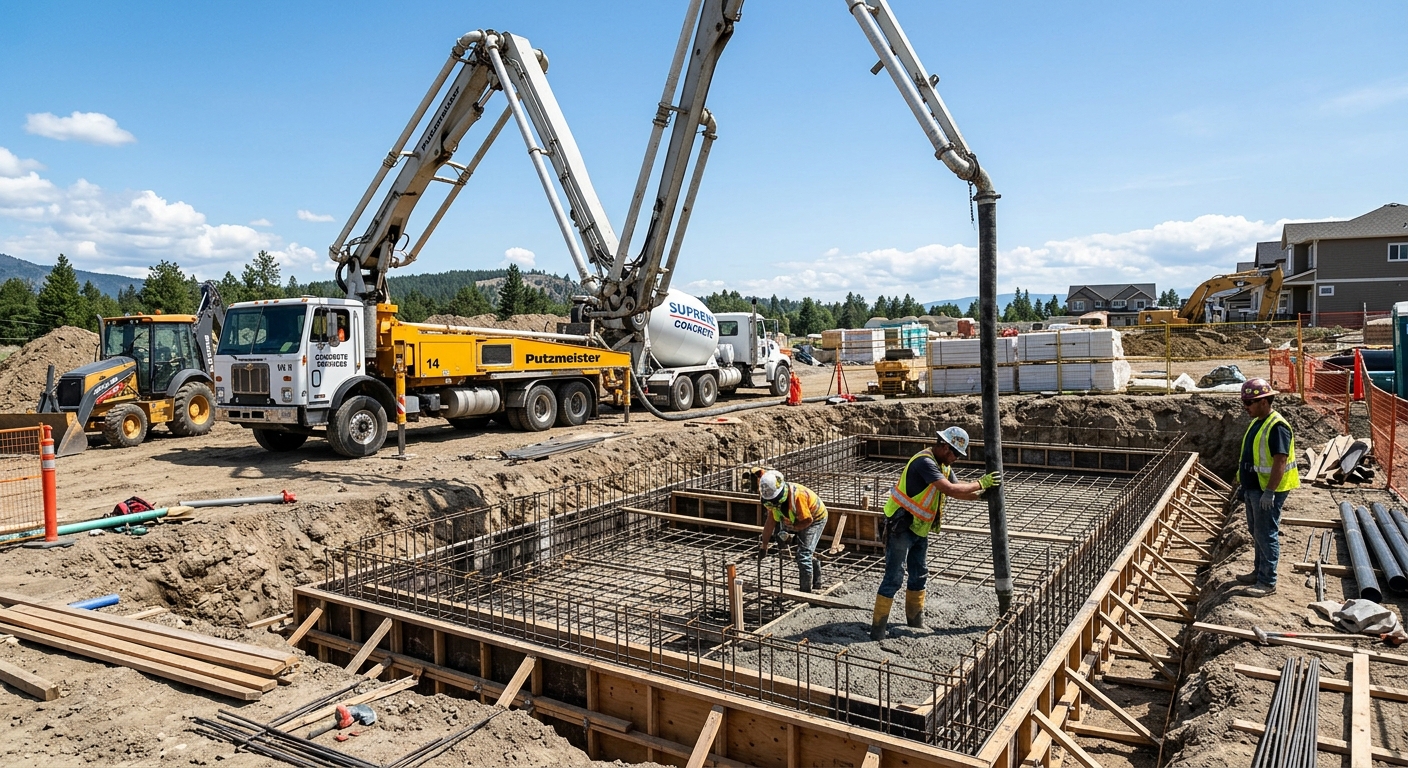
Concrete work options and costs in East Hastings
In East Hastings, British Columbia, choosing the right concrete option comes down to how you want it to look, how much traffic it will see, and how it needs to perform through the Lower Mainland–Southwest freeze–thaw cycle. With a population of 80,740 (Statistics Canada, 2021 Census), the area has steady demand for durable exterior flatwork—especially around family-oriented neighbourhood pockets where driveway and patio replacements are common. East Hastings also has a housing mix that includes many single-detached properties, which is typically where concrete driveways, walkways, and foundation work get scheduled as homes age.
Lower Mainland–Southwest weather is milder than interior BC, but it’s still wet and irregular: saturated soils, coastal rainfall, and cycles of thawing and re-freezing still stress slabs and foundations. That means even “simple” work isn’t simple—footings and thickened edges are typically placed below the assumed frost depth (commonly around 450 mm / 18"), exterior slabs usually use air-entrained mixes, and crews plan around cool nights, high humidity, and prolonged rain. Availability of experienced finishing labour can also affect pricing, particularly during peak pour months in Vancouver–Surrey–Abbotsford.
If you’re in the Hastings-Sunrise or East Hastings Street corridor, driveway and walkway projects are especially in demand because lots are often busy with vehicle traffic and regular pedestrian use. Next, compare common applications and expected budget ranges in a straightforward way.
| Application |
Typical Size |
Key Spec |
Finish Option |
Price Range |
| Concrete driveway (standard broom finish) |
350–500 sq. ft. |
Compacted base, air-entrained mix, control joints |
Broom finish, standard edging |
$18,000–$28,000 |
| Exposed aggregate driveway |
350–500 sq. ft. |
Compacted base, air-entrained mix, proper curing |
Exposed aggregate with sealer |
$22,000–$34,000 |
| Stamped concrete driveway or patio |
300–450 sq. ft. |
Compacted base, air-entrained mix, integral colouring |
Stamped patterns, release agent and colouring |
$24,000–$40,000 |
| Plain concrete patio or walkway |
200–350 sq. ft. |
Compacted base, air-entrained mix, joints as needed |
Broom or smooth trowel with light texture |
$3,200–$9,000 |
| Garage floor (interior slab) |
300–500 sq. ft. |
Vapour barrier, fibres or mesh (per design), curing plan |
Powder trowel / smooth finish |
$7,500–$16,000 |
| Foundation footings (structural, below frost) |
Varies (typical 4–10 ft wide linear ft and depth) |
Excavation, engineered reinforcement, below-frost placement |
Structural concrete, formed where required |
$200–$350 |
Prices are estimates only and vary by project scope, site access and material selection.
What affects the price of concrete work in East Hastings
In the Lower Mainland–Southwest, the same concrete job can land 30–50% apart between quotes because the “hidden” items—excavation depth, base prep quality, reinforcement details, curing strategy, and finishing complexity—change the labour hours and material requirements. Contractors also differ in how they build in seasonal risk: in British Columbia’s coastal-wet climate, your crew may need more set-up time for drainage, more protection for cool nights and high humidity, and longer schedules to reduce the chance of surface scaling and durability issues.
Frost and freeze–thaw drives nearly every spec in this region. Even with mild winters, exterior work must be designed to resist frost heave; footings and thickened edges are commonly placed below the local frost depth assumption (about 450 mm / 18") with correct excavation and forming. Exterior slabs typically use air-entrained concrete to manage freeze–thaw stress and scaling. When seasons get colder and pour days tighten, contractors sometimes add cold-weather precautions—insulating blankets and sometimes heated enclosures—so the concrete can achieve the minimum design strength. De-icing salt in driveways also accelerates spalling if the surface is not properly cured and sealed.
In East Hastings, two common examples change budgets quickly: (1) a driveway on saturated or low-drainage soil often requires more granular base and drainage work, pushing a standard broom driveway closer to the upper end of the $18–$28 per sq. ft. driveway range; (2) if you choose stamped or exposed aggregate, the cost can be justified because the finishing labour and decorative materials increase—often aligning budgets with the higher $22–$36 range seen for stamped & decorative work. Meanwhile, a basic plain patio can stay near the lower end (around $16–$26 per sq. ft.) when access is easy and base thickness is straightforward.
| Price Factor |
Why It Matters |
Cost Impact |
| Frost line depth — determines footing depth and form height |
Ensures footings are placed below the design frost depth to prevent heave |
Higher excavation/form costs where deeper digs are needed |
| Site preparation — excavation, grading, compacted granular base |
Stable base reduces settlement and cracking; drainage prevents saturation |
Can add significant labour and material time on wet/slope sites |
| Reinforcement — rebar or wire mesh requirement |
Controls cracking and improves load capacity in slabs and structural areas |
Material + labour increases, especially for thicker or larger pours |
| Mix design — air-entrainment and compressive strength spec |
Air voids protect from freeze–thaw scaling; strength supports durability |
Often modest material cost, but can affect scheduling and prep |
| Finish type — broom vs. stamped vs. exposed aggregate |
Finishing complexity drives labour hours and curing control |
Stamped/exposed typically increases cost materially |
| Pour size and concrete truck access to site |
Access affects pumping, time on site, and placement efficiency |
Bad access can add pump fees and extra labour |
| Cold-weather curing precautions — heating and blankets |
Protects concrete so it reaches target strength in cool/wet conditions |
Can raise costs during shoulder-season and rainy stretches |
| Control joint pattern and sealing cost |
Proper joints and sealing reduce random cracking and water/ion exposure |
Sealer and labour add cost but improve long-term performance |
Permits & regulations in British Columbia
In British Columbia, the biggest distinction for East Hastings homeowners is whether your concrete is structural and connected to a building system. Structural concrete work—such as footings, foundation walls, grade beams, and other load-bearing concrete elements—generally requires a building permit and often engineered drawings that the municipality reviews. Concrete flatwork (patios, walkways, and many driveways) typically does not require a permit by itself unless it changes lot grading, impacts impervious surface coverage limits, or affects the municipal right-of-way/sidewalk interfaces.
Before breaking ground in East Hastings, confirm the permitting requirement with the local authority and ensure your contractor is set up for the job. Also verify they carry liability insurance and appropriate workplace coverage (WSIB/WCB) for workers—this protects you if something goes wrong on site.
Step-by-step: how to verify a contractor’s credentials in BC
- Check the contractor’s licence/registration information using the relevant online registry for BC building trades.
- Request a certificate of insurance and make sure it’s current (ask for coverage amounts).
- Ask for proof of WSIB/WCB coverage for workers assigned to your project.
- Confirm the scope: structural vs flatwork—and whether drawings/permit work are included.
- Ask for references on similar-scale projects in the Lower Mainland–Southwest area.
Getting concrete right in East Hastings's freeze-thaw climate
Concrete failures in East Hastings usually start with water management and curing. The most common problems—scaling, spalling, and premature cracking—tie back to inadequate base preparation, missing air-entrainment, poor curing during cool nights, and joints that weren’t planned to relieve shrinkage and movement. Even though the Lower Mainland–Southwest has a shallower frost depth than northern BC, freeze–thaw cycles still happen when surfaces repeatedly saturate and then partially freeze. That’s why exterior slabs and driveways should be built on compacted granular base and designed with an air-entrained mix.
To spec the job correctly, focus on five areas: (1) base preparation—compact granular sub-base to the thickness your contractor’s design requires for local soils and drainage; (2) mix design—for exterior flatwork, target 5–7% air content and specify at least 32 MPa compressive strength; (3) control joints—spacing that limits random cracking and keeps cracks where you can maintain them; (4) curing—plan for a minimum 7 days under proper conditions; and (5) sealing—a penetrating sealer after the concrete has cured (commonly around 28 days) to help repel de-icing salts and rainfall-driven exposure.
Here’s a practical dollar example: if a sealed broom-finish driveway near the $18–$28 per sq. ft. band costs a bit more up front due to better base, air entrainment and sealer, it can be cheaper than redoing a scaled surface later. If your driveway is $30,000 for standard broom finish, adding sealers and curing protection might add a few thousand—often still far less than full replacement.
When you meet bidders, ask direct questions about air-entrainment, curing conditions, joint layout, drainage at the slab edge, and whether they will provide testable mix details and a curing plan for cool/wet days.
| Spec |
Why It Matters in East Hastings |
What to Ask For |
Impact if Skipped |
| Compacted granular base (depth?) |
Stable support reduces settlement and cracking under wet, freeze–thaw conditions |
Granular type, compaction method, and base thickness for your soil and load |
Uneven settling, early cracks, and water trapping under the slab |
| Air-entrained concrete mix (target air %?) |
Air voids protect against scaling/spalling from repeated freeze–thaw saturation |
Target 5–7% air for exterior flatwork and confirmed mix design |
Surface deterioration and spalling within a few winters |
| Compressive strength (MPa rating) |
Higher strength supports durability and load performance in exterior exposure |
Specify at least 32 MPa for the slab/flatwork mix |
Higher risk of cracking, abrasion damage, and reduced long-term performance |
| Control joints (spacing per ACI guidelines) |
Controls where cracking happens during shrinkage and thermal movement |
Joint spacing plan and saw-cut timing (or formed joints) for your slab size |
Random cracks and difficult-to-maintain fissures |
| Minimum 7-day curing period |
Proper strength gain is critical in cool, rainy, humid Lower Mainland conditions |
Curing method (blankets/sealer curing, protection) and what happens if it rains/cools |
Weaker surface, increased scaling risk, poor durability at the top layer |
| Penetrating sealer (when applied after cure) |
Repels water and ions from de-icing and coastal rainfall exposure |
Confirm sealer type and application timing (commonly around 28 days) |
Higher water absorption and faster deterioration of exterior surfaces |
How to choose a concrete work contractor in East Hastings
Choosing the right contractor in East Hastings starts with verification. In British Columbia, confirm the company is properly licensed/registered for the concrete scope you’re hiring for, then request and review: (1) a current certificate of insurance showing liability coverage, and (2) proof of worker coverage such as WSIB/WCB. Don’t rely on verbal confirmation—ask for documents before work begins, and ensure the named company matches the quote.
Next, get 2–3 itemised written quotes that separate labour and materials. Avoid “lump sum” quotes that don’t explain what’s included. Itemisation should clearly list excavation and disposal, granular base and compaction, reinforcement (if required), concrete supply and mix spec (including air-entrainment for exterior work), finishing labour, joints, and any protection/curing blankets.
Read your scope carefully: is a permit required and included, is lot grading addressed, and is site clean-up included? Ask about waste disposal and whether saw cutting and sealing are in the price. For warranty, get the length of workmanship coverage in writing, whether the product/manufacturer warranty applies to materials used, and whether any warranties transfer if you sell your home.
Finally, be cautious with payment timing. Never pay more than about 10–15% upfront. Use a holdback until the final clean-up and curing/sealing steps are complete. Get a start date and estimated completion window in writing, and ensure they schedule to protect concrete during cool nights and wet weather.
- Provide insurance certificate and WSIB/WCB proof before signing.
- Use written, itemised quotes (labour + materials), not “one number” pricing.
- Confirm exterior mix includes air-entrainment and specify expected air target.
- Ask what happens if rain hits during curing; confirm protection measures.
- Verify joint layout plan (spacing and how/when joints are cut).
- Confirm base preparation includes compaction and drainage considerations.
- Clarify reinforcement details (mesh vs rebar and spacing) where required.
- Check access assumptions: truck approach, pumping, and protection of landscaping.
- Confirm curing method and minimum curing time for strength gain.
- Ask whether sealing is included, and if not, what sealer is recommended.
- Get disposal and debris removal included in the written scope.
- Payment schedule with holdback until final acceptance.
Concrete red flags in East Hastings include: quotes that omit air-entrainment for exterior slabs, refusal to discuss curing/blankets during cool/wet stretches, no written joint layout or saw-cut plan, vague reinforcement language (or “mesh for everything” without thickness/load justification), and progress billing that demands large upfront payments.
Frequently asked questions — concrete work in East Hastings
What causes concrete to spall in East Hastings winters?
Spalling in East Hastings is usually linked to water getting into the concrete and then being stressed by freeze–thaw cycles. If the concrete mix isn’t properly air-entrained, freeze–thaw pressure can break down the surface paste and you’ll see scaling first, then spalling. Saturated soils and coastal rainfall can worsen this by keeping slabs and driveway edges wet. Poor curing—especially when cool nights and rain show up—can also leave the surface weaker and more vulnerable to de-icing salt. In practical terms, your best prevention is specifying air-entrained exterior concrete, correct base prep and drainage, adequate control joints, and a penetrating sealer applied after the concrete has cured (often around 28 days). If you’re quoting a driveway near the $18,000–$28,000 band, ask explicitly whether those freeze–thaw specs are included.
What is rebar and when is it required in British Columbia?
Rebar (reinforcing steel) is used to strengthen concrete by controlling cracking and improving load capacity, particularly in structural elements and slabs that must resist bending or movement. In British Columbia, whether rebar is required depends on the design and the engineered drawings for the specific structure—thickness of the slab, soil conditions, and the loads it carries (vehicles, foot traffic, foundation conditions). For structural concrete like foundation footings, grade beams, and foundation walls, rebar is commonly part of the engineered specification. For exterior flatwork, mesh or fibres may be used depending on slab thickness and expected loads, but the mix design for freeze–thaw durability (air-entrainment) is still crucial even if reinforcement is present. In East Hastings, wet soils and freeze–thaw make proper thickness and reinforcement details important, so ask the contractor what they propose and whether it matches the drawings and applicable requirements.
How long does a concrete project take in East Hastings?
Timelines in East Hastings depend on weather, curing requirements, and site access more than homeowners expect. Typical durations: demo and excavation can be 1–3 days for many driveway/sidewalk projects; base prep and forming often take another 1–3 days; and the pour itself is usually just hours. The “wait time” is curing and protection—concrete gains strength over time, and contractors should not treat the job as “done” right after the finish. Many exterior flatwork projects require at least 7 days of proper curing conditions before full service use, and sealing is commonly delayed until the concrete is fully cured (often around 28 days). In shoulder-season rain, contractors may add curing blankets or sealers curing protection, which can extend the schedule. If your driveway quote is within the $18–$28 per sq. ft. typical band, make sure the schedule includes curing steps—not just the day of finishing.
What is a concrete overlay and is it suited to East Hastings?
A concrete overlay is a new concrete layer placed over an existing slab, typically after the old surface is prepped (cleaned, profiled, and sometimes repaired). It can be an option when the existing driveway is generally sound but the surface is stained, worn, or lightly damaged. In East Hastings, overlays can be suitable if water and subgrade issues are addressed—because if the original slab is already pumping water, has poor drainage, or the base is failing, an overlay may not last through the freeze–thaw cycle. The key is to confirm the condition of the slab underneath: check for structural cracking, settlement, and significant spalling. Also ask whether the overlay mix will be air-entrained for exterior exposure and whether joints and sealing plans are included. Compared to replacing the driveway (often in the $18–$28 per sq. ft. range), overlays can sometimes reduce disruption, but only when the base problems are corrected.
How do I seal concrete to protect it in East Hastings?
Sealing helps protect exterior concrete from water and salts. In East Hastings, the freeze–thaw cycle plus de-icing salt and persistent coastal rainfall can accelerate surface deterioration, so sealing is a practical durability step. The process is timing and product selection: use a penetrating sealer (not just a surface film) and apply it after the concrete has fully cured—often around 28 days, assuming weather allows. The surface must be clean and dry enough to accept the sealer; sealing too early can trap moisture and reduce performance. Your contractor should specify the sealer type, coverage, and weather conditions. Even when sealing is included, you still need the fundamentals—proper base compaction, air-entrained exterior mix, correct control joints, and good curing. If you’re budgeting for a standard broom driveway in the $18,000–$28,000 band, ask whether sealing is included or what it would cost as an add-on.
What is the difference between concrete and cement?
Concrete and cement are related, but they’re not the same thing. Cement is one of the ingredients used to make concrete—it’s the binding material. Concrete is the final manufactured product made by mixing cement with water, sand, gravel (or other aggregates), and often admixtures. In East Hastings projects, the difference matters because what actually protects your driveway or patio through British Columbia’s freeze–thaw cycles is not just the “type of cement,” but the overall concrete mix design. For exterior flatwork, the contractor should specify air-entrainment, appropriate compressive strength (commonly at least 32 MPa), and a curing plan that protects strength gain in cool, wet conditions. So while cement is the binder, concrete is the full system—mix proportions, air voids, reinforcement (if needed), placement, finishing, joints, curing, and sealing all work together to prevent premature cracking and spalling.