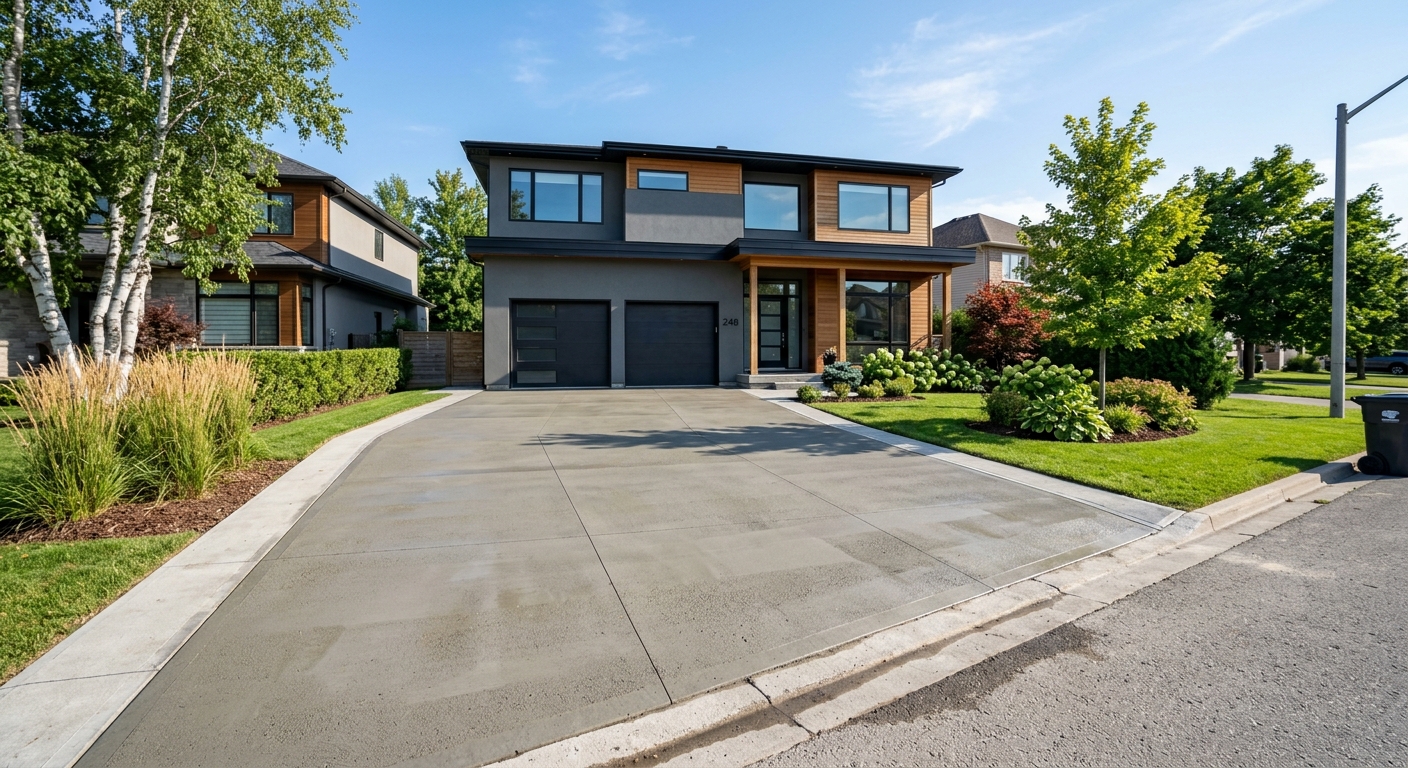
Concrete work options and costs in Lumby
Concrete work in Lumby typically comes down to two things: what you’re building and how winter behaves on your property. With 66.7% of local dwellings being single-detached homes, driveways, patios, walkways and interior garage slabs are some of the most common flatwork projects we see (Statistics Canada, 2021 Census). Lumby’s housing stock also skews older—42.5% of homes were built before 1981—so many jobs involve replacement slabs, foundation touch-ups, or repairs tied to drainage and frost performance.
In the Thompson–Okanagan, contractors plan around frost depth and freeze–thaw cycles, not “minimum” footing rules. Regional practice assumes frost can reach roughly 45–60 cm for exterior work, which means footings and foundation elements must sit below frost, and slabs need properly compacted granular base plus good drainage. That drives excavation and forming time, and it’s why our concrete pricing in Lumby sits above generic BC numbers. You’ll also notice availability changes during the short shoulder-season pour window—cool, wet weeks require curing protection (insulating blankets, controlled drying), which adds labour and materials.
In Lumby, trades are especially busy around the downtown corridor and the nearby residential areas toward Scotch Creek Road, where older properties often get updated drive access and front steps. From there, your budget usually starts to narrow when you choose between broom-finish concrete, exposed aggregate, or decorative stamped options—see the table below for typical Lumby pricing ranges.
| Application |
Typical Size |
Key Spec |
Finish Option |
Price Range |
| Concrete driveway (standard broom finish) |
400–600 sq. ft. |
Air-entrained exterior mix; compacted granular base; control joints |
Broom finish |
$9,000–$15,000 |
| Exposed aggregate driveway |
400–600 sq. ft. |
Air-entrained exterior mix; wash/expose process; densified surface |
Exposed aggregate |
$12,500–$19,500 |
| Stamped concrete driveway or patio |
250–500 sq. ft. |
Air-entrained exterior mix; colour hardener + seal; planned joint layout |
Stamped pattern |
$11,000–$22,000 |
| Plain concrete patio or walkway |
200–350 sq. ft. |
Compacted granular base; air-entrained mix; edging and joints |
Plain broom/float finish |
$2,800–$7,500 |
| Garage floor (interior slab) |
400–600 sq. ft. |
Vapour barrier; proper base; reinforcement where required |
Light broom or smooth trowel |
$9,000–$16,500 |
| Foundation footings (structural, below frost) |
Per project (commonly 4–12 lin. m) |
Engineered sizing; below-frost bearing; reinforcement as designed |
Structural concrete |
$12,000–$23,000 |
Prices are estimates only and vary by project scope, site access and material selection.
What affects the price of concrete work in Lumby
In Lumby and across the Thompson–Okanagan, it’s common to see quotes for the same basic job vary by 30–50% once you include proper frost-proofing, prep work and curing. The reason is that exterior concrete isn’t just poured “to a thickness”—it’s engineered for freeze–thaw conditions and how your subgrade behaves over winter. In colder interior pockets, deeper footings and better drainage preparation typically add excavation, granular and forming time compared with warmer, lower-frost areas.
Every spec ties back to frost line depth and freeze–thaw cycles: exterior footings and foundation elements must extend below the design frost depth to help prevent frost heave and long-term cracking. Exterior slabs also need air‑entrained concrete mixes so the surface can survive repeated freezing and thawing. Cold weather around shoulder seasons shortens the practical pour window and often forces cold-weather curing precautions—insulating blankets, temporary heat, or curing compound—so the concrete reaches strength instead of staying “green.” On top of that, de-icing salts accelerate surface spalling in poorly sealed or poorly finished concrete, so sealing becomes a practical durability upgrade for driveways and walkways.
Cost can move up or down based on jobsite details. For example, if your driveway ties into an existing slope and requires extra grading and a thicker compacted base, you’ll usually see the project land closer to the $18–$28 per-sq.-ft. backbone for concrete slab work. If it’s a straightforward patio with good access and a simple joint layout, it often comes closer to the $14–$24 per-sq.-ft. range for patios and walkways. Also, because 42.5% of Lumby homes were built before 1981, many replacement slab jobs include selective excavation around older drainage patterns, which can add disposal and rebase costs.
| Price Factor |
Why It Matters |
Cost Impact |
| Frost line depth — determines footing depth and form height |
Footings must sit below frost to reduce heaving and cracking |
Higher excavation/forming; can add major labour and material cost |
| Site preparation — excavation, grading, compacted granular base |
Strong slabs start with a stable, well-compacted base and drainage |
Loose soils or poor drainage increase granular, rework, and time |
| Reinforcement — rebar or wire mesh requirement |
Controls cracking and supports loads where designed |
Adds steel, chairs/ties and labour; sometimes required for garage slabs |
| Mix design — air-entrainment and compressive strength spec |
Air helps manage freeze–thaw damage; strength supports durability |
Improves performance but can raise material costs |
| Finish type — broom vs. stamped vs. exposed aggregate |
Decorative finishes require extra steps and careful timing |
Stamped/exposed work typically costs more than broom finish |
| Pour size and concrete truck access to site |
Smaller access-limited pours cost more per sq. ft. |
Extra crew time, pumping/hosing, or multiple mobilizations |
| Cold-weather curing precautions — heating and blankets |
Prevents early freezing and supports strength gain |
Blankets/temporary heat can add noticeable add-on charges |
| Control joint pattern and sealing cost |
Joints limit random cracking; sealing reduces salt scaling |
Usually modest cost that protects the finish over winters |
Permits & regulations in British Columbia
In British Columbia, the permit process mainly depends on whether the concrete work is structural. Structural concrete work—such as footings, foundation walls, grade beams, and any elements that support a building—typically requires a building permit and, in many cases, engineered drawings reviewed through the municipality. Concrete flatwork (patios, walkways and driveways) usually does not require a permit by itself, unless it affects lot grading, changes drainage in a way that impacts neighbours, or creates/adjusts an impervious surface area that triggers local requirements. Before you start, confirm what applies to your specific project in Lumby with the local authority.
Before signing a contract, verify three basics for any contractor you hire in BC: licence/registration status (if applicable to the work type), liability insurance, and Workers’ compensation coverage (WCB). Step-by-step, you should:
- Ask for the contractor’s certificate of insurance and confirm the jobsite address is covered.
- Ask whether they carry WCB coverage for the crew; request proof/clearance information.
- Check the contractor’s online presence for business details that match their estimate and invoicing.
- Request references for similar-scale concrete flatwork or foundation work.
- If it’s a structural scope, ask whether the permit will be pulled by the builder/engineer team or coordinated through the homeowner’s application process.
Finally, keep everything in writing: who pulls the permit (if needed), what inspections are expected, and what the contractor is responsible for—so you don’t get surprised partway through a frost-sensitive schedule.
Getting concrete right in Lumby's freeze-thaw climate
Concrete failures in Lumby usually trace back to three problems: weak base preparation, the wrong mix for freeze–thaw exposure, and poor curing/jointing practices. Thompson–Okanagan winter can cycle from freezing to thawing, which puts stress on slabs and drives when water has a pathway into the subgrade or at the concrete surface. To spec the job correctly, start with base preparation: excavate to the proper depth for local soil and frost conditions, then place well-compacted granular sub-base with correct grading and drainage away from the house.
Next, require an air‑entrained exterior mix. For exterior flatwork, target about 5–7% air content, and don’t accept a lower spec when it’s an all-weather job. Also ask for a minimum 32 MPa compressive strength mix, so the concrete gains the strength it needs before winter exposure. Control joints should be planned to manage movement—spacing must be consistent so cracking is controlled rather than random across the panel. Curing is also critical: allow at least 7 days of proper curing conditions. In cool weather, insulating blankets or other cold-weather precautions can be the difference between long-term durability and early scaling.
Finally, sealing: for Lumby driveways and walkways exposed to de-icing salts, apply a penetrating sealer after curing—typically once the concrete has had about 28 days to cure—so salts don’t chew into the surface pores.
Here’s where price differences are justified: upgrading from a plain broom-finish patio to a sealed broom finish is often a small add-on compared with decorative stamped work, but it protects the surface through winters. Stamped concrete typically costs more (often aligned with the $24–$38 per-sq.-ft. decorative band), and that premium is usually worth it when you want aesthetics and you’re also getting the same frost-focused base and mix specs. Avoid the common “cheap pour” approach—spalling from inadequate air-entrainment is the most expensive mistake.
| Spec |
Why It Matters in Lumby |
What to Ask For |
Impact if Skipped |
| Compacted granular base (depth?) |
Stable support prevents settlement cracks during freeze–thaw |
Granular depth to suit your soil and design; compaction documentation if available |
Settlement, uneven cracking, and premature joint failure |
| Air-entrained concrete mix (target air %?) |
Manages expansion/contraction from freezing and thawing |
Exterior mix with 5–7% air content |
Surface scaling/spalling, especially with de-icing salts |
| Compressive strength (MPa rating) |
Durability depends on strength gain and long-term performance |
Minimum 32 MPa |
Reduced wear resistance and higher risk of early deterioration |
| Control joints (spacing per ACI guidelines) |
Limits random cracking across exterior panels |
Joint layout and spacing plan before pour |
Random cracks where you can’t control repair appearance |
| Minimum 7-day curing period |
Strength development must complete before freeze exposure |
Confirm curing method; cold-weather plan if temps are marginal |
Weak concrete, cracking and surface damage |
| Penetrating sealer (when applied after cure) |
Reduces salt scaling and helps keep surface performance consistent |
Penetrating sealer applied after full cure window (commonly ~28 days) |
Faster surface wear and salt-driven spalling |
How to choose a concrete work contractor in Lumby
Choosing a contractor in Lumby starts with verification. In British Columbia, you should confirm liability insurance (with coverage limits appropriate for the scope) and Workers’ compensation coverage (WCB) for the crew. Ask for documentation before work begins and match the details to the company that’s quoting you. For insurance, request a certificate of insurance showing the active policy period and jobsite coverage. For WCB, ask how they can provide proof of clearance/coverage for their workers. If it’s structural concrete, ensure the contractor is set up to coordinate permits/engineered drawings where required, and that the scope matches the drawings.
Next, get 2–3 itemised written quotes. You want a breakdown that separates labour from materials and shows what’s included (excavation, granular base, reinforcement, joints, formwork, finishing, disposal, and sealing if applicable). Avoid lump sums where the exclusions are vague. Pay close attention to whether they include permit pull (if required), whether rebar mesh is supplied where designed, and whether they handle curing protection and cold-weather measures.
Warranty matters too: ask for the workmanship warranty length and what it covers (cracking related to shrinkage/jointing, surface scaling, workmanship defects) and whether it’s transferable if you sell the home. Payment schedule should be conservative—never more than about 10–15% upfront, and hold back a portion until the job is complete and you’ve inspected it.
Finally, confirm the timeline in writing: start date, curing conditions, and completion estimate. In Lumby’s freeze–thaw climate, a delayed pour or rushed cure can erase the value of a good spec.
- Request proof of liability insurance and confirm policy validity dates.
- Ask for WCB coverage proof/clearance for the workers assigned.
- Get itemised quotes (labour vs materials) instead of a single lump figure.
- Confirm excavation depth, granular thickness, and compaction requirements.
- Ask about air‑entrainment and the stated air % for exterior work.
- Verify compressive strength spec (e.g., minimum 32 MPa).
- Check that control joint layout is described before the pour.
- Ensure curing plan is included (blankets/heat if needed).
- Confirm sealing is included (and when it will be applied).
- Ask who manages disposal and whether landfill fees are included.
- Review warranty terms in plain language, including transferability.
- Agree on a payment schedule with a holdback until final inspection.
Concrete red flags in Lumby: contractors who won’t discuss air-entrainment specs, quotes that skip compaction/granular depth details, no clear joint plan (or joints “after the fact”), vague curing timelines, and crews that expect you to accept early-season pours without temperature protection.
Frequently asked questions — concrete work in Lumby
How deep must footings be for Lumby’s frost line?
In Lumby and the Thompson–Okanagan, the practical answer is “below the design frost depth,” not a one-size minimum. Interior BC freeze–thaw conditions are significant, so typical construction practice assumes frost depth in the 45–60 cm range for many exterior elements and designs footings and foundation elements to sit below frost to reduce heaving and cracking risk. The exact depth for your property should follow the engineered foundation plan (or local requirements) because soil type, drainage and slope can change what’s appropriate.
If someone quotes footings based only on a generic “12 inches” rule of thumb, that’s not how we build for this climate. If your home was built before 1981 (many in Lumby are), you may also be dealing with older drainage patterns that can worsen frost movement, so proper rebase and drainage upgrades can matter as much as the footing depth. Structural footing work commonly falls in the $220–$350 per unit band depending on design and scope.
Why does concrete crack in Lumby and how is it prevented?
Concrete cracks for normal reasons—shrinkage as it cures, temperature movement, and loading—but in Lumby’s freeze–thaw climate those movements become more visible if the foundation and slab system aren’t built as a whole. The most common preventable drivers are weak or poorly compacted base, missing or poorly spaced control joints, and exterior mixes that aren’t properly air‑entrained. When water gets into pathways and the slab cycles through freezing and thawing, you can see random cracking and surface deterioration.
Prevention is spec-driven: compacted granular base with correct drainage, air‑entrained exterior concrete, a control joint pattern planned for panel dimensions, and correct curing so the concrete reaches strength before winter exposure. Sealing after the cure window can also help protect the surface from salt scaling. If you’re budgeting, the “cheap” option is often false economy—repairs can cost far more than a well-jointed broom-finish project in the $18–$28 per-sq.-ft. slab backbone.
Stamped vs broom-finish concrete — cost difference?
Stamped concrete costs more than broom-finish because it requires extra materials and labour: colour hardeners or integral colour, stamp textures, release agents, and more careful finishing to achieve consistent patterning and edges. In Lumby’s climate, the stamp work doesn’t replace the core frost specs—your driveway still needs the same air‑entrained exterior mix, proper base prep and joint planning—so a quality quote keeps those items consistent between options.
As a budget guide for Lumby, decorative concrete often aligns with the $24–$38 per-sq.-ft. range, while standard driveway/slab work usually lands in the $18–$28 per-sq.-ft. backbone. A common scenario is a stamped walkway upgrade where the total square footage is smaller—so the premium may be noticeable but still manageable. The key is to compare quotes that include base preparation, joints, curing precautions, and whether sealing is included after cure.
When is the best time to pour concrete in Lumby?
The best time to pour concrete in Lumby is when air temperatures and ground conditions support predictable curing without freezing risk. In the Thompson–Okanagan, the practical pour season is shorter than in milder BC areas, so summer and early fall are typically easiest. However, shoulder-season pours can still work when contractors plan cold-weather curing precautions—insulating blankets, temperature monitoring and protective methods—especially for exterior slabs and driveways.
What matters is more than the calendar date: it’s whether the contractor can protect curing concrete through the first days so it reaches strength before freeze–thaw exposure. If temps swing quickly or nights approach freezing, costs can increase due to heating/blanket materials. That’s why Lumby quotes can differ even when the job size seems identical—successful exterior work depends on the cure plan, not just the pour day.
How long does concrete take to cure?
Concrete curing has two phases: early strength gain and long-term durability development. As a practical homeowner guideline in Lumby, you should plan for at least 7 days of curing under proper conditions before expecting normal exterior exposure or heavier traffic. Early strength still depends on temperature and protection, which is why cold-weather curing measures (blankets or controlled heat) can be part of a quality quote in the Thompson–Okanagan.
For sealing, most penetrating sealers are applied after the concrete has had time to cure sufficiently—commonly around 28 days—so moisture levels and surface conditions are right for adhesion and salt-resistance. If you rush sealing or open the slab too early during cool, damp weeks, you can reduce the long-term performance you paid for. A well-built broom-finish driveway with correct curing and jointing typically outlasts a decorative job where curing and protection were treated casually.
Do I need a permit for concrete work in British Columbia?
In British Columbia, it depends on whether the concrete work is structural. Structural concrete—like footings, foundation walls, grade beams and other elements that support a building—typically requires a building permit and often engineered drawings reviewed through the municipality. Concrete flatwork such as patios, walkways and driveways usually does not require a permit on its own unless it affects lot grading, drainage, or impervious surface requirements, or it impacts a municipal right-of-way.
For a Lumby driveway or patio, confirm details before breaking ground. A reputable contractor will tell you whether your scope triggers a permit and whether they handle it (or coordinate with the builder/engineer). Also verify documentation: your contractor should carry liability insurance and have WCB/WCB clearance for the crew, and you can ask to see certificates before work begins. If your quote is “permit not included” and you need one, that timing can delay a frost-sensitive pour.