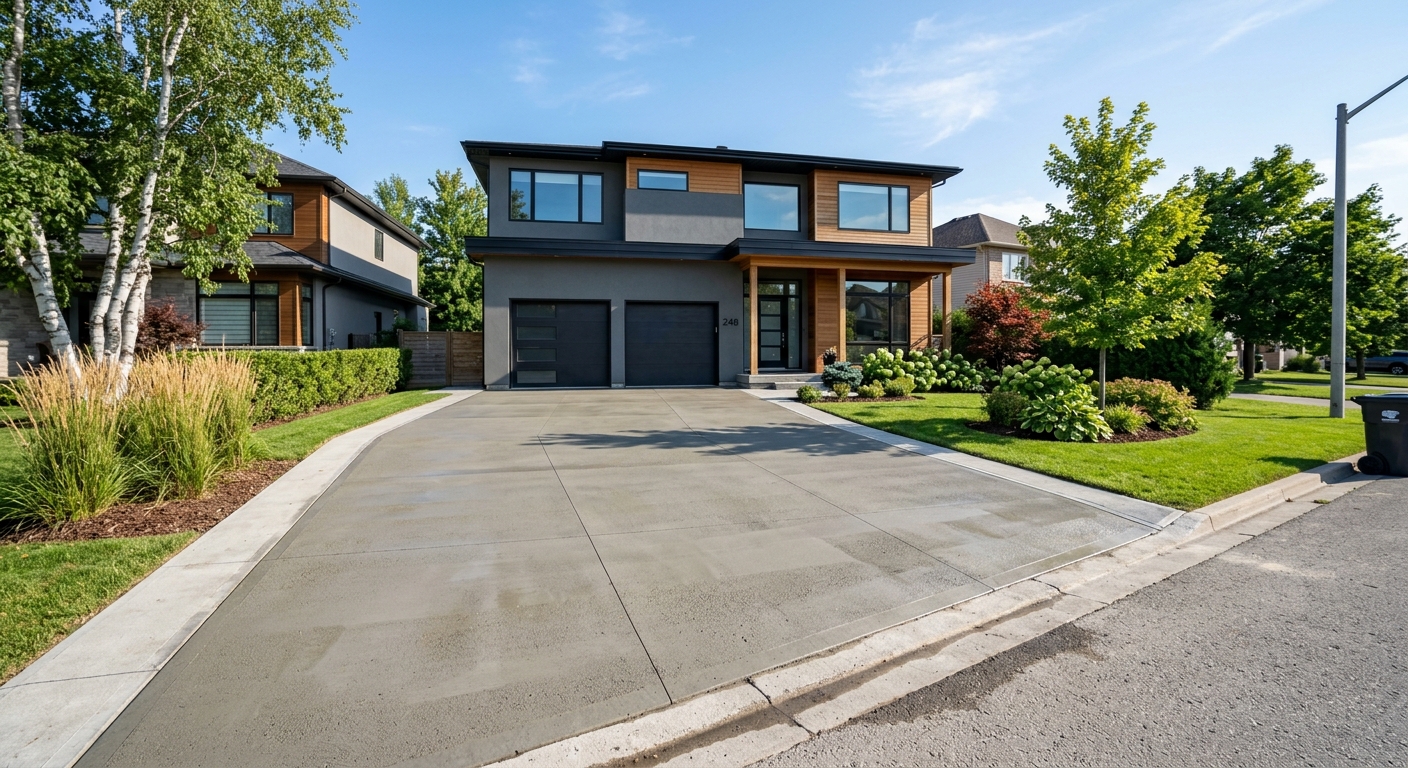
Concrete work options and costs in Cordova Bay
Cordova Bay is one of those Peninsula communities where homeowners expect concrete flatwork to look sharp and last through wet coastal winters. With a 2021 population of about 8,100 people (Statistics Canada, 2021 Census), the trade is busy, but the bottleneck is often weather-dependent scheduling and base-prep quality—not just the pour itself. Most concrete driveway and patio work here ties to long-term family housing, and the local housing stock is dominated by single-detached homes, which typically means more driveways, thicker edges, and higher expectations for durability on salt-exposed surfaces.
In the Lower Mainland–Southwest, mild winters can be deceptive: the frost depth is assumed around 450 mm / 18", yet freeze–thaw cycles and saturated soils still drive cost. That’s why contractors in Cordova Bay commonly build compacted granular base systems, use air-entrained mixes for exterior slabs, and plan around prolonged rain, cool nights, and higher humidity. In practice, that means slower curing and sometimes added protective measures (curing blankets, sealers, and extended cure times) for patios, walkways, and driveways.
Demand is especially steady around the core residential pockets in and near Cordova Bay Village, plus the waterfront-influenced streets where runoff management and drainage details matter. Below is a practical comparison of common options so you can benchmark quotes before you talk with a contractor.
| Application |
Typical Size |
Key Spec |
Finish Option |
Price Range |
| Concrete driveway (standard broom finish) |
400–600 sq. ft. |
Air-entrained mix, compacted granular base, control joints |
Broom finish |
$8,000–$14,500 |
| Exposed aggregate driveway |
400–600 sq. ft. |
Air-entrained mix, proper curing, stone exposure process |
Exposed aggregate |
$10,000–$16,800 |
| Stamped concrete driveway or patio |
300–600 sq. ft. |
Air-entrained mix, integral color, release agent, joints |
Stamped pattern |
$9,000–$21,000 |
| Plain concrete patio or walkway |
200–450 sq. ft. |
Compacted base, control joints, air-entrained exterior slab |
Float-and-trowel with light broom |
$3,200–$10,000 |
| Garage floor (interior slab) |
400–600 sq. ft. |
Vapour barrier (as needed), slab prep, joints as required |
Steel-trowel finish |
$7,500–$15,500 |
| Foundation footings (structural, below frost) |
Per linear ft. (varies by design) |
Excavation to design frost depth, rebar, structural concrete |
Unfinished structural concrete |
$200–$350 |
Prices are estimates only and vary by project scope, site access and material selection.
What affects the price of concrete work in Cordova Bay
In Cordova Bay and the wider Lower Mainland–Southwest, two quotes for the same driveway or patio can easily land 30–50% apart. The gap usually isn’t the concrete itself—it’s the “invisible” items: excavation depth and haul, granular base thickness, reinforcement decisions, mix design, and the time it takes to cure properly in a coastal-wet climate. Contractors who build for freeze–thaw performance (instead of just pouring concrete) tend to spend more on preparation and control joints, but homeowners see the difference in scaling and long-term appearance.
Frost line depth and freeze–thaw cycles dictate specs in the region. Even though coastal BC typically uses a shallower frost depth (often 0.5–1.2 m in coastal conditions), exterior slabs and footings still must be placed below the design frost depth to prevent frost heave. That’s why exterior concrete is normally air-entrained, with control joints and curing procedures sized to manage freeze–thaw stress and moisture movement. Cold weather precautions also matter: when nights cool down during shoulder seasons, teams may add insulation blankets and plan shorter pour sequences, which increases labour. De-icing salt accelerates surface spalling if the mix and finishing aren’t right, so sealing is a common add-on for driveways and steps.
In Cordova Bay specifically, costs can rise when drainage is poor or when saturated soils require extra base and careful compaction. Conversely, a small, accessible walkway with good subgrade can keep pricing closer to the patio band (about $16–$26 per sq. ft. as a general guideline). A larger stamped driveway can justify the premium (often in the decorative band around $22–$36 per sq. ft.) when the pattern, colour, and jointing plan reduce future maintenance and improve curb appeal for older shoreline homes.
| Price Factor |
Why It Matters |
Cost Impact |
| Frost line depth — determines footing depth and form height |
Footings must sit below design frost to prevent heave and settlement |
Can add excavation/formwork days; major driver on structural work |
| Site preparation — excavation, grading, compacted granular base |
Saturated or weak soils need a stable base and controlled drainage |
Higher if haul/disposal is needed or if base depth is increased |
| Reinforcement — rebar or wire mesh requirement |
Controls cracking and improves load transfer in driveways and slabs |
Added material and labour; pricing swings with slab thickness and soil conditions |
| Mix design — air-entrainment and compressive strength spec |
Air-entrainment helps concrete resist freeze–thaw scaling and spalling |
Typically modest material cost but can require careful batching/verification |
| Finish type — broom vs. stamped vs. exposed aggregate |
Durability and appearance depend on finishing timing and curing control |
Stamped/exposed work is labour-intensive; costs trend higher |
| Pour size and concrete truck access to site |
Narrow access increases pumping/time and may require extra equipment |
Truck constraints can add mobilization and labour hours |
| Cold-weather curing precautions — heating and blankets |
Helps reach strength during cool, humid, rainy periods |
Can add daily costs and reduce scheduling flexibility |
| Control joint pattern and sealing cost |
Jointing manages cracking; sealing reduces salt-water penetration |
Often a small line item, but skipping it can lead to costly surface repair |
Permits & regulations in British Columbia
In British Columbia, the concrete permitting requirements depend heavily on what part of the structure you’re building or repairing. Structural concrete work—such as foundation walls, grade beams, and footings—typically requires a building permit, and engineered drawings are often reviewed through the municipality as part of the permit process. On the other hand, concrete flatwork like patios, walkways, and driveways usually does not require a permit unless it affects lot grading, stormwater management, impervious surface coverage limits, or municipal right-of-way conditions (for example, work that encroaches near boulevards or changes drainage toward neighbours).
If you’re replacing or adding a driveway, the permitting question is often really about water flow and grades rather than the concrete itself—especially in coastal communities where heavy rainfall can overwhelm older drainage patterns.
To protect yourself in Cordova Bay, verify before work starts: ask the contractor for their certificate of liability insurance and proof they carry the required workers’ coverage (WSBC/WCB coverage as applicable for the contractor’s workers). Next, confirm their business licence status and credentials using the appropriate online provincial registry resources and/or any public licensing listings available. Finally, request references from similar-scope jobs in the Capital Regional District or nearby areas. Step 1 is always to ask what permits (if any) they will pull and who is responsible—then confirm that responsibility in writing.
Getting concrete right in Cordova Bay's freeze-thaw climate
Concrete fails in Cordova Bay most often when the base isn’t built for local soils and moisture, or when the mix and curing plan can’t handle freeze–thaw stress. In coastal-wet conditions, water saturation plus temperature swings drives freeze expansion, and the first weakness homeowners notice is surface scaling or spalling—especially on driveways, steps, and patio slabs that see de-icing salts and puddling.
To spec the job correctly, start with base preparation: contractors should excavate to the required bearing depth, then place and compact a properly graded granular sub-base so the slab doesn’t pump or shift. Next, require an air-entrained exterior mix. A common target is 5–7% air content for exterior flatwork, paired with a minimum 32 MPa compressive strength. For cracking control, insist on a deliberate control joint pattern (not “where it happens”), with joint locations planned around edges, doorways, and changes in slab width. Curing is another make-or-break item: aim for at least 7 days of curing under suitable temperature and moisture conditions. In cool, rainy shoulder seasons, crews may use blankets or other protection to avoid early freezing. Finally, sealing matters: a penetrating sealer is typically applied after the concrete has cured (commonly around 28 days) to reduce salt and water penetration.
If a contractor offers the cheapest price without addressing air entrainment, joints, and curing protection, that’s where you lose money later. For example, going from a broom-finish driveway to a stamped driveway may move you toward the decorative band (often $22–$36 per sq. ft.). That price difference is justified when the plan includes correct jointing, proper curing timing, and sealing—rather than relying on the “pattern” alone.
| Spec |
Why It Matters in Cordova Bay |
What to Ask For |
Impact if Skipped |
| Compacted granular base (depth?) |
Prevents pumping and settlement under saturated, coastal soils |
Base thickness, compaction test approach, and drainage plan |
Early cracking, uneven settling, and voids beneath slab |
| Air-entrained concrete mix (target air %?) |
Helps resist freeze–thaw scaling and salt-related spalling |
Target 5–7% air for exterior flatwork and mix confirmation |
Surface scaling/spalling within a few winters |
| Compressive strength (MPa rating) |
Design strength affects durability and wear resistance |
Minimum 32 MPa compressive strength spec |
Reduced strength gain and higher risk of premature deterioration |
| Control joints (spacing per ACI guidelines) |
Manages where cracks happen in a freeze–thaw environment |
Planned joint layout and spacing consistent with ACI guidance |
Random cracking through visible surfaces |
| Minimum 7-day curing period |
Strength development is slower in cool, humid conditions |
Curing method and protection plan for cool nights/rain |
Lower surface strength, higher scaling and texture loss |
| Penetrating sealer (when applied after cure) |
Repels moisture and salt intrusion from coastal traffic and de-icing |
Sealer type and timing after curing (commonly ~28 days) |
Faster deterioration and staining, especially near edges and joints |
How to choose a concrete work contractor in Cordova Bay
Start with contractor verification. In British Columbia, confirm the contractor’s credentials through available public licensing/business listings and make sure they carry liability insurance and the required workers’ coverage (WSBC/WCB coverage for their employees). Ask for a current certificate of insurance and a clearance letter if applicable—then verify the policy limits are realistic for driveway and foundation work. Don’t rely on verbal assurances; request documents before scheduling the pour.
Next, get 2–3 itemised written quotes. The best quotes break labour and materials apart: excavation and disposal, compacted granular base, reinforcement, concrete supply with mix details, finishing (broom, stamped, or exposed aggregate), curing/blankets, joint cutting, and sealing. Even if the final total is similar, itemisation reveals whether the cheaper option is short on base prep, air-entrainment, rebar, or curing protection.
Read exclusions carefully: is permit pulling included (when required), is truck access equipment included, and is concrete removal/demolition disposal included? Confirm warranty terms: ask for (1) workmanship warranty length, (2) any manufacturer/product warranty (for sealers or admixtures), and (3) whether warranties are transferable if you sell the home.
For payment, never pay the majority upfront. A common safer approach is keeping upfront deposits around 10–15%, then releasing progress payments as milestones are completed. Insist on a written start date and completion estimate that accounts for rain/cool nights. In Cordova Bay, weather can move the schedule, so your quote should state how delays are handled.
- Ask for proof of liability insurance and WSBC/WCB coverage before site work
- Request 2–3 itemised quotes (not lump-sum only) with labour and materials separated
- Confirm the concrete mix is air-entrained for exterior flatwork and that jointing is planned
- Verify base prep depth and compaction expectations (not “we’ll grade it”)
- Check whether rebar/wire mesh is included where required
- Ask what’s included for curing blankets or protection during cool, rainy conditions
- Make sure concrete saw-cut timing and joint layout are described
- Confirm sealing is included or listed as an optional line item after cure
- Look for clear demolition/disposal scope and whether hauling is included
- Confirm truck access and whether pumping or extra labour is included if needed
- Get start and completion dates in writing
- Ensure the warranty is in writing and specifies coverage and response steps
Concrete red flags in Cordova Bay: (1) “Don’t worry about air-entrainment—we’ve never had a problem,” (2) vague jointing plans (“we’ll cut joints later”), (3) no detail on base thickness/compaction, (4) heavy pressure for large upfront payments, and (5) quoting only a per-square-foot number without listing what’s included (disposal, reinforcement, curing, sealing).
Frequently asked questions — concrete work in Cordova Bay
What is the difference between concrete and cement?
In British Columbia, homeowners often use “cement” and “concrete” interchangeably, but they’re not the same. Cement is one ingredient—a powder (typically Portland cement) that reacts with water to create paste. Concrete is the finished material: cement plus water, fine and coarse aggregates (sand and stone), and often admixtures like air-entrainment. For exterior flatwork in Cordova Bay, the mix design matters because freeze–thaw cycles and coastal moisture can be hard on surfaces. That’s why exterior pours typically use air-entrained concrete and controlled curing, regardless of whether people call it “cement” or “concrete.” A good contractor will specify the performance (air content and strength) rather than just the label.
How much does concrete work cost in Cordova Bay?
Costs in Cordova Bay generally track the Lower Mainland–Southwest pricing bands, but the final number depends on base prep, reinforcement, drainage details, and finish type. For example, a plain patio or walkway typically lands around $16–$26 per sq. ft. as a guideline for budgeting. Driveways are usually higher: concrete driveway work often comes in around $18–$28 per sq. ft. depending on excavation needs, slab thickness, and whether you’re doing standard broom finish or something more labour-intensive. Decorative options like stamped concrete typically price higher (roughly $22–$36 per sq. ft.). Always ask for itemised quotes so you can see what’s included—disposal, granular base depth, joints, curing protection, and sealing.
How deep must footings be for Cordova Bay's frost line?
In coastal BC, footings are typically designed to be below the design frost depth, which is often much shallower than in interior or northern regions. While practices vary by site conditions and the engineered design, coastal BC commonly assumes a frost depth in the range of about 0.5–1.2 m. The key point for Cordova Bay homeowners is that the design frost depth governs the footing depth—contractors shouldn’t “eyeball” it. Structural work must follow the engineer’s foundation details and local building requirements. If you’re adding a foundation, ask your contractor for the engineered drawings and confirm that excavation is carried down to the specified elevation below the frost line. This is a primary reason foundation work can differ significantly between quotes.
Why does concrete crack in Cordova Bay and how is it prevented?
Concrete cracks in Cordova Bay mainly because shrinkage and temperature/moisture movement create stress, and freeze–thaw cycles intensify that stress when water gets into the slab system. Cracking isn’t automatically “bad workmanship”—it’s expected to some degree, which is why control joints matter. Prevention is about directing cracking to planned locations and ensuring the slab system is stable: a properly compacted granular base, correct air-entrained mix for exterior durability, planned joint layout, and correct curing timing. De-icing salts and coastal saturation can worsen surface scaling if the mix isn’t designed for freeze–thaw resistance. A contractor should be able to explain the joint spacing strategy and finishing timing, not just promise it “won’t crack.”
Stamped vs broom-finish concrete — cost difference?
Stamped concrete costs more than broom-finish because it’s more labour-intensive and requires additional steps: integral colour (or colouring approach), release agent, careful stamping timing, and often more detailed finishing to maintain pattern integrity. For budgeting in Cordova Bay, plain broom-finish driveway work often trends around $18–$28 per sq. ft., while stamped concrete commonly sits higher—roughly $22–$36 per sq. ft. Decorative concrete also benefits more from correct joint planning and sealing because stains and wear are more visible in patterned surfaces. If you’re seeing a small price gap between stamped and broom, that’s a reason to ask what’s included (air-entrained mix, jointing plan, curing protection, and sealing). The best value comes from meeting durability specs, not from skipping steps for speed.
When is the best time to pour concrete in Cordova Bay?
In Cordova Bay and across the Lower Mainland–Southwest, the “best time” is less about summer heat and more about having workable conditions for base preparation, proper finishing, and adequate curing. Spring and early summer can be easier for scheduling, but cold snaps and overnight cooling still affect strength gain. Rain is a major scheduling factor—cool, wet weather increases the time needed for curing and protection, so contractors often plan around forecast windows and use curing blankets or protective measures when nights cool down. Shoulder seasons can still work, but you should expect more curing precautions. If a contractor offers early pouring without protection for cool nights or without a curing plan, that’s risky for freeze–thaw durability. Ask how they manage curing time, protection, and sealing timing for your specific pour date.