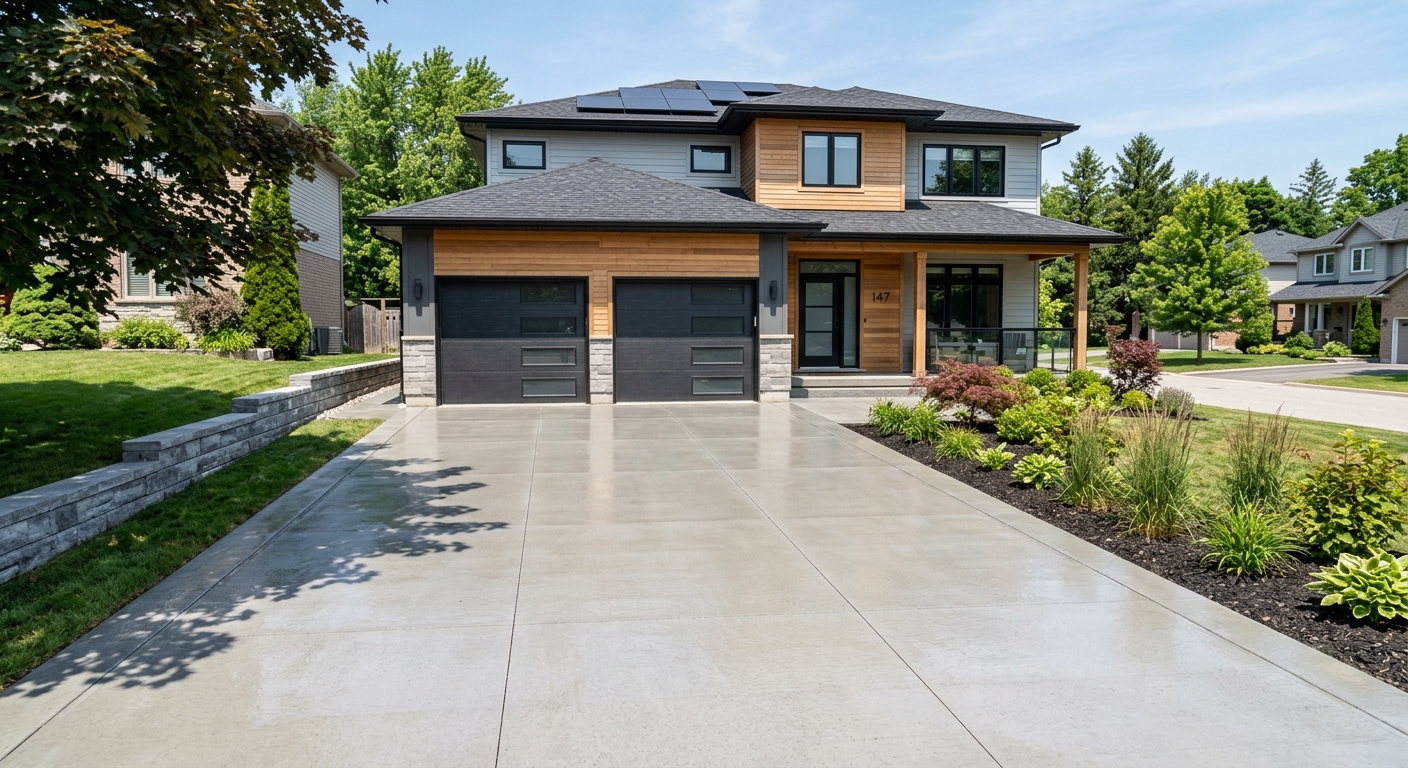
Concrete work options and costs in Madeira Park
Concrete work in Madeira Park has a way of reflecting the town’s coastal-wet reality and the Lower Mainland–Southwest market around it. Madeira Park’s population was 3,039 in 2021 (Statistics Canada, 2021 Census), and that small-town scale affects scheduling: fewer local crews can mean tighter availability during dry stretches, while rain-heavy weeks can push back pours and finishing. Housing mix also matters for demand—single detached homes are a big driver of outdoor flatwork projects like driveways and patios, which in turn influences how often contractors book site visits and line up concrete trucks.
In the Lower Mainland–Southwest region, even with mild winters, we still design around a shallow-but-real frost depth of about 450 mm / 18". Footings, piers and thickened edges are set below that to reduce frost heave risk, and exterior slabs are typically specified with air-entrained concrete and properly planned control joints to handle freeze–thaw cycles and saturated soils. Coastal rainfall means base prep and drainage get priced as real work—not “optional extras”—because standing water and weak subgrade lead to settlement and early surface wear.
You’ll often see especially steady demand in the waterfront and hillslope-adjacent areas where lots are tight and access matters; in practice, that’s where driveway widening, retaining edges, and patio upgrades come up most. With that climate-and-access context in mind, here’s a straightforward comparison of common options and typical local price bands to help you read quotes side-by-side.
| Application |
Typical Size |
Key Spec |
Finish Option |
Price Range |
| Concrete driveway (standard broom finish) |
400–600 sq. ft. |
Engineered base, compacted granular, air-entrained exterior mix |
Broomed and sealed |
$18,000–$28,000 |
| Exposed aggregate driveway |
400–600 sq. ft. |
Air-entrained exterior mix, cure plan for wet/coastal conditions |
Exposed stone finish |
$22,000–$34,000 |
| Stamped concrete driveway or patio |
300–500 sq. ft. |
Air-entrained exterior mix, integral colour, proper joints |
Stamp pattern with release and sealer |
$19,000–$38,000 |
| Plain concrete patio or walkway |
200–400 sq. ft. |
Compacted base, exterior air content, slope for drainage |
Float/screed with light broom texture |
$3,200–$10,400 |
| Garage floor (interior slab) |
300–600 sq. ft. |
Vapour barrier (if required), fibre or mesh, 32 MPa typical spec |
Plain finish, optional densifier |
$8,000–$20,000 |
| Foundation footings (structural, below frost) |
Per linear foot / typical small foundation |
Excavate below frost (~450 mm / 18" design reference), form & rebar per engineer |
Unfinished structural concrete |
$6,000–$12,000 |
Prices are estimates only and vary by project scope, site access and material selection.
What affects the price of concrete work in Madeira Park
Even for the “same” concrete job, quotes across the Lower Mainland–Southwest can swing by 30–50% once you account for frost protection, drainage, and finishing complexity. In Madeira Park and the surrounding Vancouver–Surrey–Abbotsford corridor, contractors commonly price jobs based on engineered base prep, the right concrete mix, and scheduling/cure controls for cool nights and frequent coastal rain. Meanwhile, in other parts of British Columbia where winters are colder, the same slab or footing can cost more because excavation and winter protection measures become more extensive—shorter pour seasons and more cold-weather precautions raise labour and materials costs.
Here’s the core: frost line depth and freeze–thaw cycles dictate every spec in our region. Exterior footings must extend below the design frost depth (in coastal BC, often about 0.5–1.2 m depending on conditions and design), and exterior slabs are usually air-entrained so the concrete can tolerate repeated saturation and freezing. If the contractor’s mix doesn’t meet the air and strength requirements, spalling and scaling show up early—especially where driveways meet de-icing salt in winter. Curing also changes the cost: in Madeira Park, cool, humid conditions often require longer curing time and sometimes curing blankets to reliably reach strength.
Two concrete examples that show why pricing differs: (1) a standard broom driveway might fall in the $18–$28 range per typical project tier, but switching to stamped concrete typically adds labour for form liners, stamping, colour, and extra sealing work—moving you into the higher stamped band; (2) a foundation-related scope that requires deeper excavation and engineered reinforcement can jump quickly even when “concrete volume” looks similar, because formwork, rebar placement, and below-frost digging are labour-intensive. Local housing stock also plays a role: older properties often have uneven grades or soft spots that demand additional base correction before any slab goes down.
| Price Factor |
Why It Matters |
Cost Impact |
| Frost line depth — determines footing depth and form height |
Controls how far down excavation and forms must go to prevent frost heave |
Can add significant excavation and rebar-form labour |
| Site preparation — excavation, grading, compacted granular base |
Wet coastal soils and saturated subgrade require drainage-focused prep |
Major swing factor; more hauling and re-compaction raises totals |
| Reinforcement — rebar or wire mesh requirement |
Engineered designs manage shrinkage and load cracking |
Material + placement labour increases, especially for foundations |
| Mix design — air-entrainment and compressive strength spec |
Air-entrainment protects against freeze–thaw scaling and spalling outdoors |
Higher-quality mix and QA testing typically increase material cost |
| Finish type — broom vs. stamped vs. exposed aggregate |
Finishes require different labour time, tools, and sealing systems |
Stamped/exposed finishes commonly move projects into higher tiers |
| Pour size and concrete truck access to site |
Tight driveways/hillside access can slow placement and limit truck size |
May require additional labour for distribution and pumps |
| Cold-weather curing precautions — heating and blankets |
Cold nights and humidity can delay strength gain |
Blankets/heaters can add daily labour and equipment rental costs |
| Control joint pattern and sealing cost |
Joints manage cracking while sealing helps repel de-icing salts and water |
Skipping or downsizing these steps increases lifecycle damage risk |
Permits & regulations in British Columbia
In British Columbia, structural concrete work usually requires more oversight than “cosmetic” flatwork. Footings, foundation walls, and grade beams are typically part of a building permit and often rely on engineered drawings that the municipality reviews as part of the building process. For homeowners in Madeira Park, that means if the work is supporting a foundation or altering structural capacity, plan on permits and engineering sign-offs before excavation begins.
Concrete flatwork—driveways, walkways, and patios—often does not require a permit by itself, but there are important exceptions. If the project changes lot grading, increases impervious surface coverage beyond local allowances, affects drainage patterns toward neighbouring properties, or touches municipal right-of-way conditions, you may need municipal confirmation (and sometimes permitting). When in doubt, confirm with the local authority before breaking ground.
Before you hire a contractor, verify coverage and credibility in a practical sequence. First, confirm the contractor’s business registration and any applicable professional/contractor licensing information available through provincial or official registries (the listing should match the legal business name). Next, ask for a current Certificate of Insurance showing liability coverage that matches your job size and scope. Finally, confirm WSBC coverage: request proof of clearance (or the appropriate WSBC letter/number) so you’re not left exposed if someone is injured during the work. Also ask for references on similar-scale jobs in the Lower Mainland–Southwest—especially outdoor air-entrained flatwork in wet, freeze–thaw conditions.
Getting concrete right in Madeira Park's freeze-thaw climate
Concrete failures in Madeira Park are almost always about water movement and durability, not just “mix quality.” In our coastal-wet environment, rain saturates base soils; during cold snaps, freeze–thaw cycles then stress the slab and edges. If the base isn’t compacted to the right depth for local soils, water finds pathways and the concrete can settle or crack. If exterior concrete isn’t air-entrained, the freeze–thaw process can cause spalling and scaling—often visible first at corners, along joints, and near areas where salt is applied.
To spec the job correctly, start with base preparation: compacted granular sub-base to the project’s design depth (and shaped with proper slopes for drainage). Next, require the mix design: exterior flatwork commonly targets 5–7% air and a minimum 32 MPa compressive strength. Then plan control joints so cracks occur where they’re intended—typically at predictable spacing and alignment—rather than random breaks. Curing is critical here: plan for at least 7 days of proper curing conditions, and in cooler weather ask about insulating blankets or curing methods to avoid early freezing of the concrete surface. Finally, seal: apply a penetrating sealer after the concrete has cured (commonly at 28 days) to repel de-icing salts and reduce water penetration.
If you’re comparing options, pay attention to where the cost is justified. For instance, moving from a plain broom finish patio in the $16–$26 tier to stamped concrete in the higher decorative band is worth it only if the contractor still delivers the same durability specs (air content, base prep, correct joints, and proper sealing). A cheaper decorative job that cuts curing or uses the wrong mix can cost more later when patching and sealing become recurring.
| Spec |
Why It Matters in Madeira Park |
What to Ask For |
Impact if Skipped |
| Compacted granular base (depth?) |
Reduces water saturation and prevents settlement under freeze–thaw cycles |
State target base depth and compaction method for your soil and slab thickness |
Uneven settlement, cracking, and joint failure |
| Air-entrained concrete mix (target air %?) |
Protects exterior surfaces from scaling and spalling in cold, wet conditions |
Specify 5–7% air content for exterior flatwork and confirm mix meets spec |
Early surface damage around edges and joints |
| Compressive strength (MPa rating) |
Ensures concrete reaches design durability and performance in real conditions |
Confirm minimum 32 MPa compressive strength requirement |
Lower strength leads to faster wear and cracking |
| Control joints (spacing per ACI guidelines) |
Controls where cracks develop, improving long-term performance |
Ask for a joint layout plan and spacing based on slab size and thickness |
Random cracking and difficult-to-repair surface breaks |
| Minimum 7-day curing period |
Ensures strength development before the slab is exposed to rain and temperature swings |
Confirm curing method and how the crew protects the slab in cool weather |
Surface weakness and reduced durability |
| Penetrating sealer (when applied after cure) |
Helps repel de-icing salt and reduces water ingress |
Ask for application timing (after cure; often around 28 days) and sealer type |
Faster staining, scaling risk, and more frequent maintenance |
How to choose a concrete work contractor in Madeira Park
Choosing the right concrete contractor in Madeira Park comes down to verification, transparency in the quote, and proof they’ve done outdoor, air-entrained flatwork properly. In British Columbia, your first step is confirming licensing/registration for the legal business name—then requiring liability insurance documents that match the project scope. For worker protection, ask for WSBC coverage proof: a current clearance letter or documentation that confirms the firm is in good standing. Don’t rely on “we’re covered” answers; ask to see the certificate and clearance paperwork before work starts.
Next, get 2–3 itemised written quotes. The best quotes break costs into labour and materials (excavation/base prep, reinforcement, concrete supply, finish labour, forms, disposal, and curing/sealing). Avoid lump-sum offers that don’t specify finish (broom vs stamped), air-entrainment/mix strength, or whether sealing and joint work are included. Read the exclusions line-by-line: is permit handling included if required, is site disposal included, and who deals with unexpected soft spots or additional haul due to over-excavation?
For warranty, look for workmanship coverage that’s meaningful for concrete flatwork—both for surface integrity and joint/crack related items—plus clarity on how product/manufacturer warranties apply. Confirm whether warranties are transferable if you sell the property. On payment, keep it conservative: never pay more than 10–15% upfront, and hold back until the job is complete and inspected.
Finally, request a written timeline: proposed start date, concrete delivery/curing plan, and a completion estimate. In Madeira Park’s coastal climate, the ability to coordinate rain days and cold nights is part of the contractor’s real performance.
- Ask for proof of liability insurance with job-specific coverage limits.
- Request WSBC clearance documentation before signing.
- Confirm the quote includes air-entrained mix and minimum strength (e.g., 32 MPa for typical specs).
- Get the base prep scope in writing: granular type, depth (where applicable), and compaction method.
- Require a joint layout plan (spacing and placement) and inclusion of joint sealer where specified.
- Clarify finishing: broom finish vs exposed aggregate vs stamped, and whether integral colour/release is included.
- Confirm sealing: product type and whether penetrating sealer is applied after cure (often around 28 days).
- Ensure disposal/haul and any demolition of existing concrete are clearly stated.
- Ask about truck access method: walk-behind placement vs pump vs smaller truck requirements.
- Check warranty terms for workmanship and what “defects” include.
- Use a payment schedule with a holdback until completion and cleanup.
- Demand a written schedule that addresses rain and cool nights (curing blankets/cover plan if needed).
Concrete red flags in Madeira Park include: vague quotes that don’t mention air-entrainment or strength; no clear joint plan or refusal to seal; promising work “whenever it fits” without a curing/weather protection plan; cutting base prep thickness or skipping compacted granular; and asking for large upfront payments or avoiding a written scope with exclusions.
Frequently asked questions — concrete work in Madeira Park
How long does a concrete driveway last?
A well-built concrete driveway in Madeira Park can last decades, but lifespan depends heavily on freeze–thaw durability details and how the base and edges were done. In this Lower Mainland–Southwest climate, the biggest early failure driver is usually water and salt exposure—especially at joints and edges—when concrete isn’t properly air-entrained or when joints and sealing weren’t handled correctly. If your driveway is built to exterior specs (air-entrained mix, correct compacted granular base, control joints, and a penetrating sealer applied after cure), it typically performs far better through wet winters and short cold snaps. For budgeting, it’s common to see driveway tiers around $18,000–$28,000 for a standard broom finish, with higher costs for finishes like stamped concrete when the durability specs are still included.
What is air-entrained concrete and why does it matter here?
Air-entrained concrete is mixed with tiny, intentionally created air bubbles that give freezing water places to expand. That matters a lot in Madeira Park because we experience freeze–thaw cycles even with milder winters, plus lots of coastal moisture. Without the right air-entrainment, water that soaks into the concrete can freeze and expand, leading to scaling and spalling—often first on edges, corners, and areas near de-icing. That’s why exterior flatwork should be specified with a target air range (commonly 5–7% for exterior flatwork) and supported by proper joints, base drainage, and curing. If a quote is low but doesn’t clearly state air-entrainment and sealing, I’d treat it as a risk—repairs can become expensive and repetitive.
How do I prepare the base for a concrete slab?
Base prep is where durable concrete is either created or undermined. In Madeira Park, the contractor should excavate to a design depth based on soil conditions, then place a compacted granular base in layers and compact it properly. The goal is to limit water saturation and reduce settlement during wet periods and cold snaps. You should also expect grading for positive drainage so water doesn’t pool under or beside the slab. For exterior work, drainage and compaction are especially important because repeated wetting and freeze–thaw stresses everything above it. When reviewing quotes, ask for the base prep scope (depth, granular material type, and compaction method). Skipping or “thin-lift” base work might save money upfront, but it can shorten the driveway or patio life quickly.
How do I compare concrete quotes?
Comparing quotes gets easier when you compare apples-to-apples. For Madeira Park projects, don’t just look at total price—ask whether the quote includes the same durability specs: air-entrained exterior mix, minimum strength (often 32 MPa), compacted granular base, reinforcement needs (mesh vs rebar where applicable), control joint layout, and sealing. Also check what’s included for site conditions: demolition and disposal of old concrete, truck access/pumping requirements, and protection for rain and cool curing. A standard broom driveway might align with the region’s typical tier around $18,000–$28,000, but a stamped concrete driveway generally costs more because of finish labour and materials—so $19,000–$38,000 can be reasonable if durability and sealing are still included. If one quote is much lower, read the exclusions line-by-line.
Can concrete be poured in cold weather in Madeira Park?
Yes, concrete can be poured in cold weather in Madeira Park, but “cold” has to be managed correctly. The limiting issue is not just temperature—it’s protecting the concrete so it reaches strength without freezing the surface or slowing hydration too much. A reputable crew should describe cold-weather curing precautions such as using insulating blankets, temperature monitoring, and ensuring the slab is kept protected long enough to develop the required strength. Coastal humidity and rain can also complicate finishing and curing, so scheduling and protection plans matter. In practice, contractors may slow down or shift timing to avoid bad windows, but they shouldn’t refuse to explain the curing method. When reviewing your quote, confirm curing duration (minimum 7 days) and whether additional protection is included if temperatures drop.
How do I maintain concrete in Madeira Park's freeze-thaw climate?
Maintenance in Madeira Park is about reducing water and salt damage. After installation, the key steps are: keep traffic off the slab during initial cure, avoid heavy de-icing salt where possible, and use a penetrating sealer applied after cure (often around 28 days) if it’s included in your original scope. Once sealed, reapply based on manufacturer recommendations and your exposure level—driveways where cars and salt hit regularly need more attention than a sheltered patio. During freeze–thaw seasons, quickly remove standing water and avoid repeated puddling near joints. If you see minor spall or joint gaps opening, repair early so water can’t penetrate deeper. Good maintenance helps your driveway or patio hold up far longer than it would without sealing and joint upkeep.