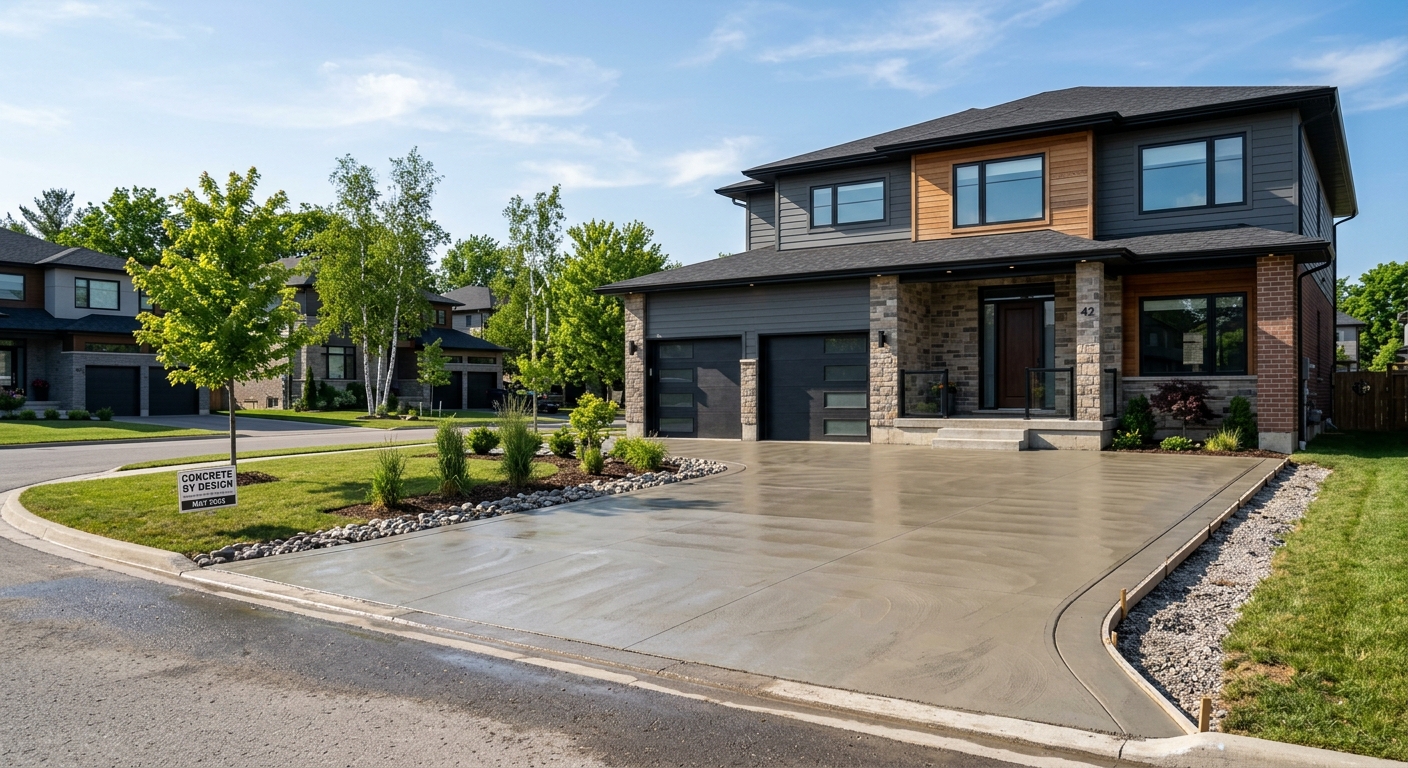
Concrete work options and costs in Powell River
Powell River is a coastal community where concrete flatwork has to perform through rain-soaked ground, cool nights, and frequent freeze–thaw cycles. That matters because local homes tend to be older and many are single-detached—72.1% of dwellings are that style—and a large share of households are homeowners (4,820 homeowner households, 75.5% of households own, Statistics Canada, 2021 Census). In practical terms, driveways, patios, and walkway replacements are some of the most common concrete projects we see on roads around areas like Westview and the hospital corridor, where curb access and vehicle turnaround dictate excavation, forming, and concrete truck staging.
In the Lower Mainland–Southwest, pricing is shaped by a shallow but meaningful frost depth (typical design assumptions are around 450 mm / 18") and the need to keep slabs and footings safe from frost heave. Exterior pours also require air-entrained mixes, tighter control-joint planning, and patience with curing because high humidity and prolonged rain can slow strength gain and surface durability. Contractor availability can also influence cost—when multiple jobs stack up during short, workable windows, forming labour and pump/finish scheduling can push bids upward.
Below are realistic price bands for common options in Powell River. Use them to compare what’s being offered in your quote and to sanity-check any “too low” or “too high” numbers before you commit.
| Application |
Typical Size |
Key Spec |
Finish Option |
Price Range |
| Concrete driveway (standard broom finish) |
400–500 sq ft (37–46 m²) |
Air-entrained exterior slab; thickened edge; control joints |
Broom finish |
$7,200–$11,500 |
| Exposed aggregate driveway |
400–500 sq ft (37–46 m²) |
Air-entrained exterior slab; proper base drainage |
Exposed aggregate (acid-wash/surface reveal) |
$9,800–$14,800 |
| Stamped concrete driveway or patio |
300–450 sq ft (28–42 m²) |
Air-entrained mix; integral colouring |
Stamped pattern + seal |
$10,500–$18,000 |
| Plain concrete patio or walkway |
200–300 sq ft (19–28 m²) |
Air-entrained slab; compacted granular base; joints |
Float/skim + light broom |
$3,800–$6,900 |
| Garage floor (interior slab) |
300–450 sq ft (28–42 m²) |
Vapour barrier (as needed); sub-base compaction; fibre/rebar as specified |
Steel trowel or broomless finish |
$6,000–$10,900 |
| Foundation footings (structural, below frost) |
Typical 1–2 day excavation/forming scope (project-specific) |
Footings below design frost depth; engineered rebar; inspection-ready |
Structural concrete (no decorative finish) |
$6,500–$12,000 |
Prices are estimates only and vary by project scope, site access and material selection.
What affects the price of concrete work in Powell River
In Powell River and across the Lower Mainland–Southwest, it’s common to see bids for the “same” concrete job differ by 30–50%—not because contractors are guessing, but because the specs that protect concrete in our coastal, freeze–thaw conditions are often not identical. One quote might include proper granular base depth and drainage detailing; another may treat it as a simple slab pour. Those differences directly affect excavation, forming, labour hours, mix design, and curing time.
Frost line depth and freeze–thaw cycles dictate the entire structure of exterior concrete. Footings must extend below the design frost depth to prevent frost heave, and exterior slabs typically use air-entrained concrete so the paste can resist scaling and surface loss through repeated wetting and freezing. In colder regions, the pour season is shorter and cold-weather curing precautions (heating, insulated blankets) add cost; even in coastal BC, you still need realistic scheduling and curing care when nights are cool and humidity stays high. De-icing salts also accelerate spalling; that’s why sealing and proper jointing matter for driveways that see winter maintenance.
Two local examples: (1) a driveway replacement on a sloped lot in Westview often costs more because the base and drainage require extra grading and granular rework to manage runoff; (2) a smaller patio on a flatter, easier-access property may only need minimal excavation and can stay closer to the lower end of the plain patio/walkway band (for example, $16–$26 per sq ft). Meanwhile, if you choose stamped concrete instead of broom finish, the higher labour for forms, finishing, and colour typically explains moving toward the $22–$36 per sq ft stamped/decorative band—so the extra cost is usually justified when you care about long-term appearance.
| Price Factor |
Why It Matters |
Cost Impact |
| Frost line depth — determines footing depth and form height |
Controls how deep excavation must go to avoid frost heave |
Higher footing depth/form height can add significant excavation and forming labour |
| Site preparation — excavation, grading, compacted granular base |
Proper base reduces settlement and helps drainage during heavy rainfall |
Often the biggest swing factor between “cheap” and “built-right” bids |
| Reinforcement — rebar or wire mesh requirement |
Limits cracking and supports load distribution in slabs |
Cost increases with higher reinforcement scope and heavier bar placement |
| Mix design — air-entrainment and compressive strength spec |
Air-entrainment helps resist freeze–thaw damage and scaling |
More stringent mix specs typically increase material cost and placement care |
| Finish type — broom vs. stamped vs. exposed aggregate |
Finishes change labour time, tools, and sealing requirements |
Stamped/exposed are higher due to longer finishing and add-on materials |
| Pour size and concrete truck access to site |
Small access issues can force extra labour or pumping |
Hard access can raise costs quickly due to staging and additional handling |
| Cold-weather curing precautions — heating and blankets |
Protects strength gain and surface durability when cool nights occur |
Added labour/equipment costs can increase totals during shoulder seasons |
| Control joint pattern and sealing cost |
Joints manage cracking; sealing reduces moisture and salt damage |
Correct jointing and sealing add line-item cost but reduce long-term failure |
Permits & regulations in British Columbia
In British Columbia, structural concrete work typically needs a building permit, and your municipality often expects engineered drawings for components like footings, foundation walls, and grade beams. If your project involves structural reinforcement details, waterproofing systems connected to foundation elements, or any work that changes how a building supports loads, plan for permit review. For Powell River homeowners, the safest approach is to ask your contractor to confirm whether the scope requires permits before excavation begins.
Concrete flatwork—patios, walkways, and driveways—usually does not require a permit by itself, unless it affects lot grading, changes drainage patterns, alters municipal right-of-way conditions, or triggers impervious surface coverage or stormwater-related requirements. Even when a permit isn’t required, the contractor should still follow property and municipal standards for drainage and slope.
Before hiring, verify three items step-by-step:
- Confirm contractor licensing status through the province’s public registry for applicable categories (and ensure any subtrades are properly licensed).
- Request a current Certificate of Insurance naming you (or your property) as applicable—look for general liability coverage and the policy effective dates.
- Ask for WSBC/WCB coverage proof for workers. The clearance letter (or coverage confirmation) should match the contractor legal name.
- Get references on similar-scope work around Powell River to confirm they’ve handled our wet-season scheduling and curing needs.
With that, you protect yourself from both compliance problems and the common concrete failures that happen when drainage and curing are treated as optional.
Getting concrete right in Powell River's freeze-thaw climate
Powell River concrete fails most often for predictable reasons: water finds the weak points (subgrade, edges, joints), then freeze–thaw cycles expand those vulnerabilities, leading to scaling, spalling, and uneven settlement. To spec the job correctly, start with the base. Concrete longevity is driven by compacted granular sub-base placed to the right depth for local soils and frost protection—then graded so water drains away from the slab. Without that engineered base, you can pour “perfect” concrete and still get cracking or rocking slabs within a few winters.
Next, demand the right mix. For exterior flatwork, use air-entrained concrete with a target air content of about 5–7% and a minimum 32 MPa compressive strength (project-specific design may be higher for critical structural scopes). Air bubbles are the difference-maker for freeze–thaw durability; inadequate air content is a common cause of spalling when de-icing salts and coastal rainfall combine.
Control joints are also essential. Plan joint placement so cracking stays where it’s meant to be—typically by using spacing rules consistent with ACI practice and our slab thickness. Then, curing: aim for at least 7 days of curing under proper conditions. When cool nights and rain slow strength gain, curing blankets or other cold-weather precautions may be required so the slab reaches its design durability. Finally, apply a penetrating sealer after the cure window (commonly around 28 days) to repel moisture and reduce salt-related surface damage.
As a pricing example, homeowners sometimes choose broom-finish to save money. If your base prep and air-entrainment are done right, a standard driveway can land in the lower end of the concrete driveway band (for example, $18–$28 per sq ft). Paying for stamped work is different: it costs more due to finishing labour and colouring, but it’s justified when you want a specific look—just don’t trade away the air-entrainment, joints, and curing to fund aesthetics.
| Spec |
Why It Matters in Powell River |
What to Ask For |
Impact if Skipped |
| Compacted granular base (depth?) |
Supports the slab and manages drainage through wet coastal seasons and freeze–thaw |
Base thickness for your soil conditions and slope; compaction method and inspection points |
Settlement, cracking, and premature failure at edges and low spots |
| Air-entrained concrete mix (target air %?) |
Resists freeze–thaw scaling in exterior slabs |
Confirm air target (about 5–7% for exterior flatwork) and whether mix design is air-entrained |
Surface scaling/spalling, especially when salt is used |
| Compressive strength (MPa rating) |
Strength gain supports durability and reduces early surface damage |
Minimum 32 MPa for flatwork (or higher if engineered); cylinder testing/records |
More vulnerability to weathering and reduced long-term performance |
| Control joints (spacing per ACI guidelines) |
Controls where cracks open and helps limit water infiltration |
Joint spacing and sawing timing plan; joint finishing details |
Random cracking that allows water into the slab and base |
| Minimum 7-day curing period |
Strength development matters in cool, humid conditions |
What curing methods will be used (curing compound, blankets) and for how long |
Weak surface, higher risk of scaling and early wear |
| Penetrating sealer (when applied after cure) |
Helps repel moisture and reduces salt-related surface breakdown |
Penetrating sealer type and application timing (commonly around 28 days after pour) |
Faster moisture/salt penetration and reduced surface durability |
How to choose a concrete work contractor in Powell River
Choosing the right contractor in Powell River comes down to proof and process. Start with British Columbia licensing and insurance. Ask for their certificate of general liability and confirm it’s current; then request WSBC/WCB clearance or coverage confirmation for their workers. You should also see clear project references for concrete flatwork and structural scopes they’ve completed in wet/coastal conditions, not only interior work.
Next, get 2–3 itemised written quotes. Look for a breakdown that separates excavation/site prep, forms, rebar/mesh, concrete supply, pumping (if needed), finishing, joints, and sealing/curing provisions. A quote that only says “concrete and labour” without specifying base preparation depth, mix design (air-entrainment), and jointing is hard to compare and often ends in change orders. Also ask: is debris disposal included? Is permit pulling included if the scope is structural? Are elevations and drainage addressed?
Warranty matters too. Ask for both workmanship warranty length and whether there’s a product/manufacturer warranty on specialty materials (like sealers or admixtures), and whether it transfers to future owners if you sell. For payment, never pay more than 10–15% upfront. Hold back a portion until the final finishing, jointing, sealing (where included), and site cleanup are complete. Finally, get the start date and completion estimate in writing, tied to weather realities—Powell River schedules can shift due to rain and curing conditions.
- Verify current BC licensing status for the contractor’s applicable categories.
- Confirm general liability insurance is active and request the certificate.
- Request WSBC/WCB coverage confirmation/clearance for workers.
- Get itemised quotes (labour + materials) instead of a single lump sum.
- Check that base prep, granular depth, and compaction are included.
- Ensure the mix is explicitly air-entrained for exterior slabs.
- Confirm control joint type, timing, and spacing plan.
- Ask how curing will be handled during cool nights and rain.
- Confirm whether penetrating sealer is included and when it will be applied.
- Read exclusions: disposal, trucking access, pumping, and rebar placement.
- Confirm warranty terms for workmanship and any specialty materials.
- Use a payment schedule with a holdback until final acceptance.
Concrete red flags I look for in Powell River include quotes that don’t mention air-entrainment, no plan for control joints, vague curing/“we’ll do our best” wording, missing proof of WSBC/WCB coverage, and crews that start digging without confirming drainage and base preparation requirements for freeze–thaw conditions.
Frequently asked questions — concrete work in Powell River
Stamped vs broom-finish concrete — cost difference?
In Powell River, stamped concrete is typically more expensive than a broom-finish driveway because it requires additional labour time for imprinting, colour materials, and careful finishing/texture management. As a guide for the Lower Mainland–Southwest pricing tier, broom-finish concrete driveway work usually falls in the $18–$28 per sq ft band, while stamped & decorative options are commonly around $22–$36 per sq ft. The difference isn’t just “a stamp”—it’s also the extra finishing steps and, often, a higher-end seal to protect the surface in our wet coastal weather. If your contractor wants to “save money” by skipping air-entrainment or control joints to offset stamp pricing, that’s a problem in our freeze–thaw climate. Ask your quote to specify air content, joint spacing, curing method, and whether sealing is included.
When is the best time to pour concrete in Powell River?
The best timing in Powell River is when you can get workable weather for excavation, forming, and at least the first week of proper curing. Because we can see cool nights and extended rain periods, contractors usually prefer late spring through early fall, when rainfall is more manageable and surfaces can cure without being soaked or prematurely frozen. That said, experienced crews can pour outside the ideal window if they plan for curing blankets/heating and protect the slab from moisture extremes. When you’re getting quotes, ask whether the contractor includes cold-weather precautions and how they handle rain scheduling. A well-prepped base and correct curing are critical here—Powell River’s freeze–thaw cycles can stress poorly cured concrete, even if the pour “looks fine” on day one.
How long does concrete take to cure?
Concrete strength gain is time-dependent, but “curing” for durability is more than just waiting for it to dry. For exterior flatwork in British Columbia, you should plan for at least a 7-day curing period under appropriate conditions, and better results when temperatures and humidity support normal strength development. Full design strength is commonly referenced around 28 days, especially for performance and readiness for sealing. That’s why many contractors apply penetrating sealer after the cure window (often around the 28-day mark) to repel moisture and reduce salt-related surface damage. If a contractor is willing to seal immediately or says you can open/drive on it right away, ask for clarification—rushing curing in Powell River’s cool, humid conditions is one of the easiest ways to end up with surface scaling.
Do I need a permit for concrete work in British Columbia?
In British Columbia, structural concrete work—like footings, foundation walls, and grade beams—typically requires a building permit and often engineered drawings reviewed through the municipal process. Concrete flatwork such as patios, walkways, and driveways usually does not require a permit by itself, but it can change depending on drainage, lot grading, impervious surface limits, or whether the work affects municipal right-of-way conditions. For Powell River, the practical step is to confirm with the local authority (or have your contractor confirm as part of their scope) before excavation. Also verify the contractor has liability insurance and WSBC/WCB coverage so you’re protected if something goes wrong. If your plan involves any structural change, treat it as a permitting matter from day one.
Concrete vs pavers for a patio in Powell River?
Both concrete and pavers can work well in Powell River, but concrete is often preferred when homeowners want a long-lasting, low-maintenance surface with consistent joints and easier drainage detailing. Pavers are attractive because they’re visually flexible, but they require a correctly engineered base and bedding layer to prevent shifting under freeze–thaw and foot traffic. Concrete patio costs in the local pricing tier are commonly around $16–$26 per sq ft for plain broom-finish work, while stamped/decorative concrete typically runs higher (about $22–$36 per sq ft). If you choose concrete, ensure air-entrainment, control joints, and curing are included—those specs drive durability more than appearance. If you choose pavers, insist on documented base compaction and an edge restraint system that won’t let water undermine the bedding over wet seasons.
How long does a concrete driveway last?
A well-built concrete driveway in Powell River can last many years—often decades—when it’s engineered for our coastal wetting and freeze–thaw cycles. The key is what’s underneath: compacted granular base to the right depth, correct drainage, and air-entrained concrete for exterior durability. Control joints must be placed to manage cracking, and curing needs to be handled properly so the slab reaches durability strength. Sealing also helps; penetrating sealer applied after the cure window (commonly around 28 days) can improve resistance to moisture and de-icing salt damage. If your contractor cuts corners—thin base, no air-entrainment, weak curing—driveways can show surface scaling or spalling much sooner, regardless of whether you paid in the lower end of the driveway band (for example, $18–$28 per sq ft) or higher.