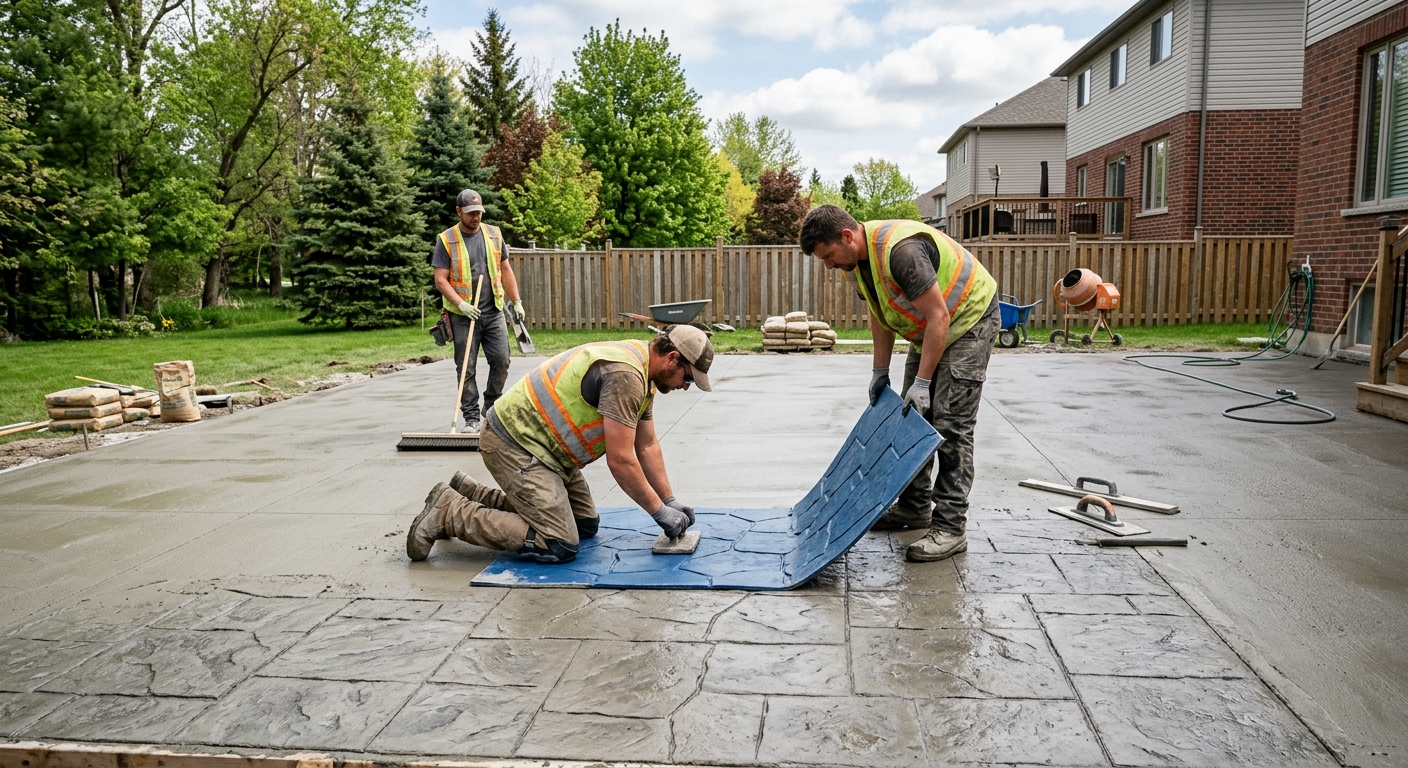
Concrete work options and costs in 108 Mile Ranch
Concrete work in 108 Mile Ranch starts with choosing the right application and finish for how you actually use the space. In a community of 1,043 residents (Statistics Canada, 2021 Census), most driveways and outdoor slabs are tied to single-detached home lots, which is where concrete flatwork sees the most demand—especially in older neighbourhood pockets where upgrades are common. In the Lower Mainland–Southwest, even though winters are milder than interior B.C., the local freeze–thaw pattern and wet stretches still push the cost of concrete projects upward compared with “simple slab” expectations. We commonly design for a frost depth around 450 mm (18"), which means footings and thickened edges sit below that level to reduce frost heave risk, while exterior slabs use air-entrained mixes and properly detailed control joints to manage cracking and scaling. Scheduling also matters: frequent rain, cool nights, and high humidity can slow curing, so crews plan around weather windows and often use curing blankets or sealers to protect surfaces while concrete gains strength. Labour availability in the Vancouver–Surrey–Abbotsford corridor can also affect turnarounds, which is why it’s smart to book when you’re ready rather than waiting for “perfect weather” that may not arrive.
If you’re weighing options for a new driveway or patio, the table below compares typical sizes, key specs, finish choices, and realistic price bands for a typical 108 Mile Ranch homeowner project—then you can decide what’s worth spending on.
| Application |
Typical Size |
Key Spec |
Finish Option |
Price Range |
| Concrete driveway (standard broom finish) |
16 ft x 32 ft (512 sq ft) |
4" slab, air-entrained mix, compacted granular base, control joints |
Broom finish |
$9,200 – $14,300 |
| Exposed aggregate driveway |
16 ft x 32 ft (512 sq ft) |
4" slab, retarder + wash, air-entrained mix, joints as required |
Exposed aggregate |
$12,000 – $18,200 |
| Stamped concrete driveway or patio |
12 ft x 20 ft (240 sq ft) |
4" slab (or thickened edge where needed), air-entrained mix, integral base colour |
Stamped pattern |
$6,000 – $10,200 |
| Plain concrete patio or walkway |
10 ft x 16 ft (160 sq ft) |
4" slab, compacted granular base, joints to manage shrinkage |
Bare concrete / light trowel |
$2,600 – $4,200 |
| Garage floor (interior slab) |
20 ft x 22 ft (440 sq ft) |
4" slab, vapour control where applicable, wire mesh or rebar as required |
Plain trowel finish |
$7,200 – $12,100 |
| Foundation footings (structural, below frost) |
Per project (typical 1–2 storey) |
Excavation to below design frost, reinforced concrete, proper formwork |
Reinforced concrete only |
$6,000 – $12,000 |
Prices are estimates only and vary by project scope, site access and material selection.
What affects the price of concrete work in 108 Mile Ranch
Even when you’re comparing the “same” concrete job on paper, quotes in the Lower Mainland–Southwest can differ by about 30–50% once you factor in how winter conditions, excavation, and labour availability hit the details. In British Columbia, it’s rarely just the concrete that costs money—it’s what the crew has to build around the concrete to make it last. Frost depth and freeze–thaw cycles dictate every spec. Locally, exterior footings and thickened edges are placed below the local design frost depth (commonly around 450 mm / 18") to prevent frost heave, and all exterior slabs require air-entrained concrete so the paste survives repeated wetting and cooling. When you move toward colder parts of the province, the pour window tightens and contractors often need cold-weather curing precautions (insulating blankets and sometimes temporary heating), which adds cost. De-icing salts and wet freeze–thaw cycles also increase the risk of surface scaling, so sealing and good curing become “real” line items rather than optional extras.
In 108 Mile Ranch, you’ll often see cost swings from drainage and soil conditions. For example, one driveway estimate might include a thicker compacted granular base and improved runoff control because saturated subgrade needs more prep; another might price a simpler base where soil is already firm. That’s one reason a standard broom-finish driveway can land in the $18–$28 per sq ft backbone range, while upgrading to stamped or decorative work can shift you toward the $22–$36 per sq ft decorative backbone range. Housing age matters too: older lots may have mature landscaping, uneven grades, or buried services, which can increase excavation/disposal and forming time—pushing total project costs upward by hundreds or even thousands of dollars even if the concrete area stays the same.
| Price Factor |
Why It Matters |
Cost Impact |
| Frost line depth — determines footing depth and form height |
Footings must be below design frost to reduce frost heave |
Higher excavation and deeper reinforcement can add significant labour and concrete |
| Site preparation — excavation, grading, compacted granular base |
Wet/saturated soils need engineered base and drainage to stabilize the slab |
Extra haul-off, granular, and compaction time can increase costs materially |
| Reinforcement — rebar or wire mesh requirement |
Controls cracking and supports loads, especially for driveways and garage slabs |
Material + placing labour can raise the price even before finishing |
| Mix design — air-entrainment and compressive strength spec |
Air content and strength support durability through freeze–thaw and rainfall cycles |
Correct mix slightly increases material cost but prevents premature spalling |
| Finish type — broom vs. stamped vs. exposed aggregate |
Finish methods require extra labour, materials, and curing/colour control |
Stamped/exposed can add a noticeable premium per square foot |
| Pour size and concrete truck access to site |
Access affects pump/placement time and whether batching logistics change |
Pumping, traffic control, and longer placement time add costs |
| Cold-weather curing precautions — heating and blankets |
Concrete gains strength slower in cool, damp conditions |
Blankets/heaters and longer protection periods increase labour |
| Control joint pattern and sealing cost |
Joints manage shrinkage cracking; sealing helps with de-icing salts and scaling |
Often small per-foot compared to repairs, but it adds line-item cost |
Permits & regulations in British Columbia
In British Columbia, structural concrete work—like foundation walls, grade beams, reinforced footings, and other load-bearing components—generally requires a building permit, and engineered drawings are often reviewed by the municipality before construction. Concrete flatwork such as patios, walkways, and driveways usually does not require a permit by default, unless the project affects lot grading, drainage, or impervious surface coverage limits, or ties into municipal right-of-way requirements. Because each lot and municipality can have different conditions, the right move is to confirm requirements with the local authority before breaking ground.
For homeowners in 108 Mile Ranch, start your contractor verification by asking for three things: (1) their liability insurance certificate, (2) clearance or proof that they carry the required workplace coverage (WSBC / WorkSafeBC registration), and (3) their licence/registration status where applicable to their contracting work. Step-by-step: search the contractor’s name online to find the registry/licensing entry and confirm the registration is active; request a current Certificate of Insurance and check the policy is valid for the period of your project and includes liability coverage that matches the scope; and ask for WSBC clearance documentation (not an old letter) that shows they’re in good standing for workers who will be on-site. Also ask for photos and references on similar concrete jobs in B.C., ideally with freeze–thaw exposure like exterior driveways and slabs. This is how you protect yourself if something goes wrong.
Getting concrete right in 108 Mile Ranch's freeze-thaw climate
Concrete fails in 108 Mile Ranch mostly because of how water interacts with freeze–thaw cycles, not because the slab “looked fine” at pour day. The most common homeowner-visible problem is spalling and scaling at the surface—usually tied to inadequate air-entrainment, poor curing, and weak base preparation that lets water sit under or against the slab edges. To spec the job correctly, focus on five essentials. (1) Base preparation: excavate to the right depth for local soils and frost conditions, then place compacted granular to create a stable, well-drained base. (2) Mix design: for exterior flatwork, specify air-entrainment—typically 5–7% air content for freeze–thaw durability—and a minimum 32 MPa compressive strength so it reaches design performance. (3) Control joints: place joints to control shrinkage cracking; spacing should limit random cracking and keep water out of the cracks. (4) Curing: plan for at least 7 days of curing under proper conditions, with extra protection when cool, rainy weather slows strength gain. (5) Sealing: apply a penetrating sealer after the slab is fully cured—often around 28 days post-pour—to repel moisture and reduce salt-driven surface damage.
When you ask technical questions up front, you avoid costly rework. For instance, upgrading from a basic driveway finish to stamped concrete can be worth it, but only if the foundation prep and air-entrained mix are already correct. If your driveway is in the backbone range of $18–$28 per sq ft, a stamped upgrade closer to $22–$36 per sq ft may add several thousand dollars—yet it’s justified when the design requires durability, consistent colour/texture, and proper joint sealing. If the quote is cheaper because they’re “skipping details,” that usually shows up as cracking or surface wear within the next freeze–thaw season.
| Spec |
Why It Matters in 108 Mile Ranch |
What to Ask For |
Impact if Skipped |
| Compacted granular base (depth?) |
Controls settlement and keeps water from migrating under the slab during wet/cold cycles |
Granular type and compacted depth specified to match your soil and frost conditions |
Uneven cracking, pumping, and accelerated deterioration at edges |
| Air-entrained concrete mix (target air %?) |
Air voids protect the paste during freeze–thaw and reduce spalling risk |
Target air content for exterior flatwork (typically 5–7%); mix design confirmation |
Scaling/spalling, especially near joints and areas exposed to salts |
| Compressive strength (MPa rating) |
Strength gain supports durability and surface abrasion resistance |
Minimum 32 MPa compressive strength and curing plan |
Surface wear, cracking, and reduced long-term performance |
| Control joints (spacing per ACI guidelines) |
Manages shrinkage cracking so cracks stay predictable and drainable |
Joint spacing and saw-cut timing schedule |
Random cracks, water tracking, and joint blowouts |
| Minimum 7-day curing period |
Proper curing is critical in cool, rainy conditions to reach strength safely |
Protection methods if nights are cool or rain is expected |
Lower strength, higher cracking risk, and weaker surface durability |
| Penetrating sealer (when applied after cure) |
Repels moisture and helps reduce salt-driven scaling in exterior B.C. conditions |
Type of sealer and timing (often around 28 days post-pour) |
Faster surface deterioration and staining; more maintenance needs |
How to choose a concrete work contractor in 108 Mile Ranch
Choosing a contractor in 108 Mile Ranch is less about flashy photos and more about confirming credentials and workmanship details. In British Columbia, you want three checks done before you sign: (1) licensing/registration status as required for the work they’re performing, (2) liability insurance certificate (valid for the project dates and scope), and (3) WorkSafeBC coverage (WSBC/WorkSafeBC clearance documentation) for workers on-site. How to check: look up the contractor’s status through the applicable online registry/record source, then request a current Certificate of Insurance showing coverage limits that make sense for your project; and ask for WSBC clearance/confirmation that they’re in good standing.
Next, get 2–3 itemised written quotes—not one lump total. Ask for a breakdown that shows labour, concrete supply, excavation/grading, granular base, reinforcement, finishing materials (including any stamp/aggregate systems), and curing/sealing. Read the scope carefully for what’s excluded: permit pull responsibilities, disposal/hauling, damage restoration, and whether existing concrete removal is included or extra. Warranty matters too: ask for the length of the workmanship warranty and whether it covers cracking, joint performance, and surface scaling. Confirm the product/manufacturer warranty on any admixtures or decorative systems and whether it’s transferable to future owners.
Finally, protect your cashflow: never pay more than about 10–15% upfront; keep a holdback until the job is complete and cleanup is satisfactory. Get a written start date and completion estimate so the crew isn’t waiting on materials or weather without notifying you.
- Ask for an itemised quote (labour + materials, not just totals).
- Confirm excavation depth and granular base specification in writing.
- Require the concrete mix to be air-entrained for exterior flatwork.
- Verify reinforcement details (wire mesh vs. rebar) match your use case.
- Check control joint spacing and saw-cut/finish timing plan.
- Ask how they handle rain, cool nights, and curing blankets.
- Confirm whether penetrating sealer is included and when it’s applied.
- Clarify disposal/hauling and where excavated material goes.
- Verify truck access, pump requirements, and placement method.
- Get start date and completion target in writing.
- Review warranty length and exactly what it covers.
- Confirm insurance and WorkSafeBC clearance before work begins.
Concrete red flags in 108 Mile Ranch: a contractor who won’t discuss air-entrainment and curing; quotes that omit granular base and drainage details; “too-good-to-be-true” pricing that doesn’t align with $18–$28 per sq ft driveway backbone; refusal to provide itemised scope; and asking for a large upfront payment (beyond about 10–15%).
Frequently asked questions — concrete work in 108 Mile Ranch
How long does concrete take to cure?
In 108 Mile Ranch and across British Columbia’s freeze–thaw conditions, curing time matters as much as the pour date. For most exterior slabs, crews plan for at least a 7-day curing period so the concrete reaches early strength safely, especially when cool evenings or rain slow hydration. Even after 7 days, the concrete continues to gain strength and reaches typical design-related performance closer to 28 days. That’s also why penetrating sealer is commonly applied around 28 days post-pour—so the slab is dry enough to accept the sealer and durable enough to benefit from moisture resistance. If you’re seeing contractors rushing traffic or heavy loads before the full cure window, that’s a major concern.
Do I need a permit for concrete work in British Columbia?
Often, concrete flatwork like driveways, patios, and walkways does not require a building permit in British Columbia unless it affects grading, drainage, impervious surface limits, or municipal right-of-way conditions. However, structural concrete like foundation walls, footings, and grade beams typically requires a building permit and often engineered drawings reviewed through the municipality process. For homeowners in 108 Mile Ranch, the practical step is to ask the contractor whether your scope touches lot grading or drainage or includes any structural elements. Then confirm with the local authority before the first excavation. A good contractor will be clear on what’s included and can point you to the right path early, rather than discovering late that a permit is needed.
Concrete vs pavers for a patio in 108 Mile Ranch?
For patios in 108 Mile Ranch, concrete usually wins on installation speed and long-term maintenance when the base is built properly for wet/cold cycles. Plain concrete patios typically land around $16–$26 per sq ft in this region, while decorative stamped options cost more (often driven by labour and system materials). Pavers can be great if you want easy panel replacement and a more “modular” look, but they still require proper excavation, compacted base, and drainage detailing—otherwise you can see shifting, weeds, and uneven settlement. Concrete also benefits from control joint strategy and sealing to reduce salt/surface damage during freeze–thaw. The best comparison is apples-to-apples: same patio thickness intent, same base depth, and same drainage assumptions.
How long does a concrete driveway last?
A well-built concrete driveway in British Columbia commonly lasts decades, but the real predictor is durability details, not just finish. In 108 Mile Ranch’s climate, the driveway surface has to handle repeated wetting and freeze–thaw, plus occasional de-icing salt. That’s why air-entrained mix, proper base prep, correct control joints, and adequate curing are key. Sealing after full cure (often around 28 days) helps repel moisture and slows surface scaling. Cost-wise, driveways typically fall in the $18–$28 per sq ft backbone range depending on reinforcement, base work, and finish. If you choose the cheapest quote that skips air entrainment or shortens curing, you’ll likely see early cracking or spalling and may pay for patching long before the driveway should age naturally.
What is air-entrained concrete and why does it matter here?
Air-entrained concrete is a mix designed with tiny, evenly distributed air voids that give freezing water a place to expand without destroying the cement paste. In 108 Mile Ranch and the broader Lower Mainland–Southwest market, exterior slabs see cycles of moisture and temperature swings that can lead to scaling and spalling if the concrete isn’t correctly air-entrained. That’s why contractors should specify the target air content (commonly 5–7% for exterior flatwork) and confirm the mix design. Standard “interior-only” mixes or poorly controlled batches can look fine early, then deteriorate at the surface after the first couple of freeze–thaw seasons. If a contractor won’t explain their air-entrainment plan for exterior work, pause and ask again before signing.
How do I prepare the base for a concrete slab?
Base prep is where most driveways and patios succeed or fail in British Columbia. For a slab in 108 Mile Ranch, the contractor should excavate to the required depth, remove soft/unstable material, and then place compacted granular base to the correct thickness for your soil and frost-related requirements. The base should be graded properly for drainage so water doesn’t pond at slab edges or under the concrete. Compaction is not optional—it must be done in lifts with the right moisture content so you avoid future settlement and cracking. Next comes reinforcement (as specified for your load and slab type) and joint planning. When you’re reviewing a quote that mentions only “concrete supply,” ask specifically for granular depth, drainage strategy, and compaction method.