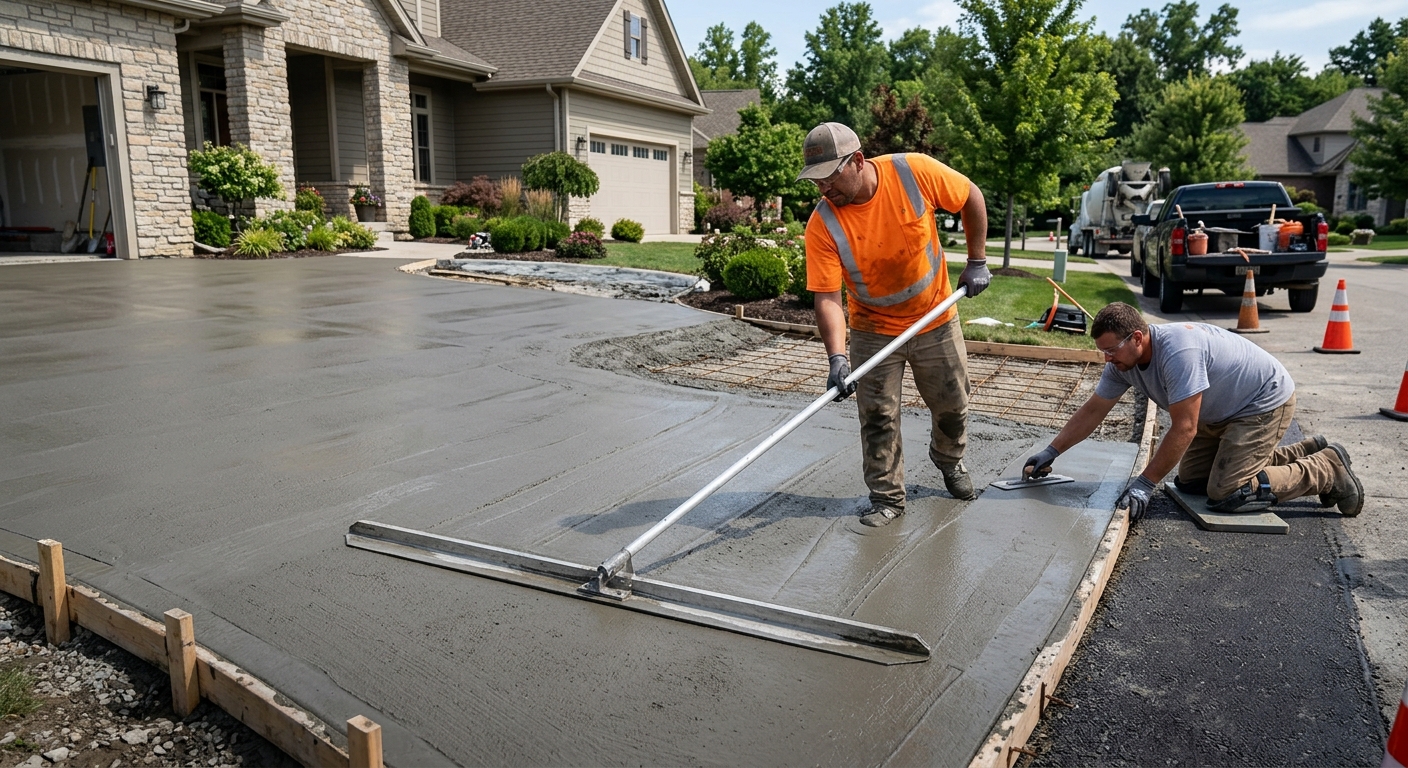
Concrete work options and costs in Cawston
Concrete work in Cawston is popular because residents want low-maintenance, long-wearing outdoor surfaces on a small-town scale. With a population of 1,040 (Statistics Canada, 2021 Census), trades tend to be busy in the spring and early summer, especially around local community hubs where more driveways and backyard upgrades get scheduled. In the Lower Mainland–Southwest, concrete costs are shaped by a frost depth assumption of about 450 mm (18") for design, which means exterior footings and thickened edges must still be protected from freeze–thaw movement. The other big driver is our coastal-wet climate: frequent saturation, cool nights, and rain can delay pours and slow curing, so contractors often plan longer cure protection and tighter weather scheduling. That impacts labour availability and the time it takes to complete formwork, base prep, and finishing—especially for slab work like driveways and patios.
Where this is most noticeable is the timing of projects near high-traffic residential areas and older neighbourhood pockets where homeowners are replacing worn flatwork and adding drainage. If you’ve been quoted a wide range for the “same” job, it’s usually because the specs behind the finish are different—air content, reinforcement, footing depth, and how the contractor manages rain and curing. Use the table below to get a realistic feel for typical scope levels in Cawston before you compare itemized proposals.
| Application |
Typical Size |
Key Spec |
Finish Option |
Price Range |
| Concrete driveway (standard broom finish) |
24' x 10' (240 sq. ft.) |
Air-entrained mix; compacted granular base; control joints |
Broom finish |
$4,320–$6,720 |
| Exposed aggregate driveway |
24' x 10' (240 sq. ft.) |
Air-entrained mix; retarder/aggregate exposure; sealed surface |
Exposed aggregate |
$5,280–$7,920 |
| Stamped concrete driveway or patio |
18' x 12' (216 sq. ft.) |
Air-entrained mix; thicker edge/thickened perimeter; release agent |
Stamped texture |
$4,752–$7,776 |
| Plain concrete patio or walkway |
12' x 16' (192 sq. ft.) |
Air-entrained mix; compacted base; joints as needed |
Float/screed with light broom |
$3,072–$4,992 |
| Garage floor (interior slab) |
20' x 20' (400 sq. ft.) |
Vapour barrier (where required); reinforcement; proper thickness |
Standard finish + saw cuts |
$7,200–$11,200 |
| Foundation footings (structural, below frost) |
Per linear foot (typical home footing length varies) |
Excavation + formed/placed concrete below design frost depth; rebar per plan |
Structural concrete |
$200–$350 |
Prices are estimates only and vary by project scope, site access and material selection.
What affects the price of concrete work in Cawston
In Cawston and across the Lower Mainland–Southwest, it’s common to see quotes for the “same” driveway or patio come back 30–50% apart. The gap usually isn’t the concrete itself—it’s the specifications and the amount of protection needed to survive our wet, freeze–thaw conditions. In British Columbia, shallow frost in coastal areas can still be enough to cause movement at the surface if the base and footing design aren’t right, so contractors frequently build in deeper excavation, engineered base thickness, air-entrained concrete, and careful joint layout. When a contractor also has to schedule around rain, cool nights, and limited pour windows, labour and equipment time increases, and those costs show up in your quote.
Frost depth and freeze–thaw cycles dictate every exterior spec. Footings and thickened perimeters must be placed below the design frost depth to prevent frost heave, and exterior slabs should use air-entrained concrete to manage freeze–thaw scaling. Colder regions generally need longer cold-weather precautions, but even here the coastal climate can create “cool but wet” conditions that slow curing—often requiring curing blankets and longer protection to hit design strength. De-icing salt and wet exposure can also accelerate surface wear, which is why sealing becomes more important for driveways and steps.
Two examples from Cawston pricing: (1) switching from plain concrete to stamped typically adds form + labour time; (2) adding a proper compacted granular base and drainage often raises the upfront price by a few dollars per square foot, but it reduces the risk of settlement-related cracking and early scaling—especially where soils hold moisture. If one quote for a broom-finished driveway lands near the regional band of $18–$28 per sq. ft. and another comes in lower, it may be cutting corners on air-entrainment, thickness, or base prep rather than just “working cheaper.”
| Price Factor |
Why It Matters |
Cost Impact |
| Frost line depth |
Determines footing depth and form height |
More excavation and rebar positioning when deeper protection is required |
| Site preparation |
Excavation, grading, compacted granular base |
More base material, compaction passes, and disposal if the site is poor or tight |
| Reinforcement |
Rebar or wire mesh requirement |
Added steel and placement labour; may be essential for longer spans or thicker edges |
| Mix design |
Air-entrainment and compressive strength spec |
Higher-spec mix costs and more careful batching/verification |
| Finish type |
Broom vs. stamped vs. exposed aggregate |
Stamped/exposed requires extra labour steps, release/retarder materials and finishing time |
| Pour size and concrete truck access to site |
Access affects how much labour is needed to place/finish |
Small access constraints can trigger pumping/extra labour or redesign of pour method |
| Cold-weather curing precautions |
Heating and blankets to protect early strength |
Blankets, heaters, and time to maintain temperature increase labour and materials |
| Control joint pattern and sealing cost |
Controls cracking and reduces salt/moisture damage |
More saw cutting/layout time and an additional sealing step 28 days after pour |
Permits & regulations in British Columbia
In British Columbia, most structural concrete work needs a building permit. That typically includes foundations such as footing excavation and concrete footings, foundation walls, and grade beams—any element that supports the building loads. These projects often require engineered drawings reviewed by the municipality or local building authority before the work begins. By contrast, concrete flatwork like patios, walkways and most driveways usually does not require a permit unless it affects lot grading, creates or changes drainage patterns, or triggers impervious surface/side-yard or right-of-way requirements. If you’re tying a driveway into existing slopes, adding retaining elements, or changing how surface water flows, it’s worth confirming first.
For a homeowner in Cawston, the best way to protect yourself is to verify the contractor before any excavation. Step-by-step: (1) Ask for the contractor’s certificate of insurance for liability—ensure the coverage amounts are current and that the start date matches your project window. (2) Ask for their WCB coverage information (commonly shown via clearance documentation) so you know they’re properly enrolled for their workers. (3) Confirm they carry the right business information and can provide references for similar driveway or footing scope. If engineered foundation work is involved, request the project details and confirmation of who is submitting drawings and who is responsible for field compliance.
Finally, always confirm permit responsibility in writing. Even when a permit isn’t required for the flatwork itself, your contractor should tell you if grading or drainage changes mean an approval may be needed.
Getting concrete right in Cawston's freeze-thaw climate
Concrete fails in Cawston’s climate mostly because water finds its way into the slab system and then freezes and expands. The common story is freeze–thaw scaling (surface damage), spalling at edges and corners, and cracking that shows up sooner than expected after heavy rain. To spec the job correctly, you want five things nailed down: (1) base preparation—compacted granular sub-base to a depth that supports the slab and gets the drainage right under the concrete; (2) mix design—exterior concrete should be air-entrained, typically around 5–7% air content for durable exterior flatwork, with a minimum 32 MPa compressive strength; (3) control joints—placed to limit random cracking and lined up for predictable, clean joints; (4) curing—plan on at least 7 days of curing under proper conditions, with extra protection when nights are cool or rain is persistent; and (5) sealing—use a penetrating sealer applied after the slab has properly cured (commonly around 28 days) to repel de-icing salt and reduce moisture uptake.
Here’s how to ask the right questions. When a contractor mentions “air-entrained” but can’t tell you the air target or how they manage rain and early curing, treat it as a red flag—spalling due to inadequate air entrainment is one of the most expensive problems to fix. In a practical cost example, homeowners sometimes choose a plain broom driveway expecting savings, but when a properly prepped base and air-entrained mix are included, the difference between standard broom and upgraded finishes becomes easier to justify. Stamped work costs more in labour and materials, yet a sealed, well-cured slab with correct joints is what protects both plain and decorative finishes from early scaling.
| Spec |
Why It Matters in Cawston |
What to Ask For |
Impact if Skipped |
| Compacted granular base (depth?) |
Reduces settlement and helps manage moisture before freeze–thaw |
Granular type and compacted thickness; compaction method; drainage plan if needed |
Uneven support, cracking, and accelerated surface deterioration |
| Air-entrained concrete mix (target air %?) |
Protects against freeze–thaw scaling in exterior exposure |
Air target range (commonly 5–7%); confirmation it’s for exterior durability |
Higher risk of spalling and scaling at edges and exposed surfaces |
| Compressive strength (MPa rating) |
Ensures the concrete reaches required performance before heavy use |
Minimum 32 MPa and curing approach to reach strength |
Weaker surface, dusting/early wear and reduced durability |
| Control joints (spacing per ACI guidelines) |
Limits random cracking from shrinkage and movement |
Joint spacing plan and layout for your driveway/patio geometry |
Wider, irregular cracks that can admit water and undermine the slab |
| Minimum 7-day curing period |
Builds early strength and stabilizes the surface in cool, wet periods |
How they protect the pour from rain/cool nights; curing blanket plan |
Premature damage, reduced strength gain, and surface weakness |
| Penetrating sealer (when applied after cure) |
Repels moisture and helps manage salt exposure on driveways/steps |
Sealer type and schedule—typically applied around 28 days post-pour |
Faster moisture intrusion, staining and salt-related surface breakdown |
How to choose a concrete work contractor in Cawston
Start with verification. In British Columbia, you should ask every contractor for (1) current liability insurance (certificate of insurance) and (2) proof of WCB/WCB clearance or documentation showing they’re set up for worker coverage. If the contractor is performing work that involves employees or subcontractors, don’t accept vague answers—request clear paperwork. You can also ask for business registration details and check for a credible business presence before signing. When you’re comparing contractors, insist they provide itemized quotes so you can see labour and materials separately and understand what’s included.
Next, get 2–3 written, itemized quotes with the same scope baseline. Good quotes list excavation and grading, compacted granular base, concrete thickness, reinforcement, concrete mix type (air-entrained for exterior), joints and sealing, and how they handle disposal and cleanup. Confirm whether permits are included when your project involves grading changes or other triggers, and ask if the quote covers concrete supply coordination and weather contingency. For warranty, look for a workmanship warranty length in writing and confirm whether it includes labour if there’s early failure (and how “early” is defined). Product/manufacturer warranty usually covers specific materials, so ask whether it’s transferable.
Payment schedule matters: never pay more than about 10–15% upfront. Hold back a portion until the job is complete, including final grading checks, finishing quality, curing follow-up, and documentation (like mix details) if available. Finally, get the timeline in writing with a start date and completion estimate—rain and cool nights in the Lower Mainland can extend the calendar even when the crew is ready.
- Ask for liability insurance and WCB/WCB clearance documentation before signing.
- Request at least one recent reference for a driveway/patio with similar exposure.
- Use itemized quotes: labour, materials, reinforcement, base prep, disposal.
- Confirm concrete is air-entrained for exterior flatwork.
- Verify thickness and joint layout (don’t rely on “we’ll figure it out on site”).
- Ask about compacted granular base type, depth, and compaction method.
- Confirm curing/blanket plan for cool, wet weather windows.
- Ask whether sealing is included and the schedule timing (typically after cure).
- Clarify truck access: how they place concrete and whether pumping is needed.
- Check exclusions: what happens if rain interrupts or excavation finds poor soils?
- Confirm warranty terms in writing and whether it covers labour for early defects.
- Keep payment aligned to milestones; avoid large upfront deposits.
Red flags in Cawston: contractors who won’t discuss air-entrainment or curing protection; quotes that ignore base depth/compaction details; vague scope language like “standard concrete” without mix targets; requesting a large deposit (over 10–15%); and starting excavation without clear confirmation of permits or drainage/grading responsibilities.
Frequently asked questions — concrete work in Cawston
Concrete vs pavers for a patio in Cawston?
For patios in Cawston, concrete is often the better value when you want a uniform surface that’s easy to clean and designed for long-term freeze–thaw exposure. Pavers can look great and are easier to spot-repair if a single area fails, but they still need a properly prepared base with correct drainage. Concrete patios typically land in the regional band of $16–$26 per square foot, depending on thickness, reinforcement, and finish (plain vs stamped). If your priority is durability through our cool, wet cycles and consistent slope for water run-off, a correctly specified air-entrained concrete mix and sealed surface usually wins. If you want flexibility in design and aren’t as concerned about minor weed growth or re-leveling over time, pavers may suit you—just ensure the installer is just as strict about base prep and jointing.
How long does a concrete driveway last?
A well-built concrete driveway in British Columbia commonly lasts decades, but “how long” depends heavily on freeze–thaw protection details. The biggest influences are a compacted granular base, correct slab thickness, air-entrained concrete, control joints, and proper curing. In the Lower Mainland–Southwest, coastal rainfall and repeated wetting/cooling can shorten service life if sealing isn’t addressed or if air content is wrong. In typical Cawston builds, homeowners choose concrete driveways around the $18–$28 per square foot band; what they’re really paying for is not just the finish but durability specs and execution. Sealing after full cure (often around 28 days) and using the right de-icing approach helps reduce surface scaling and spalling. If you’re comparing quotes, insist on seeing thickness, joint plan, and whether air-entrainment and curing protection are included.
What is air-entrained concrete and why does it matter here?
Air-entrained concrete includes tiny, evenly distributed air bubbles in the mix. In Cawston and across coastal BC’s freeze–thaw cycle, that controlled air space gives water somewhere to expand when it freezes, reducing cracking and surface scaling. That’s why exterior slabs—driveways, patios, and walkways—should typically use air-entrained concrete, often targeting about 5–7% air content for durability. Without proper air entrainment, water pressure builds in the paste near the surface, and you can get spalling and scaling at edges and corners after repeated wetting and cooling. This failure is hard to fix cleanly, so it’s a “spec once, pay once” item. When you compare proposals, ask what mix they’re using, what air target they plan for, and how they’ll protect the pour from rain and cool nights to reach strength.
How do I prepare the base for a concrete slab?
Base preparation is where concrete jobs are won or lost. For a Cawston slab, the contractor should excavate to the right depth, remove organic material, grade to the required slope for drainage, and place a compacted granular sub-base. The granular layer needs to be compacted in lifts to achieve the support the slab needs—particularly important because saturated soils and freeze–thaw movement can be more damaging when drainage isn’t handled. Ask your contractor for the base depth, granular type, and compaction method. Also ask how they address any soft spots, perched water, or drainage issues near foundations and downspouts. A patio or walkway should be built on a stable base even if the finish is simple; for driveways, the base prep often determines how long the surface stays flat. If a quote is low, it’s often because base prep details are unclear or cut.
How do I compare concrete quotes?
To compare concrete quotes in Cawston, avoid just comparing totals. Instead, make sure the scope is the same: slab dimensions, thickness, concrete mix requirements (air-entrainment for exterior), reinforcement, control joint locations, and finishing method. Ask for an itemized breakdown so you can see labour and materials separately—base prep, excavation, disposal, rebar or mesh, concrete supply, and finishing. Confirm whether sealing is included and when it’s applied (after full cure, commonly around 28 days). Compare what happens under weather delays: do they include curing blankets or protections for cool nights and rain? A stamped driveway costs more than broom or plain concrete, and you’ll commonly see stamped in the $22–$36 per square foot band, reflecting extra steps and materials. If one contractor quotes “stamped” with no mention of release materials, curing plan, or joint layout, that’s a mismatch you should question.
Can concrete be poured in cold weather in Cawston?
Concrete can be poured in cold weather in British Columbia, but the project must be controlled so it reaches strength safely. In Cawston, cool nights and wet conditions can slow curing, so contractors typically plan cold-weather precautions such as curing blankets, protecting the slab from rain and wind, and sometimes using temporary heating methods if needed to maintain workable conditions. The key is that “pouring” is only half the job; curing protection is what prevents early weakness. If the contractor can’t explain their curing plan or when they start counting curing days, ask questions before proceeding. Also confirm mix design suitability for the temperature window and how they plan around freeze–thaw risk early in the cure. A properly managed cold-weather pour protects the investment—even if your pricing is similar to warm-season work (for example, broom-finished driveways are commonly in the $18–$28 per square foot band), execution quality determines the long-term outcome.