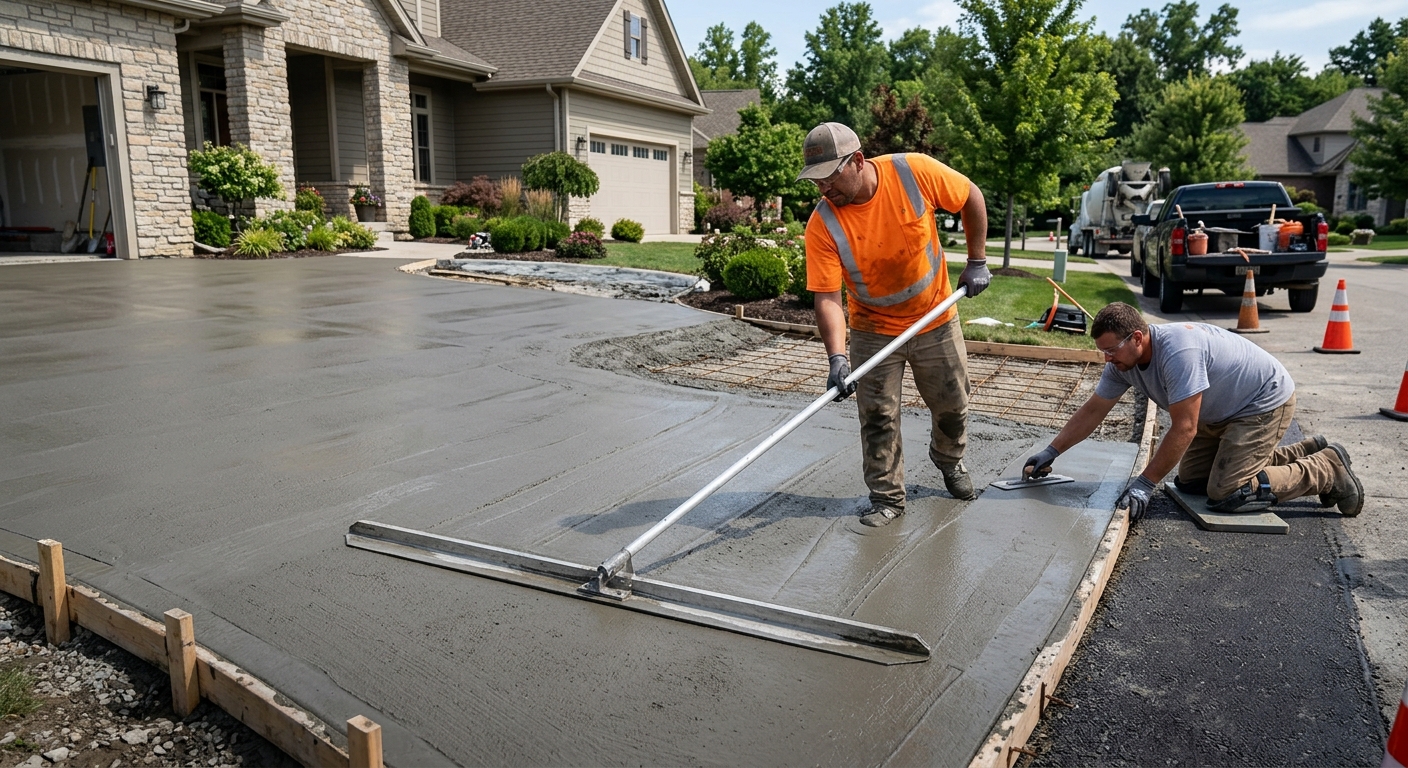
Concrete work options and costs in Pritchard
Pritchard is a small community (population 1,500 per the Statistics Canada, 2021 Census), and that shows up in concrete pricing: fewer large crews means scheduling windows can be tight, especially when contractors are juggling multiple jobs across the Lower Mainland–Southwest. Most local concrete flatwork is tied to residential construction—largely single-detached homes—and driveway and walkway upgrades are a common homeowner project in town. In the Lower Mainland–Southwest, mild winters and a shallow design frost line help keep some foundation specs leaner than interior or northern BC, but the wet climate and repeated freeze–thaw cycles still demand careful base preparation and drainage. In practice, we assume frost depth around 450 mm / 18" for typical design, then place footings and thickened edges below that to protect against frost heave.
Concrete costs in Pritchard also move with the realities of hauling and curing. Coastal rainfall and high humidity can slow curing, so crews often plan around cool nights and extended wet weather, using curing blankets, sealers, and longer cure times to reach design strength. That matters for exterior slabs like patios and driveways where surface durability is on the line (scaling and scaling-driven cracking are common complaints when jobs aren’t spec’d for air entrainment and jointing). In areas like the older residential pockets near downtown Pritchard, driveways and sidewalk replacements tend to be in higher demand because slopes and drainage issues show up after heavy rain.
Below is a practical comparison of typical sizes, specs and price bands so you can benchmark quotes before you choose a finish.
| Application |
Typical Size |
Key Spec |
Finish Option |
Price Range |
| Concrete driveway (standard broom finish) |
400–600 sq. ft. |
Engineered base + air-entrained mix, control joints |
Broom finish + saw-cut joints |
$18,000–$28,000 |
| Exposed aggregate driveway |
400–600 sq. ft. |
Air-entrained mix, proper retarder timing |
Exposed aggregate (brush/surface reveal) |
$22,000–$34,000 |
| Stamped concrete driveway or patio |
250–500 sq. ft. |
Air-entrained mix, stamped release + jointing plan |
Stamped pattern with sealer |
$22,000–$36,000 |
| Plain concrete patio or walkway |
150–300 sq. ft. |
Compacted granular base, air-entrained mix |
Float/trowel or light broom |
$16,000–$26,000 |
| Garage floor (interior slab) |
300–600 sq. ft. |
6–5.5" typical thickness, proper sub-base and vapour control where required |
Standard finish (steel trowel) or broom edge |
$14,000–$24,000 |
| Foundation footings (structural, below frost) |
Per linear metre |
Excavation + forms + rebar + concrete placed below design frost depth |
Structural concrete only (covered by engineering) |
$200–$350 |
Prices are estimates only and vary by project scope, site access and material selection.
What affects the price of concrete work in Pritchard
In the Lower Mainland–Southwest around Pritchard, it’s common to see 30–50% differences between quotes for what looks like the “same” concrete job. The reason is that concrete is mostly spec work: excavation depth, base build-up, drainage, reinforcement, mix design, finishing labour, and curing plan all change the real cost. One contractor may price to the minimum appearance, while another prices to durability—especially for our freeze–thaw cycles and persistent coastal moisture.
Frost line depth is the big driver. Even though coastal BC tends to have a shallow design frost line, exterior slabs and footings must be protected below that frost plane to prevent heave. All exterior slabs need an air-entrained concrete mix to survive freeze–thaw cycling and reduce scaling risk. In colder regions, crews also deal with a shorter pour season and pay for cold-weather curing precautions (heating, insulating blankets, longer cure times). In Pritchard, the rain-and-humidity side of the equation still matters: you may see added labour and material for weather control (blankets/sealers), and that can push an exterior pour closer to the upper end of the bands.
Two examples that commonly raise cost here: (1) a driveway or patio over saturated soils, where we need additional granular base and drainage grading to keep water from sitting under the slab; and (2) a stamped driveway, where the detailing and labour time go up because the pattern needs clean edges and consistent timing before sealing. If your scope is modest—say a plain patio near the low end of the $16,000–$26,000 band—you’ll usually avoid heavy reinforcement and complex finishing. If you’re upgrading to stamped concrete near the $22,000–$36,000 range, that extra cost is often justified by pattern labour, release materials, and sealing for durability.
| Price Factor |
Why It Matters |
Cost Impact |
| Frost line depth — determines footing depth and form height |
Footings and thickened edges must sit below the design frost depth to avoid frost heave |
Can swing footing scope and excavation time by hundreds or thousands |
| Site preparation — excavation, grading, compacted granular base |
Wet or soft subgrade needs a proper granular base and drainage grading |
Higher trucking/hand work can add significant labour and material cost |
| Reinforcement — rebar or wire mesh requirement |
Controls cracking and improves performance for exterior and heavier loads |
Adds material + tying/placing labour; changes placement plan |
| Mix design — air-entrainment and compressive strength spec |
Air entrainment helps resist freeze–thaw scaling; strength spec supports design load needs |
Costs more per yard but reduces early surface failures |
| Finish type — broom vs. stamped vs. exposed aggregate |
Finish labour and materials (forms, retarders, stamps, sealers) vary a lot |
Often moves you from mid-band to upper-band pricing |
| Pour size and concrete truck access to site |
Long carries and crane/pump needs increase labour and scheduling |
Access issues can add pump/crane fees and extra crew time |
| Cold-weather curing precautions — heating and blankets |
Maintains temperature for proper set and early strength gain |
Extra materials and time during shoulder-season weather |
| Control joint pattern and sealing cost |
Joints control cracking; sealer protects surface from moisture and de-icing salt effects |
More labour at the edges + added sealer material |
Permits & regulations in British Columbia
In British Columbia, structural concrete work—typically anything tied to the building’s structural system like footings, foundation walls, grade beams, and engineered foundation elements—generally requires a building permit, and engineered drawings are often reviewed by the municipality. Concrete flatwork (such as driveways, patios, and walkways) usually does not need a permit by default, unless it changes lot grading, affects stormwater/impervious surface coverage limits, or impacts municipal right-of-way requirements. Even when a permit isn’t required for the pour itself, it’s smart to confirm with the local authority before you break ground.
For Pritchard homeowners, use a simple verification sequence:
- Ask the contractor for their business/contractor licence details (and the correct permit responsibility, if engineering/structural work is involved).
- Request a certificate of insurance showing liability coverage, and confirm the policy is active for the dates of the job.
- Confirm worker coverage under WCB/WorkSafeBC (often via proof of clearance/coverage). If they’re not covered, the risk shifts to you.
- Collect references from projects of a similar scale (a driveway with drainage issues, for example, is different from an interior slab).
Before you schedule the pour, ask directly: “Who pulls the permit if this becomes structural or grading-related?” That one question prevents delays later.
Getting concrete right in Pritchard's freeze-thaw climate
Concrete failures in Pritchard are usually about water movement and temperature swings. When water gets under or through a slab and the material experiences freeze–thaw cycles, you can get scaling, surface spalling, and random cracking—especially if air content and jointing aren’t right. The good news is that the spec is predictable: the Lower Mainland–Southwest still uses a design frost depth around 450 mm / 18" and places exterior bearing and footings accordingly, but the coastal-wet environment means drainage and curing are just as important as depth.
To spec the job correctly, focus on five things. First, base preparation: use a compacted granular sub-base to the right depth for the local soil conditions and keep water from pooling. Second, mix design: specify an air-entrained concrete mix (typical target is 5–7% air content for exterior flatwork) and a minimum 32 MPa compressive strength so the concrete performs under freeze–thaw stresses. Third, control joints: saw-cut or form joints at appropriate spacing so cracks occur where you planned. Fourth, curing: plan for at least 7 days under proper conditions; when nights are cool and humidity is high, contractors may use curing blankets or other measures to protect early strength gain. Fifth, sealing: a penetrating sealer applied after cure helps repel moisture and supports durability against coastal rainfall and de-icing salt exposure.
A price example: if you’re choosing between a plain patio and a stamped option, the plain finish may land closer to the $16,000–$26,000 band, while stamped typically pushes toward the $22,000–$36,000 band. In many Pritchard projects, that extra cost is worth it only when the contractor also maintains the same durability specs (air entrainment, proper base, and joint pattern). A “pretty” slab with the wrong mix will cost more later in repairs.
| Spec |
Why It Matters in Pritchard |
What to Ask For |
Impact if Skipped |
| Compacted granular base (depth?) |
Prevents settlement and reduces water pressure under the slab in wet weather |
Confirm target base depth and compaction testing/verification method |
Premature cracking, pumping, and uneven surface |
| Air-entrained concrete mix (target air %?) |
Improves freeze–thaw resistance and reduces scaling/spalling |
Specify 5–7% air content for exterior flatwork |
Surface scaling and spalling after winter cycles |
| Compressive strength (MPa rating) |
Ensures early and long-term performance under loads and exposure |
Minimum 32 MPa compressive strength (as specified for exposure class) |
Reduced durability and higher chance of surface damage |
| Control joints (spacing per ACI guidelines) |
Controls where cracking happens as moisture and temperature change |
Ask for joint spacing plan and saw-cut timing |
Random cracking and wider, more visible defects |
| Minimum 7-day curing period |
Builds strength and improves long-term resistance in cool, humid conditions |
Confirm curing method and protection requirements during weather |
Lower strength gain and poor surface durability |
| Penetrating sealer (when applied after cure) |
Helps repel moisture and reduces risk of freeze–thaw surface deterioration |
Request penetrating sealer application after cure (often around day 28) |
Faster wear from rainfall, salts, and staining |
How to choose a concrete work contractor in Pritchard
Choosing the right contractor matters in Pritchard because your slab’s long-term performance depends on the details: drainage, base depth, air entrainment, jointing, and curing. Start by verifying British Columbia requirements the right way. Ask for their current proof of liability insurance (certificate of insurance) and confirm they have active WorkSafeBC coverage (WCB). If they have clearance letters or coverage documents, request them in writing. If they can’t provide them, that’s a major red flag.
Next, get 2–3 itemised written quotes. You want a labour + materials breakdown, not just a lump sum number. The quote should spell out excavation and disposal, base materials, reinforcement type, concrete mix spec (air entrainment and strength), thickness, joint plan, finish type (broom vs. stamped vs. exposed aggregate), curing methods, and whether sealing is included and when. Ask whether permit handling is included if grading changes or if any structural work is discovered or required.
For warranty, insist on clarity: what workmanship warranty length is offered, whether it covers labour and re-placement, and whether any product/manufacturer warranty applies to sealers or concrete admixtures. Confirm if the warranty is transferable if you sell the home. Finally, payment schedule should be sensible: never pay more than about 10–15% upfront. Hold back a portion until cleanup is complete and curing/finishing requirements are satisfied. Also get the start date and completion estimate in writing so you aren’t waiting through weather windows.
- Request concrete mix spec details: air entrainment target and minimum MPa strength.
- Ask for base depth and how the subgrade will be assessed.
- Confirm drainage plan (especially where water runs toward foundations).
- Verify reinforcement type (rebar vs wire mesh) and where it’s placed.
- Get the joint layout and saw-cut timing in the scope.
- Ask how rain and cool nights will be managed during cure.
- Clarify finishing method for your finish type (broom, stamp, exposed aggregate).
- Confirm if sealing is included and when (often after cure, not immediately).
- Require disposal and hauling listed separately.
- Check truck access plan; ask about pumping/short carries if needed.
- Review warranty terms in writing, including labour coverage.
- Confirm payment schedule and holdback amount before signing.
Concrete contractor red flags in Pritchard: vague mix specs (no mention of air content), no drainage or base prep details, skipping or postponing joints, avoiding written cure/sealer timelines, and asking for large upfront payments without a clear schedule.
Frequently asked questions — concrete work in Pritchard
How do I prepare the base for a concrete slab?
Base preparation in Pritchard starts with assessing the subgrade and controlling water. The goal is a stable, compacted granular sub-base to the depth required for your local soil and the slab thickness. For exterior flatwork, that also means shaping the grade so water sheds away from foundations, and installing drainage where needed so freeze–thaw cycles don’t pump moisture under the slab. A contractor should describe excavation, granular placement in lifts, and how compaction will be verified (not just “we’ll pack it down”). This is one of the biggest cost and durability differences behind quote variations across the Lower Mainland–Southwest. If you’re budgeting, base prep is part of why a driveway can land anywhere in the $18,000–$28,000 band depending on site conditions.
How do I compare concrete quotes?
When comparing concrete quotes in Pritchard, don’t compare only total dollars—compare what’s included. Ask for an itemised scope: excavation and disposal, granular base depth, reinforcement (rebar vs wire mesh), concrete thickness, concrete mix spec (air entrainment and minimum MPa), joint spacing plan, curing approach, and whether sealing is included. For exterior slabs, insist the quote references an air-entrained mix because our coastal-wet freeze–thaw cycles make scaling and spalling a real risk if air content is wrong. Also check access and whether truck pumping is assumed. A bid that’s $3,000 lower might be using less base prep or skipping reinforcement. For stamped work, compare whether the quote includes sealing and the correct finishing labour; stamped driveways often sit nearer the $22,000–$36,000 band because pattern work and sealing are part of the spec.
Can concrete be poured in cold weather in Pritchard?
Yes, concrete can be poured in cold weather in Pritchard, but it has to be managed. The Lower Mainland–Southwest generally has milder winters than interior BC, yet cool nights and damp weather can still affect early strength gain. In practice, contractors protect the pour with curing blankets or insulating measures when needed, and they may heat materials or the work area depending on forecast conditions. The key is curing and protection for at least 7 days under proper conditions so the concrete reaches expected strength. Don’t let a contractor rush form removal or allow de-icing or heavy traffic too soon. If you’re dealing with a shoulder-season schedule, ask how they’ll handle rain, temperature swings, and curing time. That planning is one reason winter pours can move toward the upper end of pricing bands, particularly for exterior slabs.
How do I maintain concrete in Pritchard's freeze-thaw climate?
Maintenance is mostly about keeping water off the surface and protecting the slab from moisture intrusion. In Pritchard’s freeze–thaw climate, cracks and joints are natural stress release points—so focus on joint condition and surface protection. Clean leaves and debris promptly so water doesn’t sit. Use de-icing sparingly and follow the contractor’s guidance; de-icing salt can accelerate spalling if the concrete isn’t properly air-entrained and sealed. For exterior flatwork, sealing is important: a penetrating sealer is typically applied after cure (often around day 28) to repel water and reduce staining. Re-check your downspout and drainage so water isn’t running toward the slab edges. If you see isolated scaling, address it early rather than waiting for the area to expand. Well-installed driveways and patios near the $16,000–$26,000 band for plain finishes can last many years when the sealing and drainage plan are followed.
What causes concrete to spall in Pritchard winters?
Spalling in Pritchard winters is usually tied to moisture + freeze–thaw, and it almost always traces back to the concrete spec and exposure details. The most common cause is inadequate air entrainment: if the mix doesn’t have the right air content for freeze–thaw resistance, water inside the concrete freezes and expands, damaging the surface and leading to scaling and spalling. Poor or shallow base prep can also contribute by letting water sit under edges, causing movement. Another contributor is curing problems: if the contractor doesn’t protect the pour in cool, damp weather, early strength gain can be insufficient, making the surface more vulnerable. Finally, aggressive de-icing without appropriate surface protection can worsen the deterioration. If you suspect spalling, review whether your contractor used air-entrained concrete, proper control joints, and a sealing plan after cure.
What is rebar and when is it required in British Columbia?
Rebar is steel reinforcing bar placed inside concrete to help resist cracking and improve structural performance, especially under tension. In British Columbia, whether rebar is “required” depends on the engineered design, slab type, soil conditions, and the loads the concrete must carry. For example, structural concrete elements like foundation footings and grade beams are typically engineered and will specify reinforcement placement and sizing. For exterior flatwork like driveways and patios, reinforcement may be specified based on thickness, base conditions, and design loads; sometimes contractors use wire mesh for simpler cases, but rebar is more common in heavier-duty applications or where engineering directs it. In Pritchard, the freeze–thaw environment makes it even more important that reinforcement and joints work together—reinforcement controls crack behaviour while joints control crack location. If you’re building or renovating near a foundation, ask your contractor to reference the design intent before deciding on reinforcement scope.