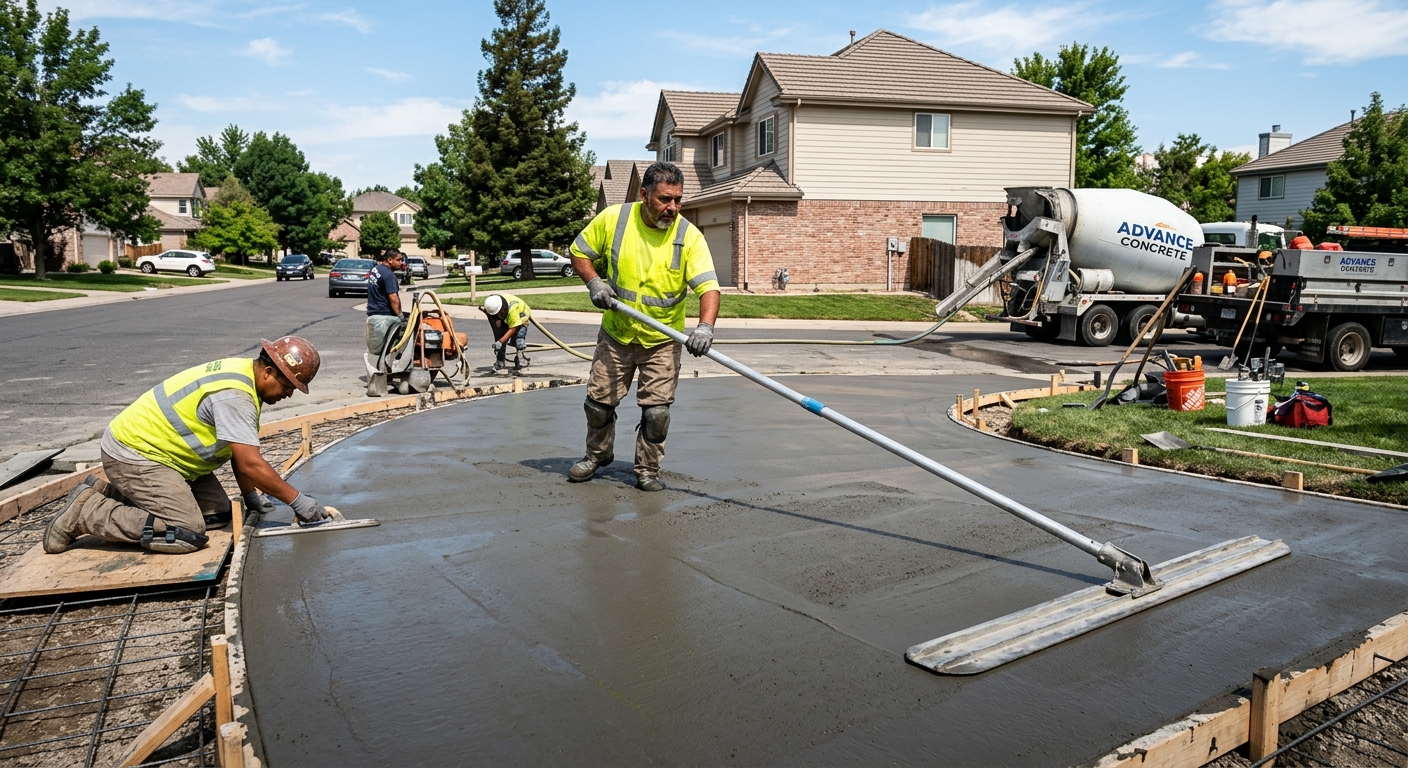
Concrete work options and costs in Cranbrook
Concrete work in Cranbrook is largely driven by the type of homes people own and how they maintain their lots. In the city and surrounding Kootenay communities, a big share of housing is single-detached—65.2% of dwellings—so driveways, patios and walkways are frequent projects, whether it’s a new build or a replacement after years of salt, snow storage and freeze–thaw movement. Homeownership is also common (73.5% of households own), which typically means longer planning horizons and a higher willingness to invest in proper base prep and air-entrained mixes.
Prices in Cranbrook can’t be separated from our climate. Cold continental winters and repeated freeze–thaw cycles push the frost line deeper than many homeowners expect, so footing and slab specs depend on local soil and drainage. That affects labour and materials because contractors often have to over-excavate, install properly compacted granular base, and control curing conditions. The short pour season also means scheduling pressure in the spring and fall, plus added cost for insulation blankets or heating when temperatures drop. In neighbourhoods like College Heights and parts of west Cranbrook where driveways are frequently tight-access and slope-sensitive, availability of experienced crews and the time needed for excavation/compaction can influence your final budget.
To help you budget accurately, here are realistic price ranges for common concrete options in Cranbrook, using the city’s local Kootenay market bands.
| Application |
Typical Size |
Key Spec |
Finish Option |
Price Range |
| Concrete driveway (standard broom finish) |
400 sq. ft. (e.g., 20 ft x 20 ft) |
Air-entrained mix; compacted base; control joints |
Broomed surface |
$7,200–$11,200 |
| Exposed aggregate driveway |
400 sq. ft. (e.g., 20 ft x 20 ft) |
Air-entrained mix; proper mix timing and curing |
Exposed aggregate (washed finish) |
$9,200–$14,000 |
| Stamped concrete driveway or patio |
300 sq. ft. (e.g., 15 ft x 20 ft) |
Air-entrained mix; reinforced where needed; stamping system |
Stamped patterns with release/border |
$8,700–$12,000 |
| Plain concrete patio or walkway |
200 sq. ft. (e.g., 10 ft x 20 ft) |
Air-entrained mix; compacted base; light finishing |
Float and broom/straight edge |
$2,800–$4,800 |
| Garage floor (interior slab) |
480 sq. ft. (e.g., 20 ft x 24 ft) |
Vapour control as required; reinforcement; 32 MPa target strength |
Steel trowel / broom edges as specified |
$10,800–$16,800 |
| Foundation footings (structural, below frost) |
Per linear foot varies (e.g., 40 ft total) |
Below frost depth; engineered sizing; rebar; proper inspection |
Structural concrete only |
$3,600–$7,200 |
Prices are estimates only and vary by project scope, site access and material selection.
What affects the price of concrete work in Cranbrook
In Cranbrook and across the Kootenays, it’s common to see quotes for the same concrete scope swing by 30–50% when you compare apples-to-apples. That gap usually comes down to how deeply contractors build the “system”: frost-depth excavation, drainage and compacted base, reinforcement, air-entrained concrete, and curing in cold weather. In British Columbia, contractors also price for logistics—truck availability, fuel costs, and how far they must travel between Cranbrook, Kimberley, Trail and Nelson—so labour and minimum job sizes can affect your unit cost even before you get to finish details.
Every exterior pour has to be designed around frost and freeze–thaw cycles. Footings must extend below local frost depth to prevent frost heave, and exterior slabs need air-entrained concrete so the surface doesn’t deteriorate into scaling and spalling. When the pour season is shorter, colder placement temperatures can force the contractor to add heated enclosures, curing blankets, and more controlled scheduling. Those precautions add labour and equipment time, which is why a standard broom driveway may fall closer to the $18–$28 per sq. ft. band, while stamped or exposed work climbs toward the higher end once forms, patterns, and tighter finishing schedules are included.
In Cranbrook specifically, a sloped site near the Kootenay River valley can drive up excavation and drainage work, while straightforward flat lots with good access may keep costs nearer to the lower bands. A driveway replacement over unknown fill can also change the price quickly—if the old base must be removed and hauled, you’ll pay for extra excavation and disposal before you ever pour.
| Price Factor |
Why It Matters |
Cost Impact |
| Frost line depth |
Determines footing depth and form height |
Can raise foundation/footing scope and concrete volume; increases excavation and labour |
| Site preparation |
Excavation, grading, compacted granular base |
Increases cost on soft/filled areas; straightforward sites reduce unit pricing |
| Reinforcement |
Rebar or wire mesh requirement |
Adds material and labour; needed more often for slabs under heavier loads |
| Mix design |
Air-entrainment and compressive strength spec |
Air-entrained exterior mixes and strength targets increase material costs |
| Finish type |
Broom vs. stamped vs. exposed aggregate |
Stamped/exposed adds labour and timing controls; commonly shifts you toward higher bands |
| Pour size and concrete truck access to site |
Impacts delivery, placement time and pumping needs |
Tight access or pump requirements can add crew time and equipment charges |
| Cold-weather curing precautions |
Heating and blankets |
Necessary for late-season pours; increases labour and equipment rental |
| Control joint pattern and sealing cost |
Controls cracking and extends service life |
Proper joint layout and sealing materials/labour add cost but reduce long-term repairs |
Permits & regulations in British Columbia
In British Columbia, the permit picture depends on what you’re building. Structural concrete work—things like footings, foundation walls, and grade beams—typically requires a building permit, and engineered drawings are often reviewed by the municipality and/or the building department as part of the foundation approval process. For those projects, the contractor should be aligned with the engineered design, inspections, and any required special inspections for reinforcement and placement.
Concrete flatwork—such as driveways, patios, sidewalks and walkways—often does not require a permit by default. However, it can trigger review if it affects lot grading, stormwater drainage, impervious surface coverage limits, or if any work comes near municipal right-of-way or affects how water is managed on the property. In practice, in Cranbrook, the safe approach is to confirm with the City of Cranbrook or the relevant local authority before you start breaking ground.
No matter the permit situation, verify your concrete contractor is properly insured and accountable. Start by checking their liability insurance certificate (request a current COI naming you as additionally insured where applicable) and confirm they carry the right coverage for workers (WCB coverage in BC). Then ask for references on similar Cranbrook projects—especially exterior slabs and winter-season pours. If any engineered or municipal requirements apply, ensure the contractor can clearly map what inspections they expect and when.
Getting concrete right in Cranbrook's freeze-thaw climate
Concrete failures in Cranbrook almost always trace back to the basics: poor base preparation, the wrong mix, weak/short curing, or skipping the joint/sealing system that manages movement. In a climate with frequent freeze–thaw cycles, water expands in pores and along micro-cracks—so a driveway that looks fine at first can scale and spall when de-icing salt hits a surface that wasn’t air-entrained or properly protected during curing.
To spec the job correctly, treat it like a system rather than a single material. First, base prep: confirm the contractor over-excavates to remove organic/unstable soils, then places and compacts a properly graded granular sub-base to the design depth for your soil conditions and frost considerations. Second, mix design: for exterior flatwork, ask for an air-entrained mix typically targeting about 5% to 7% air content and a minimum 32 MPa compressive strength. Third, control joints: spacing should be planned to reduce random cracking and to prevent joints from drifting into the wrong locations. Fourth, curing: even if the surface can be walked on, proper curing conditions matter—aim for at least 7 days, and in cold weather, expect insulating blankets or temporary heating so concrete can gain strength safely. Fifth, sealing: apply a penetrating sealer after the slab is fully cured (often around 28 days post-pour) to help repel de-icing salts.
As a dollar reality check, upgrading from a basic broom driveway toward an exposed aggregate finish can add cost, but when the contractor also improves base compaction and controls joints correctly, you’re paying for durability—not just appearance. If the quote is similar between options, the key question is whether both include the right air-entrained mix and winter curing precautions.
| Spec |
Why It Matters in Cranbrook |
What to Ask For |
Impact if Skipped |
| Compacted granular base (depth?) |
Provides stable support and drains water to reduce heave and cracking |
State excavation depth, base thickness, and compaction method/density |
Settlement and random cracking; faster surface deterioration |
| Air-entrained concrete mix (target air %?) |
Resists freeze–thaw damage and helps prevent spalling/scaling |
Air-entrainment target of about 5% to 7% for exterior flatwork |
Higher risk of spalling after salt and winter cycles |
| Compressive strength (MPa rating) |
Strength gain supports durability under traffic and thermal stresses |
Minimum 32 MPa target (as specified for the project) |
Weaker surface, increased wear and cracking |
| Control joints (spacing per ACI guidelines) |
Controls shrinkage cracking in a predictable location |
Ask for joint layout and spacing plan before scheduling the pour |
Random cracks that spread and allow water infiltration |
| Minimum 7-day curing period |
Strength development and reduced cracking when temperature swings |
Minimum 7 days under proper conditions; winter protection plan if cold |
Slower strength gain, increased cracking and surface scaling |
| Penetrating sealer (when applied after cure) |
Repels de-icing salts and reduces chloride ingress |
Penetrating sealer application after full cure (commonly around 28 days) |
Salt damage accelerates scaling and spalling |
How to choose a concrete work contractor in Cranbrook
Choosing the right contractor in Cranbrook is less about who has the lowest line item and more about who builds the cold-weather durability system correctly. Start with British Columbia compliance. Ask for their business licence/registration where applicable and verify their liability insurance certificate (COI) is current and covers the scope you’re hiring for. Then request proof of workers’ compensation coverage (WCB in BC) so you’re not left holding the risk if a worker is injured on your property.
Next, get 2–3 itemised written quotes. A fair quote should break out labour, concrete supply, reinforcement, excavation/granular base, forms, finishing materials, joint cutting, and any sealing or disposal/haul-away. Avoid “lump sum” estimates that don’t explain exclusions; they often hide surprises like pump fees, additional base removal, or unplanned grading corrections. Check whether permit pulls are included (for structural work) and what’s excluded, such as tree/root removal, mud hauling, or restoration of landscaping.
Warranty matters too. Ask for a workmanship warranty length, what it covers (usually cracking within the plan and surface defects), and whether the product/manufacturer warranty applies to the concrete/sealer system. Confirm if warranties are transferable if you sell your home—many homeowners in Cranbrook want peace of mind for long-term property value.
Finally, payment terms should protect you. Never pay more than 10–15% upfront; hold back an additional portion until the job is complete and cleaned. Request a written start date and completion estimate so weather delays and curing requirements (especially in shoulder season) are understood upfront.
- Request current liability insurance COI and verify the coverage limits match the project size.
- Confirm WCB coverage for workers (BC).
- Ask for 2–3 references in Cranbrook or nearby Kootenay communities with similar scope (driveways, patios, slabs).
- Get an itemised quote: excavation, base, reinforcement, concrete supply, finishing, joints, sealing, and disposal.
- Make sure the quote states the air-entrained mix and target compressive strength.
- Ask how they handle cold-weather pours: blankets, insulation, heating and curing plan.
- Confirm whether they include saw-cutting control joints on schedule.
- Verify reinforcement approach (wire mesh vs rebar) and where it’s placed.
- Check whether truck access/pumping is included or costed separately.
- Ask about drainage details (grading slopes away from the foundation) and any ditches/catch basins.
- Clarify the warranty and whether it covers labour and materials for workmanship.
- Review payment schedule: small deposit, then staged payments tied to milestones.
Concrete red flags in Cranbrook include: quotes that don’t mention air-entrainment or freezing/curing precautions; promises to “pour anytime” without a winter protection plan; missing or vague joint layout; no clear plan for base compaction and drainage; and requests for large upfront payments or refusal to provide an itemised written scope.
Frequently asked questions — concrete work in Cranbrook
How long does a concrete driveway last?
In Cranbrook, a well-built concrete driveway typically lasts 20 to 30 years, and sometimes longer, but the service life depends heavily on how the contractor handles freeze–thaw cycles and de-icing salt. The biggest durability drivers are a properly compacted granular base, air-entrained concrete for exterior exposure, and control joints cut at the right time and spacing. Sealing after the concrete cures (often around 28 days) helps reduce salt and water intrusion, which slows scaling and spalling. If a driveway was poured over weak fill or without adequate drainage, you may see early cracking or surface breakdown. Because 73.5% of households in the region own their homes (Statistics Canada, 2021 Census), many owners choose resurfacing or full replacement only after evaluating the full lifecycle cost—especially when they’ve experienced repeated winter damage.
What is air-entrained concrete and why does it matter here?
Air-entrained concrete is a mix designed with tiny, evenly distributed air bubbles that give expanding ice somewhere to expand. In British Columbia’s Kootenays, Cranbrook’s freeze–thaw cycles and the use of de-icing salt are hard on concrete. Without the correct air content (commonly about 5% to 7% for exterior flatwork), water in the paste and surface freezes and can crack/spall the surface over time. That’s why reputable contractors specifically mention air-entrainment and curing protection in their scope. It can also explain why two driveway quotes vary: an “economy” mix might look cheaper upfront but results in higher risk of early scaling. If you’re comparing options in the $18–$28 per sq. ft. driveway band, confirm the quote includes air-entrainment and the winter curing plan—not just the finishing style.
How do I prepare the base for a concrete slab?
Good base preparation is where durability is won or lost in Cranbrook. Start with excavation to remove unsuitable soils and establish the correct sub-base depth. The contractor should place a properly graded granular material (commonly crushed stone) and compact it in lifts to a consistent density. Compaction matters because concrete can’t “fix” soft spots later—settlement leads to cracking and trip hazards. Equally important is drainage: slopes should direct water away from buildings, and the area should be drained/managed so water doesn’t pool under the slab. Ask your contractor to describe the excavation depth they plan, how they’ll compact the base, and whether they’ll address drainage issues at the perimeter. If access is tight or the site is sloped (common in parts of Cranbrook), expect more time for grading and inspection, which can shift pricing within the typical patio and driveway bands.
How do I compare concrete quotes?
When comparing quotes for concrete in Cranbrook, treat every line item as part of the same durability system. Look for whether each quote includes: excavation and disposal (or not), base material type and compaction, reinforcement (rebar vs mesh and placement), and the concrete mix spec—especially air-entrainment and strength. Confirm finish scope too: broom, exposed aggregate, or stamped work each has different labour and timing requirements. Also check cold-weather curing provisions. A quote that’s lower but skips blankets/heating in shoulder-season conditions can cost more later. For a driveway example, compare projects in the $18–$28 range against a stamped option that typically costs higher (often aligning with $25–$40 per sq. ft. for stamped & decorative in this tier). Finally, make sure the joint cutting plan and sealing (if included) are spelled out so you can estimate long-term maintenance properly.
Can concrete be poured in cold weather in Cranbrook?
Concrete can be poured in cold weather in Cranbrook, but it requires the right protections and scheduling discipline. Cold conditions slow hydration, and the risk rises quickly if concrete is exposed to freezing before it reaches adequate strength. A competent contractor will include a cold-weather curing plan: insulating blankets or curing enclosures, sometimes heated enclosures, wind protection, and careful control of placement temperatures and mix adjustments. They should also coordinate timing so control joints and finishing are done at the right stages—not rushed. If your pour date is near freezing, ask how they protect the slab for at least the first week and what they’ll do if temperatures drop overnight. Skipping these steps is a common reason exterior flatwork fails early in freeze–thaw climates. The trade-off is cost: cold-weather precautions can push unit pricing toward the higher end of the local bands.
How do I maintain concrete in Cranbrook's freeze-thaw climate?
Maintenance in Cranbrook is about keeping water and salts from attacking the surface and joints. Start with cleaning: remove debris and sand build-up that can hold moisture against the slab. After the concrete is fully cured (often around 28 days), apply a penetrating sealer if your contractor recommends it—especially if you regularly use de-icing salt. Reapply as recommended by the sealer manufacturer, because once the surface protection wears down, salts and freeze–thaw damage accelerate. Inspect joints and edges in spring: if joints are opening or missing sealant, repairs should be made quickly to stop water infiltration. Avoid harsh scraping that gouges the surface. If you want a practical target, sealing and proper joint upkeep typically cost less than repairs after spalling. Given that the Kootenays have deep frost impacts and short shoulder-season curing windows, consistent maintenance is one of the most cost-effective ways to protect a driveway built within the $18–$28 per sq. ft. range.