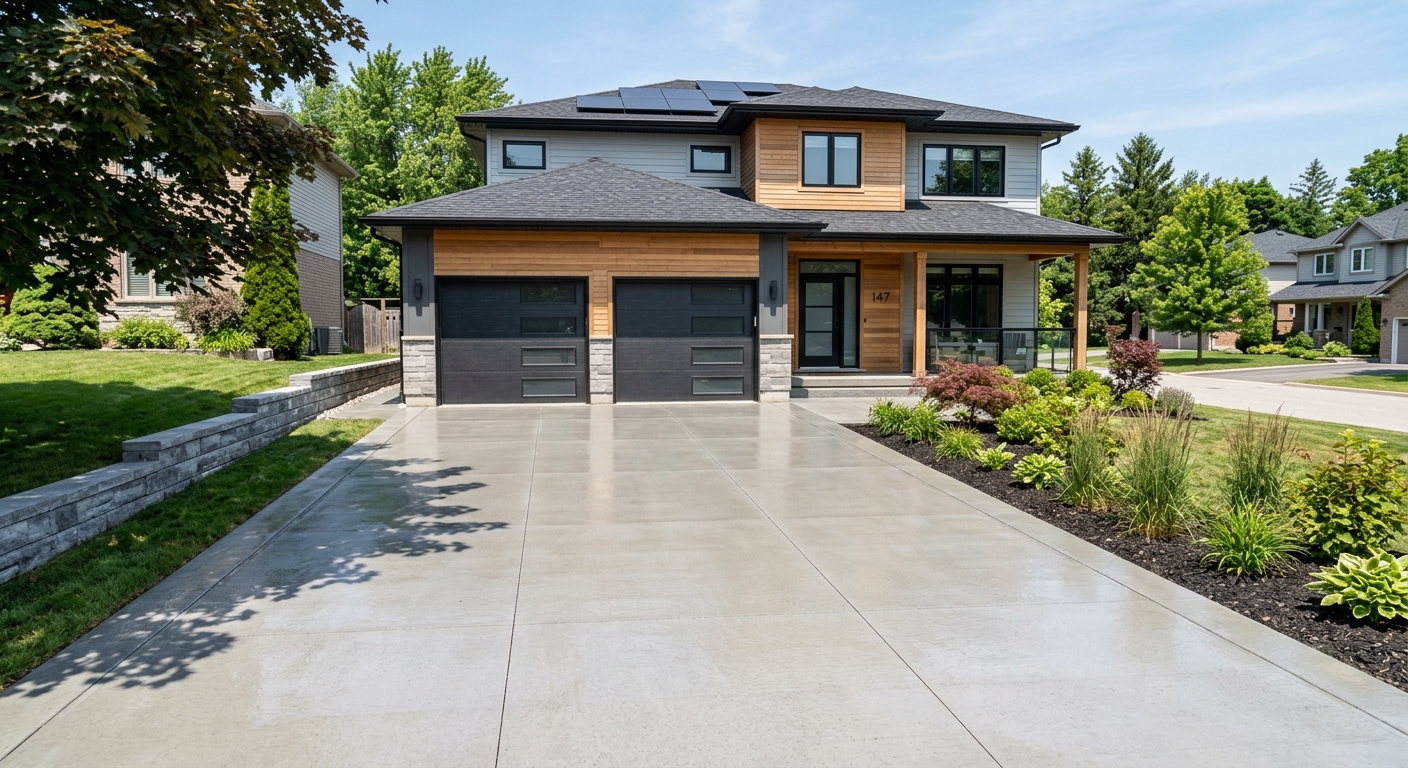
Concrete work options and costs in Gastown
Concrete work in Gastown typically includes driveways, patios and walkways for older Vancouver lots, plus structural footings and foundations for new builds. With Gastown sitting inside the Lower Mainland–Southwest, a lot of homeowners are choosing concrete for durability and low maintenance, and the broader region is home to 10,187 people in 2021 (Statistics Canada, 2021 Census)—a mix that supports steady trades availability but also competitive scheduling during dry stretches. In this area, you’ll also see a steady demand for flatwork on older residential stock and infill sites, where access lanes and tight forms can drive labour time.
Cost here is shaped less by extreme winter cold and more by our wet shoulder seasons and freeze–thaw cycles. Even with a frost depth target around 450 mm / 18", local practice still puts footings and thickened edges below that line to reduce frost heave risk. Base prep is usually engineered for drainage: compacted granular layers, attention to subgrade moisture, and air‑entrained mixes with proper control joints to manage cracking and surface scaling. Scheduling matters too—prolonged rain, cool nights and high humidity can slow curing, so contractors plan for curing blankets, sealers, and longer strength gain timelines.
In Gastown, concrete crews are especially busy around the core blocks near Water Street and the adjacent heritage streets where lane access is common. Next, compare the typical options and ranges so you can sanity-check a quote before the fine print.
| Application |
Typical Size |
Key Spec |
Finish Option |
Price Range |
| Concrete driveway (standard broom finish) |
300–400 sq. ft. (27–37 m²) |
Air‑entrained exterior mix; compacted granular base; control joints |
Broom finish, basic sealer |
$18,000–$28,000 |
| Exposed aggregate driveway |
300–450 sq. ft. (27–42 m²) |
Higher-tolerance mix and careful wash exposure; proper jointing |
Exposed aggregate, typically with sealer |
$22,000–$34,000 |
| Stamped concrete driveway or patio |
200–350 sq. ft. (19–33 m²) |
Air‑entrained mix; colour hardener; release agent; joint pattern |
Stamped pattern + colour |
$22,000–$36,000 |
| Plain concrete patio or walkway |
150–300 sq. ft. (14–28 m²) |
Sloped for drainage; air‑entrained exterior mix; control joints |
Float/smooth or light broom finish |
$2,500–$6,500 |
| Garage floor (interior slab) |
400–600 sq. ft. (37–56 m²) |
Vapour barrier and proper base; reinforcement as required |
Smooth/steel-trowel or lightly textured |
$18,000–$28,000 |
| Foundation footings (structural, below frost) |
Varies by house footprint and engineering |
Excavation, formwork, rebar and concrete to below frost depth |
Structural concrete only (not decorative) |
$200–$350 |
Prices are estimates only and vary by project scope, site access and material selection.
What affects the price of concrete work in Gastown
Even when two contractors quote the “same” concrete size, the total can swing by 30–50% across the Lower Mainland–Southwest and the wider British Columbia market. The main reason is that exterior concrete isn’t just poured—it’s engineered around frost protection, drainage, mix design, reinforcement and curing conditions. In colder regions of BC or projects with deeper excavation needs, those inputs cost more; in the Lower Mainland they’re still required, but your schedule and base conditions often become the cost differentiator. That’s why a broom-finish driveway can land near the region’s $18–$28 range per sq. ft.-equivalent, while a stamped or exposed job jumps toward the $22–$36 range once labour-intensive finishing and colour systems are included.
Specifically for Gastown, frost line depth and freeze–thaw cycles dictate every exterior detail. Footings must extend below the local design frost depth (our coastal target is around 450 mm / 18"), and air‑entrained concrete is expected for exterior slabs to survive repeated wetting and drying with winter cycles. When jobs are scheduled during cooler, rainier weeks, cold-weather curing precautions—blankets, heaters and time—add cost. Also, de-icing salts (where used) can accelerate surface spalling if the mix and air content aren’t right, which is why a quality sealer is commonly budgeted for longevity.
Two common examples from Gastown: (1) If your site has soft fill or poor drainage, excavation and granular replacement can push the job toward the higher end; (2) tight lane access near Water Street can add hours for wheelbarrowing, forming and traffic control. By contrast, a straightforward patio with good access and solid compacted base may come in closer to the lower end—especially compared with stamped work that needs longer prep, colour application and finishing time.
| Price Factor |
Why It Matters |
Cost Impact |
| Frost line depth — determines footing depth and form height |
Footings and thickened edges must sit below design frost to reduce heave risk |
More excavation and rebar/height increases material and labour; can move price by tens of percent |
| Site preparation — excavation, grading, compacted granular base |
Drainage and compaction control settlement and slab cracking |
Soft spots and granular replacement add equipment time; raises overall quote |
| Reinforcement — rebar or wire mesh requirement |
Improves crack control and structural capacity for driveways and garage slabs |
Extra steel, chairs/ties and installation time |
| Mix design — air‑entrainment and compressive strength spec |
Air-entrainment helps resist freeze–thaw scaling and spalling |
Higher-spec concrete and testing/quality control can increase material costs |
| Finish type — broom vs. stamped vs. exposed aggregate |
Complex finishes require more labour, materials and curing coordination |
Stamped/exposed often adds the biggest difference; labour-heavy |
| Pour size and concrete truck access to site |
Short access lanes can slow placement and require chutes or staging |
More labour hours and equipment; sometimes additional minimums |
| Cold-weather curing precautions — heating and blankets |
Ensures strength gain and reduces early-age cracking |
Blankets/heaters and added supervision time |
| Control joint pattern and sealing cost |
Joints guide cracking; sealing improves durability against wetting and salts |
More labour details plus materials; usually small compared to the cost of repairs |
Permits & regulations in British Columbia
In British Columbia, structural concrete work—think foundation walls, grade beams and engineered footings—usually requires a building permit, and many projects rely on engineered drawings that the municipality reviews. Concrete flatwork like patios, walkways and standard driveways typically does not require a permit by default, unless it affects lot grading, drainage plans, or municipal requirements tied to impervious surface limits or right-of-way conditions. For Gastown projects, the safest approach is to confirm before you excavate, especially when you’re changing drainage flows near lanes or adding new impermeable surfaces.
Step-by-step, here’s how a homeowner should verify the contractor before signing:
- Check contractor licensing/registration in British Columbia through the appropriate provincial online registry (use the company legal name exactly as on the quote).
- Request a certificate of insurance (liability) and confirm it covers concrete placement activities and the project address.
- Confirm WSIB/WCB coverage status (or the applicable coverage proof your contractor uses in BC). Don’t accept “we’ll be fine”—ask for documentation.
- Ask for references on similar-scale concrete jobs in the Lower Mainland–Southwest (driveway/patio with freeze–thaw conditions).
- For permit-required structural work, ask who is responsible for permit applications and what inspections are included.
If the contractor can’t clearly show insurance and coverage documents, or they won’t explain whether a permit is required for your specific scope, pause the project and get a second written answer.
Getting concrete right in Gastown's freeze-thaw climate
Concrete failures in Gastown are usually preventable if you spec the job for our “coastal-wet” reality: saturated soils, frequent freeze–thaw cycles, and long periods of cool, humid curing. The top causes I see are spalling and surface scaling from insufficient air-entrainment, settlement from poor base prep, and uncontrolled cracking from missing or incorrectly spaced control joints. The cure is not “better luck”—it’s correct construction sequencing and materials.
To spec correctly, focus on five items. (1) Base preparation: use compacted granular sub-base to the right depth for your soil and frost protection details, with drainage attention so water doesn’t stay trapped beneath the slab. (2) Mix design: exterior flatwork should be air‑entrained (commonly targeting about 5–7% air content for exterior durability) and meet a minimum compressive strength such as 32 MPa for typical engineered expectations. (3) Control joints: plan the joint layout so cracking happens where it can be managed, not randomly. (4) Curing: plan for at least 7 days of proper curing conditions—cool nights and rain mean you may need blankets or seal-curing strategies to keep strength gain on track. (5) Sealing: apply a penetrating sealer after the cure is complete (often at about 28 days) so de-icing salts and moisture don’t attack the surface.
Ask the contractor directly how they will prevent spalling. If air-entrainment is skipped or assumed, you may save in the short term but pay later. For a practical comparison, stamped concrete often costs more because of added labour and materials; if your driveway is close to the region’s $18–$28 range for broom finish, choosing stamped (often trending toward the $22–$36 band) is usually justified when you want appearance upgrades and are willing to pay for the extra finishing care and scheduling. If your priority is durability, a well-built plain broom or exposed job can deliver excellent performance without the stamp labour.
| Spec |
Why It Matters in Gastown |
What to Ask For |
Impact if Skipped |
| Compacted granular base (depth?) |
Limits settlement and supports freeze–thaw drainage and stability |
Granular depth and compaction testing plan based on your site soil |
Uneven settling, cracking, early surface deterioration |
| Air-entrained concrete mix (target air %?) |
Protects against freeze–thaw scaling and spalling in exterior exposure |
Air-content target (typically 5–7% for exterior flatwork) and confirmation in mix ticket |
Higher risk of spalling and scaling after wet winters |
| Compressive strength (MPa rating) |
Ensures durability and adequate early/long-term strength gain |
Minimum 32 MPa (or project-specific spec) and curing steps |
Soft or weak surface, increased abrasion and cracking |
| Control joints (spacing per ACI guidelines) |
Directs cracking into planned locations |
Joint layout drawing and spacing plan for your slab dimensions |
Random cracking that’s harder to repair and uglier to patch |
| Minimum 7-day curing period |
Cold nights and humidity can slow strength development |
What curing method is used when it’s cool/rainy; minimum curing time |
Reduced strength, surface damage and premature wear |
| Penetrating sealer (when applied after cure) |
Helps repel moisture and reduces attack from de-icing salts |
Sealer type and application timing (commonly after cure, around 28 days) |
Faster scaling and staining, shorter lifespan for exterior slabs |
How to choose a concrete work contractor in Gastown
Choosing a contractor in Gastown is about more than “lowest price.” Start with British Columbia licensing and coverage: ask for proof of liability insurance and WSIB/WCB coverage (or the applicable coverage evidence used for the work). In practice, I recommend you verify by (1) checking the company name matches the documentation, (2) confirming the policy is active for the work period, and (3) ensuring the coverage aligns with contractor activities such as excavation and concrete placement. If they can’t provide current documents quickly, that’s your first red flag.
Next, get 2–3 itemised written quotes. The best quotes break down labour and materials separately (concrete supply, rebar/wire mesh, granular base, forming, finishing, saw-cutting, disposal) rather than one lump number. Ask what’s included for disposal and protection of your property, and confirm whether permit pulling (when required) is included or billed separately.
Read the scope line-by-line: do they specify air‑entrained mix, control joint pattern, curing method and sealing timing? A serious contractor will put these items in writing. For warranty, ask for both workmanship warranty length and whether any product/manufacturer warranty applies to sealers, admixtures or other components—and if it’s transferable to you as the homeowner. For payment schedule, never agree to pay more than about 10–15% upfront; hold back the final portion until the job is complete, cleaned and sealed per scope. Finally, request a start date and a completion estimate in writing—rain and cool curing conditions can shift schedules, but a professional should manage that with a plan.
- Confirm British Columbia licensing/registration matches the company name on the contract.
- Request certificates: liability insurance + WSIB/WCB coverage proof (not just verbal confirmation).
- Ask for at least two recent references for similar Gastown/LVP access work (lane placement, tight forms).
- Insist on a written scope that mentions frost-depth considerations and air‑entrained exterior mix.
- Get an itemised estimate: excavation/granular/rebar/concrete/finishes/disposal/curing/sealer.
- Verify how control joints will be laid out (location and spacing) before concrete is poured.
- Ask what happens in rain/cold weather: blankets, curing plan, and minimum cure time.
- Confirm finishing specs (broom vs stamped vs exposed aggregate) and included sealing plan.
- Check whether saw-cutting is included on schedule (not “sometime later”).
- Review warranty terms in writing: workmanship coverage and what voids it.
- Agree on payment terms: 10–15% max upfront, holdback until completion and punchlist.
- Ensure jobsite protection is included (surface protection, cleanup, and debris hauling).
Concrete contractor red flags in Gastown: promises of “standard mix” with no air-content mention, vague curing/sealing timelines, no detailed joint/layout plan, refusal to provide insurance/coverage documentation, and estimates that won’t break down labour versus materials (so you can’t tell what you’re actually paying for).
Frequently asked questions — concrete work in Gastown
What is the difference between concrete and cement?
In British Columbia (including Gastown), the term “cement” usually refers to Portland cement—the powder component that reacts with water. “Concrete” is the full engineered mix: cement plus water, sand, gravel (or other aggregates), and often admixtures. For exterior work in our Lower Mainland–Southwest freeze–thaw conditions, the concrete mix design is what matters most: air‑entrainment helps the slab resist scaling and spalling during wet winters and cold snaps. That’s why a quote should specify air‑entrainment and strength, not just “cement brand” or a generic mix label. If a contractor only talks about cement but can’t explain the full concrete mix and curing plan, you’re missing the durability controls that keep exterior slabs performing.
How much does concrete work cost in Gastown?
Concrete pricing in Gastown depends on finish, base prep, reinforcement and site access. For a quick homeowner benchmark in the Lower Mainland–Southwest: driveways and slabs often trend around $18–$28 for standard concrete work, while stamped and decorative finishes commonly land around $22–$36 due to extra labour and materials. If you’re budgeting a typical plain patio or walkway, you’ll often see ranges anchored by the $16–$26 band for that category. Site conditions can shift the total: poor drainage or soft subgrade can raise excavation and granular replacement costs, and tight lane access near central Gastown can increase labour time for forming and placement. A careful, itemised quote is the best way to confirm whether you’re paying for durable base prep and correct freeze–thaw specs.
How deep must footings be for Gastown's frost line?
Gastown falls under the Lower Mainland–Southwest practice where the design frost depth is typically assumed around 450 mm / 18". In real projects, structural footings and thickened edges are placed below that design frost depth to reduce the risk of frost heave. The exact depth can vary based on soil conditions and the engineered foundation requirements for your structure, but the key point is that contractors should not rely on “surface depth” alone—footings must be formed at the proper below-frost elevation. If your contractor is estimating without referencing frost protection and soil conditions, that’s a concern. In all cases, structural concrete work in BC should follow permit and engineered drawing requirements for your foundation system, and your excavation should match the stated design depth.
Why does concrete crack in Gastown and how is it prevented?
Concrete cracks aren’t automatically a failure in British Columbia—some cracking is expected—but you want it controlled. In Gastown, freeze–thaw cycling plus wet soils can contribute to movement, and temperature changes can shrink exterior slabs slightly after finishing. The prevention strategy is built into the spec: a properly compacted granular base reduces settlement, control joints tell the slab where to crack, and air‑entrained concrete improves resistance to freeze–thaw scaling. Curing also matters; if the slab cures too slowly or is exposed to harsh early conditions, the surface can be weaker. Sealing further helps durability when moisture and de-icing salts are involved. The right joint spacing and air content are usually the biggest protections against the cracking pattern and spalling homeowners notice after a few winters.
Stamped vs broom-finish concrete — cost difference?
Stamped concrete costs more than broom-finish because it’s more labour-intensive and requires additional materials. In the Lower Mainland–Southwest, broom-finish concrete driveways typically sit around the $18–$28 range, while stamped concrete projects often trend toward the $22–$36 band due to colour systems, release agents, texture mats, and longer finishing time. Stamping also needs more careful scheduling because the slab must be finished and worked at precise timing windows to avoid defects. That said, stamped isn’t automatically better durability-wise—durability depends on the base prep, air‑entrained mix, control joints and curing. If you mainly want strength and longevity, broom finish can be the more cost-effective choice; if curb appeal is a priority, stamped can be worth the premium when the contractor specifies the same exterior durability requirements.
When is the best time to pour concrete in Gastown?
The “best time” is less about a single month and more about conditions for curing. In Gastown and the Lower Mainland–Southwest, prolonged rain, high humidity and cool nights can slow strength gain and increase risk for early surface issues. Many crews prefer to pour when temperatures are stable enough to support proper curing methods and when the site can stay protected during the initial days. In cooler periods, contractors should plan for cold-weather precautions like curing blankets and better temperature management so the slab reaches the needed strength—this affects cost and schedule. A reputable contractor will explain the minimum curing timeline (often at least 7 days under proper conditions) and how they’ll handle rain events. Always ask for the curing plan in writing before booking a pour.