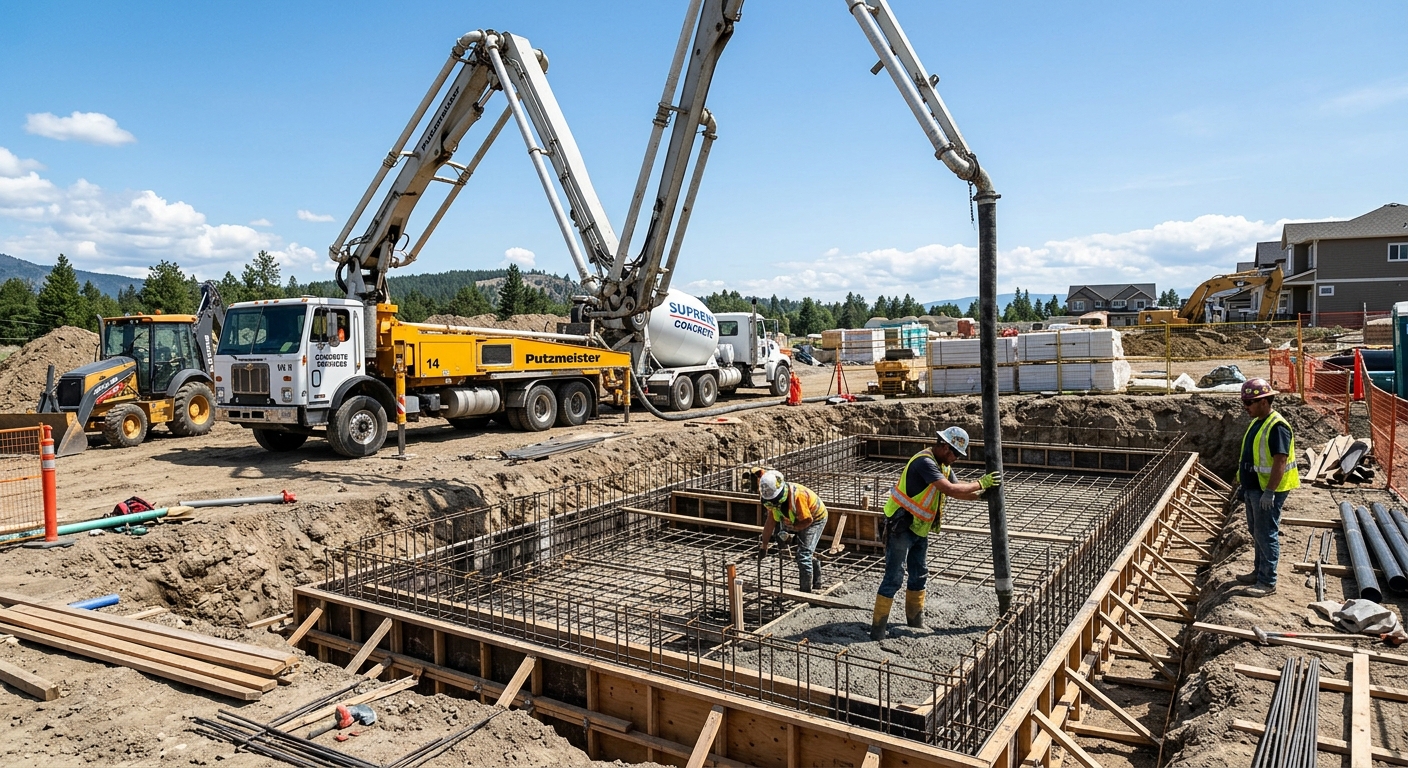
Concrete work options and costs in Glenwood
In Glenwood, British Columbia, most concrete flatwork is built for real-life wear: wet winters, occasional freeze–thaw cycles, and heavy rain that stresses drainage. With a population of 11,437 (Statistics Canada, 2021 Census), the area’s ongoing family housing demand means driveways, patios, and walkways are a constant part of residential projects—especially in neighbourhoods like the West Glenwood residential pockets where older homes commonly get refreshed landscaping and hardscapes.
Lower Mainland–Southwest pricing is shaped by a shallow-but-serious frost depth assumption (commonly around 450 mm / 18") and the need to manage saturated subgrades. Even with mild winters compared to interior or northern BC, we still design exterior slabs and footings to reduce freeze–thaw damage: compacted granular base, air-entrained mixes, proper control joints, and curing practices timed around cool nights and rain. That’s why contractor availability and scheduling can swing prices—jobs that require more excavation, longer cure windows, or extra protection from weather typically cost more.
Market variation also comes from finish and engineering choices. For example, upgrading from a plain broom finish to exposed aggregate adds surface prep and different finishing time. Stamped concrete costs more up front, but the best results depend heavily on base quality and jointing so the texture doesn’t amplify cracking. Use the comparison below to set expectations before you request itemised quotes.
| Application |
Typical Size |
Key Spec |
Finish Option |
Price Range |
| Concrete driveway (standard broom finish) |
10 m x 3.5 m (35 m²) |
Air-entrained exterior mix, control joints, compacted granular base |
Broomed surface |
$18,000 – $28,000 |
| Exposed aggregate driveway |
10 m x 3.5 m (35 m²) |
Air-entrained exterior mix, properly graded base for drainage |
Retarder + wash/expose finish |
$22,000 – $34,000 |
| Stamped concrete driveway or patio |
8 m x 4 m (32 m²) |
Air-entrained mix, deeper attention to joint layout |
Stamped pattern + release + seal |
$22,000 – $36,000 |
| Plain concrete patio or walkway |
6 m x 3 m (18 m²) |
Exterior mix, compacted base, edging and joints |
Float/trowel with broom or light texture |
$16,000 – $26,000 |
| Garage floor (interior slab) |
20 m² (e.g., 5 m x 4 m) |
Thickness per load, vapour control as needed, steel reinforcement |
Powder-finish / light trowel |
$10,000 – $18,000 |
| Foundation footings (structural, below frost) |
Varies (e.g., 40–60 m lineal length) |
Engineered layout, excavation to below design frost depth, reinforcement |
Structural concrete |
$8,000 – $21,000 |
Prices are estimates only and vary by project scope, site access and material selection.
What affects the price of concrete work in Glenwood
In Glenwood and across the Lower Mainland–Southwest region, the same concrete job can land 30–50% apart between quotes. The biggest reasons are foundation design depth, base prep effort, and how contractors handle weather-driven curing windows. Even though coastal BC is milder than interior provinces, the region still relies on a frost depth concept (often ~450 mm / 18") and protects from freeze–thaw cycling and heavy rainfall saturation. In practice, that means footings, thickened edges, and exterior slab build-ups are chosen to resist frost heave, not just to “look level.”
Concrete also varies by season. Cold or wet scheduling can force crews to use curing blankets, sealers, and sometimes add protection measures to keep concrete on track to reach design strength—extra labour and time that can push costs up. Another cost lever is mix design: exterior slabs need air-entrained concrete so the surface doesn’t scale or spall after repeated wetting and cooling. When de-icing salt is used (common on driveways during winter), sealing becomes more important and adds line-item cost.
Two common Glenwood examples that move the price: (1) a driveway on saturated or poorly drained soil usually needs more granular removal/replace and careful subgrade drainage, not just topsoil grading; (2) a stamped or exposed-aggregate finish is only worth it when the base and joints are engineered—otherwise the risk of visible cracking rises. If you’re choosing between a plain patio or walkway at roughly $16–$26 per square metre and a stamped driveway at around $22–$36 per square metre, the higher finish price is justified when drainage and jointing are done correctly from day one.
| Price Factor |
Why It Matters |
Cost Impact |
| Frost line depth — determines footing depth and form height |
Footings must sit below design frost exposure to reduce heave |
Higher excavation depth can increase labour and concrete volume significantly |
| Site preparation — excavation, grading, compacted granular base |
Compaction and drainage control long-term settlement and cracking |
Extra haul-away, granular replacement, and compaction time can add cost |
| Reinforcement — rebar or wire mesh requirement |
Helps control cracking under loading and shrinkage |
Material and placement labour varies by slab thickness and use |
| Mix design — air-entrainment and compressive strength spec |
Exterior durability depends on air content for freeze–thaw resistance |
Correct mix may cost more but prevents early scaling/spalling |
| Finish type — broom vs. stamped vs. exposed aggregate |
Complex finishes require more labour, tools, and timing |
Stamped/exposed finishes typically add a premium |
| Pour size and concrete truck access to site |
Access affects pumping/placement time and crew size |
Pump fees, longer carry, and traffic control can raise the price |
| Cold-weather curing precautions — heating and blankets |
Cool nights slow strength gain; proper protection is required |
Heating blankets and extra monitoring increase labour cost |
| Control joint pattern and sealing cost |
Joints manage cracking; sealing helps repel water and de-icing salts |
Higher quality jointing and sealers add line items but reduce future defects |
Permits & regulations in British Columbia
In British Columbia, structural concrete work generally requires a building permit, often with engineered drawings reviewed by the municipality. That typically includes concrete footings, foundation walls, grade beams, and other structural elements that support the house or transfer loads. For concrete flatwork—patios, walkways, and most driveways—permits are usually not required unless the project affects lot grading, changes drainage in a way that triggers municipal requirements, or interacts with impervious surface coverage and right-of-way conditions. Because Glenwood is within the Lower Mainland–Southwest planning context, it’s smart to confirm the exact threshold and any paperwork needs with the local authority before excavation.
Before breaking ground, verify the contractor carries liability insurance and has proper coverage for workers (commonly WSIB/WCB coverage depending on the company structure). Step-by-step, you can confirm legitimacy and readiness:
- Check the contractor’s business credentials/registration through the appropriate provincial licensing information (your contractor’s quote should include their company details).
- Request a certificate of insurance (COI) and confirm it covers the work, the project site, and is current.
- Ask for evidence of worker coverage (WSIB/WCB) and verify it matches the contractor’s legal business name.
- Request references with similar-scale concrete flatwork in BC’s wet coastal climate—look for photo dates from winter performance, not just fresh pours.
- Confirm whether a permit is included in the price for structural work and who pulls it.
Getting concrete right in Glenwood's freeze-thaw climate
Concrete failures in Glenwood typically start with water and timing. When base preparation is shallow or improperly drained, water saturates the subgrade. Then repeated freeze–thaw cycles expand and contract the soil and near-surface paste, leading to cracking, scaling, and in worse cases spalling. The correct spec isn’t only about “using concrete”—it’s about building the slab for our Lower Mainland–Southwest conditions: compacted granular base for consistent support, exterior air-entrained mix (often 5–7% air content), and a disciplined control-joint plan.
To spec the job correctly, start with base prep: excavate to the required depth and place compacted granular material to the thickness needed for your soil and frost exposure strategy. Next is mix design. For exterior flatwork, ask for air-entrainment and a minimum 32 MPa compressive strength so the slab can resist weathering. Control joints matter because random cracking is more likely if the joint pattern is delayed or too far apart. Curing is also critical in Glenwood—minimum 7 days in proper conditions, and in cooler periods, protection like curing blankets to maintain temperature and moisture. Finally, consider sealing: a penetrating sealer applied after the concrete has cured (commonly at 28 days) helps repel de-icing salt and reduces freeze–thaw damage at the surface.
On cost: upgrading finish is often the first thing people notice, but the real value is durability. A stamped patio may cost more than a plain broom-finished patio (for example, stamped at roughly $22–$36 per square metre vs. plain at $16–$26), and that premium only makes sense when jointing and drainage are done right. If joints are poorly planned or air-entrainment is skipped, the cheaper option becomes expensive later through repairs.
| Spec |
Why It Matters in Glenwood |
What to Ask For |
Impact if Skipped |
| Compacted granular base (depth?) |
Supports the slab and limits water infiltration during wet/cool periods |
Depth and material type for your soil + required compaction method/testing |
Settlement, uneven cracking, and accelerated surface deterioration |
| Air-entrained concrete mix (target air %?) |
Provides freeze–thaw durability in exterior exposure |
Target air range (commonly 5–7% for exterior flatwork) on the mix ticket |
Scaling/spalling risk rises after winter wetting and cooling |
| Compressive strength (MPa rating) |
Ensures strength gain under our schedule and curing realities |
Minimum 32 MPa (or higher if engineered for the project) |
Reduced durability and potential early cracking/weak surfaces |
| Control joints (spacing per ACI guidelines) |
Controls where cracks happen during shrinkage and thermal movement |
Joint layout plan: spacing, timing, and sawcut vs. formed joints |
Random cracking that can telegraph through finishes |
| Minimum 7-day curing period |
Cold nights and coastal humidity can delay strength gain |
How curing will be maintained and what happens if rain/cold slows progress |
Higher permeability and weaker surface prone to weather damage |
| Penetrating sealer (when applied after cure) |
Helps repel moisture and de-icing salts at the surface |
Application timing after full cure (commonly around 28 days) and sealer type |
Faster deterioration and more staining or surface scaling |
How to choose a concrete work contractor in Glenwood
Choosing the right contractor in Glenwood starts with verification, not just pricing. In British Columbia, you should confirm three things: (1) licensing/authorization to perform the type of work being quoted, (2) liability insurance, and (3) proper worker coverage (WSIB/WCB depending on the contractor). How to check each: request a COI and verify the project is covered and the policy is active; confirm the contractor’s legal company name matches the COI; and ask for evidence of worker coverage before work begins. If a contractor can’t provide documents quickly, that’s a red flag for schedule and workmanship risk.
Then get 2–3 itemised written quotes. Avoid “lump sum only” numbers—ask for a breakdown that shows labour, concrete supply, base prep, reinforcement, forms, disposal/haul-away, finishing, and sealing (if included). Scope clarity matters: does the quote include permit pulls (for structural work), sawcutting, joint filler, protection during curing, and any pumping or traffic control if truck access is tight? Also ask about exclusions like removal of old concrete and restoration of landscaping.
Warranty should be in writing. Look for a workmanship warranty period and whether product/manufacturer warranties apply to sealers or specialty admixtures. Payment should be conservative: never pay more than 10–15% upfront, and hold back until key milestones are complete and surfaces are accepted. Finally, insist on a start date and completion estimate in writing so weather delays don’t become a surprise.
- COI provided before any schedule is locked
- Worker coverage evidence (WSIB/WCB) matching the contractor’s legal name
- Clear permit responsibility: structural work vs flatwork
- Itemised base prep: excavation depth, granular material, compaction approach
- Mix specification: air-entrainment and minimum compressive strength
- Reinforcement details: where mesh/rebar is placed and slab thickness
- Joint plan: spacing, sawcut/formed timing, and joint filler type
- Curing method and weather contingencies (blankets/sealer schedule)
- Finish plan: broom/exposed/scheduled stamping process and sealing coverage
- Disposal/haul-away included or clearly excluded
- Truck access plan: pumping/carry and any additional fees
- Warranty terms and what “service call” coverage includes
Concrete-specific red flags for Glenwood contractors: vague “standard concrete” without air-entrainment details, no joint layout included in the quote, base prep described as “top up” instead of proper granular compaction, skipping curing protection during cool/rainy weeks, and refusing to itemise sealing or curing-related work where it affects durability.
Frequently asked questions — concrete work in Glenwood
How long does a concrete driveway last?
In Glenwood, a well-built concrete driveway commonly lasts 25 to 40 years, but it depends heavily on base preparation, drainage, and exterior mix design. The Lower Mainland–Southwest climate brings frequent wetting and periodic freeze–thaw, which means air-entrained concrete and a proper joint pattern aren’t optional. A driveway finished with broom texture can perform very well when the base is compacted correctly and curing is protected. Sealing after the slab cures (often around 28 days) helps repel moisture and de-icing salts, which otherwise can speed up surface scaling.
Cost plays a role in how durable the build is. For example, if you’re comparing a standard broom-finished driveway at roughly $18–$28 per square metre versus a premium option like stamped concrete at about $22–$36 per square metre, the higher finish cost is only worthwhile when the same durability spec—air-entrainment, joints, and curing—comes with it. A cheaper surface without the correct spec can fail early.
What is air-entrained concrete and why does it matter here?
Air-entrained concrete includes tiny, evenly distributed air bubbles in the mix. In Glenwood and across the British Columbia coast, those microscopic air voids give freeze–thaw cycles a place to expand—reducing pressure in the cement paste. That directly impacts exterior durability, especially where driveways and patios are exposed to wetting, cooling, and de-icing salts. Without air-entrainment, concrete can scale and spall over time: the surface breaks down, water gets in, and cracking accelerates.
When you’re getting quotes, don’t accept vague statements like “exterior mix.” Ask for the mix ticket specification showing target air content (commonly 5–7% for exterior flatwork) and the minimum compressive strength (often 32 MPa for typical exterior scopes). In Glenwood’s Lower Mainland–Southwest conditions, this is one of the biggest differences between a long-lasting driveway and one that needs repair much sooner.
How do I prepare the base for a concrete slab?
Base preparation is the part that homeowners can’t easily “see” after the pour, so it’s crucial to get it right up front. For a concrete slab or exterior flatwork in Glenwood, the contractor should excavate to the proper depth, remove unsuitable material, then place compacted granular base in lifts. The goal is uniform support and controlled drainage so water doesn’t pool under the slab during coastal rain and shoulder-season storms.
Ask your contractor: What depth of granular will you compact, what material type will you use, and how will you confirm compaction? You should also confirm the drainage strategy—grading away from the house and properly managing water at edges. Because Lower Mainland–Southwest projects commonly work around a design frost depth concept (often around 450 mm / 18"), exterior thickness and edge thickening should be planned to reduce frost heave risk. If the base is underbuilt, even a higher-end finish won’t stay crack-free.
How do I compare concrete quotes?
To compare quotes in Glenwood fairly, insist on itemised scopes rather than only lump sums. Look for details on excavation and disposal, granular base depth and compaction, reinforcement placement, and the concrete mix spec. A major quote difference can come from how each contractor addresses air-entrainment and curing protection for Lower Mainland–Southwest weather. Also check whether the quote includes control joints: spacing, sawcut timing, and whether joint filler is included.
Compare finish-related line items too. For example, a plain patio or walkway is commonly priced around $16–$26 per square metre, while stamped concrete often ranges roughly $22–$36 per square metre. If one quote is lower, find out whether it’s reducing base prep, skipping sealing, or using a less durable mix. Finally, confirm access and schedule assumptions—pumping, truck carry, and extra labour during cool/rainy periods can change the real cost even if the “price per m²” looks similar.
Can concrete be poured in cold weather in Glenwood?
Yes, concrete can be poured in Glenwood during cold weather, but it has to be managed correctly. The Lower Mainland–Southwest winters may be milder than interior BC, yet cold nights and rain can slow strength gain. That matters because concrete must reach sufficient early strength safely before it’s exposed to freezing conditions that can disrupt curing and durability.
Ask your contractor what cold-weather procedures they use: curing blankets, insulated protection, and monitoring concrete temperature and curing conditions. A good contractor will explain how they adjust the pour schedule, protect the slab edges, and verify strength gain before removing protection. If a contractor suggests pouring with no curing plan or protection measures, that’s a risk—especially for exterior slabs subject to freeze–thaw cycles. For homeowners, this is one area where paying a fair price (within the typical bands, for example $18–$28 for many driveways depending on spec) often correlates with having the right weather control measures.
How do I maintain concrete in Glenwood's freeze-thaw climate?
Maintenance is mainly about keeping water out of the surface and limiting aggressive salts. In Glenwood’s freeze–thaw environment, sealing is one of the best protective steps: a penetrating sealer applied after the concrete has fully cured (commonly around 28 days) helps repel moisture and reduces the impact of de-icing salts. After sealing, re-apply according to the sealer manufacturer’s recommendations and your winter conditions.
For everyday care, sweep debris and avoid allowing standing water in low spots—drainage and grading problems need addressing before the surface fails. Use de-icing products carefully; excessive salt and repeated freeze–thaw can still increase scaling over years. If you see hairline cracking, check whether joints are still functioning; control joints are designed to crack in the right places. In older Glenwood properties, normal shrinkage cracking happens, but well-built jointing and air-entrainment reduce how fast that turns into surface damage.