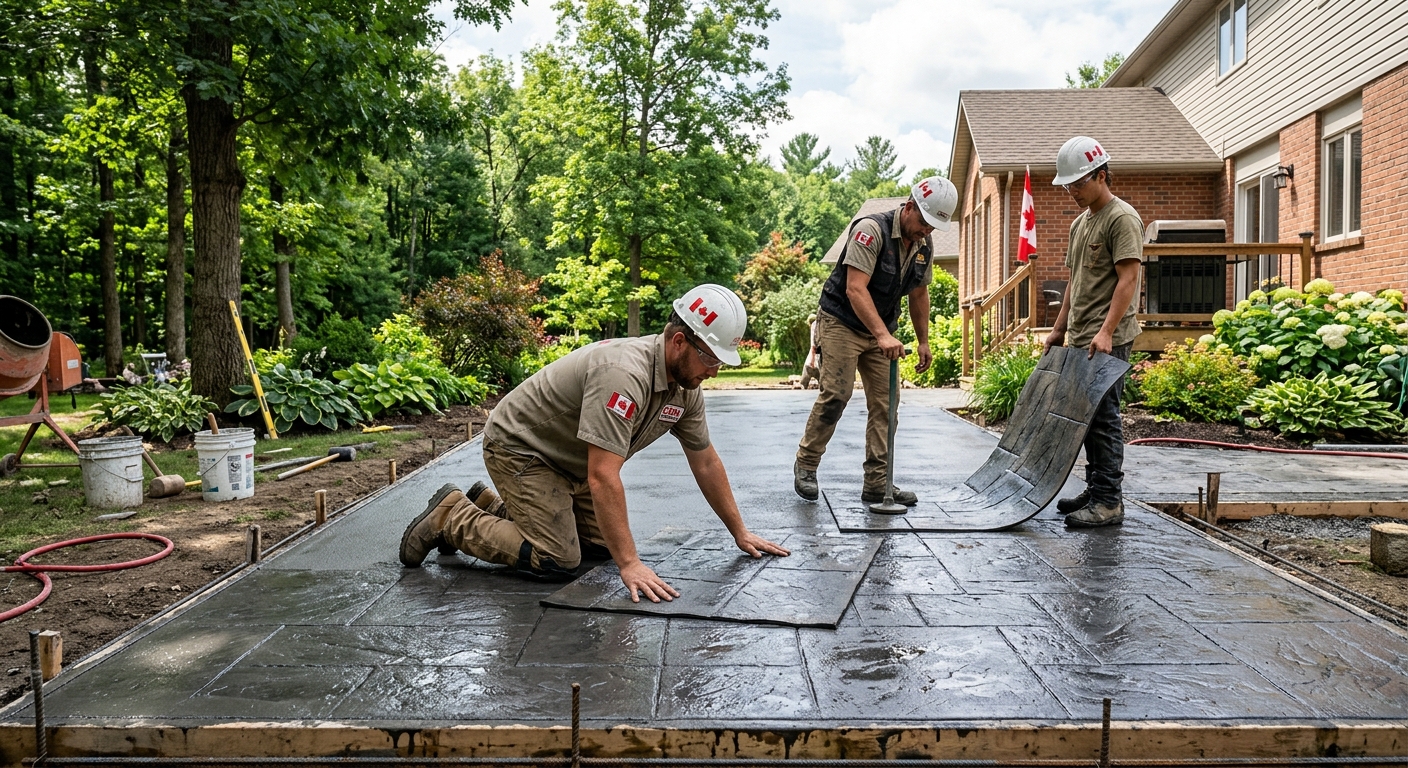
Concrete work options and costs in Hillside-Quadra
In Hillside-Quadra, concrete pricing is tied closely to the way Lower Mainland–Southwest soils and weather behave—especially around freeze–thaw cycles and coastal rainfall. Most concrete flatwork goes in front of and around homes in a neighbourhood where single-detached housing is common, and that matters because driveways and patios get used hard year-round. With a local population of 7,860 (Statistics Canada, 2021 Census), contractors tend to be scheduling-focused and often booked ahead for exterior work in areas like Quadra Village and the wider Hillside core, where infill and home renovations keep concrete demand steady.
Even though winters here are milder than interior or northern BC, our practice still assumes a shallow design frost depth of about 450 mm / 18" and then places footings and thickened edges below that to reduce frost heave risk. For exterior slabs, the cost drivers show up in base prep (compacted granular and drainage), air-entrained mixes, and the labour/time needed for proper curing during cool, damp stretches. That’s why two quotes that sound similar can differ—one contractor may include deeper base excavation, better drainage detailing, or higher-spec mix control, while another keeps the scope minimal.
Below is a practical comparison of typical options and the price band you’ll see in the Hillside-Quadra market, from standard broom-finish driveways to structural work below frost. Use it as a starting point before you request itemised quotes.
| Application |
Typical Size |
Key Spec |
Finish Option |
Price Range |
| Concrete driveway (standard broom finish) |
20 ft x 12 ft (240 sq ft) |
Air-entrained exterior mix; compacted granular base and proper drainage; control joints |
Broom finish, standard edge forms |
$4,320 – $6,720 |
| Exposed aggregate driveway |
20 ft x 12 ft (240 sq ft) |
Exposed aggregate requires correct mix and timing; reinforced placement; curing discipline |
Exposed aggregate finish with controlled wash |
$5,760 – $7,920 |
| Stamped concrete driveway or patio |
18 ft x 14 ft (252 sq ft) |
Air-entrained mix; release agents and finishing workflow; control joints planned for pattern |
Stamped pattern (e.g., slate/stone look) + sealer |
$5,544 – $9,072 |
| Plain concrete patio or walkway |
12 ft x 10 ft (120 sq ft) |
Exterior base prep; air-entrained mix; joints and grading for runoff |
Broom-float or light broom |
$1,920 – $3,120 |
| Garage floor (interior slab) |
22 ft x 20 ft (440 sq ft) |
Vapour barrier (if included), reinforcement (wire mesh/rebar as specified), and proper thickness |
Float/smooth or broom-finish interior |
$7,920 – $12,320 |
| Foundation footings (structural, below frost) |
Varies by perimeter |
Typical frost-protected depth below design frost; reinforced concrete; excavation and forms as needed |
Structural concrete pour (no decorative finish) |
$2,400 – $4,200 |
Prices are estimates only and vary by project scope, site access and material selection.
What affects the price of concrete work in Hillside-Quadra
In Hillside-Quadra, you can see the same driveway or patio priced 30–50% differently across the Lower Mainland–Southwest market—and that’s not just “profit”; it’s scope and specifications. The biggest swing comes from what’s underneath the concrete: excavation depth, compacted granular base quality, drainage detailing, reinforcement type, and the concrete mix controls (especially air-entrainment for exterior durability). These items are tightly linked to our coastal-wet conditions and freeze–thaw cycles, where saturated base soils and temperature swings can damage poorly drained slabs.
Lower Mainland–Southwest practice also depends on the design frost depth (commonly treated around 450 mm / 18"). Footings and thickened edges must go below frost to avoid frost heave, so foundations are cost-influenced by excavation volume and forming. For exterior slabs, air-entrained concrete is expected, and control joints must be placed and sealed on a sensible schedule. In colder spells, contractors may use curing blankets and other cold-weather precautions to keep the slab developing strength reliably; those steps add labour and materials.
Two quick Hillside-Quadra examples: if your site needs extra base cut to reach stable, well-compacted granular (common on older lots with soft fill), you’ll pay more than the base band. If you’re choosing stamped concrete in place of broom-finish, labour and finishing complexity can move you from the ~$18–$28 per sq ft driveway band toward the upper end of stamped & decorative pricing (often ~$22–$36 per sq ft). Conversely, a smaller 120 sq ft walkway on stable access might land closer to the lower range, especially when truck access is straightforward.
| Price Factor |
Why It Matters |
Cost Impact |
| Frost line depth — determines footing depth and form height |
Footings must be placed below design frost to prevent heave and movement |
Higher excavation and forming can add significant cost on new builds and retrofits |
| Site preparation — excavation, grading, compacted granular base |
Compaction and drainage protect the slab from saturated subgrade and washout |
Unstable soils or poor drainage increases granular removal and rebuild |
| Reinforcement — rebar or wire mesh requirement |
Controls cracking and improves load capacity |
More reinforcement (or thicker slab) raises material and labour time |
| Mix design — air-entrainment and compressive strength spec |
Air-entrained mixes resist freeze–thaw scaling and spalling outdoors |
Higher-spec mix and documentation increases per-yard cost |
| Finish type — broom vs. stamped vs. exposed aggregate |
Finishing workflow, tools, and timing are more demanding for decorative work |
Stamped/exposed typically adds labour, sealers, and more finishing stages |
| Pour size and concrete truck access to site |
Smaller pours can cost more per sq ft if access limits pumping and placement |
Crane/pump charges or extra labour for hand placement can swing the total |
| Cold-weather curing precautions — heating and blankets |
Maintains strength gain when nights are cool and humidity stays high |
Blankets/heaters add rental costs and labour supervision |
| Control joint pattern and sealing cost |
Joint planning reduces random cracking; sealing improves water/ice resistance |
More precise saw-cut scheduling and sealing materials add modest but real cost |
Permits & regulations in British Columbia
In British Columbia, the permit question depends on whether the concrete work is considered structural or affects site drainage/grade. Structural concrete work—such as foundation walls, footings, grade beams, and any work tied into the primary support system—typically requires a building permit and, in many cases, engineered drawings reviewed through the municipal process. For Hillside-Quadra homeowners, that usually means you’re coordinating with your builder/engineer on footing dimensions, rebar detail, and frost-protected depth.
Concrete flatwork (driveways, patios, and walkways) often does not require a permit by itself. However, it can trigger a review if it impacts lot grading, changes stormwater flow, or affects impervious surface coverage limits or drainage patterns near the house. If the work involves lowering/raising grade, altering discharge routes, or connecting into a lot drainage system, it’s worth checking early rather than after demo.
Step-by-step contractor verification in BC: (1) Ask the contractor for their business number and check their registration/licensing status through the appropriate online government registry; (2) request a current certificate of insurance showing liability coverage and confirm the work is properly described; (3) verify Workers’ Compensation coverage (WSBC/WCB) with a clearance letter or confirmation statement; (4) request references on projects of similar scale, ideally recent local work in the Vancouver Island/Lower Mainland market; and (5) ensure the quote clearly separates excavation, disposal, forms, reinforcement, concrete supply, finishing, curing, and any permit-related items.
Getting concrete right in Hillside-Quadra's freeze-thaw climate
The most common concrete failures in Hillside-Quadra come from water management and freeze–thaw stress: saturated bases, inadequate air-entrainment, poorly planned control joints, and rushed curing. When moisture sits under or at the surface, temperatures can swing from cool nights to damp days, creating cycles that push and pull at the concrete matrix. The fix isn’t “thicker concrete” alone—it’s correct base prep, correct mix design, and correct curing.
Spec the job like this. First, base preparation: compacted granular sub-base to the correct depth for local soil conditions so the slab doesn’t settle and so drainage works as intended. Second, mix design: for exterior flatwork, use air-entrained concrete with a target air content commonly in the 5–7% range and minimum 32 MPa compressive strength (or higher if engineering requires). Third, control joints: plan spacing to manage where cracking occurs—then clean, saw-cut as needed, and seal at the right time. Fourth, curing: plan on at least 7 days of proper curing conditions; cool, damp weather in the Lower Mainland often means blankets or sealers to protect early-age strength. Fifth, sealing: apply a penetrating sealer after cure (often around 28 days post-pour) to help repel salts and reduce surface deterioration.
On cost, the “right” spec can actually be cheaper than repeating repairs. For example, if a broom-finish driveway at the lower band is near $4,320 – $6,720, cutting corners on air-entrainment can lead to scaling/spalling that forces patching or replacement—typically costing far more in labour, demolition, and lost driveway use. Stamped work costs more (often in the decorative band) because finishing stages and timing are tighter, but it still needs the same structural durability specs.
| Spec |
Why It Matters in Hillside-Quadra |
What to Ask For |
Impact if Skipped |
| Compacted granular base (depth?) |
Limits settlement and helps drainage through wet coastal soils |
Ask for planned excavation depth, granular type, and compaction method |
Uneven settling, pumping, and early cracking/spalling |
| Air-entrained concrete mix (target air %?) |
Resists freeze–thaw scaling outdoors in BC’s wet/cool cycles |
Ask for air content target (commonly 5–7% for exterior flatwork) and mix design confirmation |
Higher risk of surface scaling and spalling |
| Compressive strength (MPa rating) |
Ensures strength gain for durability under winter moisture exposure |
Ask for minimum 32 MPa (or higher if required) and concrete test documentation approach |
Surface damage and reduced service life |
| Control joints (spacing per ACI guidelines) |
Controls random cracking driven by drying shrinkage and thermal movement |
Ask for the joint spacing plan and seal timing for exterior joints |
Cracks where you least want them; water intrusion into slab edges |
| Minimum 7-day curing period |
Cool nights and high humidity make early curing critical |
Ask how curing will be protected (curing compound vs blankets vs weather plan) |
Weak early-age concrete and higher long-term deterioration |
| Penetrating sealer (when applied after cure) |
Helps repel water and de-icing salts used on winter surfaces |
Ask for sealer type and application timing (commonly after full cure, ~28 days) |
Faster staining, scaling, and surface breakdown |
How to choose a concrete work contractor in Hillside-Quadra
Start by verifying BC basics properly. Ask your contractor for their current insurance certificate and confirm the liability coverage matches the job type and address. For work coverage, request proof of Workers’ Compensation coverage (WSBC/WCB) and a clearance letter or equivalent confirmation. For licensing, verify the contractor’s business registration through the appropriate provincial registry and confirm they’re operating under the correct business name.
Next, get 2–3 itemised written quotes (not one lump number). You want labour and materials separated: excavation and disposal, formwork, reinforcement (wire mesh or rebar—size and spacing if applicable), concrete supply (including mix design and air-entrainment), finishing, curing/blankets, saw-cut joints, and sealing (if included). Make sure exclusions are spelled out: old concrete removal, grading/sidewalk forms, trenching for drains, and whether permits (when needed) are included.
Warranty matters. Ask for the workmanship warranty length and what it covers (cracks within or beyond joint lines, spalling, settlement). Also ask whether any product/manufacturer warranty is included and whether it’s transferable if you sell the home. For payments, avoid large deposits—use a schedule where you don’t exceed about 10–15% upfront. Hold back a portion until the slab is completed, cleaned, and joint sealing/finishing details are done.
Finally, timeline. Get the start date and concrete completion estimate in writing, including weather contingencies. In Hillside-Quadra, short delays around rain and cool nights are normal, but the plan should be clear.
- Request proof of liability insurance and confirm it covers concrete operations and your site location.
- Confirm WSBC/WCB coverage with a clearance letter before work begins.
- Verify business registration and ensure the contractor name matches the quote and invoices.
- Get quotes itemised by excavation/disposal, reinforcement, concrete supply, finishing, curing, and sealing.
- Ask for the mix design specifics: air-entrainment and minimum compressive strength.
- Confirm base preparation details: granular depth (if specified), compaction expectations, and drainage plan.
- Check reinforcement scope: wire mesh vs rebar, and whether it matches the slab thickness.
- Require a joint plan (where joints go and whether they’ll be sealed for exterior durability).
- Ask how curing will be protected during cool, damp periods (blankets/curing compound).
- Clarify truck access and whether pumping is included or assumed.
- Review the payment schedule—limit upfront payments to about 10–15% and hold back until completion.
- Get the warranty in writing and understand what triggers a service call.
Concrete red flags in Hillside-Quadra: vague mix specs (no air content mentioned), “one-size-fits-all” joint spacing, refusing to discuss base depth/compaction, quoting only the concrete without excavation/disposal/curing details, or asking for a large upfront payment before forms and reinforcement are in place.
Frequently asked questions — concrete work in Hillside-Quadra
How deep must footings be for Hillside-Quadra's frost line?
For Hillside-Quadra, contractors typically design around a shallow design frost depth of about 450 mm / 18" and then place footings below that to limit frost heave risk. The exact footing depth can still vary based on geotechnical recommendations, soil type, and how the foundation is detailed, especially if you’re dealing with fill or variable subgrade. That’s why a proper site assessment and engineered detail matter for foundation work. If your project is structural (footings/grade beams/foundation walls), the permit package and engineering will set the required depth and reinforcement. For context, when exterior slabs are poured, the mix and base must also be built for our coastal-wet freeze–thaw cycles even if the frost depth itself is shallower than in colder parts of BC.
Why does concrete crack in Hillside-Quadra and how is it prevented?
Cracking in Hillside-Quadra is usually driven by shrinkage, thermal movement, and moisture—not because concrete “can’t handle” the climate. In our Lower Mainland–Southwest conditions, wet subgrade plus freeze–thaw cycles can accelerate early deterioration if base preparation and drainage are weak. Prevention is mainly about controlling where cracks occur: proper control joint layout, correctly timed saw cuts, and sealing exterior joints when appropriate. Equally important is using air-entrained exterior concrete so freeze–thaw stress doesn’t cause surface scaling and spalling that widens into cracking at vulnerable edges. Don’t overlook curing either: waiting less than a proper curing period or skipping protection during cool nights can reduce strength gain. A well-detailed broom-finish driveway in the $4,320 – $6,720 band often performs well when these basics are included.
Stamped vs broom-finish concrete — cost difference?
Stamped concrete costs more because the finishing workflow is more labour-intensive: pattern layout, release agents, careful timing, and often additional sealing/aftercare. In the Hillside-Quadra market, broom-finish driveway work commonly lands around the concrete driveway slab band of $18 – $28 per sq ft (scope and site access dependent). Stamped & decorative work is typically priced higher, often in the $22 – $36 per sq ft range in the Lower Mainland–Southwest corridor. That price difference is justified when the job also includes durable specs—air-entrained mix, engineered base prep, reinforcement as needed, and proper joint planning. If a quote is much cheaper for “stamped,” ask what’s reduced: base depth, curing protection, air-entrainment confirmation, or joint sealing. Decorative appearance doesn’t replace durability.
When is the best time to pour concrete in Hillside-Quadra?
The best window is when temperatures are consistently supportive of curing and when rain won’t interfere with finishing and early strength development. In British Columbia’s Lower Mainland–Southwest, that often means aiming for milder stretches when nights are not too cold and drainage won’t leave the sub-base saturated for days. Even though we don’t have the same deep frost line as colder regions, cool nights and high humidity can slow curing, so contractors may use curing blankets or curing compounds and keep weather protection on standby. A good contractor will include a weather plan in the schedule: how they’ll protect fresh concrete, how they’ll time saw cutting for joints, and when sealing (if included) can realistically be applied after cure. If the job is essential during wet periods, expect more careful staging rather than rushing.
How long does concrete take to cure?
Concrete cure time isn’t one single day, especially outdoors in Hillside-Quadra’s coastal-wet conditions. Practically, you should expect at least 7 days of adequate curing protection for early strength development, with performance continuing to build over subsequent weeks. If cool, damp weather is expected, a contractor may extend curing protection (blankets, plastic sheeting, or curing compound) to ensure strength gain isn’t compromised. For sealing exterior slabs, many homeowners plan for about 28 days after the pour so the concrete has completed much of its curing and drying before the sealer is applied. That timing matters because sealing too early can trap moisture and reduce long-term effectiveness against water and de-icing salts. Your contractor should also describe when the slab can be walked on, driven on, and cleaned.
Do I need a permit for concrete work in British Columbia?
In British Columbia, structural concrete work—like footings, foundation walls, and grade beams—usually requires a building permit and often engineered drawings reviewed through the municipality. Concrete flatwork such as patios, walkways, and typical driveways often does not require a permit by itself, but it can if the work affects lot grading, impervious surface considerations, stormwater flow, or drainage near the house. The safest approach for Hillside-Quadra homeowners is to confirm with the local authority (or your builder) before breaking ground, especially if you’re changing elevations or connecting to drainage systems. Also verify your contractor’s coverage before work starts: liability insurance and WSBC/WCB confirmation are essential, and references on similar projects help you gauge whether they consistently follow the local process.