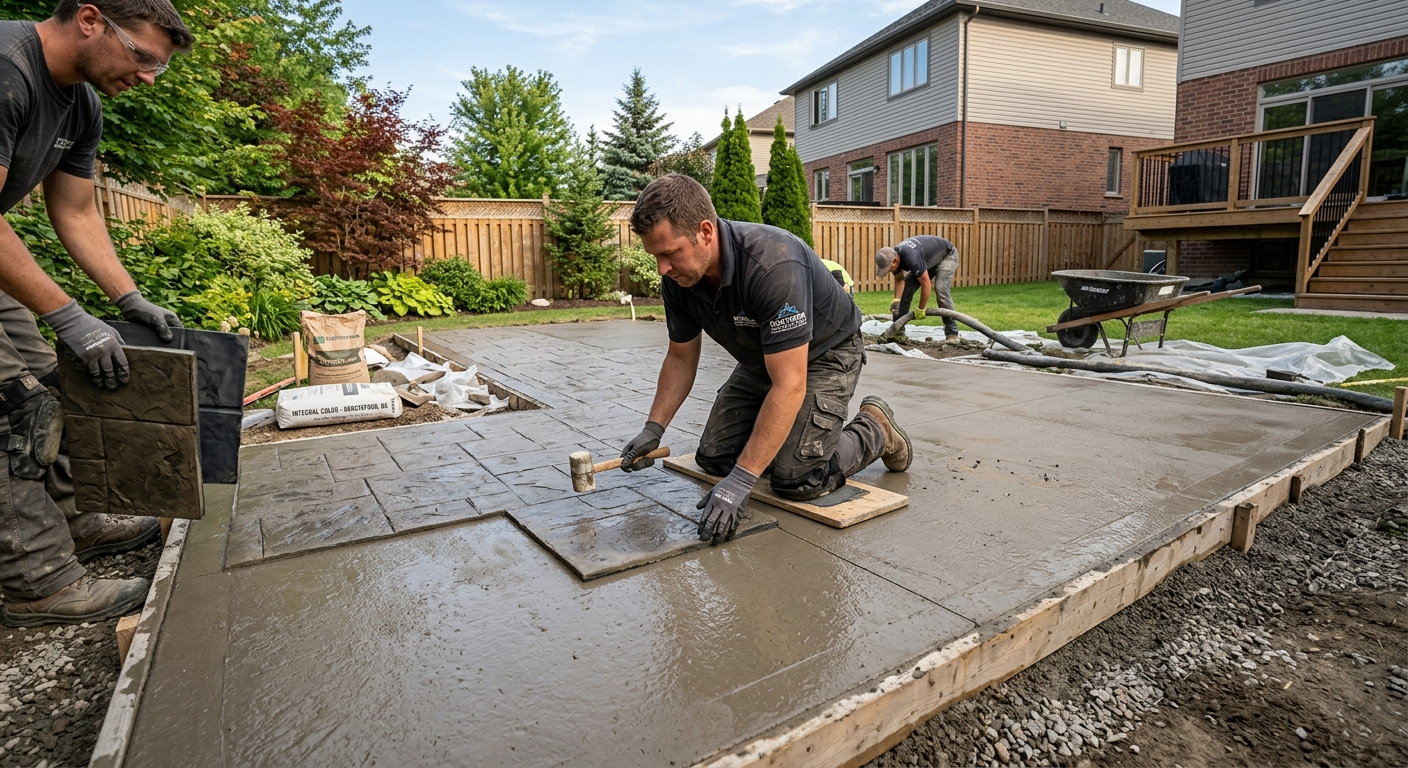
Concrete work options and costs in Maple Ridge
Maple Ridge homeowners often start planning concrete in the early spring and then tailor the design once they see how the Lower Mainland–Southwest climate affects everything from drainage to curing. That matters locally because Maple Ridge has a large base of owner households—26,205 homeowner households, representing 79.1% of households—and a strong preference for single-detached living, where 52.6% of dwellings are that style. For driveways, patios, walkways, garage floors, and foundation work, that housing mix means steady demand and a wide range of contractor availability, especially around high-traffic residential pockets like Albion, Garibaldi Highlands, and the West Maple Ridge / 232nd St corridor.
In this region, even though winters are comparatively mild and the frost depth is often assumed around 450 mm / 18", we still design and place footings below the design frost depth to reduce frost heave risk. The more frequent freeze–thaw cycling and coastal-wet weather make base prep and curing just as important as the decorative finish. Rainy stretches can slow site work, and cool nights increase curing time, which affects labour scheduling and the materials plan for air-entrained concrete, joints, and protection.
Below are practical cost ranges for common Maple Ridge concrete jobs, using the region’s typical pricing backbone. Use this table to compare contractor options, then confirm specifications (base depth, air content, reinforcement, and sealing schedule) before you sign.
| Application |
Typical Size |
Key Spec |
Finish Option |
Price Range |
| Concrete driveway (standard broom finish) |
300–500 sq ft |
Air-entrained exterior mix; compacted granular base; control joints |
Broom finish |
$18,000–$28,000 |
| Exposed aggregate driveway |
300–500 sq ft |
Air-entrained mix; surface retardation; proper curing |
Exposed aggregate |
$22,000–$34,000 |
| Stamped concrete driveway or patio |
250–450 sq ft |
Air-entrained exterior mix; thicker top finish tolerance; joint layout for shrinkage |
Stamped (pattern + colour) |
$24,000–$40,000 |
| Plain concrete patio or walkway |
150–300 sq ft |
Air-entrained mix; edge support; drainage-aware slope |
Plain broom or smooth trowel (varies) |
$8,000–$16,000 |
| Garage floor (interior slab) |
400–600 sq ft |
Vapour control (where needed); reinforcement as specified; proper curing |
Plain or light broom |
$10,000–$18,000 |
| Foundation footings (structural, below frost) |
Per linear foot / project scope |
Engineered footing elevations; below-frost placement; rebar per design |
Structural concrete |
$200–$350 |
Prices are estimates only and vary by project scope, site access and material selection.
What affects the price of concrete work in Maple Ridge
In Maple Ridge and the wider Lower Mainland–Southwest region, you can easily see the same concrete scope quoted 30–50% apart between contractors or between two similar-looking properties. The gap usually isn’t the “concrete” itself—it’s the specs behind it: base preparation, reinforcement, correct mix design for exterior exposure, and the time it takes to cure properly after rain or cool nights. Even in coastal BC, our freeze–thaw cycles and saturated soils force the design to respect frost risk. That’s why footings must extend below the design frost depth, even when the local design assumption is around 450 mm / 18" for many slabs and flatwork details.
Exterior slabs also require air-entrained concrete mixes to manage freeze–thaw damage and scaling. In colder regions, contractors need a shorter pour season and cold-weather curing precautions (insulating blankets, sometimes temporary heating), but in Maple Ridge those precautions still matter when nighttime temperatures drop during shoulder seasons. De-icing salt can accelerate surface spalling if the surface isn’t sealed and if the finish isn’t protected with proper curing and joint control.
Two common Maple Ridge examples: (1) older home lots often have buried services, regrading needs, or drainage issues—especially with homes built before 1981, which make up 28.6% of the housing stock—driving additional excavation and compacted granular base costs; and (2) sloped driveways or tight access near Garibaldi Highlands can mean extra labour for forming, repositioning the truck, and careful placement around existing retaining walls. A standard broom driveway may land near the regional backbone of $18,000–$28,000, while upgrades like stamped work typically push higher, often into the $22,000–$36,000 range depending on size and seal requirements.
| Price Factor |
Why It Matters |
Cost Impact |
| Frost line depth — determines footing depth and form height |
Footings and thickened edges must be placed below frost risk to limit heave and settlement cracks |
Can raise costs materially on structural work; also affects excavation volume and disposal |
| Site preparation — excavation, grading, compacted granular base |
Weak or poorly drained subgrade leads to voids, edge breakdown, and rapid surface deterioration |
Often one of the largest cost swings between quotes, especially on older lots |
| Reinforcement — rebar or wire mesh requirement |
Rebar helps control cracking for structural edges and garage slabs; mesh alone may not suit all exterior loads |
Additional material + labour time; depends on design and slab thickness |
| Mix design — air-entrainment and compressive strength spec |
Exterior durability depends on correct air content and minimum strength for freeze–thaw resilience |
Usually modest per cubic yard, but critical for long-term performance |
| Finish type — broom vs. stamped vs. exposed aggregate |
Decorative systems require specialized labour, surface prep, and controlled curing |
Finishes can move a job several thousand dollars depending on square footage |
| Pour size and concrete truck access to site |
Smaller pours take longer per square foot; difficult access means extra labour and equipment |
Can add time for forming, pumping, or staging materials |
| Cold-weather curing precautions — heating and blankets |
Keeping concrete within curing temperature range helps achieve designed strength and limits surface defects |
Adds equipment and labour; impacts scheduling around rainy/cool periods |
| Control joint pattern and sealing cost |
Joints control shrinkage cracking; sealing reduces water and de-icing salt penetration |
Sealing is an add-on but often cheaper than premature repairs |
Permits & regulations in British Columbia
In British Columbia, permit requirements depend on what you’re building and whether it’s structural. Structural concrete work—such as footings, foundation walls, grade beams, and other elements that carry loads—typically requires a building permit and, in many cases, engineered drawings reviewed through the municipal process. Concrete flatwork (driveways, patios, walkways) often does not require a permit by itself, unless your project triggers lot grading issues, affects stormwater drainage, or conflicts with municipal requirements for impervious surface coverage and drainage approvals. The safest approach is to confirm in writing with the City of Maple Ridge (or your relevant authority) before breaking ground.
Homeowners should also verify the contractor is properly insured and set up to legally work. In BC, you should ask for: (1) proof of liability insurance (certificate of insurance showing jobsite coverage and limits), and (2) confirmation of WSBC coverage (Workers’ Compensation coverage). Next, request references for similar-scale projects in the Lower Mainland–Southwest, ideally with exterior concrete and visible joint/seal performance after wet-season use.
Step-by-step verification you can do:
- Ask the contractor for their insurance certificate and check the expiry date.
- Request WSBC coverage proof and ensure it lists the appropriate business entity.
- Confirm they can provide the correct permit support for structural work (footings/foundations/grade beams).
- Check their contractor credentials through the province’s online contractor registry process (where applicable), and confirm the scope matches the work you’re hiring.
- Verify references include projects poured through wet/cool seasons.
For anything structural—especially foundation interfaces—treat “permit and engineering” as part of the core scope, not an afterthought.
Getting concrete right in Maple Ridge's freeze-thaw climate
Concrete problems in Maple Ridge almost always trace back to a few controllable decisions: insufficient base preparation, incorrect mix design, weak joint planning, and poor curing in our cool, wet conditions. Even though the region’s frost depth can be assumed around 450 mm / 18" for many slab details, the outside atmosphere still drives freeze–thaw cycles and water saturation around your edges. If your contractor doesn’t prepare a compacted granular base to the right depth for local soil and frost conditions, water can accumulate and undermine the slab. Exterior flatwork should use air-entrained concrete (commonly 5–7% air) to manage freeze–thaw stress; skipping air content is one of the fastest ways to see spalling and scaling.
Spec the job with these controls in mind. (1) Base preparation: compacted granular sub-base with good grading and sub-drainage where needed. (2) Mix design: air-entrainment plus a minimum 32 MPa compressive strength typical for exterior durability expectations. (3) Control joints: a planned joint layout so cracks occur where you want them, rather than randomly. (4) Curing: minimum 7 days under appropriate conditions; cool nights and damp weather may require protection to achieve strength. (5) Sealing: a penetrating sealer applied after cure (often around the 28-day mark) to reduce water and de-icing salt penetration.
When you compare options, focus on whether the quoted scope includes the right specs. For example, a plain broom patio may fit the regional band of $16–$26 per sq ft equivalent in typical pricing, while stamped concrete costs more (often tied to the higher decorative band of $22–$36 per sq ft equivalent). That difference is justified when the contractor can show proper base prep, correct joint layout, and curing and sealing steps—not just stamp labour.
| Spec |
Why It Matters in Maple Ridge |
What to Ask For |
Impact if Skipped |
| Compacted granular base (depth?) |
Controls settlement and reduces water retention under slabs in Maple Ridge’s wet, freeze–thaw conditions |
State granular type, target compacted thickness, and compaction method; confirm drainage plan |
Edge cracking, slab rocking, and accelerated deterioration |
| Air-entrained concrete mix (target air %?) |
Air bubbles help concrete resist freeze–thaw expansion and scaling |
Ask for air-entrainment target (typically 5–7% for exterior flatwork) and mix design sheet |
Spalling/scaling within seasons in wet winters |
| Compressive strength (MPa rating) |
Adequate strength supports durability under moisture and temperature cycles |
Confirm minimum 32 MPa (or the specified design strength) for exterior exposure |
Surface wear, higher risk of cracking and premature repairs |
| Control joints (spacing per ACI guidelines) |
Joint spacing limits random cracking from shrinkage and thermal movement |
Ask for joint spacing plan, joint depth/finish details, and alignment with existing elements |
Random cracks that can open and collect water |
| Minimum 7-day curing period |
Proper curing helps achieve design strength despite cool nights and humidity |
Confirm curing method, protection plan for cool/wet periods, and when foot traffic is allowed |
Weaker surface, increased dusting, faster scaling |
| Penetrating sealer (when applied after cure) |
Repels water and helps protect against de-icing salt attack |
Ask when sealer is applied (commonly 28 days after pour) and which sealer system is used |
Higher moisture ingress and earlier surface damage |
How to choose a concrete work contractor in Maple Ridge
Choosing the right contractor in Maple Ridge is mostly about verifying competence and matching the quote to the specs—not just picking the lowest number. Start with British Columbia coverage. Ask for their liability insurance certificate (and confirm the jobsite is covered), plus WSBC coverage proof. If the scope includes structural elements like footings or foundation walls, ensure the contractor supports the permit process through the correct channel and can provide documentation for engineered work where required. For concrete flatwork, you still want to see a track record of exterior durability: joint layouts, proper air-entrained mix, curing steps, and sealing schedules.
Next, get 2–3 itemised written quotes that break down labour and materials, rather than one lump sum. Make sure the quotes clearly list excavation and disposal, compacted granular base thickness, reinforcement (if required), concrete volume, finish type, and curing/finishing protection. Confirm what’s excluded: permit pulls, utility locates, minor grading, removing existing asphalt, and disposal fees can shift the price quickly if not specified. Ask about warranty terms for workmanship and whether any product warranties transfer to you.
Finally, handle payment carefully. Avoid large upfront deposits—aim for no more than 10–15%—and use a holdback until the job is complete and cleaned up. Get a start date and completion timeline in writing so rain delays don’t turn into cost surprises.
- Ask for the concrete mix design details (air-entrainment and strength targets).
- Confirm base preparation depth and compacted granular type, not just “we prep the ground.”
- Check how they handle drainage and water at slab edges in wet months.
- Verify reinforcement plan (rebar vs mesh) matches your slab and design needs.
- Request a joint layout drawing or at least a clear spacing plan.
- Confirm curing method and protection on cool nights or during rainy windows.
- Ask whether sealing is included, and when it will be applied (after cure).
- Ensure truck access and pour size are discussed; pumping or staging should be priced transparently if needed.
- Confirm disposal and haul-away costs for removed material.
- Get a written warranty length for workmanship and workmanship-only vs materials.
- Ask whether the warranty is transferable if you sell your home.
- Use a payment schedule with a holdback until punch-list items are corrected.
Concrete red flags in Maple Ridge include: vague scopes that don’t name air-entrainment or curing steps, skipping or underspecifying joint layout, promising decorative durability without sealing, starting without confirming drainage/grade details on wet lots, and demanding large upfront payments before any site work begins.
Frequently asked questions — concrete work in Maple Ridge
How do I prepare the base for a concrete slab?
Base prep is where most Maple Ridge slab failures are prevented. Ask your contractor to remove topsoil/unsuitable material and then place a compacted granular base to the required thickness for your soil and exposure. In the Lower Mainland–Southwest, moisture and freeze–thaw cycles mean drainage and grading are as important as compaction. If water can pond near edges, you’ll get cracking and surface breakdown earlier. Your quote should spell out the granular type, compacted depth, compaction method, and how they handle soft spots or drainage corrections. For exterior slabs like patios and walkways, the mix must be air-entrained and joints planned, but the base still controls settlement. If your home is older—28.6% of housing stock was built before 1981—expect more surprises on regrading, buried services, or drainage continuity, which can change excavation quantities and total cost.
How do I compare concrete quotes?
Compare Maple Ridge concrete quotes line-by-line. Two bids that sound similar may differ in base depth, air-entrainment, reinforcement, and curing protection—those differences can swing total cost by 30–50%. Start by confirming each quote includes the same items: excavation and disposal, compacted granular base, vapour barrier (where needed for garage slabs), reinforcement method, and the finish system. Then compare the finish and schedule: stamped and exposed aggregate work requires controlled curing and often has higher labour intensity, which aligns with the regional decorative band of $22–$36 per sq ft equivalent. For plain driveway work, typical estimates land nearer the region’s concrete driveway backbone of about $18–$28 per sq ft equivalent. If one contractor is cheaper but has fewer steps (no sealing plan or minimal curing), the short-term savings often turn into early repairs.
Can concrete be poured in cold weather in Maple Ridge?
Yes, concrete can be poured in cold weather in Maple Ridge, but timing and precautions matter. In coastal BC, you’ll see cool nights, damp conditions, and intermittent temperature drops that can slow curing. Contractors should protect the pour to keep it within the workable curing temperature range—often with curing blankets or, in some cases, temporary heating—so it reaches design strength. Ask what their cold-weather procedure includes and how they monitor conditions on pour day and afterward. If the job is exterior flatwork, the mix should still be air-entrained for freeze–thaw durability, and curing time should not be rushed. In shoulder seasons, a contractor’s schedule and manpower planning are part of the cost. That’s why quotes can differ even for the same slab size: one crew may include blankets and extended protection; another may assume ideal weather.
How do I maintain concrete in Maple Ridge's freeze-thaw climate?
Maintenance in Maple Ridge is about water control and surface protection. Keep edges and joints clean of debris so water doesn’t pool, and avoid using harsh de-icing practices. If your driveway or patio sees regular salt, sealing becomes more important. Many contractors apply a penetrating sealer after full cure—often around 28 days—so the surface can repel moisture and resist salt exposure. Sweep rather than blast with pressure washers that can lift surface fines. Inspect seasonally for small cracks or joint openings and repair early with proper joint materials so water can’t migrate. If your home is on a slope or has drainage challenges, addressing grading and downspouts can prevent water from saturating the slab base—this is a common issue on older lots built before 1981. With the right sealing and joint upkeep, exterior concrete typically performs better through multiple freeze–thaw cycles.
What causes concrete to spall in Maple Ridge winters?
Concrete spalls in Maple Ridge winters when water enters the surface and freezes, then expands, stressing the concrete and breaking off small pieces. The biggest drivers are inadequate air-entrainment and curing, combined with water exposure and de-icing salts. If a contractor uses the wrong mix or doesn’t hit the air target for exterior exposure, freeze–thaw resistance drops dramatically. Poor curing in cool, damp weather can also leave the surface weaker, making it easier for scaling and spalling to start. Joint issues contribute too: if cracks form randomly (from poor joint layout), joints can trap water and accelerate deterioration. Finally, inadequate base prep and drainage can cause ongoing edge saturation, leading to surface problems sooner. If you’re being quoted for a driveway in the standard range (often around $18–$28 per sq ft equivalent), ask specifically for air content, curing protection, and the sealing plan—those steps are often what separates durable concrete from spalling-prone work.
What is rebar and when is it required in British Columbia?
Rebar is steel reinforcement bars placed in concrete to improve tensile strength and crack control. In British Columbia, whether rebar is required depends on the design, slab thickness, and loads—not just local “rules of thumb.” For many foundation elements (like grade beams, structural footings, and foundation walls), reinforcement requirements are typically determined by engineering drawings and submitted for permitting where applicable. For exterior flatwork, some projects need reinforcement based on thickness and support conditions—especially where there are heavier loads, larger slabs, or weaker subgrade conditions. In Maple Ridge, reinforcement decisions often tie back to base preparation and drainage: if the base is not stable, even reinforced concrete can crack, but it usually cracks in more controlled ways. When getting quotes, ask what reinforcement (rebar or wire mesh), bar size, placement, and cover thickness are included. A good contractor will be able to match the reinforcement to your slab plan and explain why it’s being used.