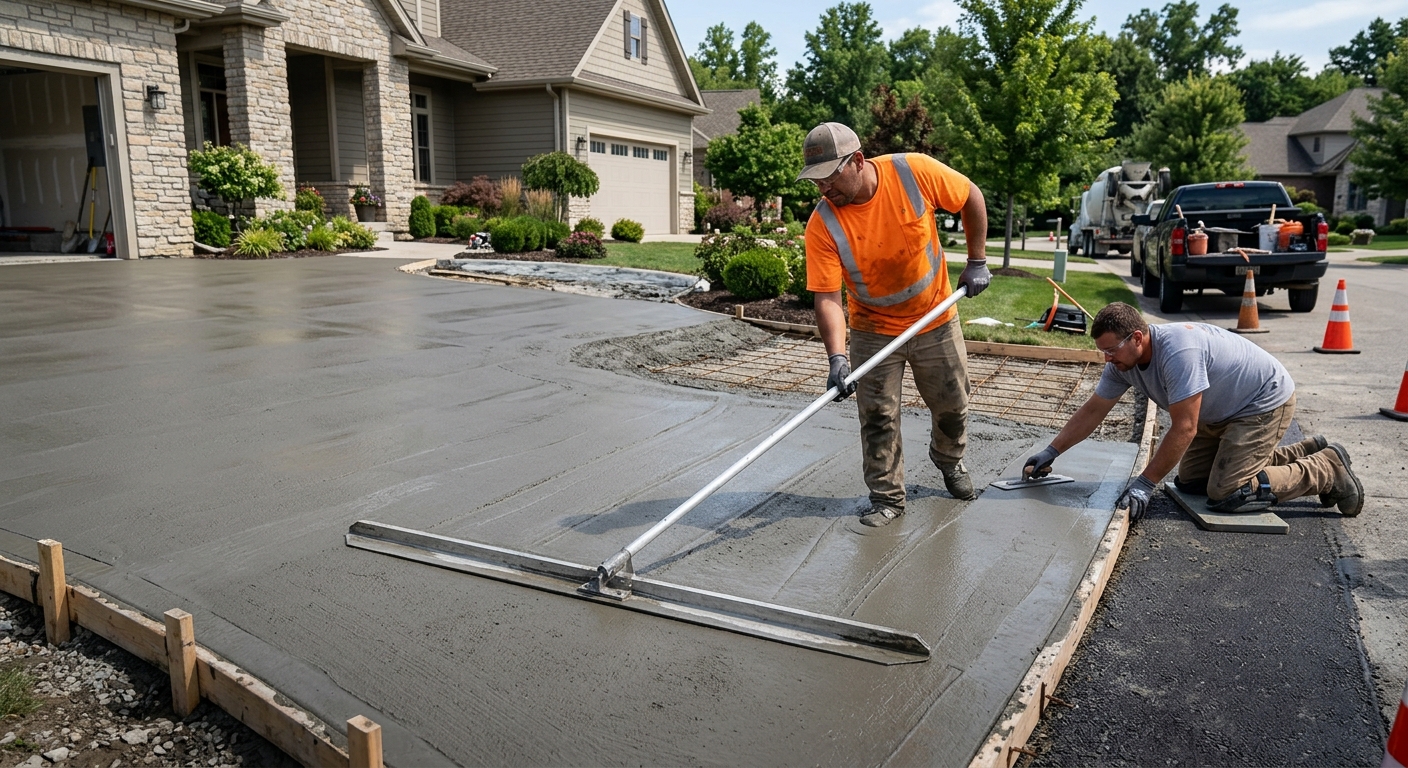
Concrete work options and costs in Tsleil-Waututh
Concrete work in Tsleil-Waututh typically comes down to two things: getting the base right and protecting the slab from the coastal-wet freeze–thaw cycles that Lower Mainland–Southwest concrete crews design for. With a total population of 1,410 (Statistics Canada, 2021 Census), local demand is concentrated in small pockets—so when you see availability tighten, pricing can shift as scheduling and truck access become more competitive. In this housing market, concrete flatwork is especially common on newer infill and long-time properties where driveways, patios, and walkways get replaced after settlement or surface scaling. It’s also a region where frost depth is treated as shallow but meaningful for exterior work; local practice often assumes about 450 mm / 18" for design, so footings and thickened edges still get placed below that to resist frost heave.
Compared with interior or northern BC, our Lower Mainland–Southwest concrete pricing often stays more consistent because winters are milder. However, costs can still rise with rain delays, cool curing nights, and saturated soils—each one can mean extra base preparation, more careful curing, and longer site time. Neighbourhoods closer to Indian Arm access and the busier pockets around smaller commercial-service areas tend to see steady requests for driveways and patios, particularly in homes that were built or renovated during periods of heavier infill activity.
Below is a practical comparison of common projects you’ll see quoted in Tsleil-Waututh, including the key specification differences that drive real-world price gaps.
| Application |
Typical Size |
Key Spec |
Finish Option |
Price Range |
| Concrete driveway (standard broom finish) |
12' x 20' (240 sq ft) |
Air-entrained mix; compacted granular base; control joints |
Broom finish |
$3,900–$6,700 |
| Exposed aggregate driveway |
12' x 20' (240 sq ft) |
Air-entrained mix; proper curing; slip-resistant surface |
Exposed aggregate |
$5,100–$8,300 |
| Stamped concrete driveway or patio |
10' x 18' (180 sq ft) |
Air-entrained mix; integral colour; release agent control |
Stamped pattern |
$4,000–$7,200 |
| Plain concrete patio or walkway |
8' x 16' (128 sq ft) |
Air-entrained mix; compacted base; control joints |
Plain finish |
$2,050–$3,330 |
| Garage floor (interior slab) |
20' x 20' (400 sq ft) |
Smooth trowel (or broom); fibre or mesh; vapour considerations |
Trowel finish |
$7,200–$12,000 |
| Foundation footings (structural, below frost) |
Per project (estimate) |
Excavate to below frost; reinforced concrete; engineered spec where required |
Structural finish (utility formwork) |
$9,500–$28,000 |
Prices are estimates only and vary by project scope, site access and material selection.
What affects the price of concrete work in Tsleil-Waututh
In Tsleil-Waututh and the wider Lower Mainland–Southwest, you can see the same concrete scope quoted 30–50% apart because the “hidden” items aren’t identical: base prep depth, drainage and compaction, reinforcement detailing, concrete mix requirements, and how the contractor schedules around rain and cold nights. Even though our frost line is relatively shallow compared to other parts of BC, the design still assumes exterior work must be protected from frost action—so footings and thickened edges are placed below the local design frost depth (often around 450 mm / 18" in Lower Mainland practice). If a site has saturated soil, you’ll pay more for excavation, granular replacement and drainage improvements before any finishing happens.
The other major cost driver is freeze–thaw durability. Exterior slabs and driveways need air-entrained concrete, proper joint placement, and curing attention. If the contractor is using a lower-spec mix or rushing curing during cool, humid stretches, you may get early scaling and surface spalling—leading to sooner repairs. And while the Lower Mainland doesn’t usually require the heavy heating systems you’d see in colder provinces, colder nights still mean extra protection to hold temperature and achieve strength.
Two examples of where Tsleil-Waututh conditions change the price: (1) a driveway on soft or poorly drained soil may need a thicker compacted base and additional granular undercut, pushing you toward the upper end of the driveway band ($18–$28 for concrete driveway work when measured per typical installed scope); (2) if your project needs decorative work—like stamped or exposed aggregate—labour time for forming, finishing timing, and curing control increases, and that’s where you feel the stamped & decorative band ($22–$36) in your final total. For older homes (often with settled landscaping and uneven subgrades), it’s common to see a dollar jump in base correction before finishing begins.
| Price Factor |
Why It Matters |
Cost Impact |
| Frost line depth — determines footing depth and form height |
Exterior structural elements must resist frost heave and freeze–thaw movement |
More excavation and higher formwork can add several thousand dollars on footing-heavy builds |
| Site preparation — excavation, grading, compacted granular base |
Weak or saturated subgrade leads to settlement and slab cracking |
Heavier undercut/replacement and drainage work can shift pricing by 10–25%+ |
| Reinforcement — rebar or wire mesh requirement |
Controls cracking potential and improves performance for slabs that see loads |
Material + labour for placement/tie-in can add noticeable cost, especially for wider slabs |
| Mix design — air-entrainment and compressive strength spec |
Air entrainment improves freeze–thaw resistance in coastal-wet climates |
A higher-spec mix and batch control typically increases material cost but reduces early failures |
| Finish type — broom vs. stamped vs. exposed aggregate |
Decorative finishes require more labour and tighter timing |
Stamped/exposed work often moves you toward higher price bands than broom-finished slabs |
| Pour size and concrete truck access to site |
Access limits can affect pump usage, staging time, and number of pours |
Long carries, restricted lanes, and pumping can add labour hours and equipment charges |
| Cold-weather curing precautions — heating and blankets |
Protects strength gain during cool nights |
Blankets/heating add cost, but without them, strength and surface durability suffer |
| Control joint pattern and sealing cost |
Jointing manages cracking; sealing helps resist moisture and de-icing scaling |
More saw cuts/joint layout and sealing materials increase totals, but improve longevity |
Permits & regulations in British Columbia
In British Columbia, structural concrete work—think footings, foundation walls, grade beams, and any engineered structural elements—typically requires a building permit and often engineered drawings reviewed by the municipality. Concrete flatwork (patios, walkways, and most driveways) usually does not require a permit on its own, unless your project changes lot grading, impacts impervious surface coverage limits, affects municipal right-of-way requirements, or triggers drainage/retaining work that the municipality treats as structural or grading-related.
For Tsleil-Waututh homeowners, the safest approach is to confirm before breaking ground: call or check the local authority guidance for your address and scope, especially if you’re adding drainage, changing slope toward a property line, or working near an access path that could be considered municipal right-of-way.
Next, verify your contractor properly. Step-by-step: (1) ask for their business name and proof of registration; then search the provincial online business/corporate registry or any contractor registry resources they provide; (2) request a certificate of insurance showing liability coverage appropriate to concrete work (and the project address if possible); (3) confirm coverage for workers through WCB/WCB-equivalent proof—many homeowners ask for the clearance letter number or proof of account status; (4) check references on similar-scale Lower Mainland projects that involved exterior air-entrained mixes and jointing. If they can’t provide documentation, that’s a red flag.
Getting concrete right in Tsleil-Waututh's freeze-thaw climate
In Tsleil-Waututh and the Lower Mainland–Southwest, the most common concrete failures are linked to moisture movement: freeze–thaw cycles expand and contract saturated materials, and coastal humidity can keep the slab wet longer. The result is spalling and surface scaling when the mix isn’t properly air-entrained, when base drainage is inadequate, or when curing is rushed during cool nights. For a durable driveway, patio, or walkway, spec the work around five fundamentals: (1) base preparation: build a compacted granular sub-base to the right depth for your soil and frost protection strategy, not just the thinnest section to “save money”; (2) mix design: use air-entrained concrete with a target air content typically in the 5–7% range for exterior flatwork, plus a minimum compressive strength spec around 32 MPa; (3) control joints: cut or form joints early enough and at appropriate spacing so cracking happens in planned lines, not randomly; (4) curing: allow at least a 7-day curing period under proper conditions, and protect the slab when nights are cool and rain is likely; (5) sealing: apply a penetrating sealer after the cure period (often at or after 28 days) to reduce moisture and de-icing salt impact.
Ask technical questions like: “What air content is your mix designed for?” and “How many inches of compacted granular base will you place and how will you verify compaction?” That’s how you avoid inadequate air-entrainment—the #1 pathway to early spalling. As for cost, stamped concrete usually runs higher—if you’re comparing a standard broom driveway versus stamped work, you might see totals moving from the driveway band ($18–$28) toward the stamped & decorative band ($22–$36). That price difference is justified only if the contractor is also delivering the right base, air-entrainment, jointing and curing; otherwise, decoration won’t stop moisture-driven failure.
| Spec |
Why It Matters in Tsleil-Waututh |
What to Ask For |
Impact if Skipped |
| Compacted granular base (depth?) |
Provides drainage and support so slabs don’t settle; supports frost protection strategy |
Specify excavation depth, granular type, and compacted lift thickness; confirm proof of compaction |
Settlement and uneven cracking; higher likelihood of joint failure |
| Air-entrained concrete mix (target air %?) |
Improves durability through freeze–thaw cycling in a coastal-wet climate |
Ask for mix design with 5–7% target air for exterior flatwork |
Early scaling and spalling, especially on exposed edges and high-salt areas |
| Compressive strength (MPa rating) |
Ensures strength gain and reduces surface wear |
Confirm minimum 32 MPa (or as engineered) and curing conditions to achieve it |
Soft surface, increased abrasion and cracking potential |
| Control joints (spacing per ACI guidelines) |
Limits random cracking pathways caused by temperature and moisture movement |
Ask for joint spacing and saw-cut timing plan; confirm edging and tie-ins |
Random cracks that are harder to hide and more likely to admit water |
| Minimum 7-day curing period |
Cool nights and humidity can slow strength development |
Confirm curing blanket/sealer schedule if temperatures drop; specify protection plan |
Reduced strength and weaker surface resistance to moisture movement |
| Penetrating sealer (when applied after cure) |
Helps repel water and reduce surface damage from salts and rain-driven moisture |
Ask for penetrating sealer and timing (commonly after cure, often around 28 days) |
Faster staining and water absorption; more risk of freeze–thaw scaling |
How to choose a concrete work contractor in Tsleil-Waututh
Choosing a concrete contractor in Tsleil-Waututh is mainly about verifying documentation and matching the quote to the technical specs your climate requires. Start with British Columbia checks: request their liability insurance certificate (with coverage for the project), and proof they’re properly covered for workplace insurance/wage-related coverage (commonly provided via WCB/WCB clearance or account proof). Then ask for their business details—name, address, and a recent work reference package for similar driveway/patio jobs in the Lower Mainland–Southwest.
For quoting, insist on 2–3 itemised written proposals, not a single lump-sum. The best quotes break out labour and materials (demo/removal, excavation, base material, rebar or mesh, concrete supply, finishing, curing protection, sealing, and disposal). Carefully read what’s excluded: is permit pulling included where needed, is load hauling/disposal included, and are repairs to existing edges or drainage part of scope? Also ask for a workmanship warranty length, whether it’s prorated, and if it’s transferable if you sell your home. Payment matters too: never pay more than 10–15% upfront, and hold back part of the final amount until the job is complete and cured as specified.
Finally, get your timeline in writing: confirm the start date, pour date contingency plan for rain, and completion estimate. In our climate, a good contractor schedules for wet weather and cool curing nights so you’re not pressured into rushing.
- Ask what mix design they’ll deliver (air content and strength spec), not just “concrete”.
- Confirm exterior work includes air-entrainment and documented joint layout.
- Request proof of compacted base depth and compaction method/verification.
- Ensure they include curing protection steps for cool nights and high humidity.
- Check they specify sealing type and when it’s applied after cure.
- Look for itemised line items for demo, disposal, excavation, granular base, and concrete volume.
- Verify whether they supply and install reinforcement (rebar/wire mesh/fibres) where required.
- Confirm truck access and whether they plan for pumping or cartage costs if needed.
- Ask who handles any permits if grading/drainage changes trigger municipality review.
- Get a workmanship warranty in writing, including exclusions and duration.
- Don’t accept a quote that doesn’t address drainage and edge support details.
- Pay in stages: keep 10–15% withheld until final finishing and cleanup are complete.
Concrete contractor red flags in Tsleil-Waututh: vague mix details (no air content or strength spec), skipping control joints or changing spacing without documentation, refusing to discuss curing in cool/wet weather, quoting a “flat price” without addressing base/drainage scope, and pushing for large upfront payments before seeing a signed, itemised contract.
Frequently asked questions — concrete work in Tsleil-Waututh
What is rebar and when is it required in British Columbia?
Rebar is steel reinforcement installed inside concrete to improve tensile performance and help control cracking. In British Columbia, whether rebar is required depends on the structural design for your foundation elements and the intended load conditions for slabs. For structural work like footings and grade beams, engineered drawings often specify the size, spacing, and placement of reinforcement, and that’s why permits are commonly tied to engineering review. For concrete flatwork such as driveways and patios in Tsleil-Waututh, reinforcement may be specified based on slab thickness, soil support, and expected loads. Many exterior slabs use wire mesh or rebar selectively, and some use fibre-reinforced concrete as part of a system, but the contractor should still explain what’s used and why. A reputable crew will align the reinforcement plan with the mix, joints, and base prep rather than treating it as an optional add-on.
How long does a concrete project take in Tsleil-Waututh?
Project duration in Tsleil-Waututh is usually driven by site prep and curing conditions rather than just the pour day. For a typical patio or walkway, you might see excavation and forming take 1–2 days, the pour and finishing on a single day, and then curing protection and final cleanup before you can schedule heavier use. Most homeowners plan for about a week of calendar time minimum before full durability expectations, because even if the concrete is “walkable” sooner, strength gain and surface performance continue over time. If rain or cool nights disrupt curing, good contractors use blankets or sealers as appropriate, which can extend timelines. Driveways with decorative finishes also require careful scheduling around finishing windows. If you’re budgeting for concrete work that’s quoted in the general patio band ($16–$26 per typical installed scope), ask the contractor to provide a start date, pour date contingency, and a curing plan that reflects Lower Mainland–Southwest humidity.
What is a concrete overlay and is it suited to Tsleil-Waututh?
A concrete overlay is an additional cement-based surface placed over an existing concrete slab to renew appearance and add thickness without removing everything. It can be suited to Tsleil-Waututh when the existing driveway or walkway is structurally sound—meaning it’s not badly cracked, heaving, or failing from poor base support. Overlays don’t fix underlying problems like settlement, drainage issues, or moisture-driven freeze–thaw movement; if those are present, the overlay can eventually crack or debond. In our coastal-wet climate, the key is whether water can infiltrate through existing joints and pores; sealing and proper joint detailing matter a lot. Overlays can also be a way to improve aesthetics when you’re not ready for full replacement and want a cost-controlled upgrade, but you’ll still need surface prep (grinding, cleaning, bonding) to make it work. If your slab is showing spalling near edges or your joints are failing, a full removal and rebuild is often the longer-lasting choice.
How do I seal concrete to protect it in Tsleil-Waututh?
Sealing concrete in Tsleil-Waututh is about reducing water absorption and improving resistance to freeze–thaw effects and coastal moisture. The most common approach for driveways and patios is a penetrating sealer, applied after the concrete has adequately cured—often around 28 days, depending on weather and product instructions. Before sealing, the surface should be clean and dry; any leftover curing compound or contaminants can interfere with penetration. Ask your contractor what product they use and whether it’s intended for exterior exposure where freeze–thaw and rainfall drive moisture in and out. If you regularly use de-icing salts, sealing becomes even more important because salts can accelerate surface breakdown in cycles. Pricing varies by project size and prep requirements, but sealing is typically a small portion of the overall job compared with base and mix design—so it’s worth doing correctly rather than skipping it.
What is the difference between concrete and cement?
Cement is one ingredient—the binding material—while concrete is the finished composite made from cement plus aggregates (sand and gravel), water, and sometimes admixtures like air-entrainment and plasticizers. In British Columbia, your concrete supplier designs the mix to meet strength and durability requirements for the exposure conditions, including freeze–thaw and moisture. For exterior flatwork in Tsleil-Waututh, mix design matters because air-entrainment helps concrete tolerate repeated freeze–thaw cycles. When homeowners think they’re comparing “prices of concrete,” they’re really comparing the mix spec, the base preparation system, reinforcement decisions, curing plan, and finish labour. That’s why two driveway bids can differ significantly even when the “concrete per cubic yard” looks similar on paper.
How much does concrete work cost in Tsleil-Waututh?
Concrete costs in Tsleil-Waututh generally track the Lower Mainland–Southwest price bands for concrete flatwork, but the final total depends heavily on excavation, drainage and curing steps. As a reference, concrete patios and walkways often land around the $16–$26 range per typical installed scope, while concrete driveways commonly price around $18–$28 depending on thickness, base prep, access, and finish. Stamped and decorative work is higher—about $22–$36—because of extra labour and precise finishing timing. For example, a homeowner choosing stamped work instead of a standard broom-finished driveway may pay noticeably more, but that difference is only justified if the contractor also specifies proper air-entrainment, control joints, and curing protection for our wet coastal climate. If you want a more accurate number, ask for an itemised quote that shows materials and labour line-by-line, not just a single total.