Concrete work options and costs in North Delta
In North Delta, homeowners typically choose concrete because it stays durable through the wet coastal seasons and the short, punchy freeze–thaw cycles that can still attack exterior slabs. North Delta’s housing stock is heavily shaped by detached homes—Statistics Canada reported 254,483 single-detached households across the broader regional profile for British Columbia in 2021, which aligns with why driveways, walkways, and patios are so consistently in demand. With a total population of 60,769 (Statistics Canada, 2021 Census), the Lower Mainland–Southwest market also has a steady pipeline of projects around Delta, Ladner, and the Tsawwassen area—where scheduling and crew availability can affect the final price.
Concrete pricing here isn’t just about the decorative finish. Even with mild winters, our practice assumes a frost depth around 450 mm (18") so footings, piers and thickened edges are placed below that to resist frost heave. Coastal rainfall and saturated soils drive base prep and drainage details, which is why many “cheap” quotes end up costing more later if the granular base and water control aren’t done properly. For driveway and patio work, contractors also plan pours around cool nights and humidity, often using curing blankets, sealers, and longer cure times to reach design strength and surface durability.
To help you compare like-for-like, here are typical cost bands for common concrete options in North Delta, followed by the key specs that explain the differences.
| Application |
Typical Size |
Key Spec |
Finish Option |
Price Range |
| Concrete driveway (standard broom finish) |
400 sq ft (approx. 12 ft x 34 ft) |
Air-entrained exterior mix, compacted granular base, joints as required |
Broom finish, sealer optional |
$7,500–$11,200 |
| Exposed aggregate driveway |
400 sq ft (approx. 12 ft x 34 ft) |
Air-entrained mix, proper curing, aggregate exposure after placement |
Exposed aggregate (light / medium aggregate) |
$10,500–$14,800 |
| Stamped concrete driveway or patio |
300 sq ft (approx. 12 ft x 25 ft) |
Reinforcement as needed, release agent, control joints |
Stamp pattern + colour (integral or dry-shake) |
$7,000–$11,400 |
| Plain concrete patio or walkway |
250 sq ft (approx. 10 ft x 25 ft) |
Air-entrained exterior mix, compacted base, control joints |
Broom or steel-trowel (light texturing) |
$4,000–$6,500 |
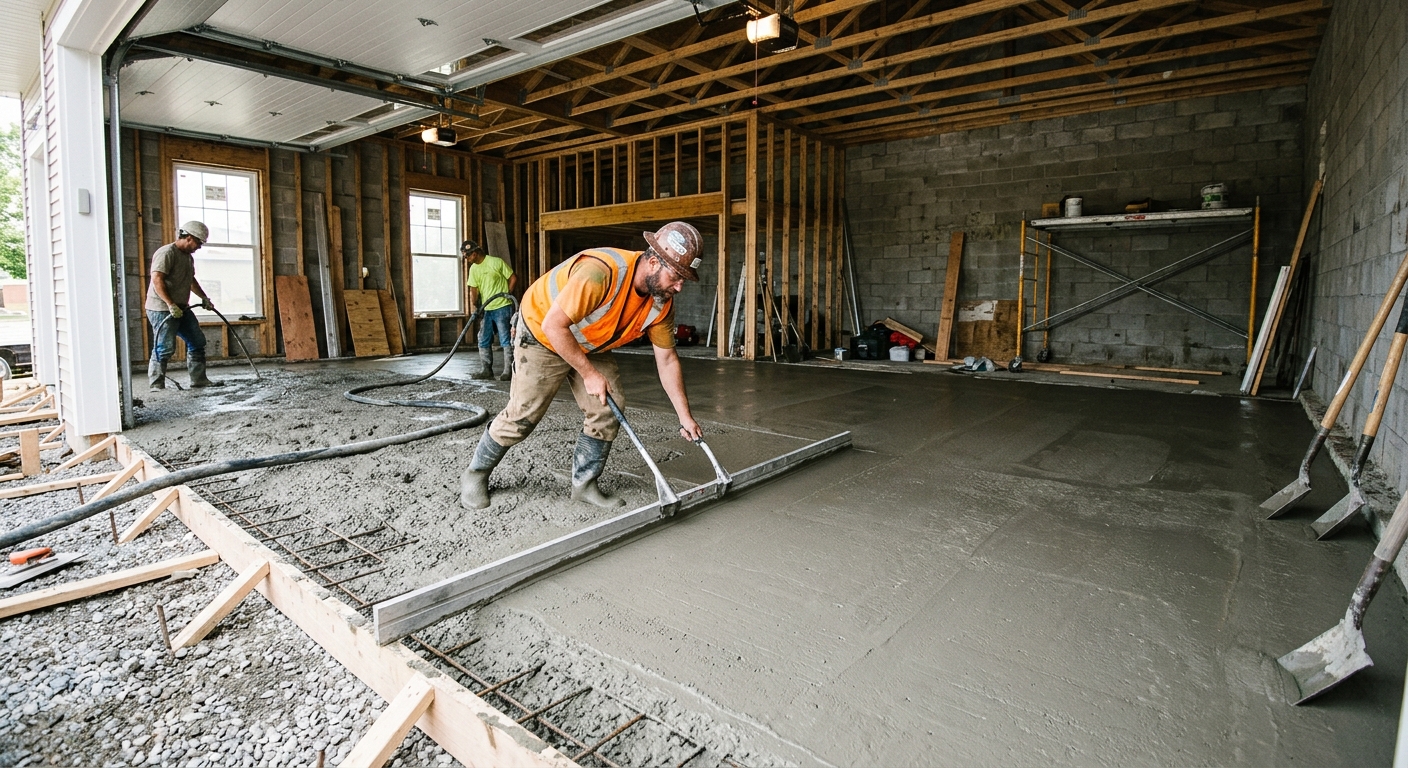
| Garage floor (interior slab) |
500 sq ft (approx. 20 ft x 25 ft) |
Vapour barrier (if specified), fibre/wire reinforcement as needed |
Float finish; optional broom finish texture |
$9,500–$14,500 |
| Foundation footings (structural, below frost) |
Per lineal foot (often 60–120 ft total) |
Excavation, rebar, concrete below frost line (~450 mm / 18"+ practice) |
Structural concrete formwork as required |
$2,600–$4,200 |
Prices are estimates only and vary by project scope, site access and material selection.
What affects the price of concrete work in North Delta
In North Delta and across the Lower Mainland–Southwest, the same “size” project can come in 30–50% apart because quotes often assume different levels of base prep, reinforcement, and climate protection. In other parts of British Columbia, labour and scheduling are also different—when crews can’t pour during the cold/wet window, contractors spend more on heating, protection, and rescheduling, which raises unit pricing. Even within the Lower Mainland–Southwest, saturated ground and drainage requirements can add real cost because you’re not just pouring concrete; you’re building a stable, drained base that can survive cycles of moisture and freezing conditions.
Here, frost line depth and freeze–thaw cycles dictate every spec. Exterior slabs and edges need air-entrained concrete to manage scaling risk, and footings must extend below the design frost depth (Lower Mainland practice commonly assumes about 450 mm / 18" for planning, but contractors often excavate deeper depending on soils and structural needs). Colder regions have shorter pour seasons and higher cold-weather curing costs, which is why you may see bigger price gaps when comparing with inland or northern BC—insulating blankets, heaters, and longer protection time add costs. In North Delta specifically, coastal-wet soils also mean more attention to compacted granular base and subgrade drainage, and de-icing salt use makes sealing more important to reduce spalling and surface scaling over time.
Two common local examples: upgrading from a standard broom driveway to stamped concrete typically moves you from roughly $18–$28 per sq ft to the stamped band of $22–$36 per sq ft, because you pay for stamping labour, colouring, and extra placement precision. Similarly, if excavation is harder due to soft ground near older lanes/drive approaches, the concrete “material” may look affordable, but excavation, haul-away, and thicker base prep can push the total closer to the higher driveway band. If your home is older, drainage may have been informal—fixing that slope and installing proper drainage bedding can protect the new slab and avoid costly repairs.
| Price Factor |
Why It Matters |
Cost Impact |
| Frost line depth — determines footing depth and form height |
Footings and thickened edges must be below frost to prevent heave. |
Can add excavation/formwork time; increases structural portion of the budget. |
| Site preparation — excavation, grading, compacted granular base |
Wet coastal soils require correct base thickness and drainage detailing. |
Major driver in North Delta; affects both labour hours and material volume. |
| Reinforcement — rebar or wire mesh requirement |
Controls slab movement and reduces cracking, especially on driveways and thicker slabs. |
Costs more upfront but reduces future patching and “cheap repair” cycles. |
| Mix design — air-entrainment and compressive strength spec |
Air-entrainment helps concrete survive freeze–thaw and scaling risk. |
Higher-spec mix slightly raises concrete material cost. |
| Finish type — broom vs. stamped vs. exposed aggregate |
Decorative finishes require extra steps and higher placement accuracy. |
Often shifts you into the higher $22–$36/sq ft range for stamped. |
| Pour size and concrete truck access to site |
Limited access means more labour to stage materials and place efficiently. |
Can increase pumping/hand-carry labour; delays can add mobilisation time. |
| Cold-weather curing precautions — heating and blankets |
Cool, damp conditions slow strength gain and increase surface damage risk. |
Adds cost when pours occur near the shoulder season. |
| Control joint pattern and sealing cost |
Joints manage where cracks occur; sealing protects against moisture and salts. |
Sealing adds a line item, but can prevent premature scaling. |
Permits & regulations in British Columbia
In British Columbia, structural concrete work typically needs a building permit. That includes footings, foundation walls, grade beams, and other concrete that forms part of the structural system. Municipalities often require engineered drawings for these components, and review timelines can affect your project schedule. For concrete flatwork—driveways, patios, and walkways—permits are usually not required unless the work changes lot grading, impacts impervious surface coverage limits, or affects municipal right-of-way requirements (for example, work near boulevards, drainage tie-ins, or curb/sidewalk interfaces). Because each site can have unique constraints, it’s smart to confirm with the local authority before breaking ground.
For contractor compliance, start by verifying insurance and coverage before you sign. In BC, ask for a current certificate of liability insurance showing your jobsite name/address and coverage limits appropriate for concrete work. Also confirm worker coverage: many homeowners require evidence of WCB/WorkSafe BC coverage (or the contractor’s applicable exemption status, if they truly qualify). If a contractor can’t provide documentation, or if they only “promise” coverage, that’s a red flag.
Step-by-step for a North Delta homeowner: (1) request the contractor’s BC licence/business details, (2) ask for a certificate of insurance and confirm it’s current, (3) request proof of WorkSafe BC coverage/clearance as applicable, (4) ask for references on similar driveway and footing scopes, and (5) ensure the written quote clearly states whether permits are included and who is responsible for them.
Getting concrete right in North Delta's freeze-thaw climate
Concrete failure in North Delta is usually about moisture management and protection of the paste—not just “cheap concrete.” The most common problems you’ll see in a coastal-wet, freeze–thaw-influenced climate are scaling/spalling on exterior slabs, random cracking from poor base support, and premature deterioration where de-icing salt meets surface water. The fix is to specify the job correctly from the ground up. First, base preparation: use compacted granular sub-base to the right depth for local soil conditions and frost considerations, and build drainage so water can’t sit under the slab. Second, mix design: exterior flatwork should use air-entrainment (commonly 5–7% air content for exterior exposure) and meet a minimum 32 MPa compressive strength spec so the concrete achieves durability under repeated wetting/cooling.
Third, control joints: spacing should limit random cracking and give the slab predetermined “break points.” Fourth, curing: plan for a minimum 7-day curing period under proper conditions; in cool, humid weather, curing blankets or sealers may be necessary to protect strength gain. Fifth, sealing: apply a penetrating sealer after cure (often around 28 days post-pour) to repel de-icing salts and reduce water penetration.
When homeowners skip these steps, they may save at first but pay later. For example, dropping air-entrainment can reduce short-term material costs, but it’s exactly what increases spalling risk when freeze–thaw cycles and salty meltwater combine. If you’re choosing between options, the price difference is often justified: stamped concrete may land in the $22–$36/sq ft band, but if you’re already repairing drainage and providing a stable base, that extra cost is about controlled finishing—not structural shortcuts.
| Spec |
Why It Matters in North Delta |
What to Ask For |
Impact if Skipped |
| Compacted granular base (depth?) |
Supports the slab and reduces pumping/potholing under freeze–thaw and rainfall saturation. |
Base depth and granular type; confirm grading and compaction testing approach. |
More settlement, uneven cracking, and early surface failure. |
| Air-entrained concrete mix (target air %?) |
Helps manage freeze–thaw pressure and reduces scaling/spalling on exterior slabs. |
Confirm air content target (commonly 5–7% for exterior flatwork) on the delivery ticket. |
Higher risk of scaling and spalling, especially with salt exposure. |
| Compressive strength (MPa rating) |
Strength gain under damp/cool conditions determines durability and surface resistance. |
Minimum 32 MPa and expected cylinder test/quality approach. |
Soft surface, increased wear, and weaker performance in wet seasons. |
| Control joints (spacing per ACI guidelines) |
Directs shrinkage cracking to planned lines so cracks don’t wander. |
Joint layout drawing/plan and timing of sawing or forming. |
Random cracking and patchy aesthetic/structural risk. |
| Minimum 7-day curing period |
Curing is critical for reaching design strength when evenings are cool and humidity is high. |
How they’ll protect concrete during the first week (blankets/cover/sealer timing). |
Reduced strength and higher likelihood of surface damage. |
| Penetrating sealer (when applied after cure) |
Repels moisture and de-icing salts, improving resistance to scaling. |
Confirm sealer type and schedule (commonly around 28 days post-pour). |
More water ingress, faster deterioration, and staining. |
How to choose a concrete work contractor in North Delta
Start with compliance checks that are simple and document-based. In British Columbia, verify the contractor’s business/BC registration details and request their certificate of liability insurance before any work begins—make sure it’s current and shows coverage for concrete construction activities. Next, confirm worker coverage through WorkSafe BC (or applicable clearance documentation). Even experienced crews shouldn’t be willing to start without proof; a legitimate contractor will provide it without pressure. For the homeowner, you can also request references for similar North Delta scopes (driveways, patios, and any footings/structural work if applicable) so you can judge workmanship and joint/finishing quality.
For pricing, ask for 2–3 itemised written quotes, not just lump sums. You want a breakdown that separates excavation/base prep, concrete supply, reinforcement, forming, finishing, and sealing/cure protection. Read exclusions carefully: confirm whether permit pull (if needed) is included, whether disposal/haul-away is part of the price, and whether forms/removal and patching tie-ins are included. A good quote will also specify slab thickness, reinforcement type (wire mesh vs rebar), and whether the mix is air-entrained for exterior exposure.
Warranty matters: ask for the workmanship warranty length, what it covers (cracking vs surface scaling), and whether the manufacturer’s product warranty applies to the concrete sealer or admixtures. Payment should be controlled—never pay more than 10–15% upfront, and hold back a portion until completion and cleanup are verified. Finally, demand a timeline in writing: start date, concrete delivery schedule, and estimated completion date based on curing windows in North Delta’s rainy/cool periods.
- Request current certificate of liability insurance (verify jobsite name/address where possible).
- Ask for WorkSafe BC coverage proof/clearance documentation.
- Confirm their scope includes compacted granular base and drainage provisions, not just the pour.
- Require slab thickness and reinforcement type/spec to be written in the quote.
- Ask for concrete delivery ticket details confirming air-entrainment for exterior work.
- Get a joint/control plan: spacing and how/when joints are cut.
- Confirm curing protection plan for cool, humid or rainy weather.
- Clarify sealing scope: product type and application timing after cure (if included).
- Check disposal/haul-away is included if excavation is required.
- Verify concrete truck access plan (pumping, chute placement, or hand-carry limits).
- Ask for a written warranty statement for workmanship and any product components.
- Use a payment schedule with a holdback until final grading, edges, and cleanup are accepted.
Concrete contractor red flags in North Delta: they won’t put air-entrainment and joint details in writing, they push for a large upfront deposit, they dismiss sealing as “unnecessary,” they refuse to show proof of insurance/WorkSafe BC coverage, or they schedule pours without a plan for cool nights, rain, or curing protection.
Frequently asked questions — concrete work in North Delta
How do I seal concrete to protect it in North Delta?
In North Delta, sealing helps because coastal moisture and de-icing salt can drive water into the surface pores, which increases scaling and spalling risk after freeze–thaw cycles. The best practice is to let the slab cure properly first—typically wait until about 28 days post-pour—then apply a penetrating sealer designed for exterior concrete. Before sealing, the surface should be clean and dry (power wash and allow adequate drying time). Ask your contractor what type of sealer they use and whether they’ll confirm moisture conditions on site. If you’re sealing a driveway or walkway that sees winter salts, sealing is one of the most cost-effective add-ons, and it’s usually priced alongside the flatwork project rather than as an afterthought.
What is the difference between concrete and cement?
In British Columbia, people often use the words “cement” and “concrete” interchangeably, but they’re not the same. Cement is one component of concrete—a binding powder (typically Portland cement). Concrete is the full engineered mix: cement plus water, aggregates (sand and gravel/crushed stone), and often admixtures. For exterior work in North Delta, the mix design is key: contractors should specify air-entrainment and appropriate strength so the hardened concrete can handle freeze–thaw and wet conditions. This is why quotes for “the same slab” can differ even when the thickness looks identical—air content targets and curing protections impact both durability and long-term appearance.
How much does concrete work cost in North Delta?
Concrete costs in North Delta generally follow Lower Mainland–Southwest unit pricing because labour, material sourcing, and scheduling are similar across the Vancouver–Surrey–Abbotsford corridor. For example, concrete driveway work commonly falls in a range of about $18–$28 per sq ft for standard broom-finish flatwork. If you want decorative options like stamped concrete, that typically lands higher—often in the $22–$36 per sq ft band—because of added finishing labour, colouring steps, and placement precision. Patio and walkway projects usually price around $16–$26 per sq ft. Your final total can be higher if excavation and drainage are more involved or if the site has limited concrete truck access.
How deep must footings be for North Delta's frost line?
North Delta’s frost protection is based on the design frost depth assumption used for local practice. In the Lower Mainland–Southwest, contractors commonly plan for a frost depth around 450 mm / 18", with footings placed below that to reduce frost heave risk. However, the actual footing depth on your site can vary based on soil conditions, structural design requirements, and how drainage performs during wet seasons. Because footing depth and thickened edges must match engineered drawings for structural work, don’t rely on generic numbers alone—your permit/engineering package (for structural foundations/footings) should specify the required elevations. When you’re comparing quotes, make sure every contractor states excavation depth/form heights and follows the same design.
Why does concrete crack in North Delta and how is it prevented?
Cracking is common in concrete, especially in exterior flatwork, because concrete shrinks as it cures and because it expands/contracts with moisture and temperature changes. In North Delta, freeze–thaw cycles plus saturated base conditions can worsen movement if the sub-base isn’t built correctly. Prevention starts with a well-prepared, compacted granular base and proper drainage, followed by correct mix design (including air-entrainment for exterior exposure). Control joints are also essential: they create predetermined crack locations, usually with a spacing plan consistent with industry guidance. A contractor should also manage curing—minimum 7 days under the right conditions—so the slab develops strength before it’s exposed to cycles of wetting and cooling. Sealing later helps limit moisture ingress.
Stamped vs broom-finish concrete — cost difference?
Stamped concrete costs more than broom-finish because it requires additional processes: layout, stamp placement, release agent, colouring, and typically more labour-intensive finishing/coordination to keep edges crisp and joints neat. In North Delta, standard broom-finish driveway work often prices around $18–$28 per sq ft, while stamped concrete usually sits higher—commonly $22–$36 per sq ft—depending on pattern complexity and colour method. It’s worth the upgrade when you want a higher-end look and you’re already getting the right base prep, air-entrained mix, and correct jointing. If a quote for stamped concrete is only slightly higher than broom-finish, ask whether the contractor is skipping reinforcement, sealing, or curing protection—those shortcuts can show up as early deterioration or poor cracking control.