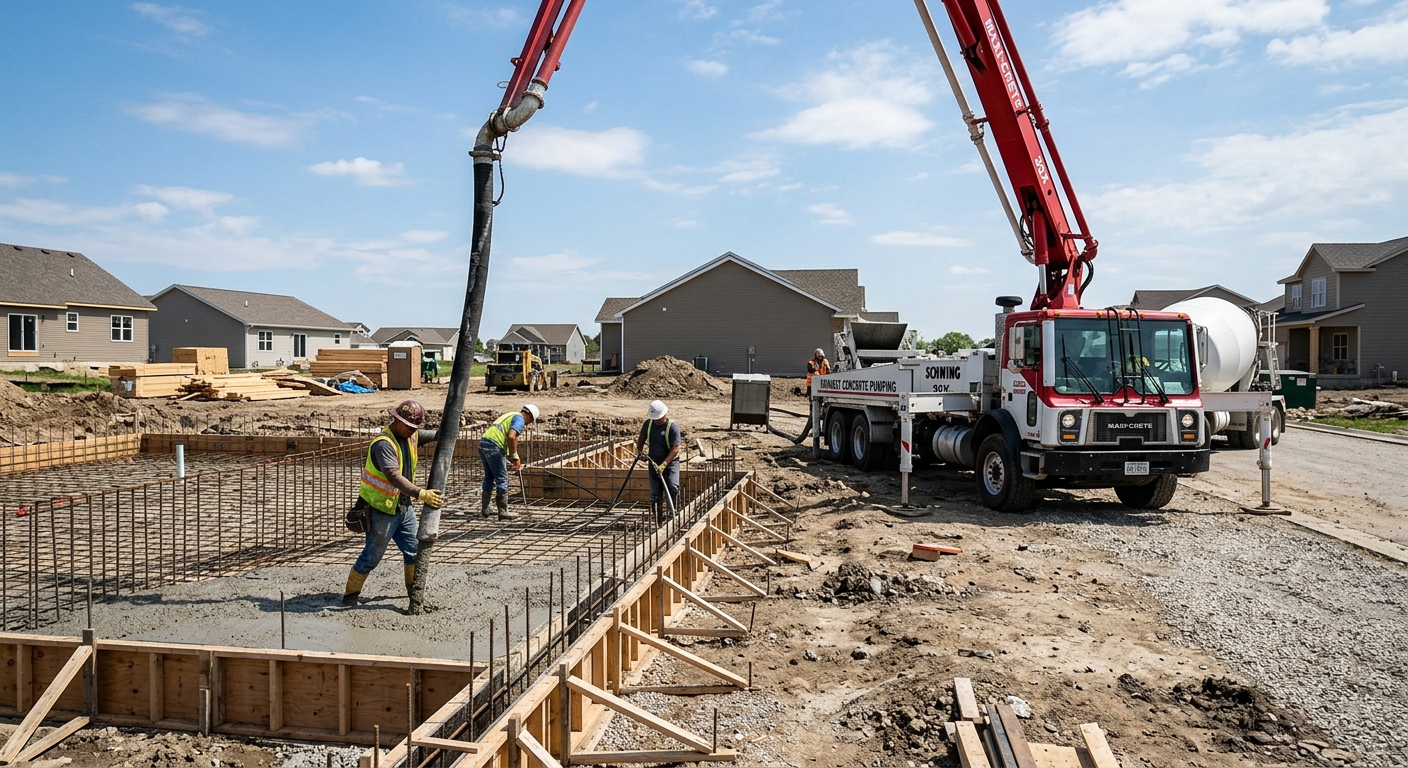
Concrete work options and costs in Sechelt
Sechelt homeowners typically choose concrete for durability and low maintenance—especially with the area’s damp coastal weather and frequent freeze–thaw cycles. In Sechelt, most neighbourhood building stock is family housing: single-detached homes make up about 75.3% of dwellings, and about 80.7% of households are owner-occupied (Statistics Canada, 2021 Census). That matters because driveways, patios, walkways, and interior garage slabs are the most common concrete projects we see, and owners often want flatwork that can handle wet winters, tire wear, and service access.
In the Lower Mainland–Southwest region, concrete pricing is shaped by a shallow but still important design frost line (commonly assumed around 450 mm / 18") and the need to protect foundations and slabs from freeze–thaw damage. Even though winters are milder than interior BC, saturated soils and heavy rainfall mean base preparation, drainage, and curing time can drive cost. We also face longer “wait-for-dry” stretches when rain bands hit, so contractors plan pours with blankets, sealers, and extended curing windows to reach design strength.
Trade demand is steady in areas like Wilson Creek / Port Stalashen, where older homes and coastal lots often require more aggressive site prep, thicker edges, and better drainage detailing. With that in mind, below is a practical comparison of common Sechelt concrete options before you choose finishes and spec details.
| Application |
Typical Size |
Key Spec |
Finish Option |
Price Range |
| Concrete driveway (standard broom finish) |
400–600 sq. ft. |
4–5" slab, compacted granular base, air-entrained mix, control joints |
Broom finish + optional sealer |
$18,500–$28,000 |
| Exposed aggregate driveway |
400–600 sq. ft. |
Air-entrained mix, proper curing to ensure even exposure, joints |
Exposed aggregate (brush/wash) finish |
$22,000–$34,000 |
| Stamped concrete driveway or patio |
300–600 sq. ft. |
Air-entrained mix, integral colour, saw-cut control joints |
Stamped pattern + seal coat |
$22,000–$40,000 |
| Plain concrete patio or walkway |
150–350 sq. ft. |
4" slab (typical), compacted base, air-entrained mix, joints as needed |
Float/trowel top + broom texture for traction |
$4,200–$9,100 |
| Garage floor (interior slab) |
300–500 sq. ft. |
4–5" slab, vapour considerations as applicable, mesh or rebar, joints |
Broom or smooth-finish top |
$6,500–$13,500 |
| Foundation footings (structural, below frost) |
Varies by house |
Concrete placed below design frost depth, engineered rebar and formwork |
Structural finish (not decorative) |
$18,000–$36,000 |
Prices are estimates only and vary by project scope, site access and material selection.
What affects the price of concrete work in Sechelt
In the Lower Mainland–Southwest, two quotes for the “same” concrete job can still vary by 30–50% because every cost driver is multiplied by site conditions and timing. Differences come from footing depth and mix specs needed for local frost protection, the amount of excavation and disposal, reinforcement, and how long the contractor must hold crews and equipment while rain cools the site. Even labour availability can shift in coastal seasons—when trucks and finish crews are booked, mobilisation costs and scheduling premiums show up in the final number.
Here’s the part homeowners often miss: frost and freeze–thaw cycles dictate every exterior spec. In colder regions, deeper excavations and cold-weather curing raise costs; in coastal BC, the frost depth is commonly around 0.5–1.2 m, but footings and thickened edges still need to be placed below the design frost line to prevent frost heave. Exterior slabs should use air-entrained concrete (often targeting about 5–7% air content) and correct jointing to control cracking and scaling. When de-icing salt is used, surface protection becomes essential—sealing is usually the difference between a slab that looks good for years versus one that begins spalling sooner.
Concrete examples in Sechelt: (1) On older lots—28.1% of homes were built before 1981 (Statistics Canada, 2021 Census)—we often remove unsuitable fill or re-grade down to competent base, which can add thousands even if the driveway area stays the same. (2) A broom finish driveway may land near the $18–$28 band, while adding stamped texture and colour can jump toward the $22–$36 band because of labour-intensive forming, texture release, and extra seal coats. (3) If access forces smaller placement loads or extra pump/telebelt time, costs rise even for “standard” flatwork.
| Price Factor |
Why It Matters |
Cost Impact |
| Frost line depth — determines footing depth and form height |
Footings must sit below design frost depth to prevent heave |
Higher excavation, deeper forms, more rebar; can add several thousand |
| Site preparation — excavation, grading, compacted granular base |
Wet coastal soils require drainage and proper base thickness |
More granular, haul/disposal, compaction and time; often one of the biggest variables |
| Reinforcement — rebar or wire mesh requirement |
Controls cracking and improves performance for driveways and slabs |
Material cost plus additional labour for placement and chairs |
| Mix design — air-entrainment and compressive strength spec |
Air content helps concrete survive freeze–thaw cycles |
Usually modest material premium, but it prevents costly repairs |
| Finish type — broom vs. stamped vs. exposed aggregate |
Complex finishes require extra steps, tools, and careful timing |
Labour-intensive; stamped/exposed typically increases total cost noticeably |
| Pour size and concrete truck access to site |
Access limits placement method and slows production |
May require pump/telebelt or multiple loads; drives mobilisation costs |
| Cold-weather curing precautions — heating and blankets |
Cool, damp conditions can slow strength gain and increase surface issues |
Extra materials and labour; can add cost during shoulder-season pours |
| Control joint pattern and sealing cost |
Joints manage cracking; sealing improves surface durability with salts |
Small material cost, but requires correct workmanship timing |
Permits & regulations in British Columbia
In British Columbia, structural concrete work—things that are part of a building’s load path—normally requires a building permit and is often supported by engineered drawings that the municipality reviews. This typically includes foundation footings, foundation walls, and grade beams. For flatwork like patios, walkways, and many driveway replacements, a permit often is not required by default, unless the project affects lot grading, impacts stormwater management, crosses municipal standards around impervious surface coverage, or touches a right-of-way or curb/sidewalk interface. Because rules can vary by the local jurisdiction and lot conditions, confirm with the local authority before breaking ground.
When hiring in Sechelt, verify contractor compliance step-by-step:
- Ask for their liability insurance certificate (COI) showing the coverage limits and effective dates.
- Check WSB/WCB coverage (WorkSafeBC) status; request proof of clearance or current registration.
- Confirm contractor credentials using relevant online registries for BC businesses where applicable, and ensure the company name on the quote matches the COI.
- Request references for similar-size projects (driveway/flatwork or footings), and confirm timelines in writing.
- If the work is structural, ensure the permit/engineer steps are included in the scope so you’re not exposed to rework.
Getting concrete right in Sechelt's freeze-thaw climate
Concrete failures in Sechelt usually start with water movement and temperature swings: saturated base and insufficient protection lead to scaling and spalling, especially when de-icing salt gets tracked onto driveways. The way to avoid this is to spec the full system—from base to mix to curing—rather than focusing only on surface appearance. First, base preparation: use compacted granular sub-base to the right depth for local soil and subgrade conditions, then shape for drainage so water doesn’t pond under the slab. Second, mix design: for exterior flatwork, specify air-entrained concrete with typical target air content around 5–7% and a minimum 32 MPa compressive strength (or higher if required by the engineered design). Third, control joints: install joints on a planned spacing pattern so cracking stays controlled and doesn’t become random. Fourth, curing: plan for at least 7 days of proper curing conditions, with extra protection (curing blankets and time) if cold, windy, or rainy weather slows strength gain. Finally, sealing: apply a penetrating sealer around 28 days post-pour to help repel salt and water from the surface.
Ask technical questions to avoid the most common problem—spalling from inadequate air-entrainment. If someone proposes “basic mix” without confirming air content targets, that’s a warning sign. As a cost example, a plain broom-finished driveway may fit the $18–$28 per sq. ft. band, while stamped concrete can move toward the $22–$36 range; that difference is often justified when joints, curing, and sealing are handled correctly. If a contractor cannot explain the mix and joint plan, paying extra for decorative work won’t protect you from future surface deterioration.
| Spec |
Why It Matters in Sechelt |
What to Ask For |
Impact if Skipped |
| Compacted granular base (depth?) |
Proper base reduces pumping and helps manage coastal moisture |
Granular depth and compaction method; drainage grade details |
Settling, cracking, and accelerated freeze–thaw damage |
| Air-entrained concrete mix (target air %?) |
Freeze–thaw survival depends on correct air void structure |
Concrete supplier mix design showing target air content |
Scaling and spalling within a few winters |
| Compressive strength (MPa rating) |
Ensures durability and strength gain despite cool, wet days |
Minimum 32 MPa (or higher per design), cure plan to reach strength |
Surface wear, reduced longevity, higher repair risk |
| Control joints (spacing per ACI guidelines) |
Controls where cracks form under thermal movement |
Planned joint layout and saw-cut timing |
Random cracking and water intrusion at cracks |
| Minimum 7-day curing period |
Cool nights and humidity slow curing in coastal BC |
How curing blankets/sealers are used and scheduled |
Weak surface layer, dusting, and premature deterioration |
| Penetrating sealer (when applied after cure) |
Helps repel moisture and de-icing salt on exterior slabs |
Sealer type and application timing around 28 days post-pour |
Faster staining, scaling, and salt-related surface damage |
How to choose a concrete work contractor in Sechelt
Start by confirming the contractor’s British Columbia compliance and insurance. Ask for their certificate of liability insurance and verify the policy covers the work at your address (Sechelt). For labour coverage, request proof of current WorkSafeBC registration/clearance (coverage for workers is essential when crews are on site). Then verify the company credentials match the quote and receipt—name consistency matters if a claim needs to be filed.
Next, get 2–3 itemised written quotes instead of one lump-sum number. A good concrete quote breaks labour and materials into line items: excavation, granular supply and compaction, forms, rebar/wire mesh, concrete supply (including air-entrainment spec), finishing labour, saw cutting, curing methods, and sealers. Also confirm what’s included/excluded: permit pull (if required for structural work), disposal/haul-away, water management, and traffic control.
Warranty and scheduling are just as important as the mix. Look for a clear workmanship warranty length and what it covers (surface scaling, cracking control, joint workmanship). Ask whether product/manufacturer warranties are included and whether they’re transferable to you as the homeowner. On payment, avoid large deposits; a common rule is no more than 10–15% upfront with the balance tied to milestones. Finally, insist on a start date and completion estimate in writing—coastal rain and cold nights can affect curing, so the timeline should reflect realistic weather planning.
- Itemised labour vs. materials breakdown (not just one total).
- Concrete mix spec including air-entrainment targets for exterior slabs.
- Planned joint layout (spacing and saw-cut timing).
- Base prep details: granular type, depth, compaction method.
- Curing plan: blankets, re-wetting approach (if any), and duration.
- Sealer type and “when it’s applied” (around 28 days post-pour).
- Confirm disposal/haul-away is included if excavation is required.
- Access notes: truck approach, pump/telebelt needs, staging area.
- Verify COI limits and start/end dates on insurance.
- Request WorkSafeBC coverage proof (registration/clearance letter).
- Clear warranty wording and what voids coverage.
- Payment schedule with milestone-based progress holdback.
Concrete red flags we see in Sechelt: contractors who can’t explain air-entrainment or joint spacing, quotes that omit base depth/compaction details, “cheap” mix substitutions after you approve colour/finish, requests for large upfront payments without a written schedule, and no written warranty terms for workmanship or curing/finishing steps.
Frequently asked questions — concrete work in Sechelt
How long does a concrete driveway last?
In Sechelt and the Lower Mainland–Southwest, a well-built driveway can often last 15–25 years (and longer) when the slab is designed for freeze–thaw exposure, drainage is correct, and the contractor uses an air-entrained mix with proper jointing. The key is not just the concrete thickness—it’s the base prep and curing. If de-icing salts are used in winter, sealing becomes more important, especially for colder, wetter stretches where moisture can sit in surface pores. When comparing quotes, don’t only look at price bands like $18–$28 for standard driveways—ask what’s included for compacted granular depth, rebar/mesh, saw-cut control joints, and whether a penetrating sealer is planned after cure.
What is air-entrained concrete and why does it matter here?
Air-entrained concrete has microscopic air bubbles intentionally included in the mix so that, during freeze–thaw cycles, water expansion pressure is relieved. In Sechelt’s coastal-wet climate, your slab is regularly exposed to saturation and temperature swings, so correct air content is one of the biggest safeguards against scaling and spalling. If a contractor can’t provide the mix design showing target air content (commonly about 5–7% for exterior flatwork), you’re taking on unnecessary risk. This is also why “lowest bid” can cost more later: repairs in a driveway area often require removal and re-pour. When you’re budgeting, this mix spec cost is usually smaller than the difference you’d pay to redo the work—especially on driveway options that fall in the $22–$36 range for more decorative finishes.
How do I prepare the base for a concrete slab?
Base preparation is where most driveway and walkway longevity is won or lost in Sechelt. The process should include removing unsuitable topsoil/fill, excavating to the required subgrade and frost-protected configuration, then installing and compacting a clean granular base in lifts to achieve the specified thickness and density. Because coastal rainfall can keep soil saturated, a good contractor also grades for drainage and avoids creating low spots where water will pond under the slab. You can ask for specifics: granular depth, compaction method, and whether any sub-drainage is needed for your lot. Quotes should reflect this work—if a proposal looks too low for a project that needs regrading and granular replacement, the contractor may be cutting corners that later show up as settlement cracks or damp-driven surface scaling.
How do I compare concrete quotes?
To compare quotes fairly in Sechelt, ask for itemised line items and verify that specs match, not just totals. Compare: (1) slab thickness and whether the base depth and compaction are described, (2) reinforcement (mesh vs. rebar and placement method), (3) concrete mix (air-entrainment targets and minimum compressive strength), (4) finish process (broom vs. stamped/exposed aggregate), and (5) curing and sealer timing. It’s normal for the same driveway size to fall within bands like $18–$28 for standard work, but stamped options often shift toward $22–$36 because of additional labour and careful finishing. Watch for exclusions: disposal/haul-away, saw-cut control joints, and whether the contractor plans for rainy or cool periods. If two quotes differ by 30–50%, ensure the scope and specs are truly aligned before deciding.
Can concrete be poured in cold weather in Sechelt?
Yes, concrete can be poured in cold weather in Sechelt, but it must be planned. Coastal BC winters can still bring cool nights and damp conditions that slow curing. Contractors typically protect the slab with curing blankets and may use cold-weather precautions so the concrete reaches design strength safely. The right approach depends on temperature at placement and during the first days of curing, as well as the mix and scheduling. If the contractor proposes a pour without a curing plan—especially for exterior slabs—cracking risk and surface durability can suffer. When you’re budgeting, cold-weather precautions can add cost, but the alternative is often premature wear and a shortened lifespan.
How do I maintain concrete in Sechelt's freeze-thaw climate?
Maintenance in Sechelt is mostly about keeping water and salts under control. Start with a proper seal: for many exterior flatwork projects, a penetrating sealer is applied after cure (commonly around 28 days post-pour) to help repel moisture and reduce salt-related wear. During winter, use sand instead of heavy salt where possible, and avoid letting meltwater sit in depressions. Keep gutters and downspouts directing runoff away from the slab and monitor for settlement or drainage issues near edges and joints. Small maintenance tasks—like cleaning debris from control joints and re-checking sealing intervals—can prevent water paths from forming. If you have a stamped driveway or patio, re-sealing becomes even more important to maintain colour and surface protection.