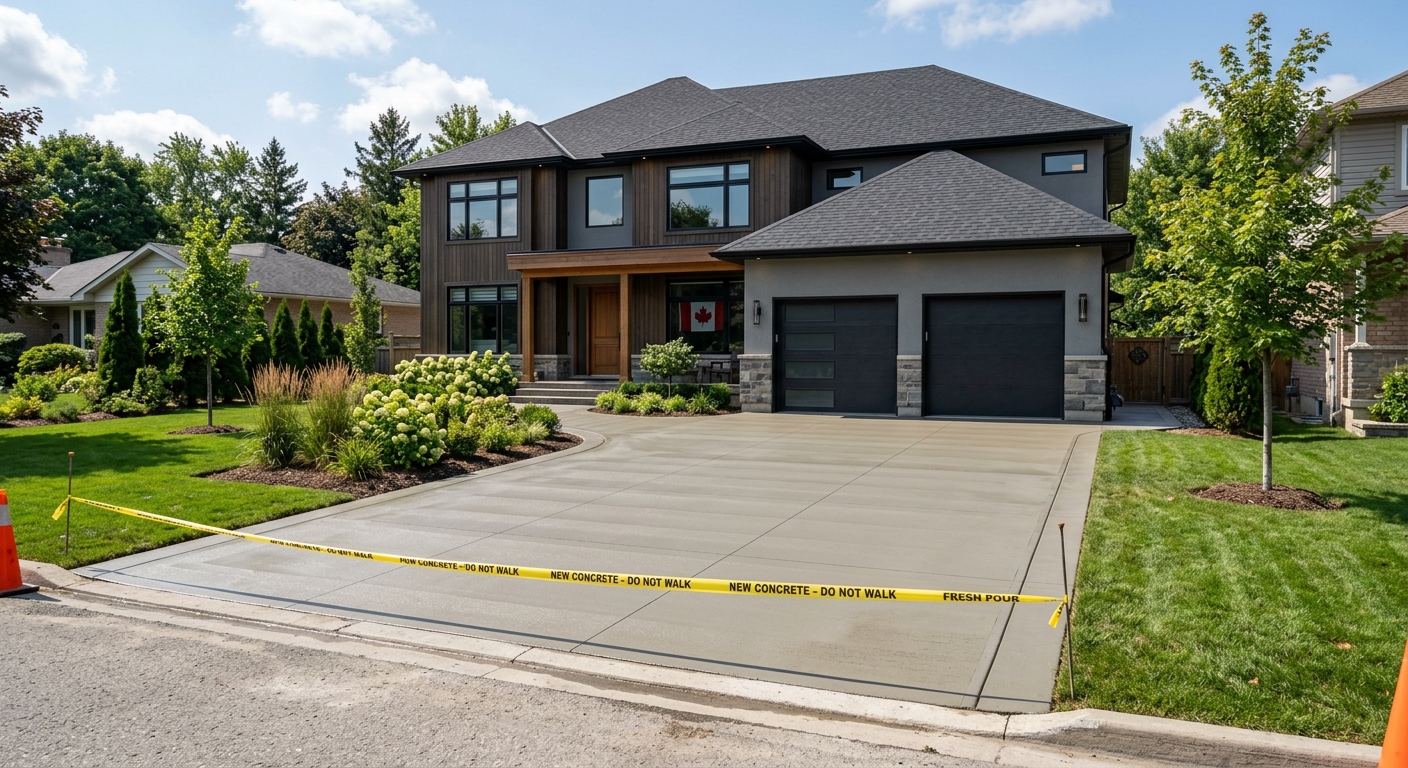
Concrete work options and costs in Queens Park
In Queens Park, concrete work is a practical choice for driveways, patios, walkways and foundation elements because the area sits in the Lower Mainland–Southwest, where winters are mild but rain and occasional freeze–thaw cycles still stress exterior surfaces. With a small city population (2,781 in the 2021 Census) and a housing mix that includes many single-detached homes—often the type that gets regular driveway and patio upgrades—there’s steady demand for flatwork and foundation-related concrete.
Pricing here is shaped by the frost-protection approach used by local crews. Even though coastal BC typically has a shallow frost depth, concrete contractors still place footings and thickened edges below the design frost depth (often in the ~0.5–1.2 m range for coastal BC) to limit frost heave. Add saturated soils from frequent coastal rainfall, and your quote starts to reflect drainage, compacted granular base, and the use of air-entrained mixes to manage cracking and scaling.
Labour availability also affects cost in Queens Park and nearby corridors where crews are booked around the best weather windows. In low periods—especially when persistent rain delays base prep—mobilization and scheduling can run higher. If you’re planning work near the commuter-heavy edges of the city and the broader Vancouver–Surrey–Abbotsford building market, such as around the transit and commercial nodes off major routes, expect higher competition for finishing crews.
Below is a realistic comparison of typical concrete options and what drives their costs, so you can line up apples-to-apples before you request site measurements.
| Application |
Typical Size |
Key Spec |
Finish Option |
Price Range |
| Concrete driveway (standard broom finish) |
12 m × 3 m (36 m²) |
Air-entrained mix, control joints, compacted granular base |
Broom finish, control-joint layout |
$18,000–$28,000 |
| Exposed aggregate driveway |
12 m × 3 m (36 m²) |
Air-entrained mix, proper curing to avoid surface haze |
Exposed aggregate (washed finish) |
$22,000–$34,000 |
| Stamped concrete driveway or patio |
60 m² (driveway + apron) or 40 m² patio |
Air-entrained mix, release agent, integral colouring |
Stamp pattern + colour |
$22,000–$42,000 |
| Plain concrete patio or walkway |
4 m × 6 m (24 m²) |
Minimum 32 MPa, control joints as needed |
Float/steel trowel or light broom |
$16,000–$26,000 |
| Garage floor (interior slab) |
7 m × 3 m (21 m²) |
Vapour barrier (as required), reinforcement per design |
Float and seal (optional) |
$10,000–$18,000 |
| Foundation footings (structural, below frost) |
Varies by home (typical 12–18 m linear) |
Below frost depth, rebar cage, engineered bearing |
Structural formwork and placement |
$2,400–$4,500 |
Prices are estimates only and vary by project scope, site access and material selection.
What affects the price of concrete work in Queens Park
In the Lower Mainland–Southwest, it’s common to see quotes for the “same” concrete job swing by 30–50%. The gap usually isn’t the concrete itself—it’s everything that has to be done around it: excavation and haul, drainage, reinforcement detailing, mix design, curing controls, and the time spent waiting out rain or cold nights.
Two technical drivers matter immediately in Queens Park. First, frost-protection details still dictate footing and thickened-edge depth. Local practice typically assumes a frost depth around 450 mm / 18" for engineered design decisions, then places footings and supporting elements below the design frost level to prevent freeze–thaw damage and frost heave. Second, freeze–thaw cycles and saturated soils require an exterior-ready spec: air-entrained concrete with proper control joints to reduce cracking and surface scaling. Those requirements are why exterior work often lands in the $18–$28/m² range for driveways and why thinner “cheap” mixes can’t compete on durability.
Cold-weather curing precautions also affect cost. Even in coastal BC, if you’re pouring late season, crews may need curing blankets, temperature monitoring, and sometimes short-term enclosure—adding labour and materials. De-icing salt is another local reality; it accelerates spalling if the surface isn’t properly cured and sealed, which is why sealing after the pour becomes part of many good quotes.
Concrete examples from Queens Park that change pricing: (1) a driveway with poor drainage and wet subgrade typically adds extra granular excavation and a thicker base (raising cost); (2) a stamped or exposed aggregate surface increases placement time, layout labour, and material handling (often shifting a driveway from the standard broom tier up toward the $22–$36/m² decorative band). On older housing lots with established landscaping, removal and reinstatement can add hundreds to thousands of dollars—sometimes more than the difference between finishes.
| Price Factor |
Why It Matters |
Cost Impact |
| Frost line depth — determines footing depth and form height |
Footings must extend below the design frost level to prevent heave and cracking |
Higher excavation and formwork; can increase total foundation-related costs materially |
| Site preparation — excavation, grading, compacted granular base |
Proper base thickness and drainage reduce settlement and surface failure |
More haul and labour when soil is wet, soft, or contaminated |
| Reinforcement — rebar or wire mesh requirement |
Controls cracking patterns, especially for driveway edges and slabs |
Material + labour time; mesh placement requires careful cover and tying |
| Mix design — air-entrainment and compressive strength spec |
Air entrainment helps exterior slabs survive freeze–thaw; strength meets durability needs |
Minor material uplift but can significantly reduce warranty risk |
| Finish type — broom vs. stamped vs. exposed aggregate |
Finishes change labour time, sequencing, and curing/cleaning needs |
Decorative work typically costs more per square metre than standard broom |
| Pour size and concrete truck access to site |
Access affects pump/hoses, manpower, and pour logistics |
Pump fees, extra labour and time if access is tight |
| Cold-weather curing precautions — heating and blankets |
Ensures concrete reaches strength gain and proper surface durability |
Added materials and monitoring; especially if nights are cool |
| Control joint pattern and sealing cost |
Joints manage cracking; sealing helps repel de-icing salts and water |
Sealing and sawcut/layout add cost, but they protect the surface |
Permits & regulations in British Columbia
In British Columbia, it’s important to separate structural concrete from decorative flatwork. Structural concrete work—such as footings, foundation walls, grade beams and other elements that support the building—generally requires a building permit and, in many cases, engineered drawings reviewed through the municipal process. Concrete flatwork like driveways, patios, and walkways usually does not require a permit unless it involves lot grading, changes to impervious surface coverage limits, affects drainage in a way the municipality regulates, or impacts the municipal right-of-way. Because requirements can depend on how the work affects stormwater and setbacks, you should confirm with the local authority before breaking ground.
Before signing, verify three practical items for any concrete contractor doing work in Queens Park (and across BC). First, confirm they carry liability insurance—request a current certificate of insurance. Second, ask for proof of worker coverage through WSIB/WCB (depending on their coverage structure); a legitimate contractor can provide documentation. Third, verify their business is properly registered and licensed where applicable for their scope—then request references for similar-scale pours in the Vancouver–Surrey–Abbotsford area.
Step-by-step homeowner checks: (1) search the contractor’s business name and trades listings online; (2) ask for a certificate of insurance and check the effective dates; (3) request clearance letters or coverage confirmations for WSIB/WCB; and (4) match references to your project type (driveway vs. footing) and ask about how they handled rain delays and curing.
Getting concrete right in Queens Park's freeze-thaw climate
Concrete failures in Queens Park usually come down to three things: water, temperature swings, and weak detailing. When exterior concrete isn’t built on a well-compacted base or lacks air-entrainment, freeze–thaw cycles and saturated subgrade can lead to scaling and spalling. In a rain-heavy coastal climate, poor drainage and thin granular support can also allow settlement, which shows up as trip edges and wider cracking over time.
To spec the job correctly, focus on five areas. (1) Base preparation: excavate to the correct depth for local soils and frost protection, then place compacted granular sub-base with proper drainage so water doesn’t sit under the slab. (2) Mix design: require air-entrainment—commonly 5–7% air content for exterior flatwork—plus a minimum 32 MPa compressive strength spec. (3) Control joints: a planned joint pattern limits random cracking and gives the slab a controlled weak line. (4) Curing: minimum 7 days curing under suitable conditions; cold nights often require curing blankets to keep surface temperatures stable. (5) Sealing: apply a penetrating sealer after the slab has cured (commonly around 28 days) to help repel de-icing salts and rainfall-driven surface deterioration.
Here’s a practical dollar example: if you’re choosing between a standard broom-finish driveway and a decorative option, the decorative stamp typically adds layout and finishing time. For a driveway that might be in the $18–$28/m² range for standard concrete, stamping can push total cost toward the $22–$36/m² tier—but the value holds only if the base, air content, joints and curing are handled the same way. Cutting corners on air entrainment or joint spacing costs far more later when spalling repairs become necessary.
| Spec |
Why It Matters in Queens Park |
What to Ask For |
Impact if Skipped |
| Compacted granular base (depth?) |
Reduces water pooling and settlement; supports slab through freeze–thaw and heavy rainfall |
Specify excavated depth and compacted granular thickness (plus drainage/grading plan) |
Soft spots, cracking, edge heaving and costly tear-out |
| Air-entrained concrete mix (target air %?) |
Exterior freeze–thaw resistance depends on proper air void system |
Request air content target (5–7% typical for exterior flatwork) and batch ticket confirmation |
Higher risk of scaling and spalling within a few seasons |
| Compressive strength (MPa rating) |
Ensures durability and strength gain through curing and weather changes |
Confirm minimum 32 MPa spec (and test/cylinder practices if required) |
Surface weakness, accelerated wear and microcracking |
| Control joints (spacing per ACI guidelines) |
Manages where cracks will form as the slab shrinks and expands |
Ask for joint spacing and a joint plan tied to slab dimensions |
Random cracking, uneven surfaces and difficult patch repairs |
| Minimum 7-day curing period |
Cold nights and rain can slow strength gain and affect surface quality |
Require curing method (blankets/thermal protection if needed) and curing duration |
Reduced strength, dusting, and premature surface deterioration |
| Penetrating sealer (when applied after cure) |
Repels water and helps protect against de-icing salt impacts |
Confirm sealer type and application timing after cure (commonly ~28 days) |
Faster staining, scaling and salt-driven spalling |
How to choose a concrete work contractor in Queens Park
Choosing the right contractor matters more in Queens Park than many homeowners expect, because exterior durability depends on what’s done before, during and after the pour. Start by verifying British Columbia compliance and basic protection. For liability insurance, ask for a current certificate of insurance naming you as the certificate holder when available. For worker protection, request proof of WSIB/WCB coverage (clearance letters or coverage confirmation) so you’re not left exposed if there’s an incident on your property. Then confirm the contractor’s business registration and licensing status for their scope, using their details on official provincial trade/business listings where applicable.
Next, get 2–3 itemised written quotes. You want a breakdown that separates excavation and disposal, base materials and compaction, reinforcement, formwork, concrete supply and placement, and finishing/sealing. A good quote will also specify whether permits are included (or excluded), whether pump/set-up is required, and what’s excluded—like removing existing concrete, tree roots, or restoring landscaping.
For warranty, ask for two pieces: a workmanship warranty length and any product/manufacturer warranty terms. Make sure it states what’s covered (cracking due to workmanship vs. normal shrinkage, for example) and whether the warranty is transferable to future owners.
Finally, check the payment schedule. Never agree to more than about 10–15% upfront; hold back a portion until the work is complete and cleaned up. Get the timeline in writing: start date, weather contingency, and completion estimate—especially important in BC where rain can disrupt curing and finishing windows.
- Confirm insurance: request a COI and verify dates and coverage limits.
- Confirm WSIB/WCB coverage (clearance letter or coverage confirmation).
- Ask for at least 3 references on similar work (driveways/patios vs. footings).
- Require an itemised quote (labour + materials), not a single lump sum.
- Check what’s included: base depth, compaction, drainage/grading, and disposal.
- Confirm concrete spec: air-entrainment and minimum compressive strength.
- Ensure reinforcement details match the slab type and loading.
- Ask for a control joint plan tied to slab dimensions.
- Ask how they handle rain and cold nights (curing blankets, sealing schedule).
- Clarify finish and sealer responsibilities (who supplies, who applies, and when).
- Look for a clear warranty statement (workmanship + product terms).
- Keep cashflow sensible: 10–15% max upfront and holdback until final sign-off.
Concrete red flags I often see in Queens Park include contractors who (1) won’t state air-entrainment and strength requirements, (2) propose “thin base” without discussing drainage, (3) skip or minimize control joint planning, (4) won’t provide proof of WSIB/WCB and liability insurance, or (5) pressure you into large upfront payments or an all-in price without a scope breakdown.
Frequently asked questions — concrete work in Queens Park
When is the best time to pour concrete in Queens Park?
In Queens Park and the Lower Mainland–Southwest, the best time to pour is typically during a dry stretch in late spring through early fall, when rain is less disruptive and night temperatures are easier to manage. While winters are milder than inland BC, you still need protection against freeze–thaw cycles—especially for exterior slabs and driveways. Contractors often schedule around storm forecasts so base prep stays firm and curing can proceed without prolonged wet surface conditions. If you’re planning exterior work near busy build seasons, lock in your date early because crews get booked quickly. Pricing can also change with timing: if you’re forced into a wetter period, expect extra labour for waterproofing/covering and slower progress, which can nudge costs toward the upper end of the $18–$28/m² driveway band.
How long does concrete take to cure?
Concrete curing is measured in strength gain, and the schedule depends on temperature and weather. As a homeowner benchmark in British Columbia, plan for a minimum curing period of about 7 days for general strength development under proper conditions—this is when many crews consider the slab “workable” for heavier handling. However, durability-focused items like sealing should be timed after adequate curing; a common approach is applying a penetrating sealer around 28 days after the pour to help repel rain and de-icing salt impacts. In cooler periods typical to Queens Park, crews may use curing blankets and temperature monitoring to avoid surface damage and strength slowdown. Don’t confuse “set” (when it stops looking wet) with “cure” (when it reaches intended strength and surface durability).
Do I need a permit for concrete work in British Columbia?
In Queens Park (and across BC), permits generally depend on what concrete work you’re doing. Structural concrete—such as footings, foundation walls, and grade beams that support a building—usually requires a building permit and often engineered drawings reviewed through the municipal process. Concrete flatwork like driveways, patios and walkways typically does not require a permit unless it impacts lot grading, stormwater/drainage requirements, impervious surface limitations, or the municipal right-of-way. The practical step is to confirm with the local authority before excavation, especially if you’re changing slopes or adding drainage adjustments. Also verify your contractor has liability insurance and WSIB/WCB coverage—those aren’t “permits,” but they’re essential homeowner protections.
Concrete vs pavers for a patio in Queens Park?
For many Queens Park homeowners, the choice comes down to maintenance, appearance, and how the base is built for water management. Concrete patios are often less expensive up front than pavers and provide a monolithic surface, especially when you include proper air-entrainment (for exterior exposure), control joints, and sealing. Pavers can offer easier spot repairs, but you still need excellent granular base preparation and edge restraints to prevent settlement and weed intrusion. In the Lower Mainland–Southwest, persistent rain and occasional freeze–thaw cycling make drainage and base compaction equally critical for both options. If you want a premium look, stamped concrete or exposed aggregate can land in a higher band than plain concrete—while standard plain patio work can fit the $16–$26/m² style range referenced for this region.
How long does a concrete driveway last?
A well-built concrete driveway in Queens Park can last decades, but “life span” depends on the details that address freeze–thaw and water. The biggest durability determinants are a properly compacted granular base, exterior air-entrained concrete with correct joint spacing, good curing, and sealing after cure. If your driveway is exposed to de-icing salts and it isn’t sealed, the surface can spall sooner, especially in wet conditions that soak the slab then cool down. For many homeowners, the most visible early issues are hairline cracking and minor scaling—then, if water gets under the slab or joints are poorly sealed, repairs become more extensive. A driveway built to the common regional exterior spec (air-entrainment, control joints, and curing discipline) is why contractors quote within the $18–$28/m² driveway range for standard broom work.
What is air-entrained concrete and why does it matter here?
Air-entrained concrete is a mix engineered to include tiny air bubbles that act like pressure relief valves during freeze–thaw cycling. In Queens Park and the Lower Mainland–Southwest, you may not have harsh winters, but you still get cycles where moisture in the concrete freezes and thaws. Without proper air entrainment, water expands inside the material and can push off the surface, causing scaling and spalling. That’s why good exterior bids specify air-entrainment and usually target around 5–7% air content for exterior flatwork, along with a strength requirement (commonly minimum 32 MPa). It also pairs with control joints and sealing after curing—sealing helps repel salt and water so the air-void system can do its job longer.