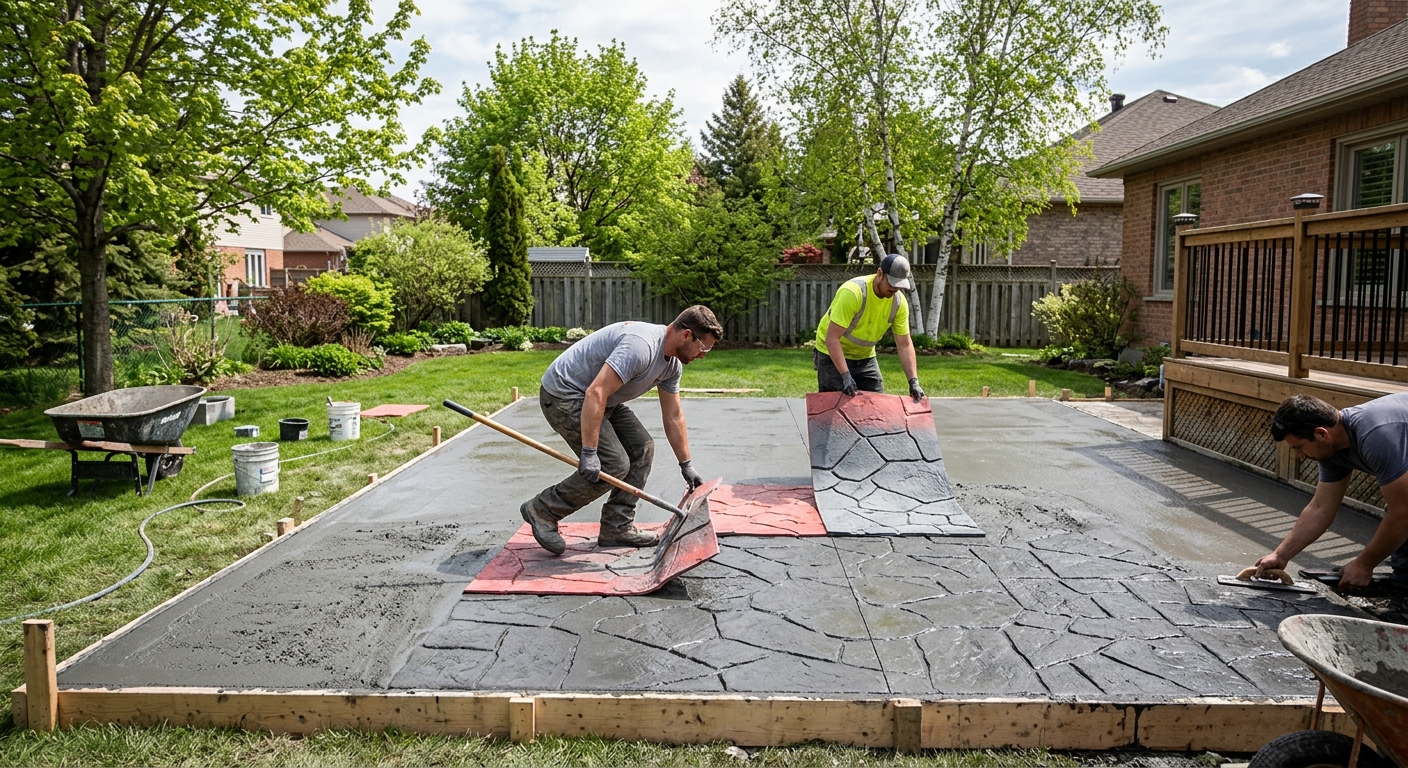
Concrete work options and costs in Historic Downtown
In Historic Downtown, British Columbia, homeowners typically choose concrete for driveways, patios, walkways and foundation work because it’s durable in a coastal-wet climate and performs well when it’s detailed for our shallow frost and frequent freeze–thaw cycles. Historic Downtown’s population is 9,910 (Statistics Canada, 2021 Census), which supports a steady stream of residential upgrades—especially around older neighbourhood blocks where people replace deteriorated slabs and improve drainage. A lot of the demand comes from single-detached homes and infill properties that want long-lasting flatwork and curb appeal.
Lower Mainland–Southwest conditions shape both design and cost. Local practice commonly assumes a frost depth around 450 mm (about 18") so exterior footings, piers and thickened edges sit below frost to reduce freeze–thaw heave. Saturated subgrades and heavy coastal rainfall make drainage and base preparation expensive but non-negotiable. Because rain and cool nights can slow curing, contractors often schedule around wet stretches and may use curing blankets or sealers for durability. In busy pockets—like the Gastown/Waterfront edge where access can be tighter—labour and traffic-safe scheduling can also influence pricing.
Below is a practical comparison of common options, so you can align the “why” (specs and access) with the “how much” before you request quotes.
| Application |
Typical Size |
Key Spec |
Finish Option |
Price Range |
| Concrete driveway (standard broom finish) |
400–500 sq. ft. |
Air-entrained mix, compacted granular base, control joints |
Broom finish + simple edging |
$18,000–$28,000 |
| Exposed aggregate driveway |
400–500 sq. ft. |
Air-entrained mix, correct base thickness, surface retarder + wash |
Exposed aggregate texture |
$22,000–$34,000 |
| Stamped concrete driveway or patio |
250–400 sq. ft. |
Air-entrained mix, reinforcement as required, integral colour |
Stamp pattern + colour hardener |
$15,000–$30,000 |
| Plain concrete patio or walkway |
200–350 sq. ft. |
Air-entrained exterior mix, compacted base, joints |
Float + broom/steel trowel finish |
$6,000–$14,000 |
| Garage floor (interior slab) |
400–600 sq. ft. |
Vapour barrier (as required), 25–35 MPa mix, reinforcement |
Steel-trowel or broom-surface |
$12,000–$20,000 |
| Foundation footings (structural, below frost) |
Varies by design |
Below frost depth, engineered rebar cage, proper excavation |
Structural concrete |
$3,500–$6,500 |
Prices are estimates only and vary by project scope, site access and material selection.
What affects the price of concrete work in Historic Downtown
In the Lower Mainland–Southwest and across British Columbia, quotes for the “same” concrete job can differ by about 30–50% because the scope isn’t identical—especially around frost protection, drainage, reinforcement, and curing on wet schedules. The concrete mix itself isn’t the whole story; what you prepare and how you place it often drives the labour cost. In older Historic Downtown properties, excavation can uncover unsuitable fill or require more granular base replacement, which pushes price upward.
Frost-line depth and freeze–thaw cycles dictate every exterior spec. Local practice often assumes a frost depth around 450 mm (18") so footings and thickened edges are placed below frost to prevent heave. Exterior slabs also need air-entrained concrete to handle repeated saturation and freeze–thaw cycles; without it, you risk scaling and spalling. Colder regions usually face longer cold-weather constraints and heavier heating/blanketing requirements—so those precautions can also show up here during shoulder-season pours when nights are cool and humidity stays high. De-icing salt (common on driveways) accelerates surface damage, so sealing is a durability cost that some homeowners defer—until the surface starts to fail.
Two examples from Historic Downtown: (1) a broom-finish driveway might land closer to the $18–$28 band when the base is already stable and truck access is straightforward; (2) switching to stamped concrete or exposed aggregate can add labour for colour, stamping, and finishing, but that added cost is justified when you want a higher curb-appeal finish that doesn’t just “look better,” it also holds up better when properly sealed. Foundation work can look “similar” across sites, yet excavation depth, reinforcement density, and disposal hauling are what push foundation/footing pricing into the $200–$350 per linear foot range.
| Price Factor |
Why It Matters |
Cost Impact |
| Frost line depth — determines footing depth and form height |
Exterior concrete must sit below design frost to prevent freeze–thaw heave. |
Higher excavation and deeper forming; can materially increase footing/edge costs. |
| Site preparation — excavation, grading, compacted granular base |
Wet, saturated or weak subgrade needs granular replacement and proper drainage. |
Extra hauling, compaction testing, and base materials raise total price. |
| Reinforcement — rebar or wire mesh requirement |
Cracking control and load capacity depend on reinforcement placement and thickness. |
More steel and labour-intensive placement; increases cost but improves performance. |
| Mix design — air-entrainment and compressive strength spec |
Air-entrainment protects against scaling in freeze–thaw conditions. |
Correct mix costs more than basic mixes; skipping it risks early failure. |
| Finish type — broom vs. stamped vs. exposed aggregate |
Complex finishes require additional steps and skilled crews. |
Stamped/exposed work often adds labour and materials; typically higher per sq. ft. |
| Pour size and concrete truck access to site |
Small access constraints can require pumping, smaller loads, or more labour handling. |
Truck/pump time and extra labour can shift pricing significantly. |
| Cold-weather curing precautions — heating and blankets |
Cold nights slow strength gain and can reduce durability if not managed. |
Blankets, heaters, and monitoring add cost, especially during shoulder months. |
| Control joint pattern and sealing cost |
Joints manage shrinkage cracking; sealing protects from salt and water ingress. |
Skipping or underdoing joints/sealer increases maintenance and early surface damage risk. |
Permits & regulations in British Columbia
In British Columbia, concrete is split into “structural” work versus typical decorative/flatwork. Structural concrete work—such as footings, foundation walls, and grade beams—generally requires a building permit, and municipalities often expect engineered drawings and inspections. Concrete flatwork like driveways, patios and walkways typically does not require a permit unless it affects lot grading, changes stormwater/infiltration, impacts impervious surface requirements, or involves works near a municipal right-of-way.
For Historic Downtown homeowners, the safest approach is: confirm the permit need before any excavation. Then verify the contractor before they break ground. Step-by-step, you can check:
- BC licence / contractor registration: look up the contractor via the applicable online registry listings used in BC.
- Liability insurance: request a certificate of insurance naming you (where appropriate) or confirming coverage limits for the project.
- WSBC/WCB coverage: confirm workers are covered through the correct workplace compensation coverage for contractors.
- Clearance letter (where required): ask for a current clearance letter or proof of good standing.
- References: request similar-scale recent jobs in the Lower Mainland–Southwest, ideally completed through wet-season conditions.
If the quote includes structural work, ask whether permits/inspections are included in the price or handled by the permit holder/engineer—so you don’t get surprises mid-project.
Getting concrete right in Historic Downtown's freeze-thaw climate
In Historic Downtown, concrete failures usually come down to water and temperature. When rain saturates a slab and the ground cycles through freezing and thawing, water expands in pores—especially at the surface—leading to scaling and spalling if the mix and curing weren’t right. The fix is not “stronger concrete” alone; it’s a complete system: base preparation, air-entrained mix, correct reinforcement/joints, and curing/sealing that matches our coastal humidity and cool nights.
To spec the job correctly, start with (1) base prep: compacted granular sub-base at the required depth for local soils and drainage. On wet sites, weak base or poor drainage costs more later because the slab settles or heaves. (2) mix design: for exterior flatwork, request air-entrainment—commonly around 5–7% air content—and a minimum 32 MPa compressive strength for durability. (3) control joints: establish a joint layout early so shrinkage cracks form where you want them. (4) curing: plan for at least 7 days curing under proper conditions; during cooler stretches, contractors may need curing blankets or procedures to protect early strength gain. (5) sealing: use a penetrating sealer applied after cure (typically around 28 days post-pour) to repel de-icing salts and reduce surface deterioration.
A practical dollar example: a plain broom-finish patio might price closer to the $16–$26 per sq. ft. band equivalent range, but skipping air-entrainment or sealing on a driveway can lead to early repairs that often cost more than the original price difference between broom and a higher-durability finish option. Spend the extra on the correct mix and sealing instead of trying to “patch” later.
| Spec |
Why It Matters in Historic Downtown |
What to Ask For |
Impact if Skipped |
| Compacted granular base (depth?) |
Reliable base prevents settlement and reduces freeze–thaw pumping under slabs. |
Confirmed excavation depth, compacted granular thickness, and drainage plan. |
Uneven settlement, early cracking, and water pathways that accelerate scaling. |
| Air-entrained concrete mix (target air %?) |
Air entrainment helps concrete survive freeze–thaw cycling and salt exposure. |
Documented air content target (commonly 5–7% for exterior flatwork) and mix type. |
Higher risk of spalling/scaling within a few winters. |
| Compressive strength (MPa rating) |
A strength target supports long-term durability, especially in cool, wet seasons. |
Minimum 32 MPa and curing/temperature protection plan if it’s cold. |
Slower strength gain and reduced surface durability and abrasion resistance. |
| Control joints (spacing per ACI guidelines) |
Joints direct cracking to manageable locations as the slab shrinks. |
Joint layout, spacing, and saw-cut timing. |
Random cracking and difficult-to-repair edges and corners. |
| Minimum 7-day curing period |
Proper curing builds strength and reduces surface weakness that attracts damage. |
Protected curing plan for cool nights (blankets/sealers as needed). |
Surface deterioration, increased cracking risk, and reduced long-term performance. |
| Penetrating sealer (when applied after cure) |
Sealer repels salts and water, reducing freeze–thaw damage at the surface. |
Penetrating sealer applied after cure (often around 28 days post-pour). |
Faster water/salt ingress and earlier scaling/spalling. |
How to choose a concrete work contractor in Historic Downtown
Choosing the right contractor in British Columbia is mainly about verifying coverage, then locking scope detail into the quote. Start with licensing/registration: use the correct online registry for BC and confirm the contractor is active for contracting work in your area. Next, request proof of liability insurance (certificate of insurance) and confirm WSBC/WCB coverage—you can ask for a clearance letter or current proof of coverage. If a contractor can’t provide documentation promptly, that’s a red flag.
Then get 2–3 itemised written quotes with a breakdown you can compare: excavation and haul-off, compacted granular, reinforcement type, concrete mix specification (air-entrainment and strength), formwork, labour for finishing, joints, curing, sealing, and any traffic control/pump costs. Avoid lump sums that hide key inclusions like disposal and drainage prep. Clarify exclusions in writing: What if rock is encountered? Who handles permit pulls (if required for structural work)? Is saw-cutting included? Is sealing included and at what date after the pour?
For payment, don’t front-load the entire job. A common, sensible practice is keeping upfront payment around 10–15%, with a holdback until finishing, joints treatment, curing steps, and cleanup are complete. Timeline matters in our climate—ask for a written start date and target completion window that accounts for rain and cool nights.
- Ask for a detailed written scope (not just a price).
- Confirm concrete mix design: air-entrained + target strength.
- Verify base preparation depth and compacted granular spec.
- Ask how drainage will be handled to prevent saturation.
- Confirm reinforcement plan (mesh vs rebar, placement, cover).
- Check joint layout and saw-cut timing.
- Ask what curing protection will be used if it’s cool/wet.
- Confirm sealing product type and application timing (after full cure).
- Ensure disposal/haul-off is included where excavation is required.
- Get a concrete delivery plan (access/pump assumptions).
- Review warranty length for workmanship and product/manufacturer terms.
- Use milestone-based payments; keep a holdback.
Concrete red flags in Historic Downtown: vague mix specifications (no air content/MPa stated), “we’ll figure out the base later,” no joint plan or late saw-cutting, pressure to pay most of the cost upfront, and no proof of insurance/coverage when structural work is involved.
Frequently asked questions — concrete work in Historic Downtown
How do I seal concrete to protect it in Historic Downtown?
In Historic Downtown and across the Lower Mainland–Southwest, sealing is mainly about protecting the surface from water and de-icing salt. Concrete should be allowed to cure properly first—typically around 28 days post-pour for driveway and patio surfaces—so the sealer can penetrate rather than trap moisture. Ask your contractor for a penetrating sealer (not just a film-forming coating), because it helps reduce salt and water ingress that drives freeze–thaw deterioration. Before sealing, the surface needs to be clean and dry; stains or residual wash water can cause poor adhesion. After that, maintain by washing off salt promptly during winter and rechecking the sealer’s performance as part of your regular maintenance cycle.
What is the difference between concrete and cement?
Concrete is the finished construction material you see—made from cement plus water, plus aggregates (sand and gravel/stone), and often supplementary materials like fly ash or slag. Cement is only one ingredient within concrete; it’s the binder that reacts with water to help concrete harden and gain strength. This matters for your quote because contractors should be talking about the concrete mix design: for exterior slabs in British Columbia, you want air-entrainment (commonly about 5–7% air content for exterior flatwork) and a stated compressive strength target (often minimum 32 MPa) to resist scaling from freeze–thaw cycling. If a quote only mentions “cement content” without mix performance, it’s not specific enough.
How much does concrete work cost in Historic Downtown?
Concrete pricing in Historic Downtown depends on what you’re building, the finish, and how difficult the site access and base preparation are. For a driveway or slab, many homeowners see project totals in line with the local backbone bands: concrete driveway work often falls around $18–$28 for typical driveway/slab scopes. Patios and walkways are commonly lower, often aligning with the $16–$26 band for typical sizes and finishes. If you’re considering stamped or decorative work, stamped concrete can trend higher, and foundations/footings are priced differently because they involve excavation and structural reinforcement—commonly represented as $200–$350 per linear-foot type budgeting in many estimate systems. Always compare quotes with itemized inclusions like drainage prep, joints, and sealing so you’re comparing real scope, not just total dollars.
How deep must footings be for Historic Downtown's frost line?
In the Lower Mainland–Southwest, local design practice commonly assumes a frost depth around 450 mm (about 18") when detailing footings. The key is that footings and structural supports must be placed below the design frost depth to reduce freeze–thaw heave and prevent frost pumping. For your specific site, the required depth should match the engineered design (and any geotechnical recommendations if available), especially on older properties where soils can be variable. Because Historic Downtown experiences frequent wetting and cool nights, it’s not enough to “cut it close” on depth—contractors need to follow the stated foundation plan and excavation must reach the specified bearing level. If your contractor can’t explain how the footing depth is confirmed on-site, ask for the engineering reference and excavation verification method.
Why does concrete crack in Historic Downtown and how is it prevented?
Concrete cracks are often normal shrinkage and temperature effects, but in British Columbia the risk of problematic cracking increases when water and freeze–thaw cycles get involved. In Historic Downtown, common causes include weak or uneven base, insufficient drainage leading to saturation, missing or poorly planned control joints, and finishing that doesn’t align with curing conditions during cool/wet weather. Prevention is about the full system: properly compacted granular base, air-entrained exterior concrete for durability, reinforcement where required by the structural design, and a control joint pattern with saw-cut timing that encourages cracks at planned locations. Sealing after cure also helps reduce water ingress at the surface, which lowers freeze–thaw stress. If your quote doesn’t discuss joints and curing, you’re missing two of the most important crack-control items.
Stamped vs broom-finish concrete — cost difference?
Stamped concrete costs more than broom-finish because it involves additional steps: integral colour or colour hardener, stamp mats and release agents, more labour for pattern control, and careful finishing to keep the surface uniform. In Historic Downtown, a broom-finish driveway typically fits better with the $18–$28 backbone range for typical driveway/slab scopes, while stamped work often shifts upward because you’re paying for decorative labour and materials. That said, stamped concrete isn’t automatically “better”—it’s better when the job is detailed correctly (air-entrained exterior mix, correct base, control joints, and sealing). Ask whether the contractor is including joints planning and sealing, because the decorative surface still needs protection from our coastal-wet freeze–thaw cycles and de-icing salt exposure.