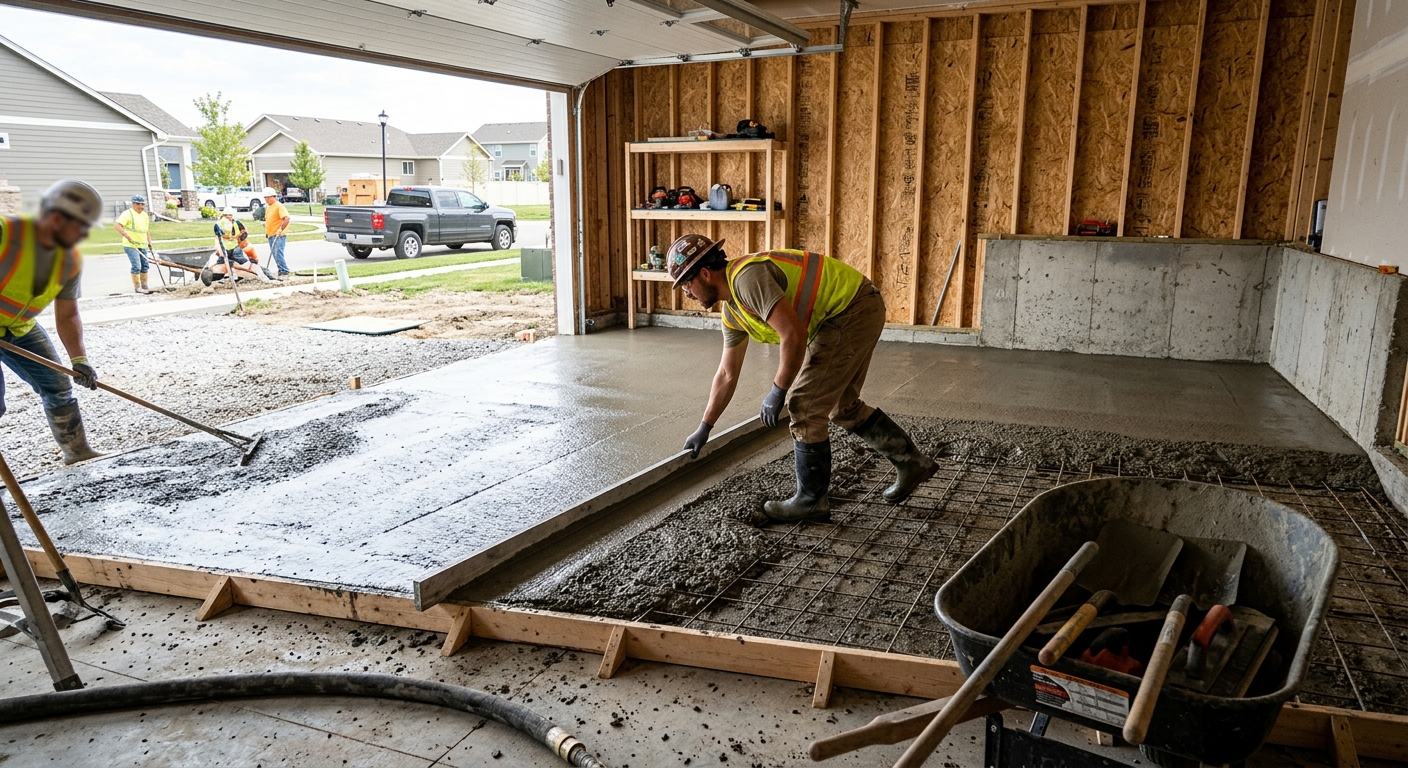
Concrete work options and costs in Austin Heights
Austin Heights is a fast-growing community in the Lower Mainland–Southwest, and concrete flatwork is one of the most common exterior upgrades homeowners consider—especially where schedules, drainage and durability matter. With a population of 3,340 people (Statistics Canada, 2021 Census), most concrete demand is tied to residential renovations and new homes on local streets and cul-de-sacs. In this area, driveways, patios and walkways are the backbone of day-to-day access, while foundations and footings need to be built for our wet conditions and freeze–thaw cycles.
Because the Lower Mainland–Southwest has mild winters but a shallow frost line, contractors typically design exterior footings and thickened edges to sit below the frost depth—locally around 450 mm / 18" in standard practice. That means the excavation, granular base build-up, and the mix design are consistent, repeatable costs. Coastal rainfall also extends drying and curing windows, so base preparation, protection during cool nights, and longer curing times can add labour—even when the concrete itself is “standard.”
Concrete crews are especially busy in older, established pockets near shopping and main access corridors (including areas around Austin Heights’ convenient neighbourhood services), where many homeowners upgrade aging driveways and replace settled slabs. If you’re comparing contractor bids, it helps to anchor your expectations. The table below breaks down common projects, the specs that drive the cost, and realistic price bands for this city tier—so you can spot what’s included versus what’s being left out.
| Application |
Typical Size |
Key Spec |
Finish Option |
Price Range |
| Concrete driveway (standard broom finish) |
400–600 sq. ft. |
Exterior air-entrained mix; compacted granular base; control joints |
Broom finish, standard edges |
$6,500 – $10,000 |
| Exposed aggregate driveway |
400–600 sq. ft. |
Exterior mix with proper aggregate selection; adequate curing for durability |
Exposed aggregate finish |
$9,000 – $13,500 |
| Stamped concrete driveway or patio |
250–450 sq. ft. |
Exterior air-entrained mix; release agent; jointing plan |
Stamp pattern + colour hardener/sealer |
$7,000 – $13,500 |
| Plain concrete patio or walkway |
200–350 sq. ft. |
Exterior mix; compacted base; proper slope and drainage |
Broom or light trowel finish |
$3,500 – $7,500 |
| Garage floor (interior slab) |
400–600 sq. ft. |
Reinforcement based on soil + thickness; good sub-base compaction |
Steel trowel + light broom texture (as needed) |
$6,500 – $11,000 |
| Foundation footings (structural, below frost) |
Varies by plan |
Engineered design; excavation below frost depth; correct rebar placement |
Structural formwork and finishing as required |
$12,000 – $25,000 |
Prices are estimates only and vary by project scope, site access and material selection.
What affects the price of concrete work in Austin Heights
In the Lower Mainland–Southwest, two quotes for what looks like the “same” concrete job can still differ by 30–50%. The big reason is that the visible concrete surface is only part of the cost—footing depth below frost, base prep, reinforcement, mix design and curing protection are often where bidders diverge. Even within British Columbia, cold timing, rainfall delays and the level of engineering detail can change labour hours and material choices, which is why a driveway at one address can price one way and a nearby one can price another way.
Start with frost and freeze–thaw. In Austin Heights, exterior work is commonly planned around a frost depth of about 450 mm / 18", and footings/thickened edges must extend below the design frost line to reduce frost heave risk. Exterior slabs also need air-entrained concrete to withstand repeated cycles and scaling. When nights get cool, we may need cold-weather curing precautions (blankets, temperature monitoring, longer protection periods). That directly impacts scheduling and labour efficiency. Finally, de-icing salt can accelerate surface spalling, so a proper sealer plan is often essential for driveways and patios.
Here are a few real Austin Heights examples that move the number up or down: (1) replacing a failed driveway over soft subgrade or poor drainage often adds excavation and granular base depth, pushing costs toward the higher end of the $18–$28 per sq. ft. driveway band; (2) a stamped driveway typically adds form/labour and finishing time, which is why those projects trend closer to the $22–$36 per sq. ft. stamped & decorative band; and (3) easier access (short hose-run, fewer hurdles) can keep labour efficient and prevent higher equipment mobilization costs. Housing stock also matters—many older lots have mature landscaping, so removal/disposal can be a meaningful dollar item even before the first load arrives.
| Price Factor |
Why It Matters |
Cost Impact |
| Frost line depth — determines footing depth and form height |
Footings and thickened edges must sit below design frost to prevent heave and cracking |
Higher excavation + formwork if depth/soil conditions require it |
| Site preparation — excavation, grading, compacted granular base |
Concrete performance depends on stable, well-drained subgrade and proper base thickness |
Can swing total cost a lot if drainage is poor or disposal is needed |
| Reinforcement — rebar or wire mesh requirement |
Rebar supports structural demands; slabs may need mesh based on thickness and soil |
Material + labour to place ties, chairs and proper cover |
| Mix design — air-entrainment and compressive strength spec |
Exterior air-entrainment helps resist freeze–thaw scaling and spalling in wet/cool cycles |
Specialty mix costs + stricter handling and quality checks |
| Finish type — broom vs. stamped vs. exposed aggregate |
Decorative finishes add tooling, timing, and extra layers/products (colour, releases, etc.) |
Labour-intensive finishes push pricing toward the decorative band |
| Pour size and concrete truck access to site |
Access controls pump needs, conveyance labour, and whether multiple trucks are required |
Poor access increases labour time and equipment rental |
| Cold-weather curing precautions — heating and blankets |
Cool nights and damp weather can slow strength gain and surface durability |
Additional labour, blankets/monitors, and longer protection windows |
| Control joint pattern and sealing cost |
Joints manage cracking; sealing repels moisture/salts and improves surface longevity |
Small per-item costs, but often overlooked—leading to replacement sooner |
Permits & regulations in British Columbia
In British Columbia, structural concrete work generally needs a building permit because it affects structural safety. That includes footings, foundation walls, grade beams, and any other cast-in-place elements that support the building. Many projects also involve engineered drawings, and those are typically reviewed during the permit process by the municipality and/or building officials.
Concrete flatwork such as driveways, patios, and walkways usually does not require a separate permit, unless it changes lot grading, connects to drainage in a way that affects water management, exceeds impervious surface limits, or impacts municipal right-of-way requirements (for example, work near curb/sidewalk interfaces). The safest approach is to confirm in writing with your municipality before the first excavation.
For Austin Heights homeowners, verify the contractor properly before you sign: start by asking for their current business credentials and proof they carry appropriate liability insurance. Next, confirm coverage for workers through WCB (worker protection). Then request a recent certificate of insurance showing project/cost coverage dates and an endorsement for general liability. Most reputable contractors can also provide references from similar concrete jobs in the Lower Mainland–Southwest corridor. If they can’t, that’s a practical warning sign—especially for exterior work where freeze–thaw performance depends on the details.
Step-by-step, you can check: (1) the licensing/credentials are current, (2) the certificate of insurance is valid and matches the project type, (3) WCB coverage is active, and (4) references include similar slab/driveway work—not only interior pours.
Getting concrete right in Austin Heights's freeze-thaw climate
Concrete failures in Austin Heights are usually not about the look—they’re about durability under our wet, cool conditions and repeated freeze–thaw cycles. The most common problems I see are surface scaling and spalling, often tied to inadequate air-entrainment, poor base drainage, or curing that didn’t reach proper early strength. In the Lower Mainland–Southwest, the frost depth is commonly around 450 mm / 18", so you still need below-frost excavation for footings and correctly thickened edges; shallow bases on poor soils can also settle and crack.
To spec the job correctly, focus on five items. (1) Base preparation: compacted granular to the right depth with proper drainage so water doesn’t sit under the slab. (2) Mix design: exterior air-entrained concrete (commonly 5–7% air content) and a minimum 32 MPa compressive strength spec for typical exterior flatwork. (3) Control joints: planned spacing and clean saw-cut timing to limit random cracking. (4) Curing: protect the pour so it reaches strength; in practice that means at least 7 days in proper conditions, and longer/extra protection when it’s cool and humid. (5) Sealing: apply a penetrating sealer after full cure (commonly around 28 days) so de-icing salts and rainfall don’t attack the surface.
Here’s where dollars are justified: if you compare a standard broom driveway to stamped concrete, the stamped option costs more, but it’s worth it when the contractor is also using the correct air-entrained mix and joint/sealer plan. A decorative driveway might land closer to the $22–$36 per sq. ft. stamped band, while a standard driveway may fit the $18–$28 per sq. ft. band—yet the technical “health” of the concrete still depends on base, mix, curing and joints more than on the texture.
| Spec |
Why It Matters in Austin Heights |
What to Ask For |
Impact if Skipped |
| Compacted granular base (depth?) |
Prevents water retention and supports the slab through wet/cool cycles |
Base thickness based on soil, subgrade condition and design frost considerations |
Settlement, cracking, and faster surface deterioration |
| Air-entrained concrete mix (target air %?) |
Helps resist freeze–thaw scaling and spalling in exterior exposure |
Air content target typically 5–7% for exterior flatwork |
High risk of scaling/spalling in winter freeze–thaw |
| Compressive strength (MPa rating) |
Ensures adequate early and long-term durability for traffic loads |
Minimum 32 MPa (confirm project spec) |
Reduced strength gain; increased cracking and surface wear |
| Control joints (spacing per ACI guidelines) |
Controls where shrinkage cracks occur so it doesn’t happen randomly |
Joint spacing plan and sawing schedule |
Random cracking and potential water intrusion |
| Minimum 7-day curing period |
Cold nights and high humidity can slow strength development |
Confirm curing approach and protection on cool/wet days |
Weaker surface, increased risk of early cracking and damage |
| Penetrating sealer (when applied after cure) |
Helps repel moisture and salt attack on exterior surfaces |
Apply around 28 days after pour (or per product directions) |
Faster surface breakdown and staining |
How to choose a concrete work contractor in Austin Heights
Choosing the right contractor in Austin Heights starts with verification, not just price. In British Columbia, make sure the company carries liability insurance and active WCB coverage for its workers. How to check: ask for a current certificate of insurance (and confirm the policy is valid for the project dates) and request proof of WCB account status. If they won’t provide documentation promptly, that’s a red flag. Also request a clear scope and references for similar-scale driveway and exterior slab work—ideally within the Lower Mainland–Southwest, because the climate-driven specs are the difference between a slab that lasts and one that flakes.
Next, get 2–3 itemised written quotes rather than one lump sum. Breakdowns should show excavation/base prep, reinforcement, formwork, concrete supply and finish labour (broom vs stamped), joints, curing protection, and disposal. Confirm whether a permit (if required) is included, and whether demo and haul-away are part of the price. A solid warranty should state workmanship coverage length and whether it’s limited or transferable. Payment schedule matters too: never pay more than 10–15% upfront, and use a holdback until the final grade, clean-up and finishing details are complete. Finally, insist on a written start date and completion estimate—rain and cool nights can shift schedules in BC, so reputable contractors plan for that.
- Ask what frost-depth and drainage approach they use for exterior slabs and footings
- Require the quote to list air-entrained mix and a compressive strength spec (confirm 32 MPa or project equivalent)
- Confirm reinforcement approach: mesh vs rebar and where it’s placed
- Check that joint layout (spacing and saw-cut timing) is included
- Get curing/protection steps in writing for cool nights and rainy periods
- Ask whether sealer is included (and when it’s applied after cure)
- Confirm concrete truck access plan, pump needs, and any conveyance costs
- Clarify exclusions: landscaping restoration, saw cutting existing slab, drainage upgrades
- Verify disposal/demo haul-away is included or priced separately
- Review warranty terms: workmanship vs product warranty; duration and exclusions
- Use an itemised payment schedule with a holdback until completion
- Request at least two references from recent similar projects in the Lower Mainland
Concrete red flags in Austin Heights include: quotes that don’t mention air-entrainment or joints; “cheap” pricing that skips granular base depth or reinforcement for the stated soil conditions; inability to provide certificate of insurance and WCB proof; finishing that looks good on day one but no plan for curing/blankets during cool stretches; and payment demands that exceed 10–15% upfront or refuse a practical holdback.
Frequently asked questions — concrete work in Austin Heights
How do I compare concrete quotes?
To compare quotes in Austin Heights (and the wider Lower Mainland–Southwest), focus on what’s inside the scope—not just the total price. Ask each contractor to itemise excavation, compacted granular base depth, reinforcement (mesh/rebar), concrete mix spec (including air-entrainment), finishing, control joints, curing protection, and sealing if included. For a baseline reference, many standard driveways land in the $18–$28 per sq. ft. band, while stamped/decorative work trends higher at about $22–$36 per sq. ft. If one quote is far below the band, it’s often missing base drainage, air-entrainment, or joint/sealer details—things that matter in our wet, freeze–thaw climate. Also confirm concrete truck access, disposal of old concrete, and whether permits (if required) are included.
Can concrete be poured in cold weather in Austin Heights?
Yes, concrete can be poured in cold weather in British Columbia, including Austin Heights, but it depends on temperature and how the contractor manages curing. The key is protecting the mix so it reaches early strength before it freezes. Reputable crews use curing blankets, temperature monitoring, and sometimes temporary heating around the pour area. In the Lower Mainland–Southwest, the season isn’t as harsh as inland BC, but cool nights and high humidity still slow strength gain, which is why planning matters. Ask whether the contractor has a written cold-weather curing approach and how they handle rain delays. A quote that doesn’t mention blankets/heating and a minimum curing plan is risky—especially for exterior slabs where freeze–thaw durability depends on proper early performance.
How do I maintain concrete in Austin Heights's freeze-thaw climate?
Maintenance in Austin Heights is mostly about keeping water and salts away from the surface. Start with drainage: ensure downspouts and grading don’t push water onto your slab. Clean leaves and debris regularly so moisture doesn’t sit in corners and along joints. For exterior driveways and patios, sealing is one of the best protections—typically a penetrating sealer applied after cure (often around 28 days) helps repel moisture and reduce salt penetration. Avoid aggressive de-icing practices that can damage surfaces; use de-icer sparingly where possible. If you notice spalling or widened joints, address repairs early—small failures spread when water infiltrates. Good joints and sealing—done correctly at install—are the foundation for easier maintenance later.
What causes concrete to spall in Austin Heights winters?
Spalling in Austin Heights winters is usually linked to freeze–thaw stress plus moisture and salt exposure. The most common technical cause is insufficient air-entrainment. Without the right air void system, water inside the concrete expands when it freezes, chipping off the surface paste. Base drainage problems can make it worse by keeping the slab saturated longer. Poor curing also contributes—if the concrete didn’t develop adequate early strength, it can be more vulnerable to scaling. Finally, de-icing salt accelerates deterioration when the surface is unsealed or when sealing was skipped. That’s why exterior work should use an air-entrained mix and a jointing plan, then be protected with proper curing and, when appropriate, penetrating sealer after cure.
What is rebar and when is it required in British Columbia?
Rebar is reinforcing steel (bars) cast into concrete to help the slab or foundation resist tension and control cracking under load. In British Columbia, whether rebar is required depends on engineering design, slab thickness, soil conditions, and intended use. For structural elements like footings and foundation walls, rebar is typically part of engineered design and is not optional for safety and code compliance. For driveway slabs and interior garage floors, reinforcement may be required depending on thickness, support conditions, and whether the design specifies mesh/rebar. The right spec is important because reinforcement placement (cover, spacing, and chair supports) affects performance—just “having steel” isn’t enough. In your quote, ask where rebar/mesh will be located and whether the contractor is following an engineered drawing or a documented slab design.
How long does a concrete project take in Austin Heights?
Project duration in Austin Heights depends on the type of concrete work, weather, and site conditions. A typical small patio or walkway can be scheduled quickly, often with demo/base prep taking a full day or two, then the pour and finishing the next day—followed by curing/protection time before you can use it normally. Driveways take longer mainly due to excavation, base prep, forms, reinforcing setup, and decorative finishing timing (especially for stamped concrete). Even when concrete placement is fast, crews must protect it during cool or rainy periods to meet curing needs; that’s why timelines are longer than the “pour day” suggests. Foundation footings and structural work also require additional steps: excavation below frost, formwork, inspections (where applicable), rebar placement and a controlled pour. Ask contractors for a written start date, pour date, curing/protection plan and practical completion estimate.