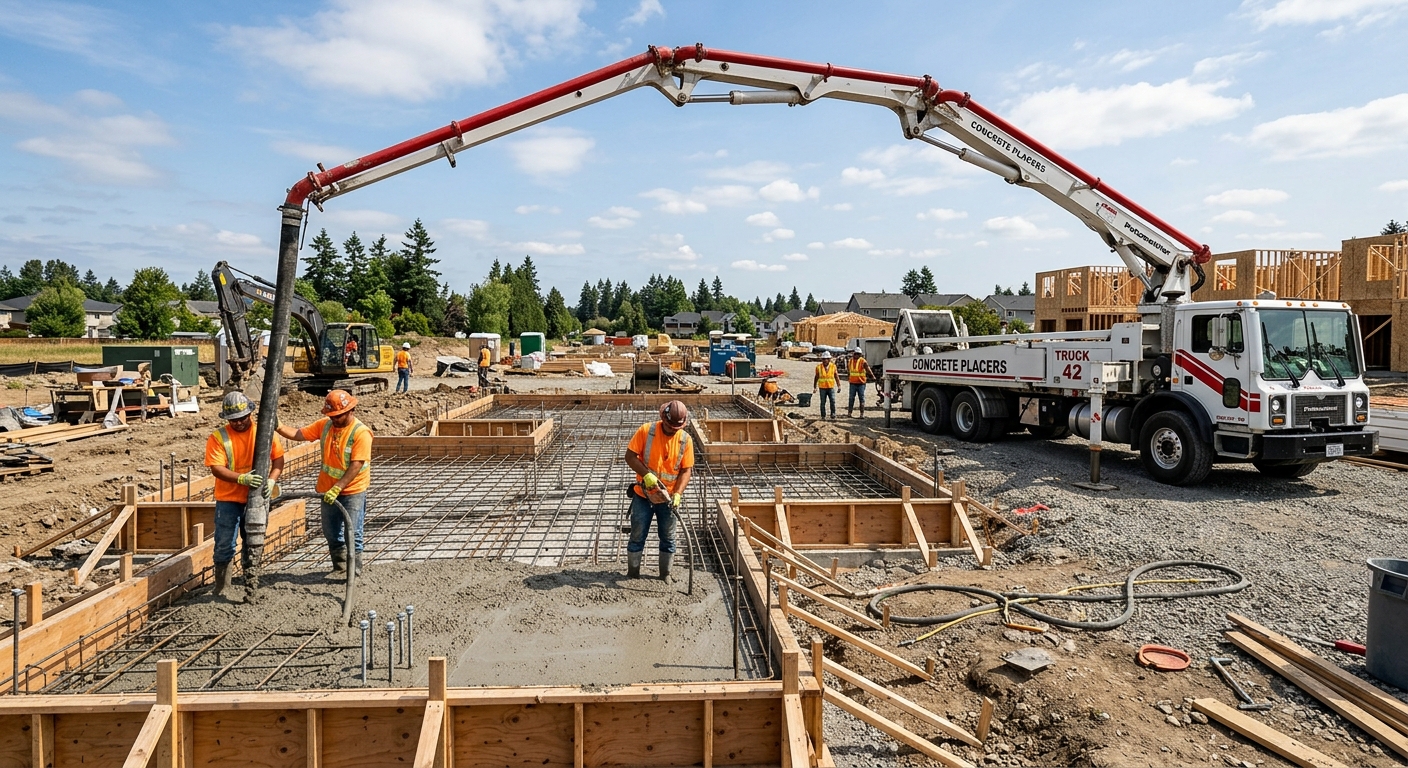
Concrete work options and costs in Oxford Heights
Oxford Heights homeowners typically choose concrete because it’s durable, clean-looking, and predictable—especially for driveways and patios. With a total population of 6,156 (Statistics Canada, 2021 Census), the area’s housing demand is steady, and concrete crews are busiest where flatwork is most common: single-detached neighbourhoods on streets with frequent driveway replacements and backyard patio upgrades. In the Lower Mainland–Southwest, mild winters don’t eliminate damage risk; we still get freeze–thaw cycles and frequent coastal rainfall. That means concrete specs still start with frost protection (typical practice assumes about 450 mm / 18" design frost), plus engineered base preparation, drainage attention, and air-entrained mixes. Scheduling and curing also affect costs: cool, humid stretches and rain can slow strength gain, so crews may extend cure times or use blankets and sealers to keep surfaces from scaling. Labour availability can also tighten around the same seasons everyone wants work done, particularly when rain pushes crews to the next clear window.
In Oxford Heights, concrete is especially in demand in the more mature residential pockets where older driveways and steps are being upgraded to manage runoff and reduce ongoing maintenance. If you’re comparing options, the best way is to match finish and thickness to how you use the space and how your soil behaves after wet weather. Next, use this price table as a realistic starting point for common projects in our region.
| Application |
Typical Size |
Key Spec |
Finish Option |
Price Range |
| Concrete driveway (standard broom finish) |
400–500 sq. ft. |
Air-entrained exterior mix, compacted granular base |
Broom finish, control joints |
$7,200–$12,000 |
| Exposed aggregate driveway |
400–500 sq. ft. |
Air-entrained exterior mix, proper curing |
Exposed aggregate with sealer |
$9,000–$14,500 |
| Stamped concrete driveway or patio |
300–450 sq. ft. |
Air-entrained exterior mix, thicker edges as needed |
Stamp pattern + colour hardener + sealer |
$8,500–$16,200 |
| Plain concrete patio or walkway |
200–350 sq. ft. |
Air-entrained exterior mix, compacted base |
Smooth or broom finish |
$3,200–$8,900 |
| Garage floor (interior slab) |
400–600 sq. ft. |
Fibre or mesh reinforcement, vapour considerations |
Smooth trowel + light broom finish edges |
$6,800–$14,500 |
| Foundation footings (structural, below frost) |
Varies by house size |
Excavation, forming, rebar, pour below frost line |
Structural concrete grade |
$22,000–$48,000 |
Prices are estimates only and vary by project scope, site access and material selection.
What affects the price of concrete work in Oxford Heights
In Oxford Heights and the wider Lower Mainland–Southwest, it’s common to see concrete quotes for the “same” job land 30–50% apart. The reason isn’t just the finish—it’s the full spec behind it: frost-depth assumptions, base preparation, reinforcement level, mix design, and how the contractor protects concrete during cool, wet weather. In other parts of British Columbia compared to the Lower Mainland, colder microclimates and shorter pour windows can increase excavation, forming, and curing costs. Labour can also shift depending on how busy crews are when rain clears. All of this matters because exterior concrete failures in our region often come from freeze–thaw stress and saturated soils, not from the concrete looking “fine” right after the pour.
Here’s how the climate drives cost: footings and thickened edges need to extend below the design frost depth (typical coastal practice is based on ~450 mm / 18" frost), and exterior slabs should use air-entrained concrete to manage freeze–thaw cycles. When temperatures drop, contractors may add heating, curing blankets, and longer cure times—costs that don’t show up on a basic material-only estimate. De-icing salts and wet freeze–thaw accelerates surface scaling, so sealing becomes an important durability step. For example, a standard broom-finish driveway typically tracks the lower end of the $18–$28 per sq. ft. band, while stamped work sits higher because of added labour for stamping/colour control and the need for careful finishing to avoid defects. If your driveway area is tight and requires pump placement or extra forming around existing features, that can also push the project toward the top of the band.
| Price Factor |
Why It Matters |
Cost Impact |
| Frost line depth — determines footing depth and form height |
Controls how far excavation must go to resist frost heave |
Can add thousands if deeper excavation is required by soil/grade |
| Site preparation — excavation, grading, compacted granular base |
Reliable base reduces settlement and scaling risk in wet soils |
Higher if access is difficult or drainage work is needed |
| Reinforcement — rebar or wire mesh requirement |
Helps control cracking under loads like cars and freeze–thaw |
More material + time; varies with slab thickness and use |
| Mix design — air-entrainment and compressive strength spec |
Air voids protect against freeze–thaw damage and scaling |
Premium mix and stricter quality control raise cost |
| Finish type — broom vs. stamped vs. exposed aggregate |
Finishing labour and materials differ significantly |
Stamped/exposed typically add major labour and product cost |
| Pour size and concrete truck access to site |
Small or inaccessible sites may need pumping or more set-up |
Pumping/extra handling increases labour and equipment fees |
| Cold-weather curing precautions — heating and blankets |
Ensures strength gain and durability during cool nights |
Can noticeably raise total cost during shoulder seasons |
| Control joint pattern and sealing cost |
Controls cracking locations and protects against de-icing salts |
Often small compared to repairs, but still adds line-item cost |
Permits & regulations in British Columbia
In British Columbia, structural concrete work typically needs a building permit and often engineered drawings that the municipality reviews. That includes footings, foundation walls, grade beams and any structural elements designed to carry loads or retain soil. Concrete flatwork such as patios, walkways and driveways usually does not require a permit on its own, unless the work changes lot grading/drainage in a way that affects municipal requirements, or it touches impervious surface coverage limits, right-of-way conditions, or permit triggers tied to stormwater management.
Before anyone breaks ground in Oxford Heights, treat permit confirmation as step one: ask your contractor whether the scope is permit-required and, if so, whether they will apply and coordinate with the reviewer. Step two is contractor proof: verify they carry liability insurance (and request a certificate of insurance showing the jobsite named) and confirm workers’ coverage through WCB/WCB-equivalent arrangements where applicable for the trades involved. Step three is credibility—request references from similar jobs: exterior slabs in coastal-wet conditions, not just interior pours.
How to verify quickly: (1) look up the contractor on the appropriate provincial registry for licence status, (2) request an up-to-date certificate of insurance and ensure it matches your address or at least the work type, and (3) ask for clearance documentation for workers’ coverage. If the contractor can’t provide documents promptly, that’s a warning sign.
Getting concrete right in Oxford Heights's freeze-thaw climate
Concrete failures in Oxford Heights usually trace back to what happens after the pour—especially during wet, cool stretches when freeze–thaw cycles and saturated soils put stress on weak spots. The best protection is a properly built base, the right mix, and workmanship that manages cracking and surface durability. Start with base preparation: a compacted granular sub-base to the correct depth for local soil and frost conditions, with drainage that prevents water from pooling under the slab. Next, use a properly designed exterior mix: air-entrainment is critical (for many exterior flatwork specs, target about 5–7% air content) so the concrete can tolerate freeze–thaw without scaling and spalling. For strength, aim for a minimum compressive strength around 32 MPa (or whatever is specified for your exposure class), and don’t shortcut water/cement controls.
Control joints matter because they guide cracking to predictable locations. Spacing should be consistent with industry guidance and the slab’s size—your contractor should layout the joint plan before the pour. Curing is equally important: allow at least 7 days under proper conditions; when cold weather hits, blankets or heaters may be necessary to maintain strength gain. Finally, sealing should be a planned step after cure (often 28 days) to repel moisture and de-icing salts, reducing surface deterioration.
Ask technical questions that target spalling: “What air content are you targeting?” and “How are you curing in cool, rainy weather?” If someone offers the cheapest option with vague answers, the savings can disappear quickly. For a practical comparison: a broom-finish driveway may land around the lower end of the $18–$28 per sq. ft. range, while stamped concrete can justify added cost (often reflected in the $22–$36 per sq. ft. band) when colour durability, proper joint planning, and curing are handled correctly. Poor detailing can make either finish fail—so pay for the spec, not the slogan.
| Spec |
Why It Matters in Oxford Heights |
What to Ask For |
Impact if Skipped |
| Compacted granular base (depth?) |
Reduces settlement and helps prevent water trapped under the slab |
“How deep is your compacted base for my soil and frost conditions?” |
Uneven settling and cracking; more moisture movement |
| Air-entrained concrete mix (target air %?) |
Manages freeze–thaw damage and scaling in wet coastal weather |
“What air content are you targeting (about 5–7% for exterior)?” |
Higher risk of spalling and surface deterioration |
| Compressive strength (MPa rating) |
Ensures durability and load performance over time |
“What is the minimum MPa rating you’re using?” |
Reduced strength gain; faster wear under traffic |
| Control joints (spacing per ACI guidelines) |
Limits random cracking locations when slabs expand/contract |
“Where will you place joints and how often (spacing plan)?” |
Random cracking that can widen and admit water |
| Minimum 7-day curing period |
Strength development is slower in cool, humid conditions |
“How will you protect the slab for at least 7 days?” |
Surface weakness, increased scaling and reduced service life |
| Penetrating sealer (when applied after cure) |
Helps repel moisture and de-icing salt intrusion |
“Which penetrating sealer and when exactly after cure?” |
Faster surface breakdown; more frequent maintenance |
How to choose a concrete work contractor in Oxford Heights
Choosing the right contractor matters in Oxford Heights because exterior durability depends on the details: base, mix, finishing and curing. Start with British Columbia verification. First, confirm licensing through the appropriate provincial registry used for your trade/contractor type. Second, request a certificate of liability insurance that shows coverage active at the time of the job and, ideally, notes the jobsite. Third, verify workers’ coverage—ask for proof that their crew is covered through WCB arrangements (or the equivalent documentation they normally provide for working in BC). If they’re vague or refuse documents, get another quote.
Then collect 2–3 itemised, written quotes that break down labour and materials—don’t accept a single lump sum without thickness, reinforcement, base depth, finish type and site access notes. Ask if a permit is included where required, who pulls it, and what’s included for disposal and concrete removal. Look for a clear warranty: workmanship warranty length, whether it covers cracking/spalling, and how manufacturer warranties apply to materials. Ask if the warranty is transferable to future owners—helpful when you sell.
For payment terms, avoid large upfront deposits. A good rule is never more than 10–15% upfront; hold back a portion until key completion steps are verified (base acceptance, finish, cure protection and final sealing schedule if included). Finally, ask for a start date and estimated completion timeline in writing so you’re not stuck waiting on rain windows without clarity.
- They list concrete thickness and reinforcement (rebar/wire mesh) in writing.
- They specify the air-entrainment and minimum strength (not “standard mix”).
- They describe base prep depth and how subgrade/drainage is handled.
- They provide a joint layout plan (locations and spacing rationale).
- They explain curing protection for cool, rainy periods (blankets/sealer plan).
- They include disposal/removal of old concrete if part of the scope.
- They confirm truck access method (direct chute vs. pumping) based on your site.
- They show examples of similar finish work (stamped/exposed aggregate) in wet climates.
- The quote includes sealing details if exterior durability is a goal.
- Warranty terms are clear and in plain language.
- They carry liability insurance and provide a certificate on request.
- Payment schedule follows standard practice with a holdback until completion.
Concrete red flags in Oxford Heights: contractors who won’t discuss air content or joint layout; quotes that exclude base preparation depth; “cheap” stamped work with no clear curing/sealer plan; vague timelines that ignore rain/temperature impacts; and payment requests that ask for most funds upfront without a defined holdback.
Frequently asked questions — concrete work in Oxford Heights
Why does concrete crack in Oxford Heights and how is it prevented?
In Oxford Heights and the Lower Mainland–Southwest, cracks usually come from shrinkage, thermal movement, and freeze–thaw stress working together—especially when slabs aren’t built on a properly prepared base. Even a well-finished driveway will crack sometimes, but the goal is predictable, controlled cracking at control joints, not random cracking across the slab. Prevention starts before the pour: compacted granular base with drainage, an exterior air-entrained mix for freeze–thaw durability, and a joint layout planned to suit slab dimensions. During curing, protect the pour for at least 7 days under suitable conditions so strength gain isn’t interrupted by cool nights. Sealing after cure (often around 28 days) helps resist moisture and de-icing salt intrusion. If you’re pricing options, a standard broom finish may land around the $18–$28 per sq. ft. band, but avoiding cracks depends far more on the spec than the finish name.
Stamped vs broom-finish concrete — cost difference?
Stamped concrete costs more than a broom finish because it’s labour-heavy and product-controlled. You’re paying for the stamped moulding process, careful finishing timing, often added colour hardener or integral colour, and typically a robust sealing system to keep the surface durable in our wet, cool climate. In Oxford Heights, stamped driveways and patios usually sit higher than standard flatwork; many projects fall into the $22–$36 per sq. ft. range depending on size and complexity, while broom-finished driveways often align closer to the $18–$28 per sq. ft. band. That difference is justified only when the contractor also does the fundamentals right: correct air-entrainment, control joints, and proper curing. If a stamped quote is “close” to a broom price but the scope doesn’t include those durability steps, you’re likely buying shortcuts that show up later as scaling or uneven wear.
When is the best time to pour concrete in Oxford Heights?
For Oxford Heights, timing is about temperature, rainfall risk, and curing conditions. The Lower Mainland–Southwest has relatively mild winters, but you still get cool nights and rain that can slow strength gain and complicate finishing. Ideally, plan pours when temperatures stay within the contractor’s target range for curing protection, and when rain interruptions are unlikely for at least the first 48–72 hours. Early spring and late summer often work well, but the “best” window depends on daily forecasts, site access, and whether the contractor has blankets/heating plans for cold snaps. Your contractor should discuss how they’ll protect curing when conditions are damp or chilly—especially because exterior slabs need consistent curing to reach durability performance. If a contractor schedules a pour without a curing plan, you can end up paying for a job that looks good initially but underperforms in freeze–thaw weather.
How long does concrete take to cure?
Concrete curing has two timeframes: initial set/handling and achieving design strength. In Oxford Heights, you should expect that the contractor will plan to protect the slab for at least 7 days under suitable conditions, which is a common minimum for exterior durability-focused work. In cool, humid stretches, curing may take longer to reach the performance needed for traffic and long-term durability, and the contractor may use curing blankets or other cold-weather precautions. Even after the slab is strong enough for normal use, sealing is typically planned later—often about 28 days post-pour—so the sealer can bond properly and repel moisture and de-icing salts. Your quote should include the curing and sealing schedule if sealing is part of the scope. Skipping proper curing is one of the fastest ways to invite spalling and surface scaling.
Do I need a permit for concrete work in British Columbia?
In British Columbia, structural concrete work—such as footings, foundation walls, and grade beams—typically requires a building permit and often engineered documentation reviewed by the municipality. Concrete flatwork like patios, walkways, and driveways usually doesn’t require a permit by itself, unless it changes lot grading/drainage, affects impervious surface requirements, or relates to municipal right-of-way conditions. For Oxford Heights homeowners, the safe approach is to ask the contractor to confirm whether your specific scope triggers a permit and to document that conversation. Also verify contractor compliance: request proof of liability insurance and confirm workers’ coverage documentation (WCB arrangements). If permit requirements apply, the contractor should explain who pulls the permit and how inspections are handled so your project doesn’t stall.
Concrete vs pavers for a patio in Oxford Heights?
Concrete and pavers can both work well in Oxford Heights, but they solve moisture and maintenance differently in our Lower Mainland–Southwest freeze–thaw conditions. Concrete is often best when you want a smooth, continuous surface with fewer joints (when built with the right control-joint plan). It also pairs well with air-entrained exterior mix and sealing strategies to resist de-icing salts and saturation. Pavers can look premium and are sometimes easier to replace selectively, but the system depends heavily on base, edge restraint and joint sand performance—if water doesn’t drain well, you can still get movement. Pricing depends on finish and scope; plain concrete patios commonly start around the $16–$26 per sq. ft. band, and stamped options can rise toward the higher decorative ranges. If you’re comparing, ask both contractors to show base design, drainage approach, and what they do to control cracks or movement over time.