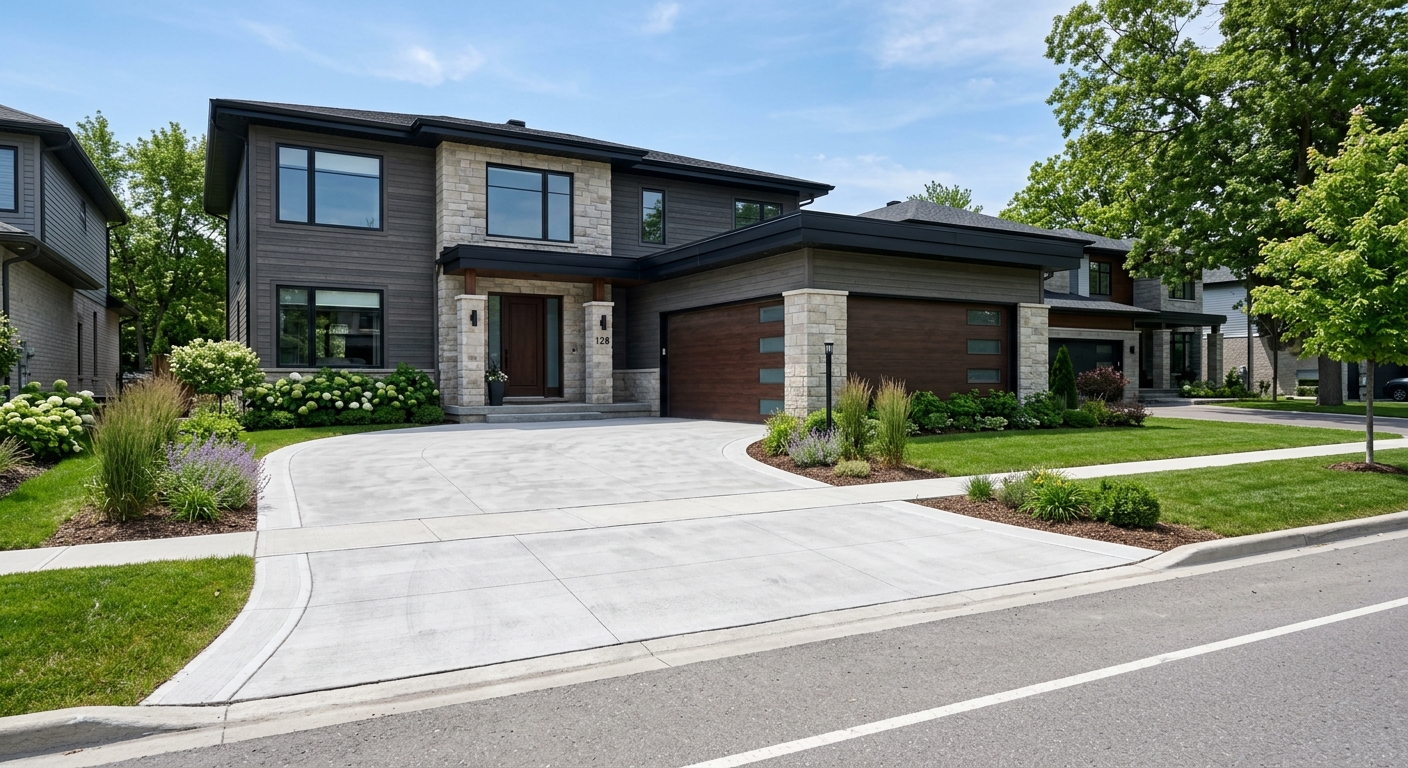
Concrete work options and costs in Twin Creeks
Twin Creeks is a small community in the Lower Mainland–Southwest, and concrete flatwork is a big part of how homes handle rain, damp soil, and the freeze–thaw cycles that cause scaling and cracking. With a population of about 2,577 people (Statistics Canada, 2021 Census), there’s a limited pool of local crews, so scheduling can tighten during good weather windows. You’ll also see a lot of homes that rely on driveway and patio upgrades to keep pace with maintenance and curb appeal—especially as many properties evolve over time in this corridor.
In the Lower Mainland–Southwest, mild winters can fool homeowners, but the frost line still matters for foundations and thickened edges. Local practice typically assumes a frost depth around 450 mm / 18", which is why footings, piers and structural bases are placed below that level to avoid frost heave. Even with relatively shallow frost, saturated soils and coastal-wet conditions drive base-prep requirements, drainage attention, and air-entrained concrete selection. That’s also why two quotes for the “same” driveway can differ: one contractor may include proper compacted granular base and air-entrained mix with control joints, while another may not plan for extended curing in cool nights and prolonged rain.
If you’re comparing options, think of it as durability-first vs look-first. Standard broom finish is usually the most budget-friendly path; stamped or exposed aggregate is where you pay more for forming complexity and finishing labour. Below is a practical price comparison to help you match the option to your goals and budget, then we’ll break down what truly moves the cost in Twin Creeks.
| Application |
Typical Size |
Key Spec |
Finish Option |
Price Range |
| Concrete driveway (standard broom finish) |
400–500 sq ft |
Air-entrained mix, compacted granular base, control joints |
Broom |
$18,000–$28,000 |
| Exposed aggregate driveway |
400–500 sq ft |
Air-entrained mix, surface retarder & proper base prep |
Exposed aggregate |
$22,000–$34,000 |
| Stamped concrete driveway or patio |
300–450 sq ft |
Air-entrained mix, colour hardener, sealing after cure |
Stamped (pattern + integral colour) |
$22,000–$36,000 |
| Plain concrete patio or walkway |
200–350 sq ft |
Vibrated concrete, joints as required, compacted base |
Float + broom/scored |
$16,000–$26,000 |
| Garage floor (interior slab) |
300–500 sq ft |
Vapour barrier (if specified), fibre or mesh, thicker edges |
Standard steel trowel or light broom texture |
$18,000–$30,000 |
| Foundation footings (structural, below frost) |
Varies by house design |
Designed footing size/steel per engineer; below frost depth |
Structural concrete |
$200–$350 |
Prices are estimates only and vary by project scope, site access and material selection.
What affects the price of concrete work in Twin Creeks
In the Lower Mainland–Southwest, quotes for what looks like the “same” concrete job can swing by 30–50% depending on how each contractor handles frost protection, base preparation, reinforcement, mix design, and curing. Even though Twin Creeks sits in a milder coastal zone, we still design around freeze–thaw cycles and coastal-wet rainfall. That affects what’s considered “included”: proper excavation and drainage, air-entrained concrete, and control joints are not optional if you want the slab to last.
Here’s the big driver: frost line depth and freeze–thaw cycles dictate every exterior spec. Footings must extend below the design frost depth (roughly 450 mm / 18" typical local assumption), so formwork height, excavation volume, and disposal costs can rise quickly on any site with soft or saturated soils. All exterior slabs should be placed with air-entrained concrete to survive repeated wetting and freezing; skipping it increases the risk of scaling and spalling. Colder regions need heated protection during curing, and while Twin Creeks doesn’t see northern severity, cool nights and wet stretches can still force contractors to use curing blankets, sealers, and longer cure schedules to reach reliable strength. Those added labour and supervision hours show up in the numbers.
Two quick examples from Twin Creeks pricing: if your driveway base is soft and needs deeper compacted granular, you may move from the standard driveway band (about $18–$28 per sq ft all-in typical market pricing) toward the higher end once drainage, deeper excavation, and careful curing are included. If you choose stamped concrete, you pay more for forming labour and stamp release work, and that’s typically justified if you also require consistent air-entrainment and a proper sealing plan—otherwise the appearance isn’t the problem, the durability is.
| Price Factor |
Why It Matters |
Cost Impact |
| Frost line depth — determines footing depth and form height |
Exterior foundations and thickened edges must sit below frost to prevent heave |
More excavation and formwork; higher labour and disposal |
| Site preparation — excavation, grading, compacted granular base |
Saturated soils need correct base thickness and compaction for load support |
Can add material/transport costs and extra machine time |
| Reinforcement — rebar or wire mesh requirement |
Helps control cracking in slabs, especially driveways and garage floors |
Material + placement labour; may affect slab thickness |
| Mix design — air-entrainment and compressive strength spec |
Air content and strength target govern freeze–thaw durability |
Higher-quality mix and careful ordering can raise cost |
| Finish type — broom vs. stamped vs. exposed aggregate |
Complex finishes require more labour, tools, and tighter timing |
Stamped/exposed generally moves you into higher price bands |
| Pour size and concrete truck access to site |
Long carries, limited access, and split pours increase labour and coordination |
Extra setup time, possible additional trips or equipment |
| Cold-weather curing precautions — heating and blankets |
Cool, damp conditions slow strength gain and increase risk of surface issues |
Blankets, monitoring, and labour hours add cost |
| Control joint pattern and sealing cost |
Joints manage shrinkage cracking; sealing protects from salt and water ingress |
Material + additional day(s) for cure and application |
Permits & regulations in British Columbia
In British Columbia, concrete work falls into two buckets: structural work that affects a building’s load path, and non-structural flatwork that typically focuses on surface drainage and appearance. Structural concrete items—such as foundation walls, grade beams, and footings for new construction or structural modifications—generally require a building permit, and you should expect engineered drawings to be reviewed as part of the permit process by the municipality. For Twin Creeks homeowners, the key point is that if the work impacts foundations, load-bearing elements, or building envelopes, you must check permit requirements before breaking ground.
Concrete flatwork—driveways, patios, walkways, and garage slabs inside an existing garage—often does not require a permit, unless it affects lot grading, drainage, or impervious surface limits, or it involves work within a municipal right-of-way. Even when a permit isn’t typically required, municipalities may still require compliance with drainage and setback rules. Always confirm with the local authority for your specific site.
To verify contractor credentials in British Columbia, start by asking for three documents: (1) proof of licensing/registration for the contractor category they’re using (check online registry sources used in BC for contractor status), (2) a Certificate of Insurance showing general liability (with adequate limits), and (3) coverage confirmation for workplace compensation through WCB/WSIB-equivalent arrangements in BC. If they can’t provide current certificates or references for similar slab and footing scopes, treat that as a red flag and move on.
Getting concrete right in Twin Creeks's freeze-thaw climate
Concrete fails in Twin Creeks most often when the base can’t drain, the mix doesn’t have the right air content, or curing is rushed during cool, wet stretches. In a wet coastal climate with repeated freeze–thaw cycles, water gets into cracks or weak edges, expands when temperatures dip, and gradually chips the surface—what homeowners commonly describe as spalling or scaling. The fix is in the specification and supervision, not just the finishing.
Start with (1) base preparation: excavate to stable subgrade, then install a compacted granular sub-base at a thickness appropriate to the soil and expected loads (driveways require more robust support than light walkways). Poor compaction or inadequate drainage leads to settlement and cracking that no finish can “hide.” (2) mix design: for exterior flatwork, air-entrainment is critical; a typical target is about 5–7% air content, paired with a minimum 32 MPa compressive strength mix for durability. (3) control joints: place and finish joints so shrinkage cracking happens where it’s least visible and most manageable. (4) curing: plan for at least 7 days of curing under proper conditions. When temperatures are cool or rain threatens early set, contractors may use curing blankets or sealers to protect early strength gain. (5) sealing: apply a penetrating sealer about 28 days after the pour (when cured) to help repel de-icing salts and water intrusion.
For homeowners, the most important technical question is: “What air-entrained mix are you ordering, and how will you protect the slab during the first week?” If a crew can’t answer clearly, you’re taking on preventable spalling risk.
On price: switching from a plain patio band (around $16–$26 per sq ft all-in market pricing for typical scopes) to stamped concrete (about $22–$36 per sq ft typical market pricing for the finish) can be justified when the contractor also includes the same high-durability base, air-entrained mix, and sealing schedule—because the real win is long-term performance, not just pattern.
| Spec |
Why It Matters in Twin Creeks |
What to Ask For |
Impact if Skipped |
| Compacted granular base (depth?) |
Supports the slab and reduces pumping under freeze–thaw moisture movement |
Minimum granular thickness and compaction testing/requirements |
Settlement, cracking, early edge deterioration |
| Air-entrained concrete mix (target air %?) |
Helps concrete resist freeze–thaw damage in coastal-wet cycles |
Confirm air-entrainment target (about 5–7% for exterior flatwork) |
Scaling and spalling risk increases sharply |
| Compressive strength (MPa rating) |
Ensures durability and adequate strength gain before exposure |
Minimum 32 MPa compressive strength specified for exterior work |
Surface weakness, wear-out and premature failures |
| Control joints (spacing per ACI guidelines) |
Controls where shrinkage cracks form in freeze–thaw conditions |
Joint spacing plan and saw-cut timing |
Random cracking and deeper water entry |
| Minimum 7-day curing period |
Strength development affects long-term scaling resistance |
How curing will be protected during cool nights and rain |
Reduced strength and increased early deterioration |
| Penetrating sealer (when applied after cure) |
Reduces water and salt ingress from winter traffic |
Penetrating sealer application about 28 days after pour |
Faster staining, salt damage, and surface breakdown |
How to choose a concrete work contractor in Twin Creeks
Choosing the right concrete contractor in Twin Creeks comes down to proof, not promises. In British Columbia, you should verify licensing/registration for the work type they’re performing, and you should request a current Certificate of Insurance showing general liability coverage (ask what limits are listed). For worker protection, confirm they have active workplace compensation coverage in the BC system—then ask for a clearance letter or equivalent coverage confirmation if their paperwork includes it. If a contractor can’t provide these documents quickly, you’re better off looking elsewhere.
Next, get 2–3 written, itemised quotes—not just a lump sum. A proper quote breaks labour and materials and spells out what’s included: excavation, granular base thickness, drainage if needed, reinforcement (mesh or rebar), concrete mix type, jointing and sealing, and disposal. Watch for exclusions like “site conditions unknown” without specifics, missing curing provisions, or finish options described vaguely. Confirm whether permits (when needed for structural concrete) are included or handled by you, and whether concrete removal/disposal is part of the price.
Warranty matters: ask for workmanship warranty length and whether it covers cracking, spalling, or joint failure. Also ask about manufacturer warranty on any sealer or admixtures and whether warranties are transferable. For payments, never allow more than 10–15% upfront; keep a holdback until the final walk-through and cure/sealer steps are completed. Finally, require a start date and realistic completion estimate in writing, especially since Twin Creeks schedules can tighten when weather windows open and crews book up.
- Provide insurance certificate with liability limits listed.
- Confirm active workplace compensation coverage for BC.
- Show examples/photos of similar driveway/patio/foundation work near the Lower Mainland–Southwest.
- Use itemised quotes (base, reinforcement, mix, finish, joints, sealing, cleanup/disposal).
- State concrete mix details including air-entrainment and strength.
- Include base prep scope: excavation to subgrade, granular thickness, and compaction expectations.
- Specify joint pattern and when joints will be cut/sawn.
- Confirm curing plan for the first week (blankets/covering if needed).
- Clarify sealing timeline (typically about 28 days after pour for penetrating sealer).
- Define access requirements for trucks and any short-pour/split-pour plan.
- Payment schedule capped at 10–15% deposit; holdback until close-out.
- Include a workmanship warranty in writing (not just “we’ll fix it”).
Concrete red flags I see in Twin Creeks: a quote that won’t name air-entrained mix or joint spacing, unusually low pricing that skips drainage and compacted granular base, no mention of curing protection during cool/wet periods, contractors who ask for large upfront deposits, and “sealed after a day” promises that ignore the curing time needed for a penetrating sealer to work.
Frequently asked questions — concrete work in Twin Creeks
Can concrete be poured in cold weather in Twin Creeks?
Yes, concrete can be poured in cold conditions in Twin Creeks, but the approach must change. In British Columbia’s Lower Mainland–Southwest, you often don’t get severe winter like the interior, yet cool nights, rain, and short windows can still slow concrete strength gain and increase the chance of surface defects. A reputable crew will protect the pour with curing blankets or insulated coverings, plan for longer protection time, and monitor temperatures so the concrete reaches strength before exposure. Ask what “cold-weather precautions” they include—heating equipment, blankets, and how they manage early-set risk. Cost-wise, protection can move you toward the higher end of driveway bands (for example, closer to the $18–$28 range rather than the low end) because labour and materials for blankets and monitoring add time.
How do I maintain concrete in Twin Creeks's freeze-thaw climate?
Maintenance in Twin Creeks is about limiting water and salt intrusion and keeping joints functioning. Start with sealing: for exterior flatwork, a penetrating sealer is commonly applied after the concrete cures (often around 28 days post-pour). This helps repel de-icing salts that can accelerate surface breakdown. Keep drainage paths clear so water doesn’t pond along edges—especially important given saturated soils in the Lower Mainland–Southwest. Clean off winter salt promptly rather than letting it sit. Inspect control joints each season: if you see joint gaps or spalled edges at joints, address repairs early so water doesn’t get under the slab. With good base prep and air-entrained concrete, routine care is usually minimal—but sealing and joint checks are what protect your investment.
What causes concrete to spall in Twin Creeks winters?
Spalling in Twin Creeks is most often tied to freeze–thaw damage and water entry. When concrete isn’t properly air-entrained or when the air content isn’t maintained during placement, water that penetrates the surface can freeze and expand, breaking the surface layer. It can also be worse if the base drains poorly or if control joints are absent or cut late, letting random cracks create pathways for water. Coastal-wet rainfall followed by cold nights is exactly the cycle that drives this kind of deterioration. If your contractor is cutting corners—skipping air-entrainment, rushing curing, or failing to seal—spalling risk rises. That’s why many homeowners find that “cheap” pours fail sooner, even if the upfront cost looked attractive compared to typical patio/driveway bands (such as $16–$26 for plain patios or $18–$28 for standard broom-finish driveways).
What is rebar and when is it required in British Columbia?
Rebar (reinforcing steel) is steel reinforcement placed inside concrete to improve tension resistance and help control cracking. In British Columbia, whether rebar is required depends on the engineered design and the type of concrete work. For structural elements like foundation footings and grade beams, reinforcement is typically specified by engineer drawings and required for structural performance. For exterior slabs such as driveways and garage floors, rebar or mesh may be required based on slab thickness, soil support, and expected loads—often recommended for driveways and larger garage slabs to help manage cracking. The key is that reinforcement isn’t a “guessing game”: a good Twin Creeks contractor will match reinforcement and slab thickness to the design requirements and explain what’s included in their quote.
How long does a concrete project take in Twin Creeks?
Most concrete flatwork jobs in Twin Creeks take a few days once the crew arrives, but the full timeline includes setup and cure planning. For example, a patio or walkway typically involves excavation and base prep on day one (or part of day one), the pour and finishing on the next workday, and then protection while curing continues. Driveways are similar but can take longer due to base thickness, reinforcement placement, and formwork around edges. If sealing is part of the plan, it usually happens after sufficient cure time (often around 28 days) rather than immediately after the pour. Weather can extend schedules when rain or cold nights affect curing. If you’re budgeting around a typical patio band ($16–$26) or a standard driveway band ($18–$28), timing and protection choices are part of what you’re paying for, not just the pour day.
What is a concrete overlay and is it suited to Twin Creeks?
A concrete overlay is an additional layer of concrete placed on top of an existing slab, usually after surface preparation and repairs. It can be suited to Twin Creeks when the original slab is structurally sound and the problem is mainly surface wear or appearance—think old broom finish that’s become stained or slightly uneven. Overlay success depends on proper bonding preparation and whether the existing slab has active movement or widespread cracking. In freeze–thaw climates, any underlying drainage issues or failing joints can reflect up through an overlay if the root cause isn’t corrected. Overlays can be a cost-effective alternative to full removal when conditions are right, but if you’re dealing with spalling, major settlement, or poor drainage, replacement is often the durable solution. For driveways that need salt resistance, ask how the overlay handles air-entrainment, joints, and curing protection before you decide.