Concrete work options and costs in East Cambie
In East Cambie, British Columbia, homeowners typically choose concrete for driveways, patios, walkways, and foundations because it handles coastal-wet weather better than many alternatives when it’s built to the right specs. East Cambie’s housing stock is largely centred on detached homes, and with a population of 10,780 (Statistics Canada, 2021 Census), there’s steady demand for contractor availability—especially in neighbourhood pockets with older lots where drainage and sub-base upgrades are frequently needed. You’ll notice this trade is particularly busy around the residential corridors close to schools and transit routes, where property access is easier but municipal lane access and neighbour coordination can still affect scheduling.
In the Lower Mainland–Southwest, pricing is shaped by mild winters and a shallow frost line, but not “easy weather.” Local practice often assumes a frost depth around 450 mm / 18", meaning footings and thickened edges are placed below that to reduce frost heave risk. Add frequent freeze–thaw cycles, saturated soils, and heavy coastal rainfall, and the cost drivers become base prep quality, drainage, air-entrained mix design, proper jointing, and longer cure management in cool, humid stretches. That’s why you may see the same concrete driveway range from roughly $18 to $28 per square foot equivalent depending on excavation, rebar/wire mesh, and whether you choose a standard broom finish versus exposed aggregate or stamped work.
Below is a practical cost comparison you can use to line up quotes and confirm scope before you sign.
| Application |
Typical Size |
Key Spec |
Finish Option |
Price Range |
| Concrete driveway (standard broom finish) |
400–600 sq. ft. |
6" slab, compacted granular base, air-entrained mix |
Broom finish, simple control joints |
$6,800 – $15,000 |
| Exposed aggregate driveway |
400–600 sq. ft. |
6" slab with designed surface aggregate exposure |
Exposed aggregate, sealed finish |
$10,500 – $19,800 |
| Stamped concrete driveway or patio |
300–500 sq. ft. |
5–6" slab, steel reinforcement as needed |
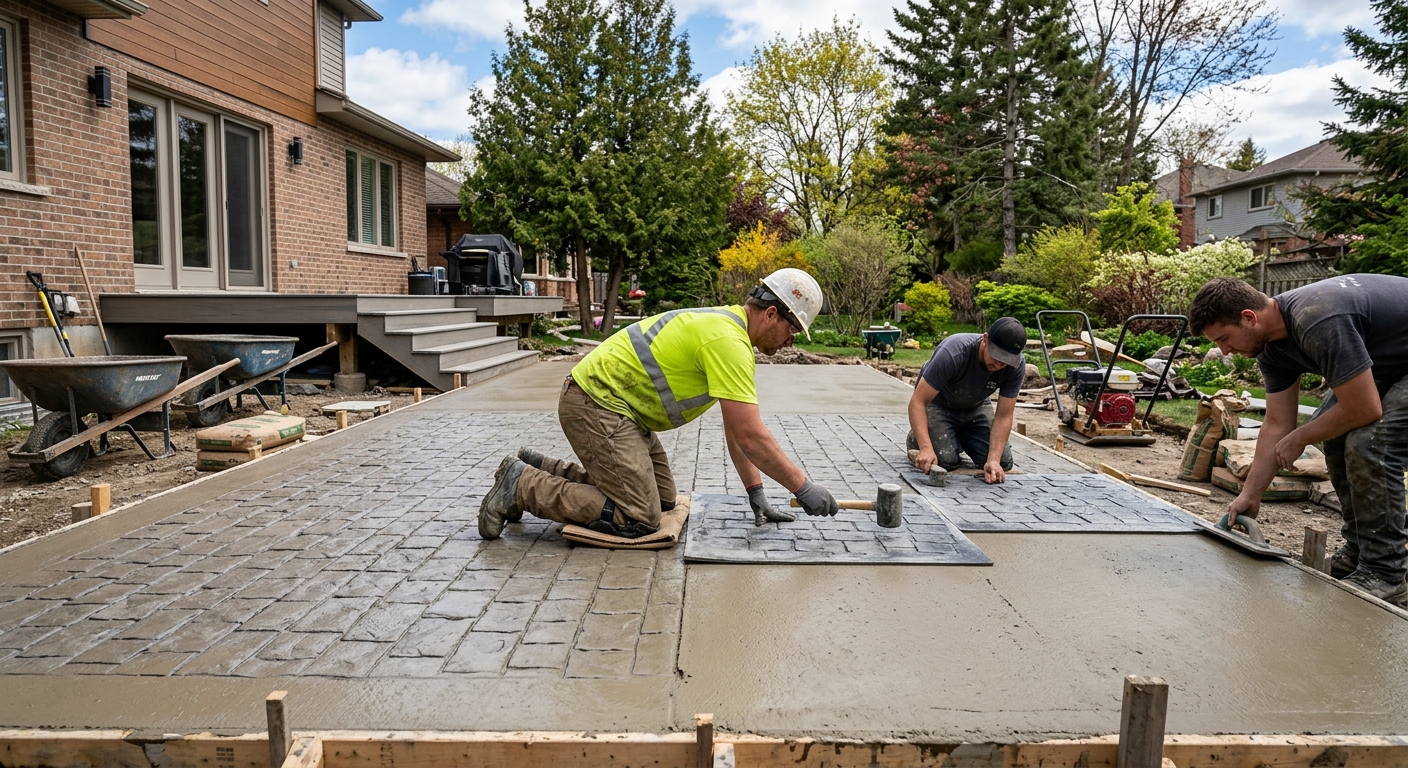
Stamped patterns (e.g., slate/stone) + sealer |
$11,000 – $22,500 |
| Plain concrete patio or walkway |
200–400 sq. ft. |
4" slab on compacted base, air-entrained mix |
Float/trowel then broom or light texture |
$3,200 – $8,800 |
| Garage floor (interior slab) |
320–520 sq. ft. |
4"–5" slab, vapour control as applicable |
Broom or trowel, optional sealer |
$7,000 – $14,500 |
| Foundation footings (structural, below frost) |
Per project (varies) |
Excavation + concrete below design frost, rebar per design |
Formed footings, engineered spec |
$12,000 – $28,000 |
Prices are estimates only and vary by project scope, site access and material selection.
What affects the price of concrete work in East Cambie
Even in the same neighbourhood in East Cambie, homeowners can see quotes swing by 30% to 50% for what looks like a “similar” concrete job. In the Lower Mainland–Southwest, the difference usually isn’t the concrete itself—it’s the preparation, specs, and how well the crew can protect the pour from coastal-wet conditions and freeze–thaw cycling. Contractors also price labour based on how busy the season is in the Vancouver–Surrey–Abbotsford corridor, plus access constraints (driveway demolition, lane work, form set space, and truck turning radius).
Here’s the technical chain that drives cost: Lower Mainland–Southwest practice assumes a frost depth around 450 mm / 18", and footings must extend below the design frost level to prevent frost heave. Exterior slabs and exposed surfaces need air-entrained concrete mixes to survive repeated freeze–thaw exposure and scaling risk. Colder regions of BC force deeper excavation and stricter cold-weather curing—while East Cambie is milder, we still get cold snaps and high humidity that can slow set and strength gain. If contractors need to use curing blankets, extra labour for protection, or longer formwork times, costs rise. De-icing salts can also accelerate spalling, so sealing and proper jointing matter for long-term durability.
Concrete examples that commonly move your budget: (1) Adding reinforcement (wire mesh or rebar) can raise cost but may be necessary for larger spans or heavier vehicle loads; (2) Upgrading drainage and compacted granular base can increase excavation time, but it reduces settlement and future cracking; (3) Choosing a stamped driveway can justify the premium if you’re already planning deeper base prep—otherwise you pay for decorative labour over a less durable base. As a baseline, plain driveways might land around the $18–$28 band, while stamped & decorative often push into the $22–$36 range depending on thickness, design complexity, and sealing.
Finally, housing age matters. Older East Cambie properties often have compacted fills, tree-root backfill, or inadequate grading around existing foundations—when we correct those, it can add meaningful dollars to the quote, even if the visible slab size stays the same.
| Price Factor |
Why It Matters |
Cost Impact |
| Frost line depth — determines footing depth and form height |
Footings must be placed below design frost to prevent frost heave. |
Higher excavation/formwork increases concrete and labour time. |
| Site preparation — excavation, grading, compacted granular base |
Proper base reduces settlement and helps manage saturated soils. |
More hauling/compaction steps can add significant labour and equipment. |
| Reinforcement — rebar or wire mesh requirement |
Controls cracking and supports load, especially on driveways and garage slabs. |
Material + placement labour can increase total cost. |
| Mix design — air-entrainment and compressive strength spec |
Air-entrainment improves freeze–thaw durability. |
Specialty mix and QA adds cost, especially for exterior durability. |
| Finish type — broom vs. stamped vs. exposed aggregate |
Surface texture changes labour, curing time management, and sealing. |
Stamped/exposed finishes typically cost more than broom-finished slabs. |
| Pour size and concrete truck access to site |
Smaller pours or difficult access may require more trips and manual handling. |
Extra crew time, traffic coordination, and re-positioning add charges. |
| Cold-weather curing precautions — heating and blankets |
Protection is needed when nights are cool and strength gain slows. |
Blankets/heaters and extra monitoring can raise line-item costs. |
| Control joint pattern and sealing cost |
Jointing limits random cracking; sealing helps repel de-icing salts. |
More layout labour and added materials for sealer. |
Permits & regulations in British Columbia
In British Columbia, structural concrete work typically requires a building permit. This includes footings, foundation walls, and grade beams—any concrete elements that support a structure or transfer loads. Many projects also need engineered drawings reviewed through the municipal permit process.
Concrete flatwork such as patios, walkways, and driveways usually does not require a permit unless it affects something the municipality regulates, such as lot grading, changes to drainage, or impervious surface coverage limits near services/right-of-way. If your project involves altering drainage patterns, tying into a municipal ditch/sidewalk area, or changing the slope of runoff, confirm requirements before breaking ground.
Step-by-step, here’s how a homeowner in East Cambie can verify credentials in BC before signing:
- Ask for the contractor’s business licence information where applicable and their contractor details.
- Request a certificate of liability insurance showing coverage amount, policy validity, and that it covers concrete-related work (not just “general business”).
- Confirm worker coverage: ask whether they carry WCB coverage (and provide proof/clearance documentation if available).
- Look for clearance/coverage letters (or proof documents) rather than verbal assurances.
- Request references for similar flatwork and foundation-scale jobs, including projects completed in wet seasons where curing protection was required.
- For permitted structural work, confirm that engineering and permit steps are included in the scope and timeline.
Bottom line: verify everything before the first excavation—especially because the Lower Mainland–Southwest schedule can be tight around wet weeks and cold snaps.
Getting concrete right in East Cambie's freeze-thaw climate
Concrete failure in East Cambie is usually a durability problem, not a “finish” problem. The most common issue is spalling (surface scaling/chipping) caused by poor air-entrainment, inadequate base preparation, or joints that don’t control cracking. In the Lower Mainland–Southwest, frequent freeze–thaw cycles combined with coastal rainfall saturate soils, and that moisture can work its way into the slab surface and edges. That’s why correct specifications—compaction, drainage-friendly base prep, an air-entrained mix, and a realistic curing plan—matter as much as the chosen look.
To spec the job correctly, focus on five areas. First, base preparation: ensure a properly compacted granular sub-base to the right depth for local soil and frost considerations; undersized base leads to settlement and edge stress. Second, mix design: exterior flatwork typically targets 5% to 7% air content with at least 32 MPa compressive strength for the intended exposure. Third, control joints: set spacing to limit random cracking paths. Fourth, curing: plan for at least 7 days of curing under favourable conditions; in cool, humid weather, curing protection (blankets/sealers by schedule) is key. Fifth, sealing: use a penetrating sealer after curing (often around 28 days post-pour) to repel de-icing salts that accelerate scaling in winter.
Ask your contractor specifically about spalling prevention, not just “standard mix.” If a stamped patio quote is lower but they can’t explain air content, jointing, or curing, that savings can backfire. For a simple example, a broom-finished patio might be closer to the $16–$26 band, while stamped work may rise toward the decorative premium; the extra cost is only justified when the durability specs—air-entrainment, joints, and curing—match the appearance upgrade.
| Spec |
Why It Matters in East Cambie |
What to Ask For |
Impact if Skipped |
| Compacted granular base (depth?) |
Limits settlement and stress from wet, saturated soils. |
Granular base thickness and compaction method (e.g., lift depth and density targets). |
Cracking, uneven slab, and premature edge deterioration. |
| Air-entrained concrete mix (target air %?) |
Improves freeze–thaw durability and reduces scaling/spalling risk. |
Documented air content target (commonly 5%–7% for exterior flatwork). |
Surface scaling and spalling during winter temperature swings. |
| Compressive strength (MPa rating) |
Ensures adequate strength gain for durability and load resistance. |
Minimum 32 MPa (or project-specific rating in writing). |
Soft or brittle surfaces, faster wear, and increased cracking likelihood. |
| Control joints (spacing per ACI guidelines) |
Controls where shrinkage/cracking occurs. |
Joint spacing plan and cut timing (and whether joints are sealed). |
Random cracking and water intrusion at uncontrolled cracks. |
| Minimum 7-day curing period |
Cold, humid periods slow strength gain in coastal conditions. |
Curing method and protection plan for cool nights/rain (blankets if needed). |
Reduced strength and higher risk of early surface damage. |
| Penetrating sealer (when applied after cure) |
Repels moisture and de-icing salt exposure at the surface. |
Sealer type and application window (often around 28 days post-pour). |
Accelerated spalling/scaling and staining from winter salts. |
How to choose a concrete work contractor in East Cambie
Choosing a concrete contractor in East Cambie starts with proof, not promises. In British Columbia, verify they can legally carry out the work by checking their liability insurance (ask for a current certificate showing policy dates and coverage) and confirm they have the appropriate WCB coverage for their workers. For insurance, don’t accept a photo of a policy—ask for the certificate directly and confirm it’s active for the job dates. Then, request references for comparable projects (driveways and patios in wet seasons, not just dry summer work).
Next, require 2 to 3 itemised written quotes that break down labour and materials rather than using only a single lump sum. The quote should list excavation and disposal, granular base, reinforcement (wire mesh/rebar if required), concrete thickness, air-entrained mix confirmation, jointing plan, curing/blankets if needed, and sealing. Make sure the scope states whether permits (for structural work) are included, and whether disposal and site cleanup are included or billed separately.
Look for a workmanship warranty length, and ask whether product/manufacturer warranties apply to sealers or systems they’re using. Confirm whether any warranty is transferable if you sell your home. For payment schedule, a healthy approach is to avoid large down payments—generally keep upfront deposits around 10% to 15% and hold back a portion until the job is complete and surfaces are protected. Finally, ask for a start date and completion estimate in writing, because coastal rain and cool nights can extend cure time and affect scheduling.
- Ask for documented air-entrainment targets for exterior flatwork.
- Confirm slab thickness and granular base thickness match the plan.
- Require a joint layout (spacing and timing of cutting).
- Ensure the quote specifies curing protection if temperatures dip.
- Check that reinforcement is included where needed (especially driveways/garage slabs).
- Ask whether sealant is included and when it will be applied after cure.
- Confirm disposal (haul-away of spoils) is included if excavation is required.
- Get truck access notes in writing (where the concrete truck can stage).
- Request at least two recent local photos of similar finishes.
- Verify the contractor provides proof of liability insurance before work begins.
- Confirm WCB coverage for workers (not just subcontractor claims).
- Clarify cleanup: sweeping, removing forms, and restoring any landscaping not within the demolition scope.
Concrete red flags in East Cambie include: refusing to discuss air content and curing, quoting a decorative finish without first confirming base prep and reinforcement, starting in wet weather without a plan for rain/cold protection, using vague “standard” specs, and asking for most payment upfront with no holdback tied to final inspection.
Frequently asked questions — concrete work in East Cambie
Can concrete be poured in cold weather in East Cambie?
Yes, but it needs planning in British Columbia. In East Cambie and the Lower Mainland–Southwest, winter pours can still be done when conditions are safe, but cold nights and high humidity slow strength gain. A reputable crew will protect the slab with curing blankets or other cold-weather measures, monitor temperatures, and avoid placing concrete on frozen subgrade. If a contractor can’t explain how they’ll maintain curing conditions for the first critical days (and how they’ll handle rain), that’s a major concern.
For exterior flatwork, specs like air-entrainment and proper jointing stay important, because even in a relatively shallow frost zone (practice often assumes about 450 mm / 18"), freeze–thaw cycling can damage poorly protected surfaces. As a budgeting reference, a standard broom driveway often falls in the $18–$28 band, but cold-weather protection can push the total higher if added blankets/heating are required.
How do I maintain concrete in East Cambie's freeze-thaw climate?
Maintenance in East Cambie is mostly about keeping water and salt exposure off the surface for as long as possible. Start with drainage: keep roof downspouts and grading directing water away from slab edges. For the concrete itself, clean with non-damaging methods (avoid harsh chemicals that could affect sealers). During winter, use de-icing products carefully—some salts increase spalling risk.
A well-built exterior slab should include control joints and air-entrained concrete. After the slab cures (often around 28 days post-pour), a penetrating sealer helps repel moisture and de-icing salts. Reapply sealer when it no longer beads water effectively, which varies by traffic and weather. If you paid for a decorative finish, sealing is especially important to protect colour and surface texture.
When budgeting for future upkeep, remember that sealing costs can be far less than replacing a failing surface—particularly if you selected a driveway in the $22–$36 stamped/decorative band.
What causes concrete to spall in East Cambie winters?
Spalling in East Cambie is commonly linked to inadequate air-entrainment, improper curing, or poor joint/base performance. In the Lower Mainland–Southwest, moisture from coastal rainfall and saturated soils enters the concrete surface or edges, and freeze–thaw cycles then expand water pockets. If the mix doesn’t include proper air entrainment (often targeted around 5%–7% for exterior flatwork) or if the concrete wasn’t cured properly in cool, damp weather, the surface can scale and then spall.
Another frequent cause is de-icing salt combined with a surface that hasn’t been sealed. When salts repeatedly wet/dry the surface, the damage accelerates. Jointing problems—like joints cut too late, joints that are too far apart, or joints that aren’t sealed where required—also allow water to travel through random cracks.
If you’re seeing early spalling, ask whether the slab was built to the air and curing specs and whether sealing was included. Don’t rely only on appearance; durability specs are what matter most.
What is rebar and when is it required in British Columbia?
Rebar (reinforcing steel bars) is used to strengthen concrete so it can better resist tension forces and cracking, especially in slabs and structural foundation elements. In British Columbia, whether you need rebar is determined by engineering and the project’s structural design—especially for foundations, grade beams, and some garage/driveway applications. For exterior flatwork, some projects use wire mesh or fibre reinforcement, but the decision depends on slab thickness, support conditions, and load requirements.
In East Cambie, driveways and garage floors often see reinforcement because they’re exposed to vehicle loads and curling stresses when moisture and temperatures change. If the contractor says “we don’t need reinforcement” without explaining your thickness, sub-base, and intended loads, ask for the basis in writing.
Also, for foundation footings and structural concrete below frost, reinforcement is usually part of engineered requirements and permit-level scopes. Prices can shift: exterior work built to higher durability specs may land toward the upper end of bands like $18–$28 for standard driveways or higher for decorative options.
How long does a concrete project take in East Cambie?
Timing depends on excavation, curing conditions, and finish type. A typical driveway or patio involves: (1) site prep and base work, (2) reinforcing placement (if required), (3) forming and pouring, (4) curing protection, and (5) sealing for exterior surfaces. In East Cambie, many standard broom-finish flatwork projects can be completed faster because there’s less finishing time, but cold nights and persistent coastal rain can extend cure time and delay trimming/sealing.
As a practical range, a straightforward patio or walkway may take about a few days on site for prep and pour, while decorative stamped work generally needs additional steps for the release agent, stamping, and careful timing. The “wait time” is often where schedule differs: you might be able to walk on the surface sooner than a vehicle-loading schedule, and sealing is usually coordinated after curing (commonly around 28 days).
If your contractor is scheduling around wet weeks, ask what curing protection they’ll use and when they expect to apply sealer. For foundation/footings (permit-level work), timelines are longer due to engineering and structural steps.
What is a concrete overlay and is it suited to East Cambie?
A concrete overlay is a new surface layer placed over an existing concrete slab after preparation—often used to improve appearance or extend service life without full demolition. Overlays can be suitable in East Cambie when the underlying slab is still structurally sound (not extensively spalled, settled, or heavily cracked). The key is surface preparation: grinding/cleaning, proper bonding system selection, and a crack/joint strategy so moisture doesn’t get trapped.
In the Lower Mainland–Southwest freeze–thaw climate, overlay performance depends on controlling water movement and ensuring compatibility with drainage and de-icing salt exposure. If your existing slab already has widespread spalling or significant movement, an overlay can fail early because the problem originates below the surface. In those cases, replacement with air-entrained concrete, correct joint spacing, and a well-prepared base is the more durable fix.
Cost-wise, overlays can sometimes be positioned between standard flatwork and decorative projects, but don’t compare prices without confirming the condition of the base. If you’re quoted near the standard driveway band ($18–$28), ask what prep and bonding system are included—those details decide whether it’s a smart renovation or a shortcut.