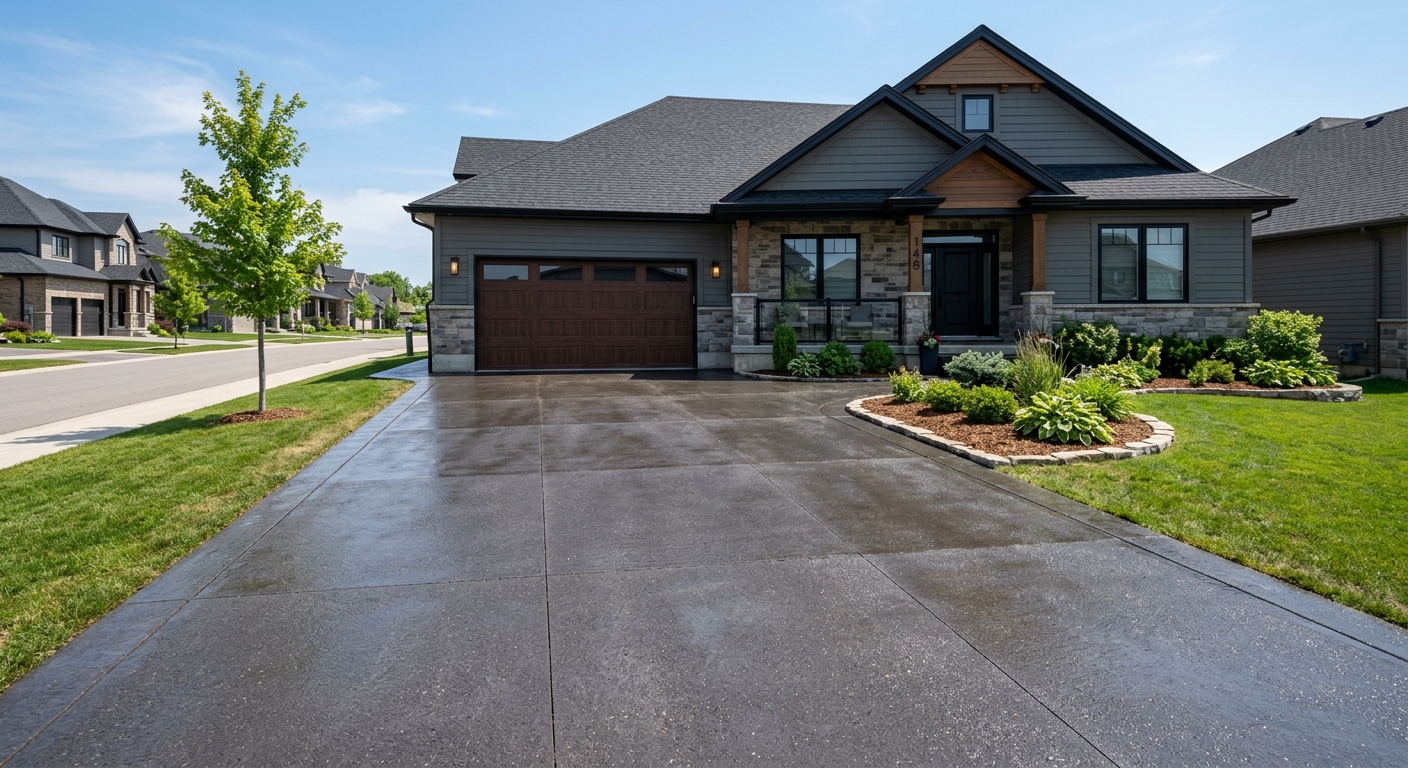
Concrete work options and costs in Central Coquitlam
Central Coquitlam homeowners typically choose concrete for driveways, patios, and foundations because it gives a smooth, durable surface that can handle Lower Mainland–Southwest conditions. With a 2021 population of 15,480 (Statistics Canada, 2021 Census), the area is busy enough that contractors are often coordinating multiple pours—especially around family neighbourhoods where flatwork is in constant demand. Concrete flatwork is also common in detached and townhome pockets across Central Coquitlam, where upgrades to curb appeal and backyard usability tend to happen at the same time as housing turnover and landscaping changes.
In this region, cost and design are shaped by mild winters but a shallow frost line; local practice commonly assumes frost depth around 450 mm (18"), so footings, piers, and thickened edges sit below that to reduce freeze–thaw damage and avoid frost heave. Even though we’re not building in deep-frost country, freeze–thaw cycles, saturated soils, and coastal rainfall still drive base preparation and drainage requirements. For exterior slabs, crews commonly use air-entrained mixes and proper control joints to limit cracking and scaling. Scheduling matters too: high humidity and cool nights often mean longer curing and more attention to surface protection.
In Central Coquitlam—particularly around Burke Mountain and along the older residential blocks closer to the Coquitlam River corridor—driveway and patio work is especially in demand as homeowners add parking pads, widen access, and resurface aging slabs. Below is a practical comparison to help you match scope and finish to realistic price expectations before you request a site visit and measurement.
| Application |
Typical Size |
Key Spec |
Finish Option |
Price Range |
| Concrete driveway (standard broom finish) |
400–600 sq. ft. |
Reinforced slab on compacted granular base, air-entrained for exterior |
Broom finish + control joints |
$18,000–$28,000 |
| Exposed aggregate driveway |
400–600 sq. ft. |
Air-entrained exterior mix + proper surface timing for wash/expose |
Exposed aggregate (light to medium texture) |
$22,000–$34,000 |
| Stamped concrete driveway or patio |
300–500 sq. ft. |
Air-entrained mix + integral colour (or colour hardener) |
Stamp pattern + release + seal coat |
$22,000–$36,000 |
| Plain concrete patio or walkway |
250–400 sq. ft. |
Exterior air-entrained slab with drainage and control joints |
Float + broom/texured finish |
$16,000–$26,000 |
| Garage floor (interior slab) |
300–500 sq. ft. |
Reinforced interior slab, moisture-conscious base prep |
Power-trowel finish (sealed optional) |
$12,000–$22,000 |
| Foundation footings (structural, below frost) |
Varies by house design |
Excavation + form + rebar; placed below frost depth for the design |
Structural concrete to engineered spec |
$6,000–$14,000 |
Prices are estimates only and vary by project scope, site access and material selection.
What affects the price of concrete work in Central Coquitlam
In Central Coquitlam and across the Lower Mainland–Southwest, the same concrete job can come in 30–50% apart from quote to quote because the differences usually aren’t “mystery markup”—they’re scope and engineering choices: excavation depth, base thickness, reinforcement, mix design, finish work, and how the contractor plans for rain and curing. In British Columbia’s coastal-wet climate, even when winters feel mild, freeze–thaw cycles plus saturated subgrades can punish thin bases and under-designed drainage.
Frost depth drives every exterior structural spec. Footings and thickened edges must extend below the design frost depth to prevent frost heave, and concrete flatwork needs air-entrained mixes to survive freeze–thaw cycles and manage scaling. Contractors also price differently based on seasonality: colder regions require deeper excavations and cold-weather curing precautions (heating and insulating blankets), which raises excavation, forming, and curing labour. While Lower Mainland projects are more workable than interior/northern BC, cool nights and prolonged rain can still slow scheduling and require extra curing protection to reach design strength.
On your site in Central Coquitlam, drainage and soil conditions are often the cost swing. For example, a driveway that needs significant regrading and a thicker compacted granular base may shift from a standard broom pour toward a higher-expectation build that supports slope and runoff. Similarly, a stamped concrete driveway or patio can be a strong value when the base is engineered correctly—otherwise the extra finish cost doesn’t solve cracking risk. If you’re comparing broom-finish driveway pricing (often aligned with $18–$28) versus stamped & decorative options (often aligned with $22–$36), the cost difference is usually justified by formwork complexity, integral colour/stamping labour, and higher seal-care requirements.
| Price Factor |
Why It Matters |
Cost Impact |
| Frost line depth — determines footing depth and form height |
Footings must be placed below frost to reduce frost heave and settlement risk |
Higher excavation and forming can add thousands on footing-heavy scopes |
| Site preparation — excavation, grading, compacted granular base |
Subgrade moisture and bearing capacity control long-term cracking and unevenness |
Bad soil or limited access can increase labour and haul/disposal costs |
| Reinforcement — rebar or wire mesh requirement |
Reinforcement ties slabs and helps control flexing where soils are variable |
More steel and chairing can materially raise material cost |
| Mix design — air-entrainment and compressive strength spec |
Exterior air entrainment improves freeze–thaw durability and scaling resistance |
Spec-compliant mix can cost more but reduces premature surface failure |
| Finish type — broom vs. stamped vs. exposed aggregate |
Complex finishes require extra labour, timing, and sealing |
Stamped/exposed finishes typically sit higher within the regional bands |
| Pour size and concrete truck access to site |
Access affects crane/boom use, pumping, and the time it takes to place concrete |
Hard access can increase labour and extend scheduling time |
| Cold-weather curing precautions — heating and blankets |
Even in the Lower Mainland, cool, damp conditions can slow strength gain |
Protective gear and longer supervision add to labour |
| Control joint pattern and sealing cost |
Proper joints guide cracking; sealing helps repel salts and staining |
Good jointing and sealing add cost, but they reduce maintenance and spalling risk |
Permits & regulations in British Columbia
In British Columbia, structural concrete work generally requires a building permit. That includes footings, foundation walls, and grade beams (anything that supports a foundation system or affects structural load paths). For many foundation situations, engineered drawings are reviewed as part of the permit process. Concrete flatwork—such as patios, walkways, and driveways—often does not require a permit, unless it affects lot grading, changes drainage patterns, or triggers municipal requirements around impervious surface coverage and stormwater handling. Before you break ground, confirm with the City/municipality requirements for Central Coquitlam and your specific lot.
Step-by-step verification for hiring safely in Central Coquitlam:
- BC licence/registration: Use the province’s online tools/registry pages to confirm the contractor’s business name and active status for the trades they claim to perform.
- Liability insurance: Ask for a current Certificate of Insurance (COI) showing general liability coverage and the correct legal name/address for the contractor.
- WCB (BC workers’ compensation): Request evidence of coverage (clearance/registration as required) so you’re not exposed if a worker gets hurt on your site.
- References: Request 2–3 similar-scale jobs (same finish type and exterior exposure) and ask to see them in person.
- Written scope: Make sure the permit responsibility and any geotechnical/drainage requirements are clearly stated in writing.
Getting concrete right in Central Coquitlam's freeze-thaw climate
Concrete fails in Central Coquitlam mainly when freeze–thaw durability and drainage are treated as afterthoughts. Water gets under slabs or into the surface, then expands during cold cycles—leading to scaling, spalling, and settlement-related cracking. To spec the job correctly here, focus on five areas. First, base preparation: use compacted granular sub-base to the right depth and bearing for your local soil, and ensure proper grading so surface water drains away from the slab. Second, mix design: require air-entrainment (commonly 5–7% air for exterior flatwork) and a minimum 32 MPa compressive strength so the concrete survives wet/cool periods. Third, control joints: place them to manage where cracking will occur, rather than letting shrinkage and restraint crack the slab randomly. Fourth, curing: plan for a minimum 7-day curing period under protective conditions; when nights run cool and humidity stays high, crews often need blankets or seal/curing protection to keep temperatures and moisture in the right range. Fifth, sealing: apply a penetrating sealer only after cure (often around 28 days) to repel de-icing salts and reduce staining.
When you ask technical questions, keep it simple and evidence-based. For example, insist the contractor specifies air entrainment in the mix design and shows how joints and drainage will be handled. A stamped patio may cost you more than a plain broom patio (the local bands typically put plain patios around $16–$26, while decorative work often lands around $22–$36), but the upgrade is only worth it if the base, joints, and air-entrained mix are correct—otherwise the decorative finish just reveals premature surface failure sooner.
| Spec |
Why It Matters in Central Coquitlam |
What to Ask For |
Impact if Skipped |
| Compacted granular base (depth?) |
Controls settlement and keeps moisture from pumping under the slab during wet winters |
Base depth and compaction requirements; confirm drainage/grading plan |
Unevenness, cracking, and premature failure even on “pretty” finishes |
| Air-entrained concrete mix (target air %?) |
Improves resistance to freeze–thaw scaling in Central Coquitlam’s coastal-wet conditions |
Target air content (commonly 5–7% for exterior flatwork) stated on the mix |
Spalling and scaling risk rises—especially where water and de-icing sit |
| Compressive strength (MPa rating) |
Strength gain supports durability and abrasion resistance in driveways and patios |
Minimum 32 MPa and how it’s verified for your pour |
Surface wear, crumbling edges, and reduced long-term toughness |
| Control joints (spacing per ACI guidelines) |
Directs cracking lines so cracks don’t grow randomly with shrinkage |
Joint spacing plan and saw-cut timing |
Random cracking, wider crack repair needs, and water intrusion |
| Minimum 7-day curing period |
Cold nights and high humidity can slow hydration and strength development |
Curing method and protection plan for cool/rainy days |
Lower strength at early age, increased risk of surface damage |
| Penetrating sealer (when applied after cure) |
Helps repel salts and reduces staining in the wet coastal climate |
Type/brand and application timing (often around 28 days post-pour) |
More water uptake, staining, and faster deterioration of the surface layer |
How to choose a concrete work contractor in Central Coquitlam
Picking the right concrete contractor in Central Coquitlam starts with verification. In British Columbia, ask for proof of active trade registration where applicable, a current Certificate of Insurance for liability coverage, and confirmation of WCB coverage for workers. The “easy win” is requesting documents up front and matching the contractor’s legal business name to the COI and paperwork. If they hesitate, it’s a red flag.
Next, get 2–3 itemised written quotes—not just a single lump sum. You want labour and materials broken out by major components: excavation and disposal, granular base, forms/finishing, reinforcement, concrete supply, joints, and sealing. Watch for exclusions like site re-grading, permit responsibility, and weather protection (blankets/curing). For warranty, confirm a workmanship warranty length and what it covers (cracks due to shrinkage vs. issues from base or mix non-compliance). Ask whether any product/manufacturer warranty is included and whether you can transfer it if you sell the home.
Payment schedule matters: don’t agree to pay more than about 10–15% upfront. Hold back a portion until completion and cleanup, especially for sealing and final joint finishing. Finally, insist on a written start date and completion estimate. In Lower Mainland–Southwest conditions, rain windows can shift timelines—good contractors plan around curing and protection, not just the pour day.
- Request COI (liability) and confirm coverage limits match your risk.
- Ask for WCB clearance/coverage evidence before work starts.
- Confirm the concrete mix specification includes air entrainment for exterior flatwork.
- Get base depth and compacted granular spec in writing (not “allowance”).
- Clarify reinforcement (mesh vs. rebar, spacing, chairs) and where it’s used.
- Ask how drainage/grading is handled so water sheds away from slabs.
- Confirm control joint spacing and saw-cut timing.
- Ask what curing protection is used in cool/wet weather (blankets/curing compound).
- For decorative work, require details on colour system, release, and sealing.
- Verify disposal is included (excavated material haul away, not “by client”).
- Check that permit pull responsibility is clearly stated where required.
- Use a payment schedule with a holdback until final inspection and sealing.
Concrete contractor red flags in Central Coquitlam: they won’t show air-entrainment or compressive strength on the ticket/spec; they propose “thin base to save money” without a compaction plan; they insist on paying nearly all upfront; they give only a pour-day timeline with no curing/protection plan; or their quotes omit disposal and drainage/grading scope and then bill changes later.
Frequently asked questions — concrete work in Central Coquitlam
How long does concrete take to cure?
In Central Coquitlam and across British Columbia’s Lower Mainland–Southwest, curing time is about both the calendar and the weather. Most contractors schedule a minimum 7 days before you treat the slab as ready for normal use, but full durability develops over longer time. If cool, damp conditions delay strength gain, reputable crews use curing protection (blankets/cover and careful moisture management) so the concrete reaches design performance. For sealing, the common practice is to wait until about 28 days post-pour so the surface has cured enough for the sealer to bond properly. If you’re pouring a driveway in the $18,000–$28,000 range, plan the timeline around curing, not just the day the forms come off—rushing is what leads to early surface wear.
Do I need a permit for concrete work in British Columbia?
In British Columbia, structural concrete work—like footings, foundation walls, and grade beams—typically requires a building permit and often engineered drawings that are reviewed through municipal processes. For most concrete flatwork such as patios, walkways, and driveways, a permit often isn’t required, but exceptions happen. If your driveway or patio changes lot grading, affects drainage patterns, increases impervious surface coverage beyond what’s permitted, or impacts municipal right-of-way rules, you may need approvals. For Central Coquitlam homeowners, the safest approach is to confirm with the local authority before work begins, especially if you’re reworking slopes or tying into existing drainage. Also verify your contractor clearly states who is pulling any required permits in the written quote.
Concrete vs pavers for a patio in Central Coquitlam?
Concrete and pavers both work well in the Lower Mainland–Southwest, but they fail differently. Concrete patios rely on a properly prepared compacted granular base and correctly spaced control joints; when those are done right, a plain patio or walkway in the $16,000–$26,000 band can look good for years with fewer individual unit replacements. Pavers can be great when you want easy section-level repairs—one cracked area often means removing fewer blocks. However, pavers can shift if drainage/granular base depth isn’t right, and weeds can creep through joint sand. In Central Coquitlam’s wet coastal conditions, either option needs a drainage plan that sheds water away from the home. If you’re considering stamped concrete (often closer to $22,000–$36,000), ask how the contractor handles joints and sealing—those details matter as much as the finish.
How long does a concrete driveway last?
A well-built driveway in Central Coquitlam commonly lasts decades, but the lifespan depends on base prep, drainage, and freeze–thaw durability. With the typical Lower Mainland approach (air-entrained exterior concrete, proper base compaction, correct jointing, and sealing where appropriate), you often see long service life before meaningful cracking. Problems usually show up when water is allowed to sit at the surface or get under the slab—leading to scaling, spalling at edges, and settlement cracking. Driveways that include correct control joint patterns and a sealed surface (after cure) generally perform better where de-icing salts and coastal rain contribute to moisture cycling. If you’re budgeting within the local driveway range (often $18,000–$28,000 for standard broom finishes), focus your comparison on whether quotes include the same drainage and air-entrainment specs—not just the final look.
What is air-entrained concrete and why does it matter here?
Air-entrained concrete is mixed to include tiny, evenly distributed air bubbles that give the cement paste room to expand during freeze–thaw cycles. In Central Coquitlam and the broader Lower Mainland–Southwest, you’re not dealing with deep interior frost, but you do experience freeze–thaw and frequent saturation from rainfall. Without air entrainment, water absorbed in the concrete paste can freeze, expand, and damage the surface—showing up as scaling and spalling. That’s why reputable exterior flatwork spec includes air entrainment (commonly 5–7% air for exterior) and proper control joints. If you’re comparing quotes for an exterior driveway or patio, ask for the mix spec and target air %—it’s one of the clearest ways to avoid a “cheap today, expensive repair later” outcome.
How do I prepare the base for a concrete slab?
Base preparation is where concrete longevity is won or lost in British Columbia. For Central Coquitlam, your contractor should plan excavation and grading so the slab sits on a properly compacted granular sub-base at the right depth for your soil and drainage conditions. The base should be level, well-drained, and compacted in lifts so it doesn’t settle after the pour. Exterior slabs also need attention to how water moves away from the home—poor grading or blocked drainage paths can flood the sub-base and trigger freeze–thaw damage even if the surface finish looks good. Ask your contractor for the base depth, compaction approach, and reinforcement placement details (mesh/rebar and chairs) as part of the written scope. If sealing is included, confirm it’s scheduled after proper curing (often around 28 days).