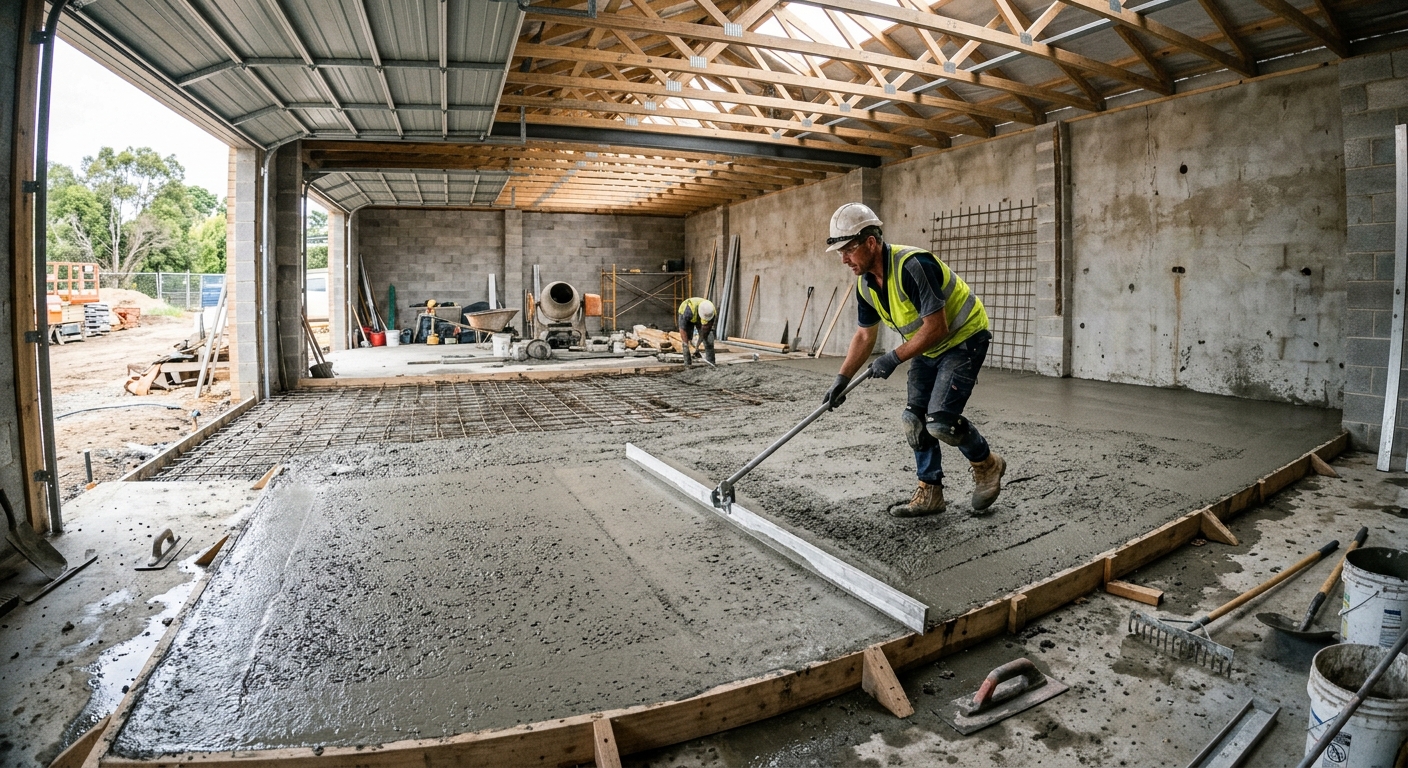
Concrete work options and costs in Kelowna
Concrete contractors in Kelowna see steady demand because most neighbourhoods here are dominated by single-detached housing—42.5% of local dwellings—so driveways, patios and walkways are a constant upgrade cycle. Across Thompson–Okanagan, the market is also strongly homeowner-led: 40,250 homeowner households make up 64.7% of households (Statistics Canada, 2021 Census). That matters because homeowners typically plan projects with predictable timelines (spring through fall), which affects crew availability and pour scheduling.
In the Kelowna area, costs aren’t just “concrete per square foot.” Thompson–Okanagan freeze–thaw activity and typical frost depths (commonly designed around a 45–60 cm practical frost consideration, with exterior footings founded below frost) push up excavation, base prep, and mix specification. You’ll also notice a tighter pour season in cooler shoulder months: the contractor may need extra curing protection (blankets/compounds and temperature management), which adds labour and equipment costs.
Demand is especially strong around established residential pockets such as Rutland and Glenmore, where homeowners are resurfacing older driveways and creating backyard entertaining spaces. If your home was built before 1981 (31.7% of homes), upgrades often include regrading and drainage corrections before the slab goes in—small site changes, but they can add real dollars.
Below is a practical comparison of common concrete options and typical Kelowna price bands, to help you line up what different quotes are really including.
| Application |
Typical Size |
Key Spec |
Finish Option |
Price Range |
| Concrete driveway (standard broom finish) |
10 m x 3 m (30 m²) |
Reinforced slab, air-entrained mix, proper base + drainage |
Broom finish + control joints |
$18,000–$27,000 |
| Exposed aggregate driveway |
10 m x 3 m (30 m²) |
Air-entrained mix, tighter finishing tolerances |
Exposed aggregate with sealer |
$24,000–$34,000 |
| Stamped concrete driveway or patio |
8 m x 4 m (32 m²) |
Reinforced slab, air-entrained mix |
Stamped patterns + release + sealer |
$26,000–$43,000 |
| Plain concrete patio or walkway |
6 m x 3 m (18 m²) |
Reinforced where required, broom finish, joints |
Broom or brushed finish |
$2,500–$4,300 |
| Garage floor (interior slab) |
6 m x 6 m (36 m²) |
Vapour retarder (if specified), reinforced, cured properly |
Float/smooth-trowel finish |
$6,500–$11,500 |
| Foundation footings (structural, below frost) |
House-style footing system |
Excavation to design frost depth, forms, rebar cages |
Standard foundation concrete |
$12,000–$22,000 |
Prices are estimates only and vary by project scope, site access and material selection.
What affects the price of concrete work in Kelowna
In Kelowna and the wider Thompson–Okanagan, the same “concrete driveway” can come back with quotes that differ by 30–50% once you compare the real specs behind the numbers. Much of that spread comes from frost-depth design choices, freeze–thaw durability requirements, and how much site correction the crew includes (or excludes). Even within British Columbia, prices can shift with local crew availability, hauling distance, and when the contractor can schedule a pour during the window when curing and protection are practical.
First, frost line depth drives footing and slab design. In our region, exterior elements are typically founded below frost (you’ll often see 45–60 cm as a practical consideration for many assemblies, with footings designed deeper where soil conditions require). That means more excavation and higher forming costs versus a “minimum depth” approach. Second, freeze–thaw cycles mean exterior slabs should use air-entrained concrete and a disciplined joint plan to limit random cracking and scaling. In colder regions, the pour season is shorter and contractors add cold-weather curing precautions—insulating blankets or heating—so strength gain isn’t compromised.
Third, de-icing salt near garage approaches and walkways accelerates surface wear. That’s why sealing is commonly included for exterior work, and why a broom-finished driveway at the lower end of the $18–$28 band can jump when you add sealing, better drainage, or upgrade the finish to exposed aggregate or stamping within the $24–$38 stamped & decorative band.
Concrete pricing also moves with site conditions: long narrow access roads, high slope lots, and older properties (built before 1981 in many neighbourhoods) often need extra grading and base rebuild. For example, a drainage correction that adds 1–2 truckloads of granular material and some subgrade stabilization can be the difference between a mid-range driveway quote and the higher end after everything is brought to a frost-appropriate, compacted base.
| Price Factor |
Why It Matters |
Cost Impact |
| Frost line depth — determines footing depth and form height |
Footings must sit below frost to reduce heaving and cracking risk |
Higher excavation + more concrete and forming can add several thousand dollars |
| Site preparation — excavation, grading, compacted granular base |
Proper base prevents settlement that causes slab movement and joint failure |
Major cost swing if the existing base is soft, wet, or needs regrading |
| Reinforcement — rebar or wire mesh requirement |
Reinforcement controls cracking pathways, especially in driveway wheel loads |
Mesh/rebar adds material and labour; mesh-only pricing may be insufficient |
| Mix design — air-entrainment and compressive strength spec |
Air-entrainment helps concrete resist freeze–thaw scaling and surface spalling |
Not optional for exterior in Thompson–Okanagan; higher-spec mixes cost more |
| Finish type — broom vs. stamped vs. exposed aggregate |
Finish complexity affects labour time and material processing |
Stamped/exposed work typically pushes you toward the upper price bands |
| Pour size and concrete truck access to site |
Smaller sections or limited access can require more trips or pump time |
Truck access constraints can add hauling and equipment charges |
| Cold-weather curing precautions — heating and blankets |
Cold slows strength gain; protection helps prevent freeze damage |
Can increase labour and equipment costs during shoulder seasons |
| Control joint pattern and sealing cost |
Joints manage movement; sealing helps resist salt scaling and staining |
Often a line-item add on—worth it for longevity on exterior slabs |
Permits & regulations in British Columbia
In British Columbia, the permit picture depends on what you’re building. Structural concrete work—footings, foundation walls, grade beams, and any concrete element that supports the structure—typically requires a building permit, and municipalities often expect engineered drawings for review before work starts. For concrete flatwork (patios, walkways and most driveways), a permit usually isn’t required unless your project affects lot grading, drainage patterns, impervious surface coverage limits, or the municipal right-of-way. In Kelowna, it’s still smart to confirm with the local authority before breaking ground, especially if you’re changing how water leaves the property or adjusting elevations near curbs/sidewalks.
To protect yourself, verify the contractor’s paperwork before you sign anything. Step-by-step, ask for: (1) proof of general liability insurance (Certificate of Insurance naming you as applicable); (2) WSBC coverage for workers (or proof of clearance/coverage); and (3) evidence of any applicable business licensing/registration they provide to operate legally in BC. Then check: the contractor’s insurance certificate for active coverage dates and limits; the WSBC clearance/coverage status; and, if provided, any online business or trade registration details through official public directories.
Also request references for similar-scale projects in Kelowna (driveway replacements, rear-yard patios, or foundation work) so you can confirm they understand frost-appropriate prep, drainage detailing, and curing practices that keep exterior concrete durable through freeze–thaw cycles.
Getting concrete right in Kelowna's freeze-thaw climate
Concrete failures in Kelowna are usually preventable, and most trace back to five controllable items: base preparation, mix design, control joints, curing, and sealing. The Thompson–Okanagan climate brings frequent freeze–thaw cycles, and when water gets into the surface pores—or when the slab shifts due to an underbuilt base—freeze expansion can lead to surface scaling (spalling), cracking, and premature deterioration. That’s why you should spec the job for durability, not just appearance.
Start with base preparation: a properly compacted granular sub-base to the right depth for local soil and frost performance is non-negotiable. Next, mix design: exterior flatwork should use air-entrainment (commonly 5–7% air content for exterior applications) and meet a minimum compressive strength such as 32 MPa so the concrete develops enough strength while resisting freeze–thaw damage.
Third, control joints: the spacing and saw-cut timing should be planned to reduce random cracking. Fourth, curing: aim for minimum 7 days under suitable conditions; if you pour when temperatures are cool, ask how they’ll protect the slab (curing blankets or compounds, heating if required). Finally, sealing: apply a penetrating sealer after the concrete has cured (often around 28 days post-pour) so de-icing salts and moisture don’t attack the surface.
When comparing options, it’s easy to feel pressured into “fancy” finishes. For example, a plain patio may land near the lower end of the patio band ($14–$24), while stamped concrete moves you toward the decorative range ($24–$38). The price difference is justified when the contractor is also installing the same correct base and durability specs—not when the upgrade is used to hide weak prep. Ask the contractor to show you their air-entrainment spec, joint plan, and curing/protection plan before you compare patterns or colours.
| Spec |
Why It Matters in Kelowna |
What to Ask For |
Impact if Skipped |
| Compacted granular base (depth?) |
Prevents settlement and movement that widen cracks during freeze–thaw cycles |
Base thickness for your soil + proof of compaction |
Uneven support → cracking, rocking slab, faster failure |
| Air-entrained concrete mix (target air %?) |
Reduces freeze–thaw scaling and surface spalling |
Target air content (commonly 5–7% for exterior flatwork) |
Higher risk of scaling and flaking in winter seasons |
| Compressive strength (MPa rating) |
Strength development supports durability under traffic and temperature stress |
Minimum 32 MPa rating (or higher if specified) |
Weaker concrete → surface wear and earlier deterioration |
| Control joints (spacing per ACI guidelines) |
Controls where cracks occur as the slab shrinks and expands |
Joint spacing and timing for saw cuts |
Random cracking and cosmetically uneven failures |
| Minimum 7-day curing period |
Ensures strength gain and reduces surface defects in cool temps |
Curing method and any cold-weather protection plan |
Lower strength → scaling, increased cracking risk |
| Penetrating sealer (when applied after cure) |
Repels moisture and helps protect against de-icing salts |
Sealer application timing (often after ~28 days) |
Salt/meltwater attack → spalling and staining |
How to choose a concrete work contractor in Kelowna
Choosing the right contractor in Kelowna starts with paperwork you can verify. For British Columbia, request proof of liability insurance before work begins; the certificate should show active coverage, policy limits, and that subcontractors are covered where applicable. Next, confirm WSBC coverage (or clearance/coverage status if they provide it). You can verify WSBC details through WSBC’s official services and look for documentation that matches the company doing the work.
Then get 2–3 itemised written quotes. You want a labour + materials breakdown (base prep, excavation/disposal, reinforcement, concrete supply, finishing, sealing and joint work) rather than a single lump sum. This is the only way to compare apples-to-apples specs like air-entrainment, reinforcement size/type, and curing protection for shoulder-season pours.
Read exclusions carefully: are permits included (if needed), is disposal included for removed concrete and excess soil, and is drainage correction part of the scope? For warranty, ask for a workmanship warranty length and whether it covers labour only or labour plus materials. Also ask if any product/manufacturer warranties are transferable when you sell the home.
For payment, never pay more than 10–15% upfront. Hold back funds until the job is complete and documented (including curing/sealing steps where promised). Finally, insist on a written start date and completion estimate—no vague “weather permitting” only. In Kelowna’s freeze–thaw climate, schedule drift can shorten curing windows and cost you long-term durability.
- Ask for the concrete mix spec and air-entrainment target for exterior slabs.
- Confirm frost-depth/cold-weather curing plan for exterior work.
- Require an itemised quote for excavation, disposal, granular base and compaction.
- Check whether reinforcement is included and what type (mesh vs rebar, size).
- Verify joint spacing plan and whether joints are saw-cut, sealed, or both.
- Ask when sealing is applied and what product type is used (penetrating sealer).
- Confirm how they manage drainage so water doesn’t pond on the slab.
- Request proof of liability insurance and WSBC coverage/certificates.
- Look for previous projects in Kelowna with similar freeze–thaw conditions.
- Ensure the quote includes site protection (barriers, protection of landscaping, clean-up).
- Clarify truck access method (standard chute vs pump) and any extra charges.
- Hold payment until finishing steps (joints/sealing/cleanup) are completed.
Concrete red flags I see in Kelowna include: quotes that don’t mention air-entrainment for exterior work, skipping base compaction details, “minimum depth” footing talk without frost design, no clear joint plan, and contractors asking for large upfront payments or refusing to provide written scope and curing/sealing timelines.
Frequently asked questions — concrete work in Kelowna
Do I need a permit for concrete work in British Columbia?
In British Columbia, permits typically apply to structural concrete such as footings, foundation walls, and grade beams, because they affect the building structure and require municipal review. Concrete flatwork like most patios, walkways and driveways often does not require a permit, unless your project changes lot grading, affects drainage, or touches municipal right-of-way or impervious surface requirements. For Kelowna homeowners, the practical risk is drainage: if your new driveway slope or patio elevation changes how water flows, the municipality may require review. Before you pour, ask the contractor what permit (if any) is included in their scope, and call the local authority to confirm the requirement for your exact location and elevation changes.
Concrete vs pavers for a patio in Kelowna?
Both can work well, but they fail differently in Kelowna’s freeze–thaw climate. Concrete patios can be long-lasting when built with the right granular base, air-entrained mix, and a controlled joint pattern; sealer after curing helps with moisture and de-icing salt exposure. Pavers can also perform well, but the performance depends heavily on base and edging; any movement can create trip hazards over time. In Kelowna, concrete also tends to be more straightforward to maintain if sealed correctly, while pavers may require re-leveling if the base settles. Cost-wise, a plain concrete patio typically falls in the $14–$24 range, while stamped or decorative options move higher into the $24–$38 band. Compare fully itemised quotes so you’re not comparing concrete with missing drainage work versus pavers with a weaker base.
How long does a concrete driveway last?
A well-built concrete driveway in the Thompson–Okanagan often lasts 20–30 years or more, but that’s conditional. The key is how the slab handles water and freeze–thaw stress: an exterior-appropriate air-entrained mix, proper compacted granular base, correct joint layout, and curing protection during cool shoulder-season weather. Sealing (typically after full cure, often around 28 days) matters too because de-icing salts and meltwater attack the surface faster in winter. For many Kelowna homeowners, the first sign of trouble is not immediate cracking—it’s scaling or surface flaking that shows the mix or finishing wasn’t durable enough. If your driveway replacement quote is near the lower end of the $18–$28 concrete driveway band, ensure the contractor still includes base prep and air-entrainment, not just a basic broom finish.
What is air-entrained concrete and why does it matter here?
Air-entrained concrete is designed to include tiny, evenly distributed air bubbles in the mix. In Kelowna and across the Thompson–Okanagan, those microscopic voids give water a place to expand when it freezes, which significantly reduces freeze–thaw scaling and surface spalling. Without adequate air content, exterior slabs are much more likely to show flaking, roughening, and deterioration after repeated winter cycles. That’s why every exterior quote should specify air-entrainment and not just “standard concrete.” For example, a driveway or walkway intended for freeze–thaw exposure should target an exterior air content commonly around 5–7% for appropriate applications. When comparing quotes, ask your contractor to confirm the mix spec and show how it aligns with their curing and joint plan.
How do I prepare the base for a concrete slab?
Base prep is what makes the difference between “looks good” and “stays solid.” For Kelowna, it means excavating to the correct elevation, removing unsuitable material, and building a compacted granular sub-base to the depth needed for frost performance and your soil conditions. Then the contractor should grade for drainage (so water doesn’t pond), compact in lifts, and confirm compaction before placing reinforcement and concrete. If you have older site conditions (many homes in Kelowna were built before 1981), don’t assume the existing base is adequate—soft or wet areas can cause settlement and cracking. A good contractor will describe their base section, compaction approach, and how they’ll manage water flow. When you get quotes in the $18–$28 driveway range, insist that base preparation is included so you’re not paying for concrete while skipping what truly prevents failure.
How do I compare concrete quotes?
Comparing concrete quotes in Kelowna is mostly about apples-to-apples scope. Start by confirming what’s included: excavation, disposal, granular base thickness, reinforcement type, concrete mix specs (including air-entrainment for exterior), finishing method, curing protection, joint spacing, and whether sealing is included. Many large differences in total price come from site correction and durability specs rather than concrete itself. Ask for an itemised breakdown (labour + materials) instead of a lump sum. Then compare the finish you’re actually buying—standard broom versus exposed aggregate or stamped decorative work (often aligned with the $24–$38 decorative range). Finally, verify contractor coverage: liability insurance and WSBC coverage, plus references for similar Kelowna projects. If two quotes land far apart, ask each contractor to explain what the other one is excluding—especially around base prep and freezing-weather curing.