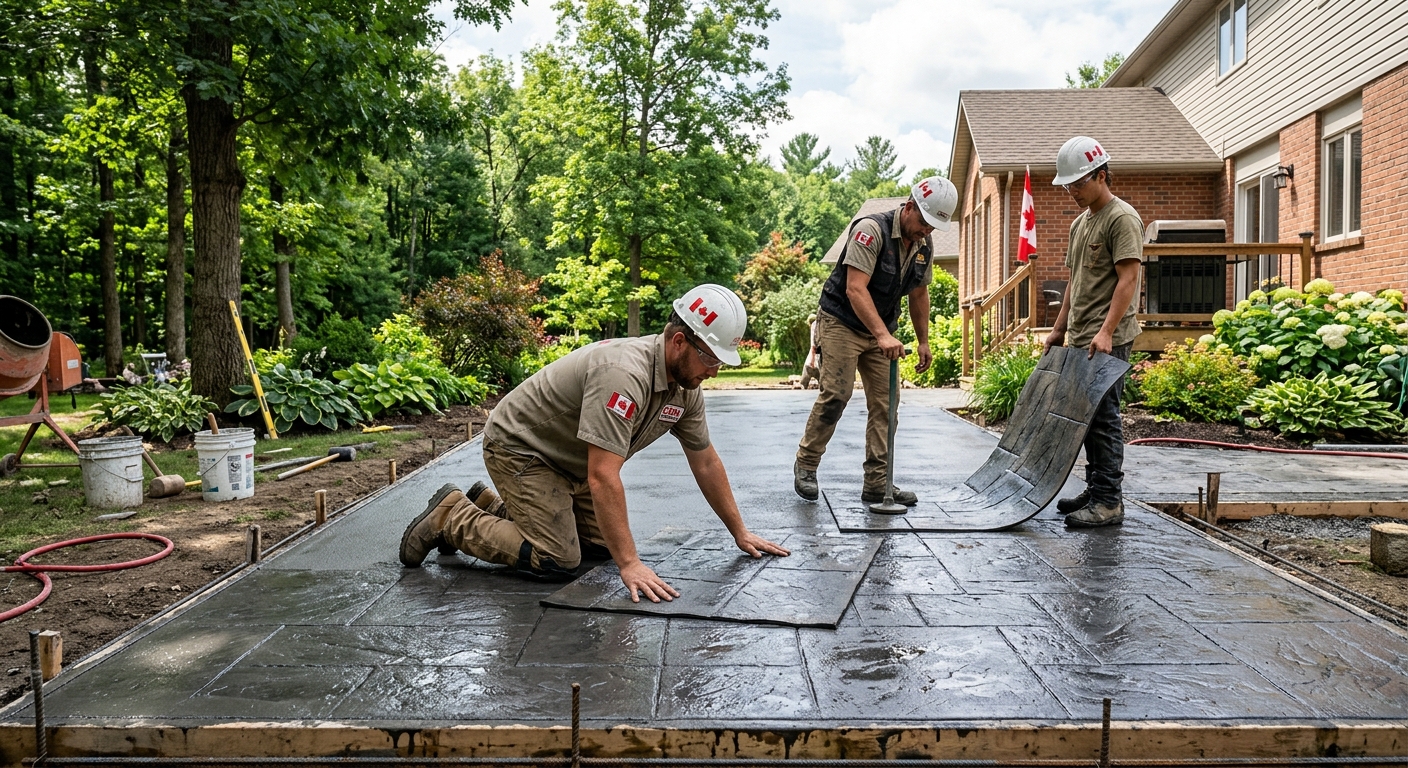
Concrete work options and costs in Richmond
Richmond homeowners typically choose concrete because it fits our housing stock and lifestyle. With 30.1% of dwellings being single-detached homes, driveway and patio work is constant in neighbourhoods like Blundell, Steveston and Hamilton. That demand also means more experienced crews are available for flatwork—especially in the busy spring-to-fall window when weather is workable. In 2021, Richmond’s population was 209,937, and the sheer volume of aging homes (25.9% built before 1981) drives a steady replacement market for worn driveways, settlement-prone walks, and foundation repairs. (Statistics Canada, 2021 Census)
In the Lower Mainland–Southwest, mild winters and a shallow frost depth still influence how foundations and slabs are built: practice generally assumes frost protection around 450 mm / 18", so exterior footings and thickened edges are placed below that line to reduce freeze-thaw heave risk. Even when it’s not “deep freeze” like interior BC, our coastal-wet climate brings frequent freeze-thaw cycles, saturated soils and high rainfall—so contractors price in drainage, compacted granular base, air-entrained concrete, and longer curing plans when nights are cool or rain persists. If you’re quoted widely on the same application, it’s usually because the contractor’s base prep, mix design and curing approach differ—not because concrete is “mysteriously” more expensive in one part of town.
Below is a realistic range for common projects in Richmond, followed by what those differences usually come from.
| Application |
Typical Size |
Key Spec |
Finish Option |
Price Range |
| Concrete driveway (standard broom finish) |
300–500 sq. ft. |
Air-entrained mix; compacted granular base; control joints |
Broom finish with edges tooled |
$18,000–$28,000 |
| Exposed aggregate driveway |
300–500 sq. ft. |
Air-entrained mix; proper curing for surface durability |
Exposed aggregate (brush/wash) |
$23,000–$35,000 |
| Stamped concrete driveway or patio |
250–450 sq. ft. |
Air-entrained mix; color hardener and release agent where required |
Stamped pattern (stone/brick/wood look) |
$22,000–$36,000 |
| Plain concrete patio or walkway |
150–300 sq. ft. |
Air-entrained mix; compacted base; control joints |
Smooth/trowel + light broom edges |
$16,000–$26,000 |
| Garage floor (interior slab) |
400–600 sq. ft. |
Vapour barrier where needed; base prep; reinforcement as specified |
Broom finish or lightly trowelled |
$20,000–$32,000 |
| Foundation footings (structural, below frost) |
Typical: per project footing plan |
Excavation; forms; rebar per design; concrete below design frost depth |
Structural finish (not for appearance) |
$200,000–$350,000 |
Prices are estimates only and vary by project scope, site access and material selection.
What affects the price of concrete work in Richmond
In Richmond, two bids for “the same” concrete project can differ by 30–50% because contractors price the whole system: excavation and disposal, base preparation, reinforcement, mix design, forming complexity, curing controls and traffic management. In the Lower Mainland–Southwest, the market also has labour competition tied to the weather window, which can tighten availability in late spring and early summer. By contrast, interior or northern regions may carry different cost drivers (longer hauling, shorter pour seasons, more cold-weather protection), but here the coastal-wet conditions and shallow frost line still force specific specs. That’s why concrete isn’t priced just per cubic metre—your quote reflects risk management for freeze-thaw durability.
Frost protection and freeze-thaw cycling dictate every exterior spec. Footings and thickened edges are placed below the design frost depth (coastal BC practice commonly assumes roughly 0.5–1.2 m, depending on conditions), and exterior slabs require air-entrained mixes to handle repeated wetting/freezing. When nights are cool and humidity stays high, contractors often plan longer curing, sometimes with curing blankets, sealers and extra coverage time to reach design strength and reduce surface scaling. De-icing salts commonly used in winter also accelerate spalling if the mix and air content aren’t right, making sealing an important “small” line item that protects your bigger investment.
Local examples in Richmond: (1) a driveway replacement that requires extensive base reconstruction after an old slab fails will climb toward the higher end of the $18–$28 band; (2) a stamped patio can jump toward the $22–$36 band when colour hardener, custom borders and tight control joint placement are included; and (3) jobs near older homes built before 1981 often need careful excavation around service lines and remedial subgrade work, which adds forming time and granular depth. With Richmond’s established neighbourhoods and lots of older foundations, these hidden prep costs show up in the final total.
| Price Factor |
Why It Matters |
Cost Impact |
| Frost line depth — determines footing depth and form height |
Footings must extend below design frost to prevent freeze heave |
Can significantly change excavation volume and forming labour |
| Site preparation — excavation, grading, compacted granular base |
Weak subgrade leads to settlement, cracking and edge failure |
Higher if granular depth, grading or drainage upgrades are needed |
| Reinforcement — rebar or wire mesh requirement |
Reduces cracking and improves load capacity for slabs |
Added material and labour for tying and spacers |
| Mix design — air-entrainment and compressive strength spec |
Air entrainment improves freeze-thaw resistance; strength impacts durability |
Moderate material cost; avoids costly failures and recalls |
| Finish type — broom vs. stamped vs. exposed aggregate |
Finish complexity drives crew skill and additional materials |
Stamped/exposed typically cost more than broom-finish flatwork |
| Pour size and concrete truck access to site |
Access affects pumping vs. hand placement and the number of truck visits |
Traffic/parking limits near older neighbourhoods can add labour |
| Cold-weather curing precautions — heating and blankets |
Cool nights and high humidity can slow strength gain |
Can add protection labour and materials; reduces risk of scaling |
| Control joint pattern and sealing cost |
Joints manage shrinkage cracking; sealing repels salts and moisture |
Small cost upfront that protects the surface over time |
Permits & regulations in British Columbia
In British Columbia, structural concrete work typically requires a building permit and often engineered drawings reviewed by the municipality. That includes footings, foundation walls, grade beams and other load-bearing structural elements. Concrete flatwork—like patios, walkways and driveways—usually does not require a permit by itself, unless it changes lot grading, impacts impervious surface coverage limits, or affects municipal right-of-way conditions (for example, drainage direction or curb/sidewalk interfaces). Because rules can vary by site and scope, always confirm with the local authority before breaking ground.
Before you hire anyone in Richmond, verify three things in writing: (1) contractor licence information if applicable to your scope, (2) liability insurance, and (3) WSIB/WCB coverage. Step-by-step, you can do this without guessing:
- Ask the contractor for their insurance certificate (COI) and confirm the coverage is active for the project period.
- Confirm they have WSIB/WCB coverage for their workers (or provide the appropriate clearance documentation).
- Request references for similar concrete scopes (driveways/footings) done within the last few years.
- For structural pours, ask who is producing/issuing the engineered design and whether the permit application will be handled as required.
- Check the licensing/registration details through the appropriate BC online registry and match the business name to the COI.
If the contractor can’t provide clear documentation up front, that’s a red flag—especially for foundation and footing work where errors are expensive and structural implications can’t be “patched later.”
Getting concrete right in Richmond's freeze-thaw climate
Concrete failures in Richmond are usually about moisture movement and shrinkage—not just “bad concrete.” The biggest enemies are saturated subgrades, inadequate drainage, and a mix that doesn’t resist freeze–thaw cycling. To spec the job correctly, start with base prep: use a compacted granular sub-base to the right depth for the soil and drainage conditions, then ensure water has a planned path away from the slab. Next, specify the mix: for exterior flatwork, air-entrained concrete (commonly targeting about 5–7% air content) and a minimum compressive strength of 32 MPa help reduce scaling and spalling risk when temperatures swing around freezing.
Then control cracking: install control joints with a pattern and spacing that limits random cracks, and plan saw-cut timing that matches the weather and slab thickness. Curing matters in our Lower Mainland–Southwest climate because cool nights and humidity can slow strength gain—so require at least 7 days of curing under proper conditions, and add blankets or protection if temperatures drop. Finally, sealing is a practical Richmond step: apply a penetrating sealer after the concrete has cured (often around 28 days) to repel de-icing salt and reduce water absorption, which slows surface deterioration.
When you compare options, look at how durability specs change the outcome. For example, a stamped patio can land in the $22,000–$36,000 range, but the real value depends on whether the contractor includes proper air-entrainment, jointing and curing. If those are missing, the “pretty finish” costs more but lasts less. A plain broom-finish patio in the $16,000–$26,000 band can outperform a decorative job if the base and mix are right. Ask technical questions early, and require the contractor to put the specs in writing.
| Spec |
Why It Matters in Richmond |
What to Ask For |
Impact if Skipped |
| Compacted granular base (depth?) |
Reduces settlement and water pumping under slabs during wet/cool spells |
Granular depth and compaction method matched to your subgrade |
Cracking, edge failure and uneven surfaces |
| Air-entrained concrete mix (target air %?) |
Improves freeze-thaw resistance for Richmond’s coastal-wet cycles |
Target air content for exterior work (commonly 5–7%) |
Spalling and scaling, especially when de-icing salts are used |
| Compressive strength (MPa rating) |
Ensures durability and correct performance under traffic and loads |
Minimum 32 MPa compressive strength spec |
Surface wear, cracking and slower strength gain |
| Control joints (spacing per ACI guidelines) |
Controls shrinkage and limits random cracking from moisture changes |
Joint spacing/locations provided in writing |
Uncontrolled cracks and costly repairs |
| Minimum 7-day curing period |
Strength and surface durability depend on curing, particularly in cool/high humidity |
Confirm curing plan and any cold-weather protection |
Reduced strength and higher scaling risk |
| Penetrating sealer (when applied after cure) |
Helps repel salt and moisture that drive freeze-thaw damage |
Penetrating sealer applied after curing (commonly around 28 days) |
Faster water absorption and surface deterioration |
How to choose a concrete work contractor in Richmond
Choosing the right contractor in Richmond is mostly about verification and clarity. First, confirm British Columbia documentation: ask for their liability insurance certificate and verify it’s current and project-specific (or at least includes your address/project scope). Then confirm WSIB/WCB coverage for their workers—request the clearance/coverage information and make sure it matches the contractor’s legal business name. Finally, ask for proof they’ve done similar concrete jobs locally (driveways, patios, slabs-on-grade, and if relevant, structural pours). In a city with a lot of older housing stock, local experience matters for site prep around utilities and for handling wet subgrades.
Next, get 2–3 written, itemised quotes. You want labour and materials broken down, not a single lump-sum line. A good quote clearly lists excavation depth and haul/disposal, granular base thickness, reinforcement (if included), the concrete spec (including air-entrainment), forms and finish method, curing plan, and sealing (if included). Review what’s excluded: permit pull, coring/saw-cutting, removal of existing concrete, underground drainage adjustments, and surface restoration can all change cost. For warranty, look for workmanship duration (for example, the period they stand behind for cracking/spalling concerns) and ask whether manufacturer warranties apply and whether they’re transferable to you.
Payment schedule should be cautious: never pay more than 10–15% upfront. Hold back a portion until the final inspection and any finish touch-ups are completed. Ask for a start date and completion estimate in writing, and confirm how rain or cool nights will be handled.
- Request a COI and confirm liability limits match typical project risk for your scope.
- Ask for WSIB/WCB clearance (or equivalent coverage documentation) before work begins.
- Compare concrete specs: air-entrainment target and minimum 32 MPa strength should be stated.
- Ask who supplies the rebar/wire mesh and whether it’s installed on chairs/ders.
- Confirm base preparation includes compacted granular and drainage considerations.
- Get the joint pattern: spacing and whether joints will be saw-cut on time.
- Require a curing plan for cool/high humidity periods (blankets/sealers if needed).
- Clarify whether sealing is included and the timing after pour (often around 28 days).
- Ask about truck access and pumping—include it if the site requires it.
- Check disposal and haul-away are included if old concrete is removed.
- Verify site protection: saw-cutting dust control, landscaping protection, and clean-up standards.
- Make sure the quote states start date, duration and weather stop/work reschedule policy.
Concrete contractor red flags in Richmond: quotes that skip base depth or compaction details, unclear concrete mix specifications (especially air content for exterior), no written curing or jointing plan, unusually low pricing that doesn’t include reinforcement or proper removal/disposal, and requests for large upfront payments without a signed scope and schedule.
Frequently asked questions — concrete work in Richmond
What is rebar and when is it required in British Columbia?
Rebar (reinforcing steel) is a steel bar grid placed inside concrete to help control cracking and increase strength for structural and load-bearing elements. In British Columbia, when the design requires reinforcement—such as foundation footings, foundation walls, grade beams and other structural components—rebar is typically part of the engineered specification and included in the permit/inspection process. For exterior slabs like patios and many driveways in Richmond, reinforcement may or may not be required depending on slab thickness, soil conditions, and intended loads (for example, heavier vehicles or poor subgrade). A good contractor will confirm whether your plan calls for rebar or wire mesh, show the placement (on chairs/spacers), and match the reinforcement to the concrete thickness and base prep. If you’re replacing an older slab built before 1981, expect extra questions because subgrade performance often drives reinforcement decisions.
How long does a concrete project take in Richmond?
In Richmond, timelines depend on scope and weather. For a typical driveway pour, the active work might take 1–2 days (excavation and prep plus the pour), but curing and protection extend the usable timeline. Even with mild winters, cool nights and high humidity can slow strength gain, so crews often plan work windows and may use curing blankets. If you’re doing a stamped patio, decorative finishing increases the number of steps after placement (color, textures, wash/release, seal prep), so it can take longer to complete in a single day. In most homeowner schedules, you should plan for: prep and forming, pour day, then at least a week to treat the slab as “stable for light use,” with sealing often occurring much later (around 28 days). Total calendar time is commonly 2–4 weeks when you include curing-related scheduling and access restoration.
What is a concrete overlay and is it suited to Richmond?
A concrete overlay is a bonded layer poured over existing concrete—commonly used to resurface a driveway or walkway without full removal. Whether it’s suited to Richmond depends on the condition of the original slab. If the old surface is delaminating, heavily cracked, or has major settlement, an overlay usually won’t fix the underlying movement, and that movement can telegraph through or cause peeling when water gets underneath during Richmond’s wet freeze–thaw cycles. If the existing slab is sound—no active pumping, minimal settlement, and good thickness—an overlay can be a cost-effective “refresh.” Overlay jobs also require proper surface preparation (grinding/profiling, cleaning, bonding checks) and the right mix/adhesive system to resist moisture intrusion. For many Richmond older homes, the decision is best made after an on-site inspection. If your slab is failing at joints or edges, full replacement may land closer to the standard driveway ranges (for example, $18,000–$28,000) but avoids recurring problems.
How do I seal concrete to protect it in Richmond?
Sealing helps Richmond concrete resist moisture and de-icing salts, which are major triggers for scaling and spalling during freeze–thaw cycles. The key is timing: you generally apply a penetrating sealer after the slab has cured properly—often around 28 days—so the concrete has reached sufficient strength and has dried to the right moisture condition. Before sealing, the surface must be cleaned (no paint overs, dirt, or curing compounds unless the sealer system approves them). In practice, homeowners in Richmond should ask the contractor to specify the sealer type (penetrating vs. film-forming), application method, coverage rate and any recoat requirements. Also confirm whether the contractor recommends a maintenance schedule. A well-sealed driveway in coastal BC usually performs better than unsealed concrete, but sealing isn’t a substitute for correct air entrainment, joints and curing—those control the root causes.
What is the difference between concrete and cement?
Concrete is the full building material: cement plus water plus aggregates (sand and gravel/crushed stone), and often admixtures. Cement is only one component—typically Portland cement—that acts like the “glue” when mixed with water to create the paste that binds everything together. In everyday conversation people say “cement” but most concrete work uses a cement-based mix designed for the exposure conditions. For Richmond’s exterior slabs, the mix design is especially important because contractors typically specify air-entrained concrete for durability through freeze–thaw and provide a minimum compressive strength (commonly 32 MPa). That means what you pay for isn’t just “cement,” but the full engineered concrete mix plus placement, compaction, joints and curing. Your quote should therefore reference the concrete spec (air entrainment and strength) rather than only mentioning cement.
How much does concrete work cost in Richmond?
Concrete costs in Richmond depend on application, size, access and how much prep is required. As a quick reference, driveway and slab work often falls into band pricing such as $18–$28 per square foot equivalent budgets for standard driveway scope, and decorative options like stamped concrete often run higher—commonly in the $22–$36 band depending on complexity and finish materials. Plain patios and walkways can fit around the $16–$26 band for typical residential sizes, while foundation footings are quoted based on engineered plans and excavation scope. If your project involves frost-protected excavation below the design frost depth, higher granular build-up, reinforcement or extended curing due to cool/wet weather, costs can shift toward the higher end. Because 25.9% of Richmond homes were built before 1981, replacement projects frequently need remedial base work, which affects the final total. For an accurate number, request an itemised quote that spells out base depth, reinforcement, mix specs and curing/finishing.