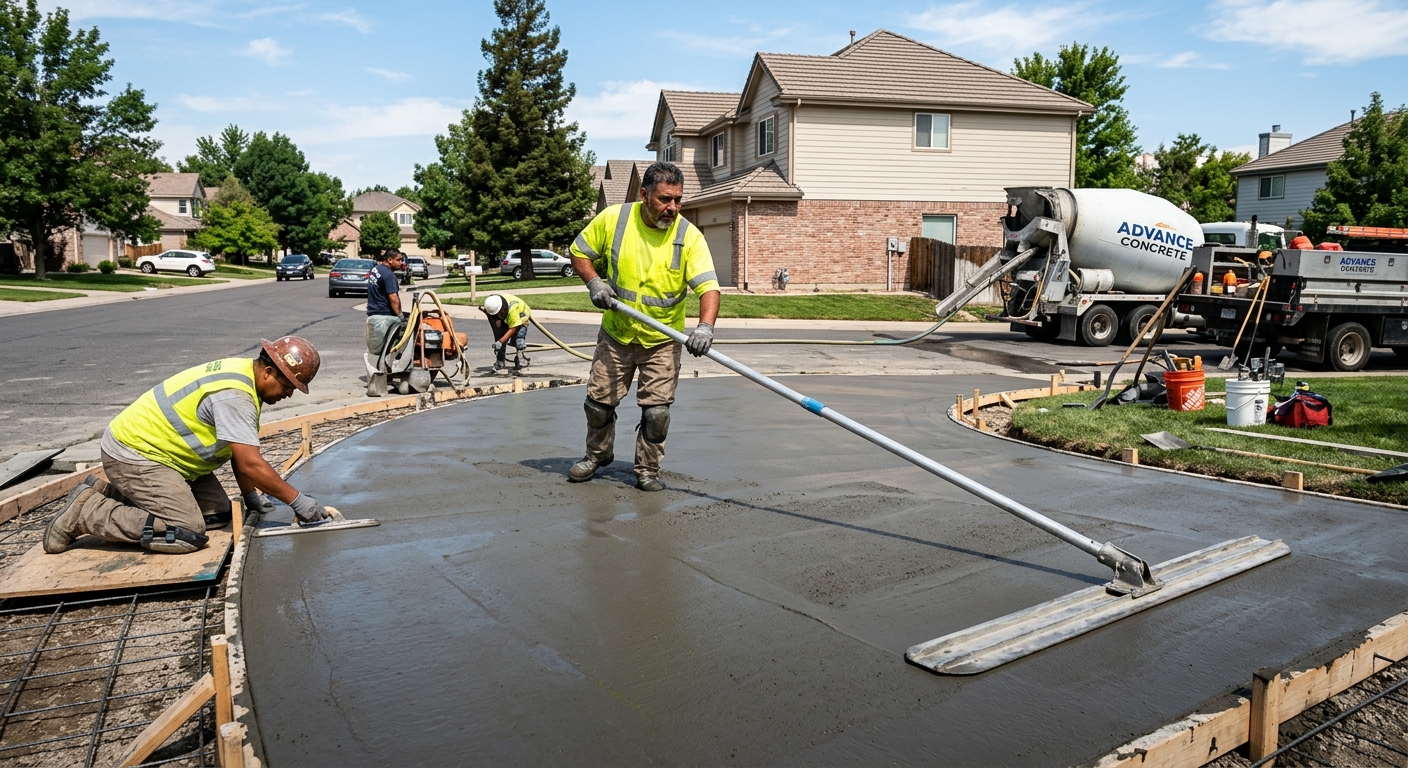
Concrete work options and costs in South Clearbrook
In South Clearbrook, concrete is one of the most practical upgrades for driveways, patios, walkways and basement foundations in and around the 10,120 residents (Statistics Canada, 2021 Census). This area’s housing mix is dominated by family properties, and concrete flatwork is especially in demand where homeowners want durable, low-maintenance surfaces that handle moisture and winter cycling. In the Lower Mainland–Southwest region, mild winters and a shallow design frost depth still require careful footing placement and base prep to manage freeze–thaw. In practice, concrete pricing is shaped by frost protection (footings and thickened edges placed below about 450 mm / 18"), drainage details for saturated soils, and air-entrained mix design to reduce scaling and surface damage. Even small changes—like better granular base, more rebar, or longer curing when cool, rainy weather hits—can move a quote by thousands because the labour and materials are different, not just the finish.
Contractor availability also tightens around peak spring and early fall schedules near Abbotsford-style growth corridors, which can affect truck schedules and forming time, particularly for driveways that need careful access planning. If you’re comparing options, it’s helpful to separate the “surface look” from the “structural durability” items like base thickness, reinforcement, and control joints. The table below compares common options and the typical cost range homeowners in South Clearbrook can expect, then you can choose based on budget and how long you want the surface to last.
| Application |
Typical Size |
Key Spec |
Finish Option |
Price Range |
| Concrete driveway (standard broom finish) |
24' x 10' (240 sq. ft.) |
Air-entrained exterior mix, compacted granular base, control joints |
Broom finish + sealer (optional) |
$18,000–$28,000 |
| Exposed aggregate driveway |
24' x 10' (240 sq. ft.) |
Air-entrained mix, proper curing schedule to expose clean aggregate |
Exposed aggregate (standard) |
$20,000–$32,000 |
| Stamped concrete driveway or patio |
20' x 12' (240 sq. ft.) |
Air-entrained mix, integral colour, control joints aligned to pattern |
Stamped + seal coat |
$22,000–$36,000 |
| Plain concrete patio or walkway |
12' x 16' (192 sq. ft.) |
Air-entrained exterior mix, compacted base, saw-cut joints |
Float/trowel with light broom texture |
$16,000–$26,000 |
| Garage floor (interior slab) |
20' x 22' (440 sq. ft.) |
Fibre or mesh reinforcement, vapour barrier (if required), finish spec |
Broom finish or hard-trowel (chosen) |
$14,000–$24,000 |
| Foundation footings (structural, below frost) |
Typical 1,000–1,400 sq. ft. bearing footprint |
Excavate to design frost depth, rebar, formwork, inspection-ready |
Structural concrete to engineered spec |
$200,000–$350,000 |
Prices are estimates only and vary by project scope, site access and material selection.
What affects the price of concrete work in South Clearbrook
In the Lower Mainland–Southwest, two contractors can quote the “same” driveway size, yet the numbers may differ by 30–50% because the cost drivers aren’t just the visible finish. Concrete pricing is very sensitive to what’s under the concrete: excavation depth, how well the subgrade is prepared, reinforcement needs, and how the mix is engineered for repeated wetting, cooling and freeze–thaw cycles. South Clearbrook sits in a coastal-wet climate where rain and high humidity can delay curing, and then colder snaps bring freeze–thaw back into the picture. That means exterior slabs still need air-entrained concrete and properly spaced control joints to manage shrinkage and random cracking.
Frost protection dictates footing and thickened edge specs. While interior and northern BC can require deeper excavations and more labour, the design frost depth used in local practice is typically about 450 mm / 18", and footings must still extend below the design frost level to reduce frost heave risk. Also, exterior concrete needs air-entrainment (commonly 5–7% air content for flatwork) plus good curing logistics. When scheduling pushes pours into cooler, wetter stretches, contractors may add curing blankets, surface protection and longer cure times—so you’re paying for time and materials, not “nice-to-have” items.
Here are a few examples of how local conditions move cost up or down in South Clearbrook:
- A driveway that requires heavier excavation for saturated soils and an engineered granular base can land closer to the upper end of the $18,000–$28,000 driveway band.
- A stamped job may cost more because of integral colour, stamp labour and pattern-aligned joints, which is why homeowners often see $22,000–$36,000 for stamped options.
- If your area is near older plumbing/foundation tie-ins or has limited truck access, forming and scheduling time can increase labour even when the slab size stays the same.
| Price Factor |
Why It Matters |
Cost Impact |
| Frost line depth |
Determines footing depth and form height to prevent frost heave |
Higher excavation and deeper pours can add significant labour and disposal |
| Site preparation |
Excavation, grading and compacted granular base control settlement |
Poor subgrade or high water tables often push costs upward |
| Reinforcement |
Rebar or wire mesh improves crack control and structural capacity |
Material + labour for placement, chairs and tie-ins |
| Mix design |
Air-entrainment and compressive strength spec affect freeze–thaw durability |
Exterior mix and tighter QA raise material cost |
| Finish type |
Broom vs. stamped vs. exposed aggregate changes labour and curing steps |
Stamped/exposed generally increases cost versus broom |
| Pour size and concrete truck access to site |
Truck approach, hose length and staging affect the pour schedule |
Limited access can increase time, labour and equipment rentals |
| Cold-weather curing precautions |
Heating/blankets protect strength gain in cool, damp conditions |
More materials and labour during shoulder seasons |
| Control joint pattern and sealing cost |
Jointing reduces random cracking; sealer helps repel salts and moisture |
Saw-cut timing and sealing add line-item costs |
Permits & regulations in British Columbia
In British Columbia, structural concrete work typically requires a building permit and often engineered drawings that the municipality reviews before construction starts. This includes footings, foundation walls, grade beams and other structural elements tied to the building’s support system. If your project involves underpinning, structural replacements, or changes to load paths, assume you’ll need a permit and plan for inspections at critical stages (commonly after excavation and before pour).
Concrete flatwork (driveways, patios and walkways) usually does not require a permit when it’s staying within normal lot grading and municipal requirements for drainage and impervious surface coverage. However, you should confirm before breaking ground—especially if your slab impacts lot grading, modifies drainage patterns, encroaches near a right-of-way, or you’re replacing an existing surface that may be affecting drainage.
For South Clearbrook homeowners, the simplest step-by-step check is: (1) ask the contractor for their current business number and municipal registration details if they have them, (2) request proof of liability insurance (certificate of insurance naming you, if applicable), and (3) confirm workers’ coverage (WSIB/WCB—BC contractors should be covered under the applicable workers’ compensation system). Then request references on similar-scale pours: a standard driveway crew and a structural foundation crew are often different specialisations. Before you sign, ask to see the certificate(s) dated within the last 30–90 days and verify coverage limits are appropriate for the job size and site conditions.
Getting concrete right in South Clearbrook's freeze-thaw climate
Concrete commonly fails in South Clearbrook when the job is designed or installed without respect to freeze–thaw cycling, saturated soils and cool, humid curing. The biggest preventable issue we see is spalling and surface scaling caused by inadequate air-entrainment or rushed finishing. The good news: these are specification choices and installation details you can control.
To spec the job correctly for the Lower Mainland–Southwest climate, start with base preparation: compacted granular sub-base placed to the right depth for local soil and frost protection needs. Next, require an air-entrained exterior mix (typically 5–7% air content for flatwork exposure) and a minimum 32 MPa compressive strength for exterior applications. Third, control joints: spacing matters because it guides cracking to predictable lines rather than random splits. Fourth, curing: plan for at least 7 days of curing under proper conditions. In cool, rainy weather, contractors often need curing blankets and surface protection to reach strength safely and reduce early-age defects. Fifth, sealing: apply a penetrating sealer after the recommended cure window (commonly at about 28 days) to help repel moisture and de-icing salt intrusion.
When you’re comparing options, it’s also useful to know where the money makes sense. For example, moving from a broom-finish driveway to stamped concrete typically costs more, often aligning with the $22,000–$36,000 stamped band versus a more standard broom driveway around $18,000–$28,000. If the base, joints and curing are the same, the price jump is justified by colouring, stamping labour and additional finishing/sealing steps—not by hiding poor preparation. Ask for the base thickness, reinforcement plan and joint layout before you decide purely on appearance.
| Spec |
Why It Matters in South Clearbrook |
What to Ask For |
Impact if Skipped |
| Compacted granular base (depth?) |
Reduces settlement and supports correct drainage under repeated wet conditions |
Base depth and compaction proof method (e.g., testing/compaction specs) |
Uneven slab, pumping, early cracking and joint failure |
| Air-entrained concrete mix (target air %?) |
Protects against freeze–thaw scaling in exterior exposure |
Documented air content target (commonly 5–7% for exterior flatwork) |
Spalling, flaking, surface deterioration within a few winters |
| Compressive strength (MPa rating) |
Ensures strength gain despite cool nights and damp periods |
Minimum 32 MPa rating for exterior pours, per spec |
Soft surface, reduced durability and increased cracking risk |
| Control joints (spacing per ACI guidelines) |
Manages shrinkage and temperature movement in a wet/cycle climate |
Proposed joint spacing and timing (saw-cut plan) |
Random cracks across visible surfaces |
| Minimum 7-day curing period |
Cold, humid conditions need proper curing to achieve design strength |
How they will cure in your pour window (blankets/sealer protection) |
Weak early-age concrete and increased surface damage |
| Penetrating sealer (when applied after cure) |
Helps limit moisture and de-icing salt penetration during freeze–thaw |
Application timing (commonly after cure, about 28 days) and sealer type |
Faster deterioration, staining and higher maintenance costs |
How to choose a concrete work contractor in South Clearbrook
For South Clearbrook homeowners, the fastest way to separate good crews from “lowest-bid” quotes is to verify credentials and ask for specifics that match our local climate demands. First, licensing and insurance: in British Columbia, confirm the contractor’s business registration/credentials (ask directly), and request a certificate of liability insurance showing appropriate coverage limits for your property and job type. Next, confirm workers’ coverage—your contractor should carry the required workers’ compensation coverage for the province so you’re not exposed if someone gets injured on site. Then ask for recent references on similar jobs (driveways and flatwork) and, if it’s a foundation, on structural pours.
Second, get 2–3 written, itemised quotes. You want line items for excavation/site prep, granular base, reinforcement, concrete supply, forming, finishing, and any curing/sealing. A good quote tells you what’s included: permit pull (if needed), disposal, hoarding/protection, and how they’ll handle rain during curing. Avoid vague lump sums where “everything” is covered but never named. Third, warranty: ask for workmanship warranty length in writing, product/manufacturer warranty where applicable, and whether it’s transferable to future owners.
Finally, payment schedule: never pay more than about 10–15% upfront, and hold back a portion until the final grade, clean-up and any sealer are complete. Get a written start date and completion timeline—especially in our shoulder seasons where rain can delay pours. In South Clearbrook, the contractor who schedules curing protection properly is usually the one delivering durable concrete, not just fast concrete.
- Ask for proof of liability insurance and confirm it’s active (certificate dated within 30–90 days).
- Confirm workers’ compensation coverage for the province (no unverified “we’re good” answers).
- Request BC-based references on driveways/patios built for exterior freeze–thaw exposure.
- Get quotes itemised for excavation, granular base, reinforcement, concrete supply and finishing.
- Verify air-entrainment is specified for exterior work.
- Ask for the proposed control joint spacing and layout on drawings or a sketch.
- Confirm concrete mix strength (minimum 32 MPa for exterior pours) is stated.
- Clarify curing plan: curing blankets/sealer protection if cold or rainy conditions are expected.
- Ask when sealing is applied (often after 28 days) and whether sealer is included.
- Check what happens with spoils disposal and whether trucking/haul-away is included.
- Confirm permit scope: included or excluded, and who files if needed for structural work.
- Review payment milestones—keep retainage until final inspection/cleanup.
Concrete contractor red flags in South Clearbrook: (1) quotes that ignore air-entrainment or discuss it as optional, (2) “too good to be true” pricing that skips reinforcement or compacted granular base, (3) no clear joint plan or denial that control joints are needed, (4) no curing plan for wet/cold days, and (5) asking for large upfront payments before any site prep or engineering documentation is completed.
Frequently asked questions — concrete work in South Clearbrook
Why does concrete crack in South Clearbrook and how is it prevented?
Concrete in South Clearbrook cracks mainly from shrinkage, temperature movement and ground movement—not because “concrete is weak.” In our Lower Mainland–Southwest climate, moisture and freeze–thaw cycles can amplify movement in poorly prepared subgrades, especially where drainage is overlooked. Prevention comes from doing the unglamorous parts correctly: compacted granular base, a mix designed for exterior exposure (including air-entrainment to limit freeze–thaw surface scaling), and a deliberate control joint pattern. Joints guide where cracks should occur rather than letting random cracking run across your driveway or patio. Also insist on proper curing time (at least 7 days under good conditions) so early-age strength develops before the weather stresses the slab. If you’re budgeting, a broom-finish driveway typically sits around $18,000–$28,000, and the durability usually depends more on the base and joints than the final texture.
Stamped vs broom-finish concrete — cost difference?
In British Columbia, stamped concrete costs more than broom-finish because the process is labour-intensive and adds materials: integral colour, stamping equipment and careful finishing to keep the pattern crisp. Stamping also means you need to align control joints with the visual grid so joints don’t look out of place. For South Clearbrook homeowners, that cost increase commonly shows up within the price bands: plain exterior broom work often lands around $18,000–$28,000, while stamped driveways and patios commonly fall in the $22,000–$36,000 range. The key is to make sure both options still include the same freeze–thaw durability specs—air-entrained exterior mix, correct base prep and curing. If a cheaper quote for broom-finish tries to “save money” by skipping those, you may end up with scaling or patchy deterioration that costs more later.
When is the best time to pour concrete in South Clearbrook?
The best time to pour concrete in South Clearbrook is typically when days are consistently above cool-weather thresholds and you can plan for reliable curing protection. Because Lower Mainland–Southwest winters are mild but still bring freeze–thaw cycles and frequent rain, contractors schedule around wet forecasts and night-time temperature drops. In shoulder seasons, the job can still be done, but the contractor must plan for cold-weather precautions—curing blankets, temperature monitoring and surface protection—so the concrete reaches design strength. If a crew promises “we pour whenever it’s convenient” without discussing curing support, that’s a concern for exterior slabs exposed to moisture and cycles. For homeowners comparing quotes, ask whether the schedule includes curing protection and how they’ll manage drainage and base prep when the ground is saturated from coastal rainfall.
How long does concrete take to cure?
Concrete curing has two “time horizons.” The minimum practical cure period for many exterior flatwork durability goals is at least 7 days under proper conditions—meaning the slab is protected from rain impacts, kept from drying too quickly, and not subjected to heavy stress. Full design strength continues to develop beyond that, and sealer timing matters too. For penetrating sealers used to repel moisture and help resist de-icing salt effects, contractors commonly apply sealer after cure—often around 28 days—so the slab is ready to accept it properly. In South Clearbrook, cool nights and high humidity can slow early hydration, so a responsible contractor won’t treat curing as “wait a week and done.” Ask how they’ll cure during your forecast window and whether they use blankets or curing protection when conditions are damp.
Do I need a permit for concrete work in British Columbia?
In British Columbia, permits are generally required for structural concrete work such as footings, foundation walls and grade beams because those elements affect a building’s support system and typically require engineered review. Concrete flatwork like driveways, patios and walkways often does not require a permit unless it affects lot grading, drainage compliance or municipal right-of-way considerations. For South Clearbrook homeowners, the safe approach is to confirm with the local authority before starting—especially if you’re changing elevations, connecting to existing foundations or adjusting drainage patterns. Also verify your contractor handles permitting responsibility correctly: a good quote should state whether permit pull is included or excluded. Before work begins, confirm the contractor is properly insured (liability and workers’ compensation coverage) and has experience with the same project type in the region.
Concrete vs pavers for a patio in South Clearbrook?
Concrete and pavers both work in South Clearbrook, but they fail differently in our Lower Mainland–Southwest freeze–thaw and wet climate. Concrete patios typically win on cost-per-surface for larger areas and on overall durability when the base is properly prepared and the mix is air-entrained for exterior exposure. Pavers can be great for design flexibility and easier localized repairs, but they depend heavily on jointing discipline, base compaction and drainage. If freeze–thaw water gets under pavers or base layers aren’t compacted well, you can get settlement or heaving. For homeowners considering price, plain concrete patios and walkways often align with the $16,000–$26,000 band for typical residential sizes, while stamped decorative options would move higher. Ask any contractor how they handle base thickness, drainage and sealing/cure timelines—those details matter more than the surface material name.