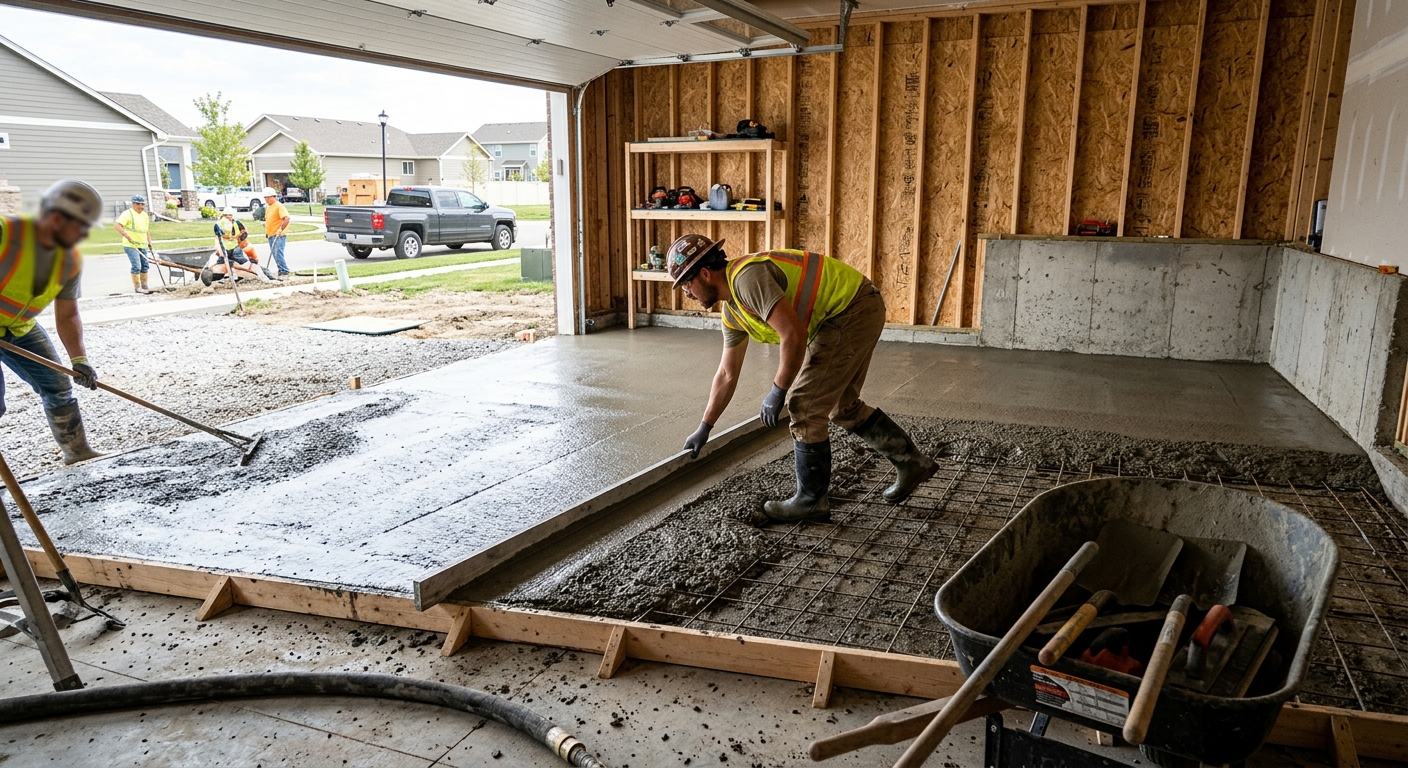
Concrete work options and costs in Cumberland
Cumberland, British Columbia is a small community with a big focus on durable outdoor living, and most concrete flatwork demand comes from homeowners in the typical single-detached home market. In Cumberland, single-detached houses make up 64.9% of dwellings (Statistics Canada, 2021 Census), and homeowner households are 72.0% of all households (Statistics Canada, 2021 Census). That matters because the same neighbourhood upgrades usually repeat: driveways, patios, walkways, and interior garage slabs—projects that need the right sub-base, reinforcement, finishing, and jointing to survive our coastal freeze–thaw weather.
On Vancouver Island and the Coast, costs are shaped by a relatively shallow frost line but frequent wetting and freezing. Contractors design footings and foundations to sit below frost, and exterior slabs require air-entrained concrete to reduce scaling and random cracking. Even though we don’t face the extreme freeze conditions of inland BC, repeated temperature swings and cool, damp curing conditions on the Island can slow strength gain. That’s why proper base prep, drainage control, and weather protection (blankets/sealers and scheduling around heavy rain and cold snaps) are included in realistic quotes.
In Cumberland, we see the highest demand for concrete work in and around the downtown/core and residential lanes near Comox Valley routes where access and drainage details are crucial. If you’re comparing options, the table below gives typical application specs and the expected price bands for the Cumberland market tier.
| Application |
Typical Size |
Key Spec |
Finish Option |
Price Range |
| Concrete driveway (standard broom finish) |
400 sq. ft. (approx. 20' x 20') |
Air-entrained exterior mix, compacted base, control joints |
Broom finish |
$6,400–$10,000 |
| Exposed aggregate driveway |
400 sq. ft. (approx. 20' x 20') |
Air-entrained exterior mix, proper curing, wash exposure |
Exposed aggregate |
$8,000–$12,500 |
| Stamped concrete driveway or patio |
300 sq. ft. (approx. 15' x 20') |
Air-entrained mix, release agent, colour integral/antiquing |
Stamped |
$7,000–$10,500 |
| Plain concrete patio or walkway |
200 sq. ft. (approx. 10' x 20') |
Reinforcement as needed, compacted base, joints where required |
Float/screed with light broom |
$2,800–$4,400 |
| Garage floor (interior slab) |
480 sq. ft. (approx. 20' x 24') |
Vapour barrier, proper compaction, reinforcement per design |
Powder-float (option for broom) |
$7,500–$13,000 |
| Foundation footings (structural, below frost) |
Typical single-detached footing package |
Excavation, forming, rebar, concrete below design frost |
Structural (no decorative finish) |
$10,500–$22,000 |
Prices are estimates only and vary by project scope, site access and material selection.
What affects the price of concrete work in Cumberland
On Vancouver Island and the Coast, you can see quote differences of 30–50% for the “same” concrete project because the real work is in the prep and specifications—not the pouring day. A broom-finish driveway and a stamped driveway can look similar from the street, but the labour, mix design controls, base thickness, reinforcement, curing protection, and finishing steps are materially different.
The biggest driver is frost performance. Even with a relatively shallow frost line in coastal BC, freeze–thaw cycles still dictate every exterior specification. Footings and foundations must extend below the design frost depth to prevent frost heave, and exterior slabs need air-entrained concrete to survive the scaling risk that comes with repeated wetting and freezing. The coastal climate isn’t as harsh as interior BC, but cool temperatures and saturated soils can slow strength gain, so contractors may include extra protection during curing. Cold-weather curing precautions—like insulating blankets, protecting the surface, and tighter scheduling—add labour and materials.
Local examples that move the number up or down in Cumberland include: (1) poor soil or drainage that requires subgrade remediation and deeper granular base, (2) limited truck access or steep grades that increase forming time and waste, and (3) older homes (note that 39.1% of homes were built before 1981 in the census profile) where existing service locations and settlement history can complicate excavation and grading.
Finish type matters too. For example, standard exterior work often aligns with the regional foundation/flatwork bands, while upgraded options align with the decorative range: plain slabs commonly fall near the $16–$25 per sq. ft. driveway band, while stamped/decorative work can shift toward the $22–$35 per sq. ft. range depending on pattern complexity and curing/colour system.
| Price Factor |
Why It Matters |
Cost Impact |
| Frost line depth — determines footing depth and form height |
Deeper excavation increases labour and concrete volume |
Higher for structural work; can swing the full foundation budget significantly |
| Site preparation — excavation, grading, compacted granular base |
Compaction quality prevents settlement and cracking |
Additional base thickness and haul-off can add substantial cost |
| Reinforcement — rebar or wire mesh requirement |
Controls cracking and improves load capacity |
Material and labour for bar placement raises pricing |
| Mix design — air-entrainment and compressive strength spec |
Air content improves freeze–thaw durability |
Upgraded exterior mix and inspection steps add cost |
| Finish type — broom vs. stamped vs. exposed aggregate |
Finishing complexity affects crew time and workflow |
Stamped/exposed typically costs more per sq. ft. than broom-finish |
| Pour size and concrete truck access to site |
Smaller pours or tighter access can require more staging |
Access constraints increase labour and may raise load-related fees |
| Cold-weather curing precautions — heating and blankets |
Prevents surface damage and ensures strength development |
Can add materials and time during rain/cold snaps |
| Control joint pattern and sealing cost |
Joints manage shrinkage; sealing helps durability |
More jointing and sealing steps increase labour but reduce failure risk |
Permits & regulations in British Columbia
In British Columbia, permit requirements depend on whether you’re doing structural work versus cosmetic flatwork. Structural concrete work—like footings, foundation walls, grade beams, and other load-bearing elements—typically requires a building permit and often engineered drawings reviewed by the municipality. Concrete flatwork such as patios, walkways, and most driveways usually does not require a building permit, unless the project affects lot grading, drainage, impervious surface coverage limits, or ties into a municipal right-of-way.
For Cumberland homeowners, the practical process is simple: (1) confirm your scope in writing (dimensions, thickness, and whether you’re touching drainage/grade), (2) check with the local authority before breaking ground, and (3) ask the contractor to include permit-related responsibilities in the quote if required.
Before hiring, verify insurance and coverage step-by-step. Request (a) a certificate of insurance showing commercial general liability, (b) proof of WCB coverage (Workers’ Compensation Board) through the contractor’s WCB account status, and (c) a clear explanation of how sub-trades (if any) are insured. Then confirm licensing: check the contractor’s business details and credentials through the appropriate online listings used in BC, and ensure the certificate of insurance matches the legal name on the quote.
Getting concrete right in Cumberland's freeze-thaw climate
Concrete fails in Cumberland most often due to a bad combination: weak base prep, insufficient air-entrainment, and poor jointing/curing during cool, wet conditions. In our Vancouver Island and Coast freeze–thaw pattern, water gets into the surface microstructure, then expands during freezing. If exterior concrete isn’t properly designed—especially with adequate air—surface scaling and spalling can start sooner than homeowners expect.
To spec your job correctly, insist on five basics. First, base preparation: a properly excavated, compacted granular sub-base to the depth required for your soil and local frost considerations. Second, mix design: air-entrained concrete with a typical target of 5–7% air for exterior flatwork and a minimum 32 MPa compressive strength. Third, control joints: a regular joint pattern to limit random cracking from shrinkage. Fourth, curing: keep the surface protected for at least 7 days, with extra attention during cold snaps to avoid early surface damage. Fifth, sealing: apply a penetrating sealer after cure—commonly around 28 days post-pour—so de-icing salts and rain-driven moisture don’t attack the surface.
When you ask “How will you prevent spalling?” you’re asking the right question. If a contractor skips air-entrainment or uses the wrong cement content, you may “save” on day one and pay later for patching. For example, upgrading from plain broom-finish to stamped can add meaningful cost, often aligning with the regional decorative band. That extra money is justified when the base prep, drainage, air content, and joint plan are upgraded to match the decorative surface’s tighter tolerances—otherwise, the pattern will only make defects more visible.
| Spec |
Why It Matters in Cumberland |
What to Ask For |
Impact if Skipped |
| Compacted granular base (depth?) |
Prevents settlement and reduces water pooling that fuels freeze–thaw damage |
Base thickness and compaction method (for your soil conditions) |
Uneven slab, cracking, and faster surface deterioration |
| Air-entrained concrete mix (target air %?) |
Improves durability against scaling and spalling in repeated wet/freezes |
Target air content in the mix for exterior flatwork |
Spalling and scaling risk rises significantly |
| Compressive strength (MPa rating) |
Ensures strength gain and load performance through coastal conditions |
Minimum 32 MPa and mix documentation for the pour |
Surface wear, cracking, and reduced long-term performance |
| Control joints (spacing per ACI guidelines) |
Controls shrinkage cracking in freeze–thaw exposure |
Planned joint spacing and sawcut timing |
Random cracks and moisture ingress into the slab edges |
| Minimum 7-day curing period |
Cool, damp weather slows strength gain and increases early-age damage risk |
How they protect curing in rain/cold snaps |
Lower surface strength and increased risk of scaling |
| Penetrating sealer (when applied after cure) |
Reduces penetration of de-icing salts and rain-driven moisture |
Sealer product and application timing after cure (commonly ~28 days) |
Faster staining, higher moisture absorption, shorter lifespan |
How to choose a concrete work contractor in Cumberland
Choosing the right concrete contractor in Cumberland starts with verification. In British Columbia, ask for proof of liability insurance (so you’re not exposed if something is damaged), and confirm WCB coverage through their WCB status information. Also confirm their business credentials and that the quote is under the correct legal entity name. If they use sub-trades, ensure those workers are covered too.
Next, don’t compare bids as “one number.” Get 2–3 itemised written quotes that break out labour and materials—base prep, excavation and haul-off (if needed), rebar/wire mesh, concrete supply, forming, finishing, joints, curing protection, and sealing if included. Review what’s excluded: disposal of excavated soil, permit fees (if required for structural work), sawcut timing, and whether traffic control or protection of landscaping is included.
Warranty matters in concrete because early-age issues can show up later. Ask for a workmanship warranty length and whether there’s a product/manufacturer warranty on admixtures or sealers. Confirm whether the warranty is transferable to future owners if you sell the home.
For payment, use a cautious schedule. A common safe approach is 10–15% upfront to secure materials, then progress payments aligned with milestones, and a holdback until clean-up and finish quality are verified. Finally, ask for a start date and completion estimate in writing so weather delays and curing protection are handled professionally.
- Request proof of liability insurance and WCB coverage before the work starts.
- Confirm their business name matches the quote and insurance certificate.
- Ask for three references on similar Vancouver Island exterior slab projects.
- Get itemised pricing: excavation/base, reinforcement, concrete, forming, finishing, joints, curing, and sealing.
- Ask whether the mix will be air-entrained for exterior flatwork in Cumberland’s freeze–thaw climate.
- Confirm footing/foundation depth approach for below-frost structural scopes.
- Verify who supplies and how they manage concrete truck access on your street.
- Require a written joint plan (spacing and sawcut timing).
- Ask about curing protection during cool weather (blankets/sealers as applicable).
- Check whether disposal, grading tie-ins, and drainage corrections are included.
- Clarify warranty terms for cracking/spalling and workmanship vs materials.
- Keep a holdback and insist on clean-up and final walk-through before final payment.
Concrete red flags in Cumberland include: vague quotes that don’t mention air-entrainment or jointing, starting pours without a curing/protection plan for wet/cold snaps, skipping base thickness/compaction details, offering decorative finishes without matching durability specs, and pressuring for large upfront payments instead of milestone-based progress.
Frequently asked questions — concrete work in Cumberland
Stamped vs broom-finish concrete — cost difference?
In Cumberland, stamped concrete typically costs more than broom-finish because it adds finishing steps (colour system, stamping labour, and careful curing). Based on local Vancouver Island and Coast pricing, a broom-finish driveway often aligns with the $16–$25 per sq. ft. band, while stamped/decorative concrete commonly sits closer to the $22–$35 per sq. ft. range depending on pattern complexity and how much preparation your site needs. The real durability difference comes from whether both options are built for the freeze–thaw cycle: air-entrained exterior mix, correct base prep, and control joints. If a contractor prices stamped “cheap” but can’t explain air content, joints, and curing, you’re not really comparing apples to apples. (Statistics Canada, 2021 Census)
When is the best time to pour concrete in Cumberland?
For Cumberland and the broader Vancouver Island and Coast region, the best window is typically late spring through early fall when you can keep the slab protected long enough for strength gain. The challenge isn’t extreme cold—it's the cool, wet conditions and sudden temperature swings that can slow curing. Contractors plan around heavy rain and cold snaps because early surface damage and inadequate curing protection can increase the risk of scaling during later freeze–thaw cycles. If you must pour in shoulder season, expect added measures such as insulation blankets and tighter scheduling to protect curing. Ask your contractor what the plan is if rain hits in the first 24–48 hours. With older housing stock common in the area (Statistics Canada, 2021 Census), access and drainage tie-ins also influence when excavation and base work can safely proceed.
How long does concrete take to cure?
Concrete curing has two timelines: strength gain and surface readiness. For most exterior flatwork in Cumberland, you should plan for a minimum 7 days of proper curing conditions before you treat it as service-ready, with extra protection during cool weather. Full performance and maximum strength development generally takes longer—often around 28 days—which is why penetrating sealing is commonly scheduled after cure (so the sealer can better repel moisture and de-icing salts). If your contractor is recommending a quick removal of forms or early use by vehicles before the slab has properly cured, that’s not the approach we take for durability in freeze–thaw conditions. Ask for what protection they provide (covers/blankets) if temperatures drop overnight during the first week.
Do I need a permit for concrete work in British Columbia?
In British Columbia, structural concrete work—like footings, foundation walls, and grade beams—typically needs a building permit and often engineered drawings for municipal review. Most concrete flatwork (patios, walkways, and many driveways) usually does not require a permit unless it affects lot grading, drainage, impervious surface coverage limits, or a municipal right-of-way. Because Cumberland homeowners often improve both the slab and how water drains away from the house, it’s important to confirm your scope before you pour. Step-by-step: provide the contractor with dimensions and thickness, ask whether your project triggers permit/grading considerations, and confirm with the local authority before breaking ground. Also verify the contractor has liability insurance and WCB coverage, not just the permit plan.
Concrete vs pavers for a patio in Cumberland?
Concrete and pavers can both work well on Vancouver Island, but concrete usually offers better long-term performance when it’s built for freeze–thaw durability with the right base and air-entrained mix. Pavers excel if you want easy localized repair and a more traditional look, but they rely heavily on consistent base compaction and jointing sand drainage. In cost terms, a plain concrete patio often falls within the $14–$22 per sq. ft. band, depending on site conditions and whether reinforcement and good drainage tie-ins are included. If your yard has drainage challenges or a lot of slope, pavers can shift if the base isn’t engineered, while a properly detailed concrete slab with control joints can be more predictable. Ask both contractors to explain base depth, compaction, joint approach, and how they manage water away from your foundation.
How long does a concrete driveway last?
A well-built concrete driveway in Cumberland can last decades, but lifespan depends heavily on durability specs. Exterior slabs need air-entrained concrete and the right base prep to handle freeze–thaw cycling. Control joints and sealing help manage shrinkage cracking and moisture penetration from rain and de-icing salts. In practice, a standard broom-finish driveway priced in the $16–$25 per sq. ft. band can deliver long service life if the contractor addresses drainage and curing—not just the finish. If water is allowed to pond, joints are poorly planned, or air-entrainment is missing, you’ll often see scaling or spalling earlier and repairs can become recurring. Since Cumberland has a high share of single-detached homes, many driveways are homeowner-maintenance priorities, so it’s worth paying for the fundamentals upfront. (Statistics Canada, 2021 Census)